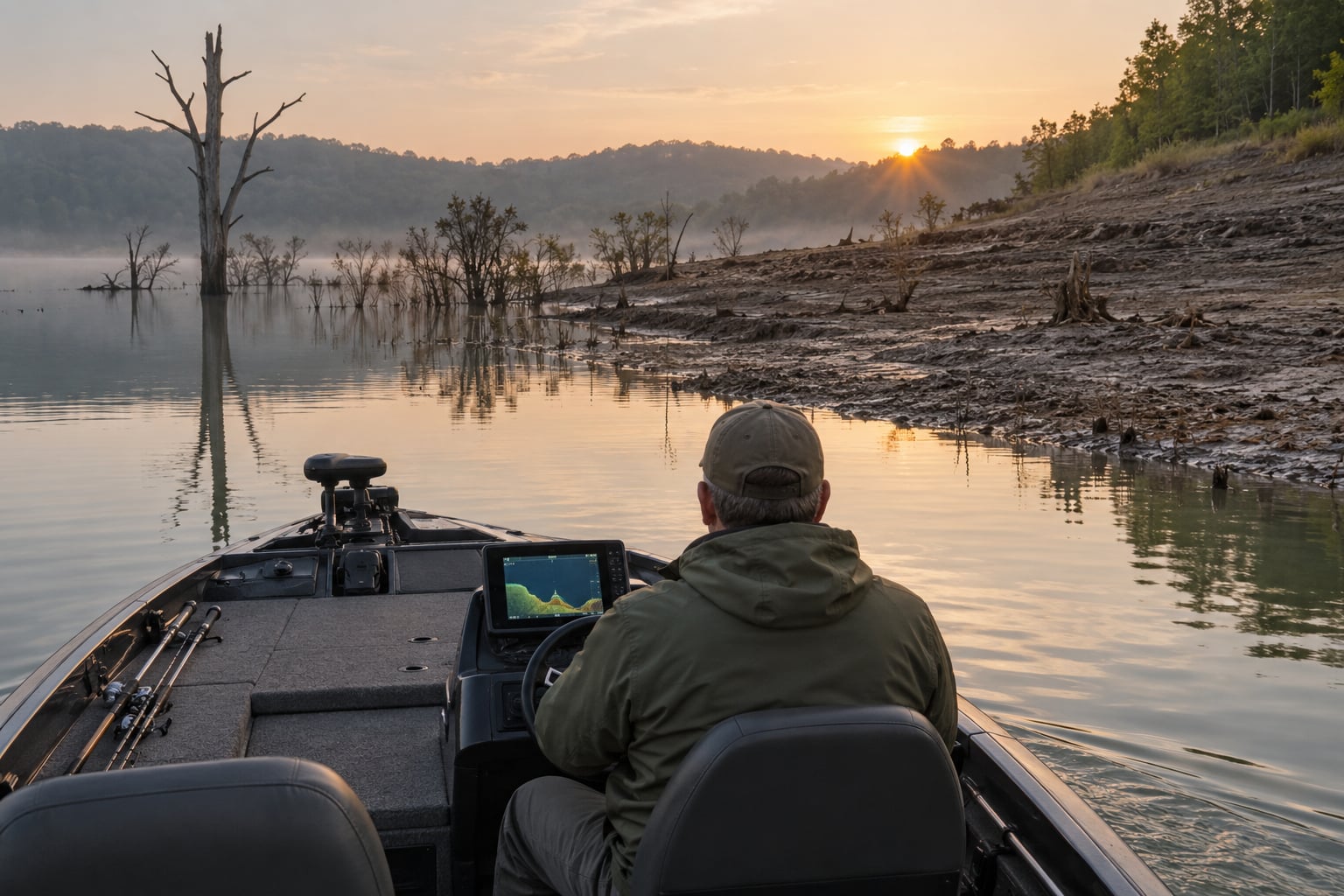
To fish a reservoir with changing water levels, check the pool trend before you launch, then match your spots to it. Rising water pushes fish shallow into flooded vegetation, creek channels and new shoreline cover. Falling water packs them into deep pockets along steep banks, drop-offs and standing timber.
Reservoirs are managed water, not natural lakes. A pool can move ten feet or more in a season because of flood control rules, dam releases, rain and snowmelt, which means the spot that produced last month may now be dry mud or twelve feet under water. Most wasted trips come from trusting an old map instead of the current gauge.
This guide walks through the whole process, from reading level data to choosing a safe route, matching tackle to clarity and flow, and deciding when a rising or falling pool changes the plan mid-morning. It takes about twenty minutes of prep before you leave the dock, plus a normal morning on the water.
Table of Contents
- What You Need
- Step-by-Step
- Check the Reservoir’s Current Conditions
- Read the Water and Find Fish Holding Areas
- Choose a Safe Boat Route and Fishing Position
- Match the Tackle and Presentation to the Conditions
- How to Fish a Reservoir With Changing Water Levels
- Watch for Bites and Fish-Holding Changes
- Adapt Quickly When the Water Level Changes
- Common Mistakes
- Frequently Asked Questions
- Is it better to fish a reservoir when the water is rising or falling?
- What fish should I target while fishing a reservoir with changing water levels?
- Where are the best fishing depths when a reservoir is rising or falling?
- How long should I fish one area on a reservoir before moving?
- When should changing water levels make me stop fishing or leave the reservoir?
- Conclusion
What You Need
You do not need a lot of gear. You need reliable information and a boat you can control in shallow, debris-filled water.
- Water level data. The USGS gauge page for the river or stream feeding the lake, plus the dam operator’s pool release schedule. Federal flood control reservoirs publish daily pool elevations, and many state and utility lakes post the same figures on their own site.
- A recent hydrograph, not just a number. The current pool elevation tells you where the water is. The trend line tells you where it has been for two weeks, and that is what actually changes fish behavior.
- Weather information. Rain upstream, wind direction and forecast changes tell you whether the pool will rise or fall while you are there, and whether the boat ramp will be usable when you come back.
- A depth finder. Any unit that shows depth and ideally a bottom contour. When the shoreline moves ten feet, you cannot see the drop that used to be obvious.
- Navigation and safety gear. A chartplotter or map you have studied, a compass, a properly sized life jacket you actually wear, a charged phone, a marine radio or handheld for remote coves, and an anchor with enough line for the depth you end up in.
- Tackle for the conditions. A floating lure and a sinking lure, a weightless or lightly weighted soft bait, and a bottom feeder. Running water makes boat control harder, so a heavier boat with adequate power helps more than a bigger casting setup.
- Local regulations. Bag and size limits, seasonal closures, boating speed zones, and whether your ramp is open. Rules do not change with the water level, but access does.
Fish-finding apps that map crowds are optional. Their shoreline detail is drawn from normal pool, so treat the contours as a starting point rather than a fact when the lake is high or drawn down hard.
Step-by-Step
Check the Reservoir’s Current Conditions
Start by comparing this week’s pool elevation with the same date a month ago and with the seasonal average. Three numbers tell you most of what you need: where the pool is, which direction it has moved, and how fast it is moving.
Then look at the cause. A pool rising on a Tuesday because the operator is releasing water for flood control is a scheduled event, and it will keep rising for days. A pool rising after two inches of rain is a runoff event that may peak within a day. Rising water is a different fish-fishing situation in each case.
Skim the local report for the practical details: inflow from creeks, reservoir temperature, and any release schedule. Anglers on fishing forum threads ask this question constantly, and the honest answer is that most level data is free and public if you know which page publishes it.
Read the Water and Find Fish Holding Areas
Fish reposition within hours of a level change. On a rise they follow the advancing waterline into shallow water, feeding on insects and bait pushed in ahead of the flood. On a drop they leave the exposed shallows and pack into the deepest structure the lake still has. In a bassresource.com discussion on rising versus dropping water, the majority view was that rising water spreads fish out while falling water concentrates them.
Read the bank itself before you cast. A band of wet mud, a fresh water line on rock, or a silt line on a stump tells you the pool has been higher recently and is now falling. On rising water, look for the opposite: drowned brush, stumps standing in open water, and the shallow inside corners of creek channels.
Concentrate on a few features rather than covering open water. On a rise, work flooded vegetation, creek mouths, the inside edge of a channel bend, and the ends of newly formed points. On a drop, work the steep bank, the deep pocket behind a point, the edge of a drop-off, and standing timber that still reaches into water deep enough to hold fish.
Choose a Safe Boat Route and Fishing Position
Pick your route from the ramp, not from the fishing spot. Flooded brush, floating junk and submerged stumps appear between visits, and a reservoir at low pool puts sandbars and tree trunks in places you have driven through at full pool for years.
Run at a slow, steady speed where depth is uncertain and get up to planing speed only on water you have confirmed with the depth finder. Keep the trolling motor off while crossing shallow ground. Never plan to anchor or fish directly beneath a standing dead tree or a dam release gate, and keep a clear escape line in case you get set on a branch.
Wear the life jacket, not the deck of the boat. When you find fish, hold the boat with the trolling motor or anchor rather than fighting the current with the outboard, and remember that falling water at the head of a reservoir can put you in moving water with submerged obstacles in it.
Match the Tackle and Presentation to the Conditions
Connect your choices to what the water is doing, not to the calendar. Clarity is usually the deciding factor.
On rising, stained water, fish rely on vibration and scent rather than sight. A heavier weighted soft bait worked slowly along the edge of flooded cover suits this, and so does a slower, deeper-running crankbait in the flooded vegetation. In water that is rising but clear, sight-feeding improves as the water settles, so a shallower, faster presentation with a reaction lure works better.
On falling water, concentrate deep and tight. A jig or a Texas-rigged craw worked along a ledge, or a deep-bodied crankbait held below the thermocline, covers more water than a topwater pattern. Anglers report that even a drop of an inch or two moves fish out of the shallows, so do not waste a morning on flooded brush that stopped producing last week.
Match line and leader to pressure from water moving past the boat. Rising water near an inflow or a dam tailrace can put real load on light tackle, so step up to heavier line and a more conservative hook and let the heavier rod do the work.
How to Fish a Reservoir With Changing Water Levels
Work a pattern of likely structure instead of casting randomly. Cast to one feature, hold the boat, give the lure a deliberate and repeatable retrieve, and note the depth where it ran. Then move a short distance and repeat, covering depth in steps rather than distance alone.
Watch the electronics while you work. On a rise, the edge of the vegetation and the transition from shallow to deeper water is where you want to be. On a drop, the contour where the bottom drops away quickly is the target. Change depth deliberately, one band at a time, and keep the boat stable enough that you can feel a strike.
If nothing responds after three or four deliberate passes over good structure, move. Most anglers who fish fluctuating water well are not more patient than everyone else, they just relocate faster when the fish are no longer where the map says.
Watch for Bites and Fish-Holding Changes
Telltale signs show where fish are before a strike does. Feeders working the surface, a tail moving just under the film, or a swirl over a specific seam all mean something is there. Watch the water while the boat is idling and while you are retrieving, because the retrieve itself often pulls a follower out of cover.
A missed strike on a falling-water pattern usually means the lure is running too deep or too fast through the strike zone. Slow down before you change the lure. Fish that have been pushed deep by a drawdown also tend to spook more and feed less reluctantly than fish holding comfortable depth, which is the argument anglers make for preferring falling water on a given lake.
When bites stop at a spot that was productive an hour ago, assume the pool moved, the current picked up, or the fish were displaced by boat traffic. Recheck the surface temperature and the direction of the wind before you assume you picked the wrong lure.
Adapt Quickly When the Water Level Changes
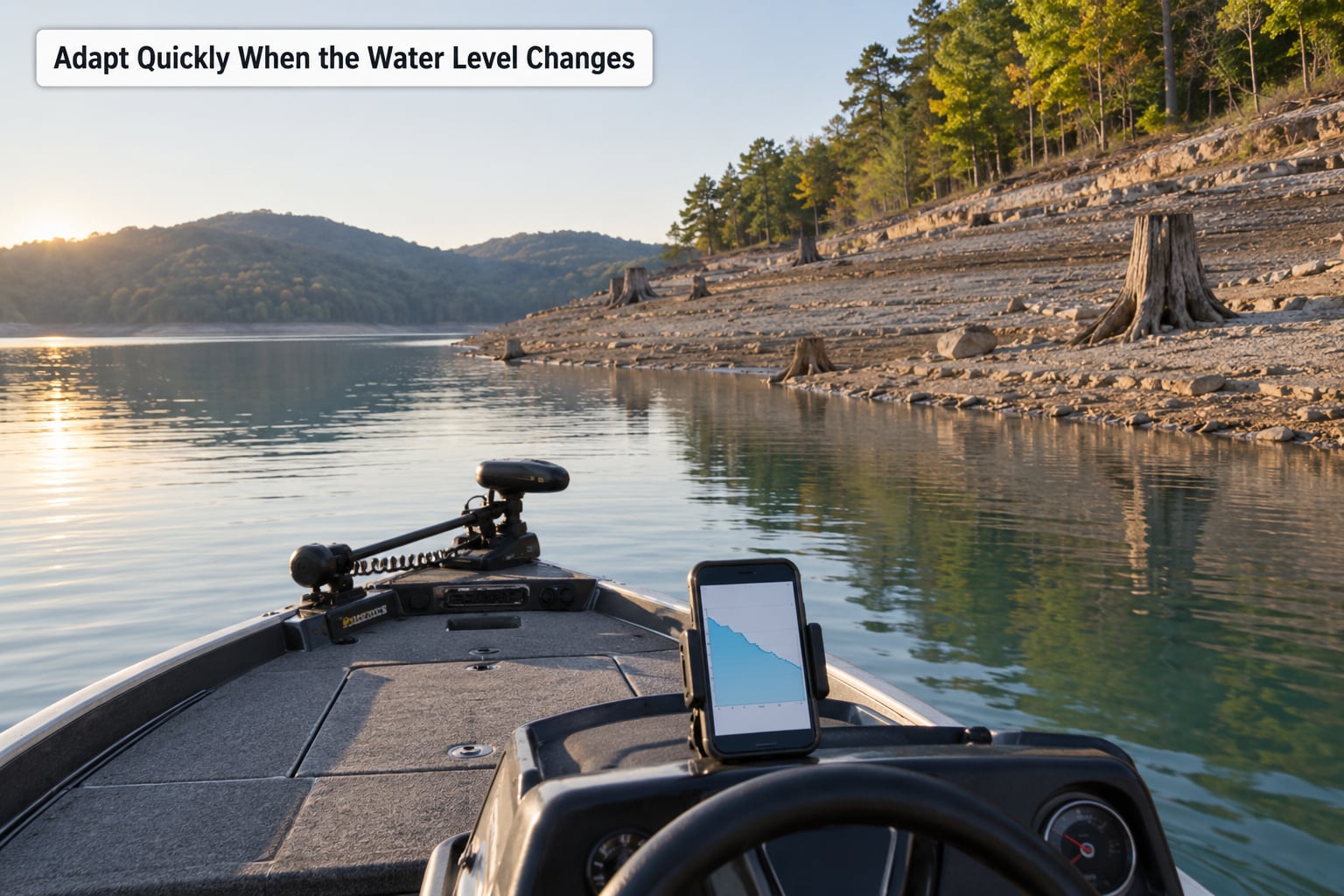
A fast rise or a fast fall changes access, current, temperature and vegetation in the space of a day. On a sharp rise, new cover appears and fish move into it, so shift your pattern toward flooded structure and creek channels, and expect the boat to be drifting more as water pushes into coves.
On a sharp fall, flooded cover dries out, temperature drops faster in the shallows, and fish leave for the remaining deep water. Reposition to the main channel, the dam end, or the deepest pocket you have, and re-check that your ramp will still be usable when you return.
Have an exit rule before the day starts. If the ramp is closed or under water, if wind is pushing chop you do not want in a small boat, or if you are far from help with deteriorating weather, the trip is over. No fish are worth being caught badly.
Common Mistakes
Fishing the old map is the most common error. The spot you know may be under water or on dry land, and the fix is to spend ten minutes at the ramp comparing the current pool with your last visit.
Sitting in one spot too long is the second. Give a good piece of structure three or four deliberate passes, then move to a different depth band or a different feature rather than working the same water harder.
Ignoring flow and wind will push you into shallow, debris-filled water at speed. Slow down in unfamiliar ground, check depth before crossing, and let the wind decide your drift rather than fighting it.
Using the wrong lure for the water clarity wastes mornings. Match lure weight and action to how much the fish can see, and add scent or vibration when they cannot see far.
Boating too quickly and skipping regulations round out the list. Slow water keeps you alive, and limits, closures and speed zones stay in force no matter what the pool does.
A few habits cover most of the rest. Carry more water and a spare prop than you think you need, tell someone your route and your return time, and keep your anchor line long enough for the depth where you actually stop.
Frequently Asked Questions
Is it better to fish a reservoir when the water is rising or falling?
Both produce fish, but for different reasons and in different places. Rising water spreads fish into shallow flooded cover and creek channels, which suits anglers looking for visible surface action and flooded vegetation. Falling water concentrates fish in deep pockets along steep banks, drop-offs and standing timber, and many anglers report more predictable feeding then. On most lakes I would target the rising pool early in the season and the falling pool through late summer.
What fish should I target while fishing a reservoir with changing water levels?
Match the species to the feature you are targeting. Largemouth bass work flooded vegetation and timber edges on a rise and ledges and deep pockets on a drop. Smallmouth prefer rocky structure and steep banks. Crappie concentrate in deep brush and creek channels under a falling pool. Trout and walleye hold near the cool inflow and the dam end, and striped bass follow baitfish along channel bends and drop-offs.
Where are the best fishing depths when a reservoir is rising or falling?
On rising water, fish spread into the first few feet near the advancing shoreline, so work from about one foot to ten feet along flooded edges, creek channels and the inside of bends. On falling water, fish pack deeper, and productive fishing shifts to the 15 to 40 foot range along drop-offs, steep banks, standing timber and channel bends. Steady water sits between the two, with structure holding nearer the bottom at mid depths.
How long should I fish one area on a reservoir before moving?
Give a promising spot three or four deliberate passes, then reassess. If you get no response on clear structure, change depth first, then change speed, then move. Most anglers who fish fluctuating water well relocate sooner rather than later. If bites were happening and then stop, that is a stronger signal to move than quiet water, because it usually means the pool moved, the current picked up, or other pressure displaced the fish.
When should changing water levels make me stop fishing or leave the reservoir?
Stop when access or conditions turn unsafe. Leave if the ramp is closed or flooded and you cannot get out, if wind is building chop in a small boat, if lightning or a fast-approaching storm is on the forecast, or if you are far from help. A rapid rise can also move flooded timber and debris into a channel you planned to run. Check the ramp before you fish, tell someone your route and return time, and keep that exit rule in mind all day.
Conclusion
Learning how to fish a reservoir with changing water levels comes down to reading the trend first and then letting it pick your spots. Rising water means shallower flooded cover, creek channels and the advancing shoreline. Falling water means deep pockets, steep banks, drop-offs and standing timber.
Before you leave, check the current pool elevation, the two-week trend, and the release schedule, then confirm the ramp is open. On the water, pick a route that avoids shallow debris, work your structure deliberately, and move the moment a productive spot goes quiet. If the pool shifts mid-trip, that is normal on a managed reservoir, not a reason to fight it.