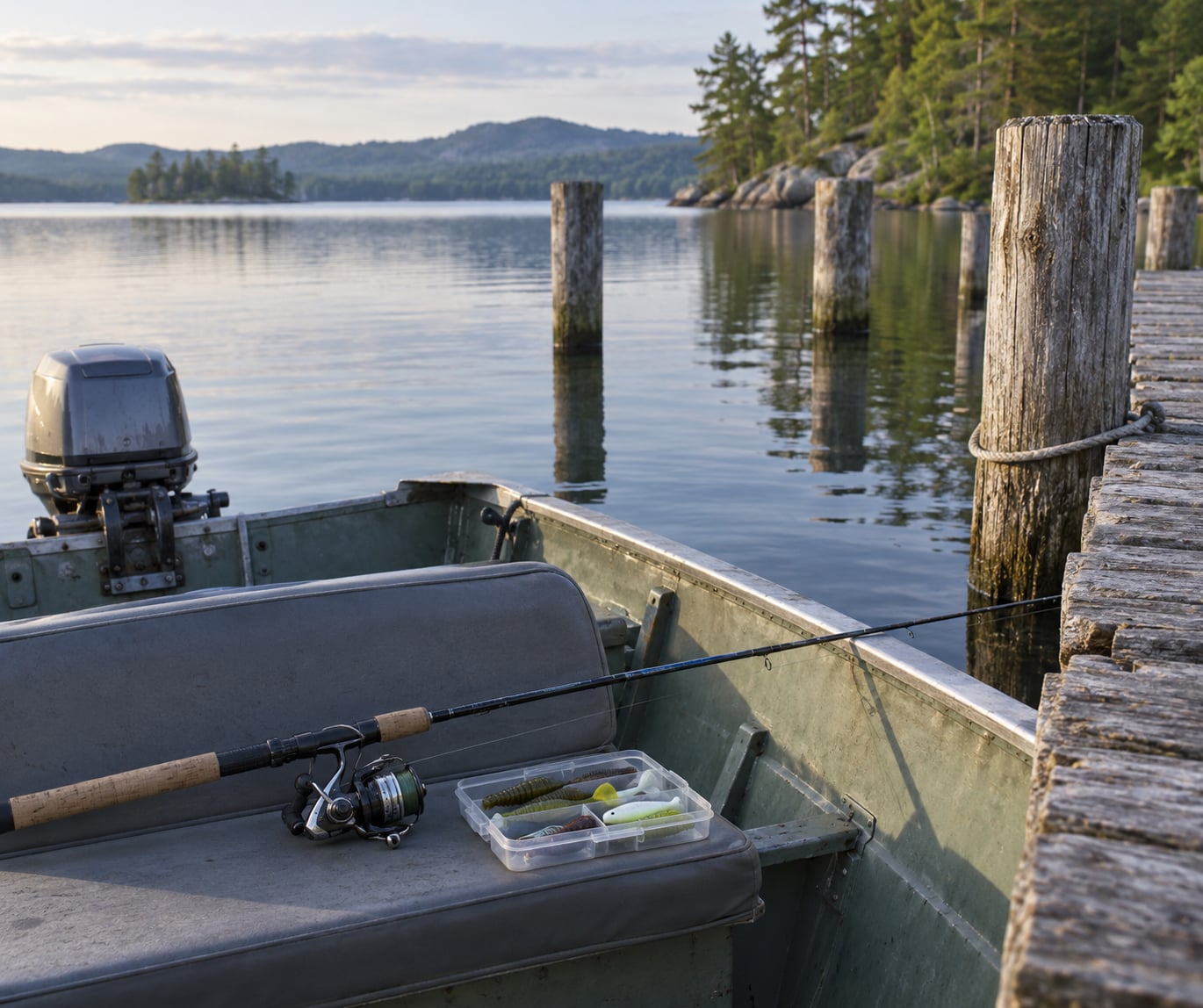
Learning how to fish around a boat dock comes down to a casting order: start at the outside corners, work the shaded backside, then skip or pitch under the deck to the front bars and walkway. Use light tackle, slow natural retrieves, and give a hooked fish room to run before it reaches a piling.
That is the whole method. A dock is an ambush point, and fish that sit in ambush are predictable if you approach them in order instead of lobbing a heavy lure at random. Twenty focused casts along one dock will tell you more than an hour of casting into open water.
Docks work because they stack several things a fish wants in one small footprint. The deck blocks sun and drops shade that runs along the sides. The floats and the pilings create a cooler pocket of water that holds more oxygen than the surrounding shallows, and the underside is a ceiling that keeps larger predators out.
The bottom under a dock also stays softer and grows more vegetation than the open shoreline nearby, which means more baitfish holding in the same place. Anglers on fishing forums say the same thing over and over: once you catch one fish under a dock, there are almost always more sitting behind it.
Dock layout also changes what you are fishing. A floating dock on a lake moves with the water and usually sits shallower, so the fish are close to the surface. A fixed pole dock on a reservoir stands on pilings over deeper water, and the fish hold along those pilings rather than under a deck. Saltwater piers work the same way with different species: striped bass, redfish, snook and flounder instead of bass, bluegill and crappie.
A good first trip takes 20 to 30 minutes of actual fishing. Skipping a bait under the floats is the one skill that takes longer to build, so pack a jig head you can pitch as confidently as one you can skip.
Table of Contents
What You Need
Start with a 7-foot medium heavy rod with a fast tip. That length lets you cast under a walkway and still pull a fish back out, and the fast tip gives you the hookset power to move a fish away from a crossbeam instead of letting the line saw through it.
On line, most anglers who fish structure land on 10 to 16 pound test. Beginners often reach for something heavier and then cannot feel a bite at all, so that is the single most common gear mistake at a dock. Fluorocarbon disappears in the water and is worth using in stained water and heavy cover, and it is forgiving when you are flipping a bait in tight quarters.
For the reel, a medium ratio baitcasting reel or a fast spinning reel both work. Bass gear aside, the only thing that truly matters is a smooth drag, because you will lean on it every time a fish finds a piling.
Bring more lures than you think you need, because you will lose some to the structure. A workable kit covers the main zones:
- Sinking worms, craw and creature baits in green pumpkin, pepper and natural colors
- Jig heads from 1/16 to 1/8 ounce, plus a heavier 1/4 ounce for stained water
- Soft swimbaits and a small bladed jig or spinnerbait
- A medium diving crankbait for working the edges and the corners
- A topwater frog or popper for the front bars in warm weather
- A wacky rig and a drop shot rig for mid-depth front bars
- Small jigs and a bobber with a night crawler if you are after panfish or crappie
Then the small things that decide whether a trip goes well: split-ring pliers, a line cutter, a hook remover, a polarized pair of sunglasses so you can track the lure under the dock, and a landing net for anything over two pounds.
Safety gear is not optional when the seat of your boat is open water. Wear a properly fitted life jacket every trip, closed-toe water shoes if the bottom is rocky, and carry a whistle, a charged phone, and a headlamp if you will be out past dusk. Bring an anchor with enough line for the depth, and a paddle.
Finally, check the rules before you launch. State regulations change, so look at your state’s 2026 boating and fishing regulations, note the size and bag limits for the species you are after, and find out whether a life jacket is required for children or for anyone under a certain age in your state. Private docks are private property, and the section on etiquette below covers that in more detail.
Fishing From a Dock vs. Around a Dock: What Changes
Fishing from a dock means standing or sitting in one spot for a few hours. You get a rod holder for free, you never run out of battery, and you can quietly work a dock that a boat cannot reach in three feet of water. The tradeoff is that you can only cover the water in front of and beside you, and you have to master the underfoot cast, which means bending over the rail or stepping to the very end of the walkway.
Fishing around a dock from a boat is the more flexible approach. You can work both sides of a pole dock, reposition with the wind, and drop straight down on a fish you see on the surface. You also add two problems: your motor scares fish off the approach, and the boat drifts into the dock if you are not anchored.
Beginners with no boat are not stuck. A pier, a seawall, or a bank next to a dock lets you learn the casting order with no boat to control, and a kayak with rod holders does almost everything a boat does if you stay shallow. The technique in this guide works from all three, and only the positioning changes.
Step-by-Step: How to Fish Around a Boat Dock
This casting order is what makes how to fish around a boat dock repeatable instead of a coin flip. Work it shallow to deep and outside to inside, and you cover the highest-probability water first instead of burning your best lure on a cast you never thought through.
1. Inspect the Dock and Choose a Safe Position
Before you drop an anchor, idle alongside the dock and read it. Look for submerged debris, an old anchor line, a chain running from a float to a motor, a fallen limb, or a boat rack sitting low. Check the water at each corner, because a pole dock on a reservoir can drop from 3 feet to 20 feet in one stride, and current that looks harmless from the deck can sweep you sideways in a strong wind.
Note the swim ladders, cleats and dock lights, and stay well clear of a powered pedestal and its wiring. If there is a gas dock next door, give it a wide berth.
Then choose your position. Set up parallel to the dock, about 20 to 30 feet off, where you can reach both ends with one or two casts. Do not block a swim area, a boat ramp, or the channel other boats need. When other anglers are already working a dock, give them space and start at the far end rather than dropping in on top of them.
If you are fishing from the dock itself, stand near the end, hold your rod high on the way in, and check that nothing is hanging below the water where someone is about to swim.
2. Fish the Edges and Structure
Cast one: the outside corner of the dock nearest you, at the base of the piling where the dock meets the drop-off. Corners are where the fish sit because moving water meets still water there, and the deeper water is right next to the shallow water. Most beginners who start here catch more fish than those who pitch under the deck first.
Cast two: the far outside corner. Same idea, opposite end, and it is rarely identical fishing to the first one.
Cast three: along the shaded side. Look for the shade line the deck casts on the water, then run a spinnerbait, a crankbait or a swimbait along that edge with a slow, steady retrieve. Fish patrol that lane, and a lure held just inside it is easy for them to see and easy to eat.
Cast four: under the deck. Deal with that one in the next section.
For all of the edge work, keep your line slack and the rod tip low. A tight line swinging into the water is what spooks fish out of a shaded lane, and beginners lose more fish to noise than to bad bait choice. If you spook a pocket, back off, wait two or three minutes, and come back with a quieter cast instead of immediately trying to force the fish.
3. Work the Top and Middle of the Water Column
Dock cover is three-dimensional, and most anglers only fish one part of it. Work the top along the front bars on bright, warm days, where a walking lure like a frog or a popper draws a strike that feels like a mistake. Work the middle of the column with a wacky rig, a drop shot, or a soft bait reeled in slowly along the crossbeams, which is where suspended baitfish concentrate.
Work deep water with a heavier football jig or a weighted worm along the outside corners and the drop-off, where the structure is easiest to reach and the biggest fish hold.
The hazards under a dock are the price of this. Support cables, crossbeams, ladder rails, cleats, and pile tops with lagging screws all sit in the flight path. If you have never skipped a lure, pitch instead: keep the rod tip low, let the lure swing under the deck, and raise it gently once it clears. The same instinct that makes a pitch accurate also keeps the lure off the cable and the line out of the beams.
Under a floating dock, aim for the shadow line at the dock edge rather than the bright water beyond it. Sunlight stops at that edge, the fish are just inside it, and a white or chartreuse lure that looks loud on the sunny side disappears the moment it crosses into the shade.
4. Use the Right Lure or Bait
Match the bait to the depth, the clarity and the species, and match the weight to how gently you need it to land. When in doubt, go lighter. A 1/8 ounce jig head and a sinking worm will reach every level of a typical dock and land softly enough not to end the fishing.
| Where on the dock | Bait that works | How to fish it |
|---|---|---|
| Outside corners | Football jig, weighted worm, crankbait | Cast past the corner, reel tight along the drop-off, keep moving |
| Shaded sides and back | Spinnerbait, swimbait, bladed jig | Slow retrieve along the shade line, rod tip down |
| Under the front bars | Sinking worm on a jig head, wacky rig, chatterbait | Pitch or skip tight to the edge, then reel out slowly |
| Mid-depth hardware | Drop shot, soft creature bait | Let it sink, hold it off the bottom, lift and shake |
| Top of the water | Frog, popper, buzzbait | Crawl it over the front bars in warm, low light |
| Deep water off the corner | Live shad or crawfish on a dropper | Bottom fish and hold, then reel up on the lift |
| Panfish and crappie | Small jigs, tube baits, bobber with a worm | Fish the front bars and posts, slower than you think |
If you cannot skip, you do not have to leave. Bottom fishing with live bait under the front bars catches plenty of fish, and so does working a soft bait with a slow, dragging retrieve at the same height the fish are holding. Skill adds fish later. Getting started does not require it.
In saltwater, swap the menu rather than the method. Bucktail jigs, spoons and a dropper rig do the same jobs on the pilings that a chatterbait does on a lake, and the corners and the shaded back of a pier hold the same way.
On clear water, go lighter on line and use natural colors, and expect fish to spook from a loud cast. On stained or dark water, brighter baits and a heavier line make the lure easier to find and harder for the fish to see coming.
5. Read Bites and Set the Hook
Most bites at a dock are not strikes. They are weight coming to a stop, a twitching line, a lure changing direction, or a fish nudging bait and drifting off. Learn to tell those apart from a real bite, because setting the hook on a bump is the fastest way to scare a dock full of fish back into the pilings.
Keep light tension on the line and watch the lure. A pickup tap, then a pause, then a second bump is a fish that turned around to eat it, and that is your moment. Set the hook on the pause or on the move toward you, and sweep the rod to one side rather than straight back, so you put hook and line in the same direction.
When a fish runs for a piling, do not try to win the drag. Bow the rod, hold it sideways against the line, and let the fish circle the post and come out the far side. Fighting straight into the structure is how good fish die. Your drag set a little loose, and your patience, will lose you fewer fish than your drag will.
Land with a net, keep the fish wet while you work the hook, and let it go. A single released fish in a shaded dock is worth more than the same fish kept, because the ones you do not take come back tomorrow.
6. Reset Your Spot Without Losing Fish
Give a dock 20 to 30 minutes before you call it dead, and work it from a plan rather than from boredom. Cast the same four zones in the same order, then move along the dock 20 or 30 feet and do it again. A long dock gives you four or five stations before you have worked the whole structure.
Work down-current first when the wind or current is moving, because that is the direction fish drift and because it is the direction you want your boat to go when you leave. Keep notes on your phone or in a waterproof notebook: water temperature, cloud cover, wind, time, which cast produced fish, and what the lure was doing when they did.
Pay attention to pattern. One quiet dock is not proof the method failed, since a low bite can mean heavy fishing pressure, and anglers report that pressure pushes fish deeper under the structure rather than pushing them out. The fix is patience and a quieter approach, not a louder one.
If you learn how to fish around a boat dock with a fixed order, a slow trip stops feeling like bad luck. If you lose a fish to a piling, note the spot and the depth and keep working past it. The second trip through the same spot is often better than the first, and the fish that ran are usually still there.
Common Mistakes
Casting straight into hardware. A cast that lands on a crossbeam ends the spot and probably the lure. Aim short and low, pitch instead of skipping until you have the touch for it, and if you must throw under, throw to the outer edge and let the lure drift in.
Using line that is too heavy. Anything from 8 pound up will protect you from abrasion and cutting through a rail, but going much past 16 pound means you cannot feel a bite in a shaded pocket. Pick the lightest line that will survive the structure.
Retrieving too fast. Dock fish are ambush predators sitting in cover, and a fast lure looks like something fleeing. Slow the retrieve down until you can barely feel the lure move, and pause longer than feels natural.
Ignoring the current. A crosswind or a current seam will hold your boat against the dock all afternoon if you let it. Anchor early, anchor far enough away to cast from, and set the hook before you swing into structure.
Standing somewhere unsafe. Sitting on the gunwale, standing up to cast from a moving boat, or casting with a line flying over swimmers is how a fishing trip turns into an emergency call. Keep the life jacket on, keep the deck clear, and check behind you before every cast.
Leaving a line unattended. A line in the water behind an idling boat can catch a prop. Keep it pinched at the rod or in a clip, and reel it in before you start the motor.
Ignoring local rules and other people’s docks. Fishing under a private dock without permission is trespassing in many states, and swim areas and boat ramps are common access points. If you cannot tell whether a dock is public, treat it as private and give it a wide berth, or ask the owner from a respectful distance.
A few habits cover most of the rest. Plan your first ten minutes at a dock as a short checklist: read the corners from a distance, pick a position up-current or up-wind of the dock, then run the four-cast order before you change lures. Fish early morning or late evening, when light is low and fish commit to feeding. In summer, work the shade; in spring, work the edges where the water warms first; in fall, work the corners and the drop-offs. A chum line or a small amount of baitfish released near the dock pulls fish in from a distance, and on a legal night trip a low-output underwater light makes the whole front bar visible.
Frequently Asked Questions
What is the best way to fish around a boat dock?
Work a fixed casting order: the near outside corner, the far outside corner, the shaded side of the deck, then under the front bars to the walkway. Start with a 7-foot medium heavy rod and 10 to 16 pound line, and keep a 1/8 ounce jig head and sinking worm ready for most of the water. Slow the retrieve down and pause more than feels natural. Fish that hold along structure are ambush feeders and punish a fast lure.
What bait or lure works best near dock pilings?
Along the pilings, a slow lure that stays tight works better than one that pulls away from the structure. A spinnerbait, a soft swimbait, or a crankbait run along the edge, while a sinking worm, craw, or drop shot held a foot off the pile gets the fish that are hiding in it. Deep corners take a heavier weight such as a football jig or a weighted worm. Match the weight to the depth so the bait lands softly.
How deep should I fish beneath a boat dock?
Most fish under a dock sit within a foot or two of the deck or the shade line, so begin shallow and work down. A sinking worm or wacky rig on the front bars covers the top few feet, a drop shot covers the mid-depth fish along the crossbeams, and the deep water off the outside corners holds the biggest fish. If nothing bites, change the depth before you change the bait, and move down the water column in stages.
How do I avoid losing a fish around a dock piling?
Bow your rod into the line and let the fish circle the piling instead of pulling it into the post. Set the hook toward the side the fish is moving so the line and the hook point the same way, and keep a slightly loose drag so the line pays out rather than stopping dead. Land with a net, work the hook quickly, and release the fish. Line wrapping is a common loss, and slack line is the simplest prevention.
Is it legal to fish from a private boat dock?
It depends on whose dock it is and where you are fishing from. A private dock sits on private property, and casting under it without permission can count as trespassing even when you are in a boat on public water. Public piers and marina slips are normally open to anyone who is walking on them, but local rules still apply. When in doubt, fish the open water just off the structure, keep off the dock itself, and ask the owner before setting foot on it.
Can I fish around a dock at night?
Yes, and it is often the best time of day, since low light covers your approach and pushes fish onto the front bars to feed. A headlamp with a red mode keeps your hands free, and a dim underwater light on the front bars helps you see fish and follow the retrieve. Move quietly, watch for other boats, and stay clear of powered pedestals and their wiring. Carry a charged phone, a whistle, and a working flashlight, and tell someone your route.
Conclusion
Here is the order to leave with. Read the dock from a distance, watch for debris, lines, current, and swimmers, then set up parallel and 20 to 30 feet off with the life jacket on. Start with the near outside corner, work to the far corner, and follow the shaded side with a slow retrieve before you try to get anything under the deck.
Keep the tackle light enough to feel a bite, go lighter on the weight when you are not sure, and when a fish runs for a piling, bow the rod and let it come around. Move along the dock in short sections rather than jumping from one spot to the next, and give each one 20 to 30 minutes before you call it done. That is the whole of how to fish around a boat dock, and those habits, repeated on one good dock, put more fish in the boat than any new lure ever will.