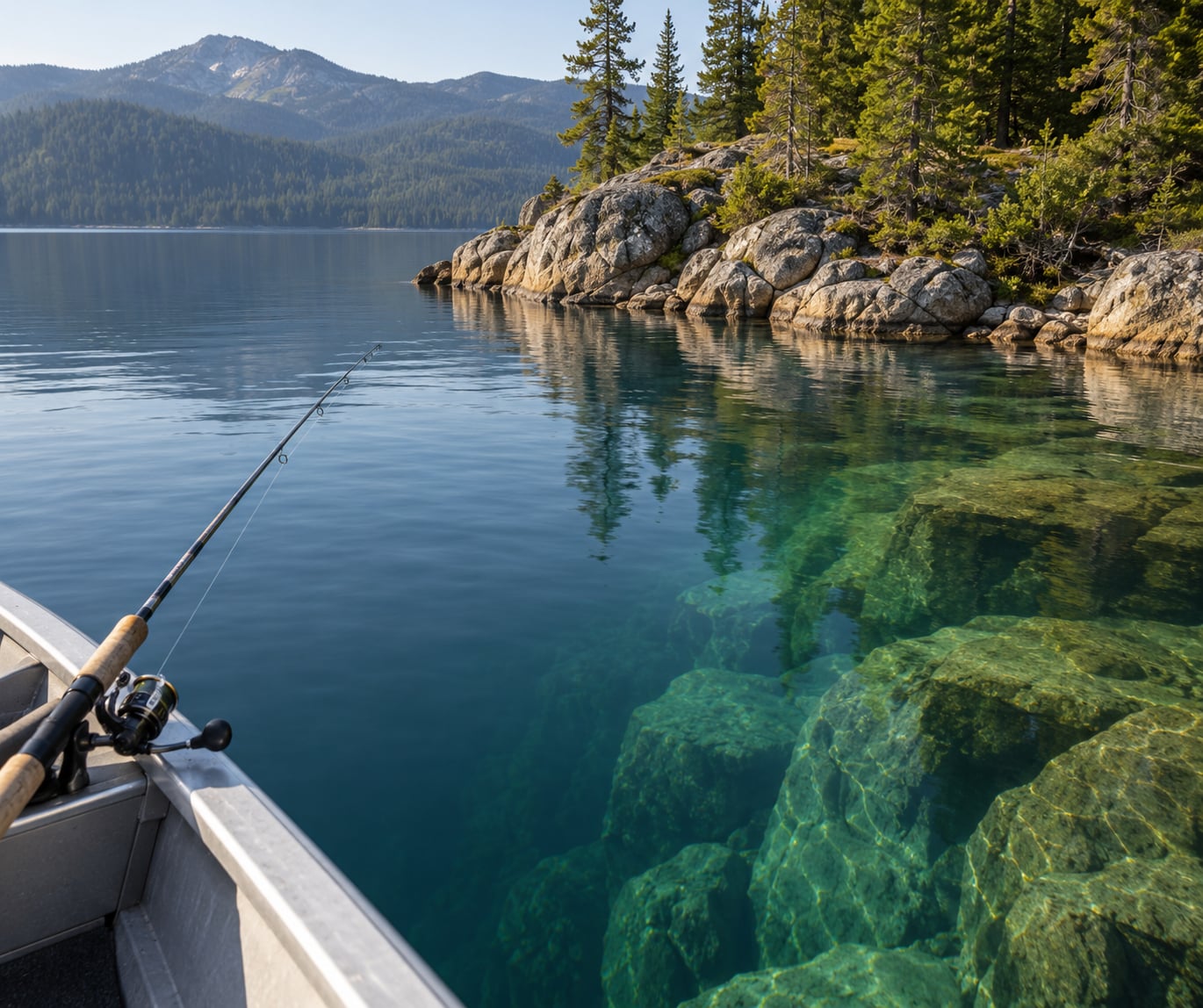
Fishing a rocky point comes down to one idea: work a bait along the hard edge where the bottom changes depth, not out over the top of the point. Find that edge, match a lure to the depth the fish are holding, and cast past the structure before bringing it back, and you will catch fish on almost any lake with rock in it. Plan on 30 to 60 minutes to locate fish and read them, then give the spot longer once the pattern starts repeating.
If you have never worked this structure before, learning how to fish rocky points in a lake comes down to position and depth far more than gear. Most anglers who miss out are not using the wrong lure. They are pitching into three feet of water at the point’s tip, then moving on before anything has time to commit. The correction is mostly about where you sit and how deep you work, and this guide walks through both step by step.
Table of Contents
- What You Need
- Step-by-Step
- Common Mistakes
- Frequently Asked Questions
- What is the best lure for fishing a rocky point in a lake?
- Should I fish the shallow side or deep side of a rocky point?
- How do I avoid losing lures and breaking line on rocks?
- What retrieve works best for bass on a rocky point?
- Can I fish a rocky point from the shore?
- When is the best time to fish a lake point?
- Conclusion
What You Need
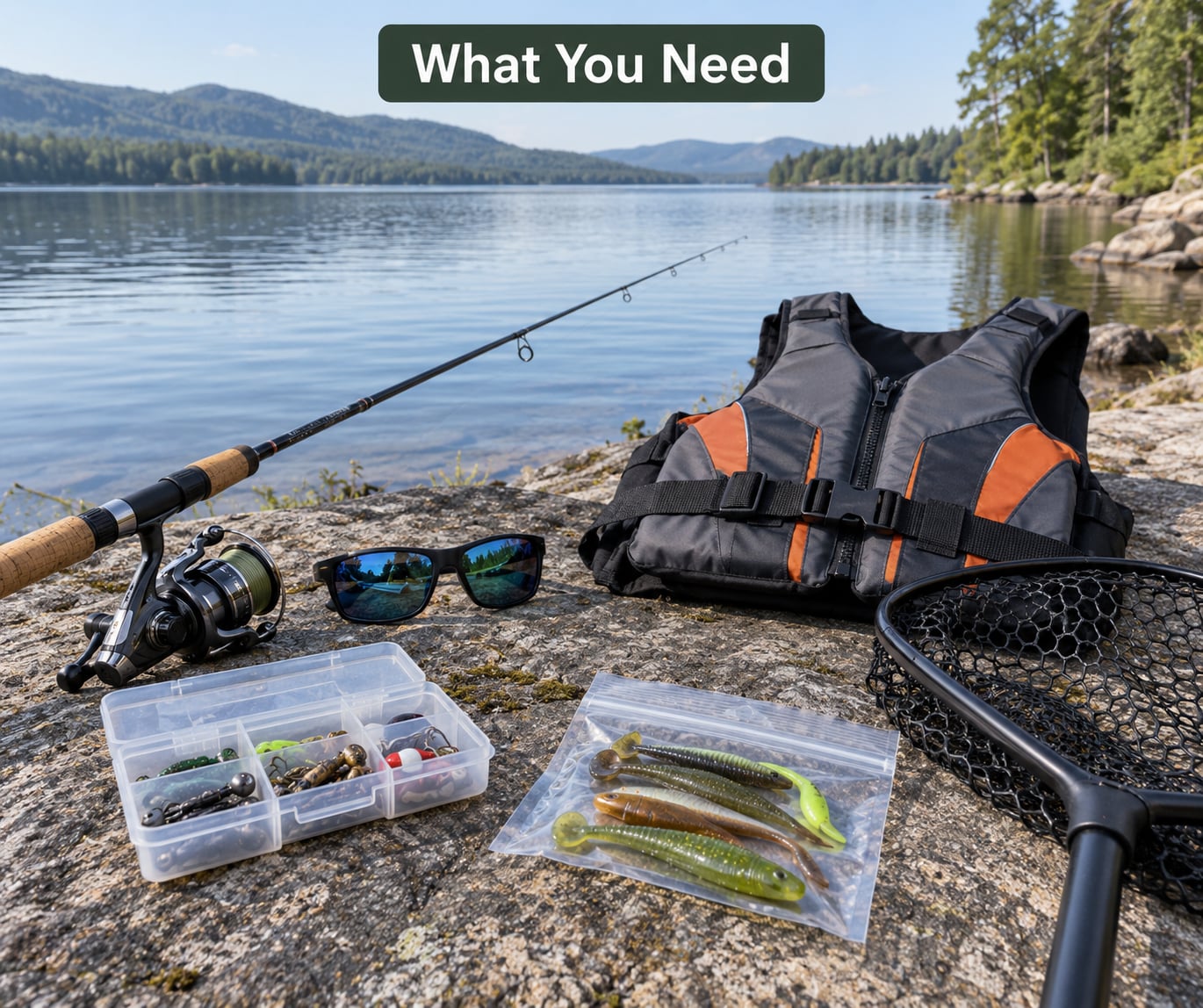
You do not need much more than a competent rod, the right line, and something that reaches the drop. The gear below is what most anglers carry, and each item has a specific job on rock.
- A medium-heavy rod and low-profile reel. A 6-foot to 6-foot-6-inch handle gives you the backbone to pull a fish off a ledge and the accuracy to place a lure on a specific rock. A heavier outfit is useful for deep rock, but it hides bites in clear water.
- A spinning outfit for finesse work. When smallmouth refuse plastic and the bite goes quiet, most anglers reach for a 2.8- to 3.5-pound rod spinning a light line with a shaky head or a drop shot.
- Polarized sunglasses. On a clear day you can actually see the rock line, boulders under the surface, and fish holding along the edge. This is the cheapest scouting tool in the boat.
- A properly fitted life jacket. Rocky shorelines are slippery, and half of a point presentation ends with an angler over the side.
- A landing net with a wide hoop. You will be landing fish next to submerged rock, where a bare-hand grab loses more fish than the hook ever did.
- Line and a leader. Braid or heavier fluorocarbon for digging into deep rock, a fluoro leader to keep a soft plastic from spinning, and abrasion-resistant line when the bottom is sharp gravel or shale.
- Hooks, in bulk. A small box of replacement trebles and single hooks lives in the tackle box. Working a crankbait over rock dulls or bends a hook fast, and bending hooks kill fish.
- A chart, a GPS unit, or a phone with a mapping app. This is how you find the next point instead of grinding the same rock all day.
- Terminal tackle options. A deep-diving crankbait, a lipless crankbait, a blade bait, a Ned rig, a drop shot, a swimbait, and a small supply of live craw or minnows for when the fish get finicky.
Step-by-Step
How to Fish Rocky Points in a Lake by Reading the Structure
A rocky point is a ridge of land or rock that runs from shallow water out into deep water. The bottom along that ridge is hard, usually rock, gravel, boulders or riprap, and the depth changes quickly on the outside edge.
On a chart, points show up as contour lines that tighten together as they run away from shore. The point itself is the bump where those lines reach furthest, and the steepest water sits just beyond it. Satellite imagery of the lake drawn at a low-water stage often shows the old shoreline and the exposed rock line, which makes an underwater point obvious before you ever launch.
Break the point into four parts, because fish do not use them equally:
- The nose is the furthest tip. It is where the depth change is sharpest, and it usually holds the most fish early and late in the day.
- The shoulder is the mid-body of the point, where the bottom starts to slope. Good for a lure held level a few feet off the rock.
- The back is the shallow half running back toward shore. Productive on rock because it warms quickly in spring, especially for smallmouth.
- The drop-off is the outside face where the ledge falls away into deep water. Suspended fish hang above it, and a bobber, a blade bait or a deep crankbait works here.
Wind matters as much as shape. With a steady wind, fish crowd the windward face where the current and food concentrate. On flat calm days under bright sun, they pull back to the shaded lee side and hold tight to the rock. Fish the windward face in wind, the lee side when the water is glassy.
Current adds one more layer. Wherever a creek or river channel swings past a rocky point, the seam between moving and still water concentrates baitfish, and the baitfish bring the predator fish. A point that sits at the end of a channel swing is usually worth an hour before you move anywhere else.
Choose the Right Tackle for Rocky Cover
Rock forces you to choose between a lure that stays above the structure and one that deliberately contacts it. Neither is wrong, but they suit different conditions.
- Deep-diving crankbait for the outside face of the point in 10 to 25 feet. It gets to depth fast, digs steeply, and handles the bumps that come with a rocky bottom. Replace or enlarge the trebles before a full day of rock work.
- Lipless crankbait for the top of a ledge and for suspended fish over the drop. Tight, fast vibration covers a lot of water, and you can stop it dead over the rock.
- Squarebill crankbait for a rock line in 2 to 6 feet, especially in spring. The bill deflects most of the contact that would snap a slender lure.
- Blade bait when fish are holding just off the point in the water column. It flashes, it holds still in a pause, and it works vertical.
- Ned rig or a drop shot for clear water, midday, and pressured fish. Work it along the rock at a slow, even pace with plenty of contact.
- Swimbait or a weighted swimbait when the fish want something that looks alive. Drag it slowly down the face, and it disappears into cracks that a crankbait will never reach.
- Crawfish or a small minnow for smallmouth that have stopped reacting to plastics. Rock holds crawfish year round, and the forage on the point tells you what the fish are eating.
For line, do not make one choice for every condition. On a deep, snaggy ledge, 30- to 40-pound fluorocarbon or braid with a heavier leader will not break on a rock edge. In clear water, that same line is visible enough to spook smallmouth, and a lighter presentation wins more fish even if you lose a few lures. Check your line for fuzzing after every few casts on rough rock. Bumped line looks fine and fails twenty minutes later.
On hook choice, most anglers report the same fix: step up to stronger, slightly larger trebles on a crankbait when working rock, or run a single hook in place of one treble where the fish are fussy. A bent hook in a fish is a dead fish, and rock punishes dull hooks faster than anything else on the lake.
Position Yourself for Accurate, Low-Snag Casts
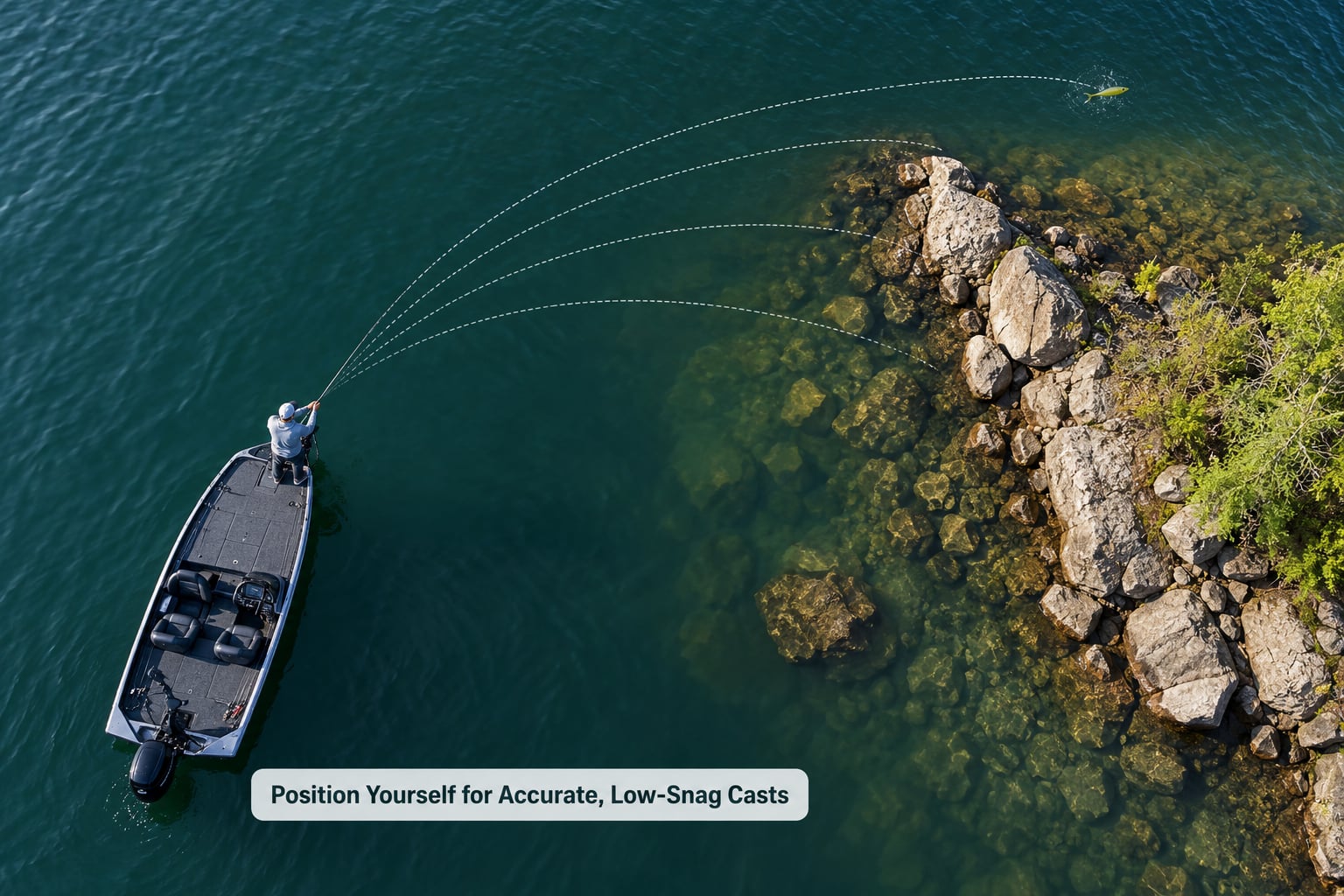
Set up 30 to 50 feet off the point in water deeper than the structure, with an end of the boat pointed at the rock. From there, fan your casts along the outside edge rather than aiming at the point itself. The goal is a landing spot past the structure so the lure comes back along the rock, not a spot on top of it.
Two rules fix most snag problems. First, cast farther than feels right, because a lure landing short never reaches the depth the fish are using. Second, aim along the line of the point rather than straight in at it, so a bad bounce carries the lure parallel to the rock instead of into a boulder.
Watch the water ahead of the boat for submerged rock just below the surface. A pale patch or a ripple that does not match the wind is usually a boulder or a shallow shelf, and a lure that lands there is a lure you will not see again.
From a kayak, the same principle holds, and it matters more because you have less mobility. Position so that wind and current carry the boat parallel to the point rather than onto it, and keep enough open water behind you to back off without fighting your own line. From shore, fish the shoulder and nose of a point that runs within casting range, and stay back from the drop until you have found the bite.
Make the Right Presentation and Retrieve
Work the lure down the face of the rock, not across it. Start your retrieve just past the point, let the lure fall or swim into the drop, and keep contact with the structure the entire way back.
For a crankbait, a steady retrieve at the speed the lure was built for lets it dig and stay on the bottom contour. If you cannot feel it tracking, you are probably too shallow for that bait or too deep for it. A pause before the lure reaches the boat gives a fish that has been watching a moment to commit, and the pause costs nothing.
A soft plastic needs a different rhythm. Let it sink, hold it still for a beat, then give a small twitch, and let it fall again. On a point this reads as a craw or a small baitfish working the cracks. Dragging it along the rock at a constant speed works well when fish are aggressive, and poorly on a drop shot when they are not.
For suspended fish over the drop, a tighter, higher retrieve gets the attention of fish that are not feeding hard. Most anglers find that the same point holds two different groups: fish actively feeding along the rock and fish hanging in the water column. The first group wants bottom contact and pauses; the second wants a lure held at their level with a visible pause. Watch your electronics and change the presentation to match the arc you see.
Depth rules the day. Two fish in a row is your signal to change one variable, not five. Drop to a slower bottom presentation before you change colors, and change depth before you change bait size.
Set the Hook and Land Fish Around Rocks
Keep light tension on rock. Line that sags lets a fish run the lure straight into the structure, and a rod tip pointed down with loose line is how most fish get lost. Watch the tip, not the water, and reel down hard enough to feel the lure without dragging it into the rocks.
When you feel the bite, set the hook with a firm sweep, not a flick. Fish on rock often have the lure pinched in their mouth rather than engulfed, and a short, hard hookset works better than a long one. A single sharp sweep and immediate reel is more reliable than waiting to feel the weight and hoping.
As soon as the fish is on, point the rod away from the structure and pump toward the boat. Most lost fish happen because the fish runs around the point and the line crosses the rock. If the fish dives, give line, keep the rod pointed at open water, and wait for it to turn before applying pressure again.
Lift with a net rather than hands, and check the line one more time for abrasion before the next cast. Catching and releasing on rock means a little care: wet your hands, keep the fish out of the air as briefly as you can, and release it away from the structure that you just pulled it out of.
Common Mistakes
Casting short onto the top of the point. A lure that lands two feet from your toes is in the last place you will find fish. Fix it by picking a target past the structure and using a longer, smoother cast so the lure arrives with accuracy, not just distance.
Fishing one depth across the whole point. A point holds fish from three feet to twenty, and treating it as one depth is why anglers cast randomly. Fix it by reading the contours, picking one depth band, and working it before you move.
Pulling the lure straight through the rocks. Retrieve speed that buries the trebles in a ledge will cost you a lure every few casts. Slow down, lift the rod a little, and remember that contact is fine while a dead hook is not.
Using the wrong retrieve for the mood of the fish. A fast crankbait retrieve covers water and catches suspended fish, but it turns off fish that are looking at a bait along the rock. Fix it with pauses, a slower reel, and a softer plastic when the bite dies.
Leaving after one fish. Anglers who lose a single fish and move on miss the whole school. One fish usually means the presentation is working. Fish the spot until two or three casts come back clean, then move.
Trying to reach a point you cannot comfortably fish. Long casts onto a rock face at the limit of your range land sideways, snag, and scare everything nearby. Move the boat or the kayak instead of muscling a longer cast.
Two extra habits separate the anglers who catch fish on rock from the ones who do not. Mark a productive point so you can return to it, and note what was working, because rock rarely changes but fish cover and wind do. A waypoint and a two-line note will save you an hour of guessing on the next trip.
Frequently Asked Questions
What is the best lure for fishing a rocky point in a lake?
For most lakes, a deep-diving crankbait worked along the outside face of the point is the best starting bet, because it reaches the depth quickly and survives contact with rock. On a shallow point, a squarebill crankbait deflects most snags. In clear water or when fish are pressured, a Ned rig worked along the rock face with a lot of contact is harder for fish to see and often produces the better catch.
Should I fish the shallow side or deep side of a rocky point?
Work the deep side and the drop-off first, since the sharp depth change is where most fish hold. Fish the shallow back of the point in spring and early summer, when it warms faster than the surrounding water and smallmouth patrol it. With a steady wind, push toward the windward face where food concentrates; on bright, calm days, work the shaded lee side where fish will not sit in bright sun.
How do I avoid losing lures and breaking line on rocks?
Cast past the structure instead of onto it, and work the lure back along the rock line so contact happens at an angle rather than square into a boulder. Use abrasion-resistant line or a heavier leader on snaggy bottom, and check for fuzzing line every few casts. Running a single hook or a stronger treble in place of a thin one prevents most breaks, and a squarebill bill deflects strikes that would snap a slender crankbait.
What retrieve works best for bass on a rocky point?
On a feeding bite, use a steady retrieve at the speed the lure was designed for and let the bill or spoon find the contour, then pause just before the lure reaches the boat. For fish that are watching but not committing, slow the reel down and add a twitch-and-pause with a soft plastic. For fish suspended off the drop, tighten the retrieve so the lure holds at their level and gives them something visible to react to.
Can I fish a rocky point from the shore?
Yes, and a point running within reach of a bank is often the most reliable shore fishing on any lake. Fish the shoulder and the nose where the point is closest to you, and target the deeper water along the outside edge. You will have less range than a boat, so pick one depth band and work it rather than covering the whole point. Stand back from any steep drop, and keep an eye on the footing, since wet rock is the real hazard.
When is the best time to fish a lake point?
Early morning and late evening are the most consistent windows, when the temperature is stable and the wind usually picks up enough to move bait toward the point. Overcast, breezy days are better than bright, flat calm ones, since fish on rock face light directly in slack water. During the heat of summer, fish the same point deeper, because the drop-off keeps it cooler than the shallows nearby.
Conclusion
Start at the drop-off, not the tip. Set up in deeper water, cast past the rock, and work a presentation that matches the depth you can read on the chart or on your electronics. Change one variable at a time when the bite slows, and stay on a productive point long enough to see whether the pattern is real. Most of what makes rocky-point fishing work is putting a lure in the right water and giving it the right motion for longer than feels comfortable.