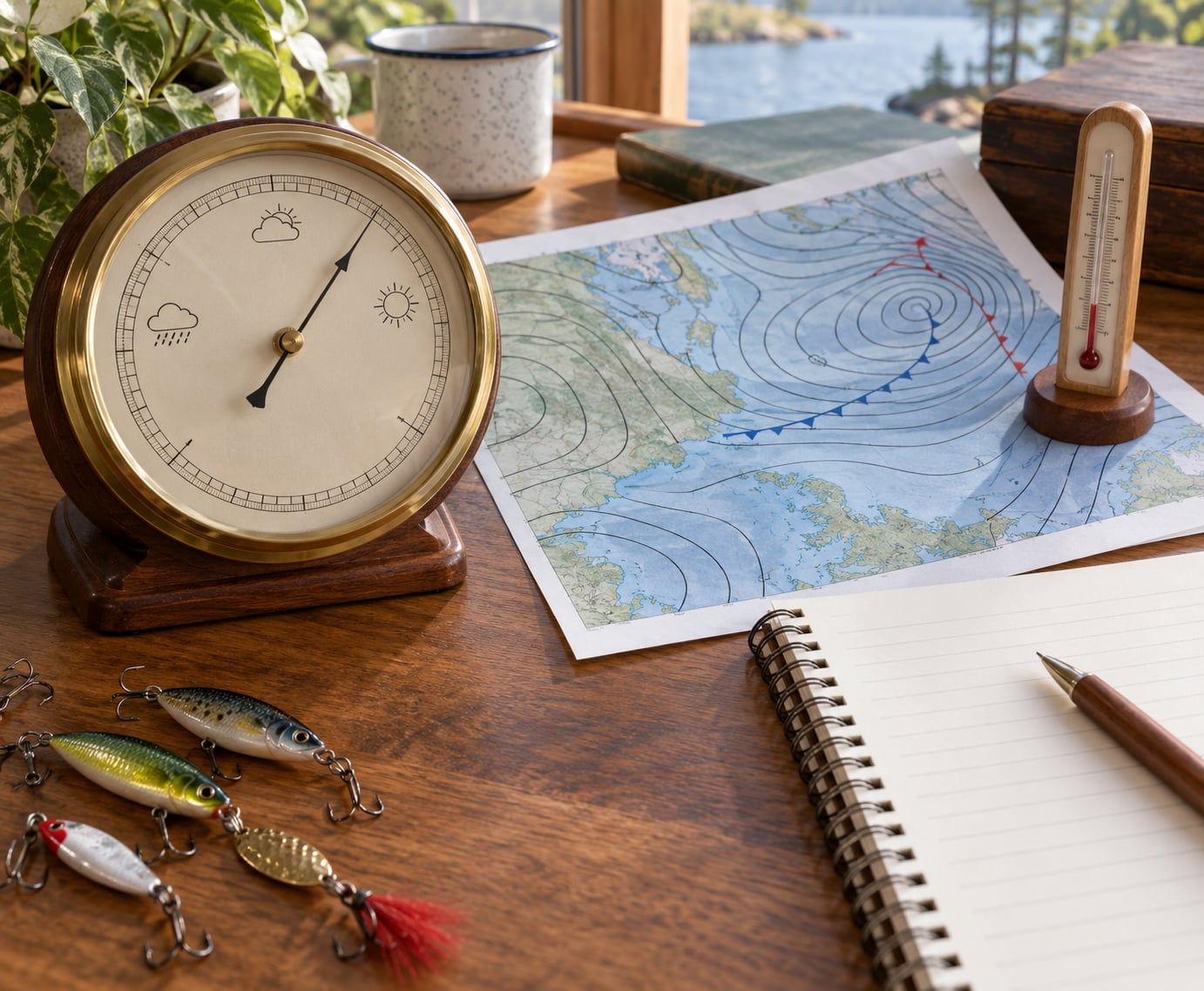
How barometric pressure affects fishing comes down to one thing: the trend matters far more than the number. A steady 29.90 tells you very little. A barometer sliding from 30.05 to 29.60 in four hours tells you a front is arriving and that the fish will probably eat hard before it gets there. Here is how pressure actually reaches a fish, what each pressure state tends to do to the bite, and how to turn a forecast into a plan for your lake.
I keep a running log of pressure, wind, water temperature and what I caught on every trip. It is not science, but after a few seasons it does more for my fishing than any rule of thumb I was taught. Pressure is one line in that log, and usually not the most important one.
Table of Contents
- What Is Barometric Pressure?
- How Barometric Pressure Affects Fishing
- Rising Pressure, Falling Pressure, or Steady Pressure: What to Expect
- How Much Pressure Change Is Significant?
- Do Different Fish Species Respond Differently?
- How to Use a Barometer or Weather Forecast
- How to Adjust Your Fishing Plan for Pressure Changes
- Common Pressure and Fishing Myths
- Other Conditions That Matter More Than Pressure
- Frequently Asked Questions
- Is fishing better at high or low barometric pressure?
- How fast does barometric pressure have to change to affect fishing?
- Should I fish before, during, or after a storm changes pressure?
- Does barometric pressure matter more for bass than for trout?
- Do I need a fishing barometer, or is a phone forecast enough?
- Can barometric pressure explain a sudden loss of fish activity?
- Conclusion
What Is Barometric Pressure?
Barometric pressure is the weight of the atmosphere pressing on everything beneath it, measured at sea level in inches of mercury (inHg) or in millibars (mb). Standard pressure is 29.92 inHg, or 1013.25 mb. The reading rises and falls as weather systems move overhead, which is why a barometer is really a remote sensor for where the nearest front is.
Two units show up on most displays. American fishing weather kits use inHg; aviation and marine forecasts use mb. One inch of mercury is worth about 33.9 mb, so 29.60 inHg is roughly 1002 mb and 30.20 inHg is roughly 1022 mb. Convert once and you stop doing mental arithmetic on the dock.
Here is the distinction that matters most. A reading is a single snapshot. A trend is the direction and speed of change over hours. Anglers obsess over readings because a number is easy to check, but the fish respond to movement, not to a snapshot of the atmosphere.
One more wrinkle worth knowing: barometers report pressure corrected to sea level, so a lake at 8000 feet still reads close to 30.00 even though the air up there is genuinely thinner. The trend stays accurate. An absolute number means more at low elevation than it does in the Rockies.
How Barometric Pressure Affects Fishing
The leading explanation is the swim bladder, the gas-filled organ most bony fish use to control buoyancy. Angling forums argue about the details endlessly, and it is worth being honest that this is a theory rather than settled science.
When atmospheric pressure falls, the gas inside a bladder expands slightly. When it rises, the gas compresses. The fish has to adjust to hold neutral buoyancy, and a fish that cannot settle easily burns energy it would rather spend hunting. The most common descriptions from the water are that a falling barometer makes fish feed hard and move shallow, while a rising barometer finds them holding tight to structure and feeding lazily.
Scale that up and the numbers stop sounding small. Water adds roughly 0.9 inHg of pressure for every foot of depth, so a fish that moves 1 to 4 feet changes the pressure on its body by roughly 8.6 percent, according to arithmetic anglers have worked out on TheFlyfishingForum. That is a bigger change than the entire swing most people get excited about on a normal day.
What the science does not support is the idea that pressure alone decides your trip. A saltwater forum consensus on Sealine puts it plainly: pressure does not change quickly enough to magically turn the bite on or off. Fish react to it, but they also react to temperature, oxygen, light, forage and the water moving over them.
The honest summary is that pressure is a decent planning signal and a poor promise. Anglers who treat it as the only variable are the ones who get burned.
Rising Pressure, Falling Pressure, or Steady Pressure: What to Expect
These five states cover almost every fishing morning, and each one tends to produce a different kind of bite. Treat them as tendencies that set your expectations, not rules that write the trip for you.
Falling Pressure
A slowly falling barometer usually puts fish on a feeding pattern before bad weather arrives. This is the classic pre-front window, and the bite is usually shallower and more aggressive than normal, with the best activity often on wind-blown banks where the current pushes bait into the fish.
If the fall is slow and gentle, the fish have time to adjust and keep eating. That is the version of falling pressure I trust most.
Rapidly Falling Pressure
Rapidly falling pressure is the strongest feeding signal anglers get, and it usually means a fast-moving front is close. Fish often feed hard right up until the front passes, then stop almost completely, so the productive window is short and front-loaded.
A fast drop is also your weather warning. Read the severe-weather note further down before you plan around it.
Rising Pressure
Rising pressure after a front usually makes fishing tougher. Fish compress, hold tighter to structure, and pick up a smaller menu of baits, so an active presentation often gets nothing while a patient one gets bit.
The recovery window matters. Many anglers report that fishing stays slow for a couple of days after the barometer stops climbing, then improves once it has been steady long enough for the fish to settle.
Rapidly Rising Pressure
A fast rise is generally worse than a slow one, because fish are being pushed down and into cover faster than they can adjust. Expect tight holding, shorter strikes, and a lot of following fish that never commit.
If you only have one day in a week, this is the one to spend somewhere other than a lake.
Steady Pressure
Steady pressure is the most productive condition to fish because the bite becomes predictable. Once the barometer holds within a few hundredths of an inch for a day or two, you can rely on the spots and presentations that worked the last time.
Plenty of my best days have been flat, boring, 29.90 mornings. Stability is not the same as mediocrity.
Pressure Bands at a Glance
This table converts raw readings into decisions. Treat the millibar column as the same numbers in the unit most aviation and marine forecasts use.
| Reading (inHg) | Approx. millibars | What it means | Likely fish response | Approach that fits |
|---|---|---|---|---|
| 30.20 to 30.40 and up | 1022 to 1029 | Settled high, often clear and cool | Freshwater bass slow and deep; inshore saltwater can still be fine | Deep structure, live bait, slow presentations, patience |
| 29.90 to 30.10 | 1012 to 1018 | Normal and holding steady | Feeding on their normal schedule and depth | Your proven spots, baits, and retrieves for the time of year |
| 29.70 to 29.90 | 1006 to 1012 | Slowly falling, unsettled air | Feeding a little ahead of the front, moving shallower | Brighter lures, faster retrieves, wind-exposed banks |
| 29.40 to 29.70 | 996 to 1006 | Rapidly falling, front close | Strong feeding, then a hard stop as the front arrives | Be on the water early; concentrate on current-fed areas |
| Below 29.40 | Below 996 | Storm in progress or heavy rain | Turbid water, dropping oxygen, fish buried in cover | Sheltered cover, cut bait, low expectations |
One number anglers quote in forums is that pressure above roughly 27 inHg keeps fish deep. Treat that as an old rule of thumb rather than a fact, but notice that it is a claim about depth, not about whether fish will eat at all.
How Much Pressure Change Is Significant?
A change of a few hundredths of an inch over a full day is background noise. What wakes fish up is a move of roughly 0.10 inHg or more within three to six hours, and the faster that happens the more obvious the effect on the water.
Marine barometers report a tendency, which is the change over the past three hours. A tendency of 0.02 inHg in three hours is a slow drift. A tendency of 0.06 inHg in three hours, often shown with a falling arrow, is a real front and a real change in how you should fish.
Here is the example I use on the dock. Yesterday afternoon the barometer read 30.10 and had not moved since noon. At 7 a.m. it reads 29.88, and the overnight low was 29.84. The number looks ordinary, right in the normal band, and yet the fish have had 0.22 inHg of falling pressure in less than a day. That is a pre-frontal morning and I would plan an active, shallow approach, not a slow one.
Compare the other way and the lesson is clearer. A steady 30.30 that has not budged in two days is less interesting than a barometer wobbling between 29.95 and 30.05 all morning. A barometer that keeps moving keeps fish off balance, which is a reason to expect a slower bite until it settles.
The long-running advice from Mercury-style weather habits is worth repeating: while the barometer is on the move, fishing slows as fish acclimate to the new level, and the water often heats up two or three days after it stabilizes. Plan the sit-down bank trip for the settled day, not the day of the change.
Do Different Fish Species Respond Differently?
Yes, and this is where most of the flat rules fall apart. Largemouth and smallmouth bass sit mid to upper water columns and often feel a pressure change before smaller fish do, which is why the falling-barometer bass bite is such a reliable story in practice.
Trout and other salmonids can be more subtle. Anglers on PAflyfish and ifish report that fish with large swim bladders detect a drop faster than fish with small ones, and trout generally do not present the aggressive pre-front feeding that bass do. Their comfort range is also narrower, so a fast swing can simply push them off feed.
Panfish, especially bluegill and crappie, tend to keep feeding through more conditions. They are small, numerous, and rarely refuse a bait even on a day when bigger fish shut down, which makes them a reasonable consolation trip.
Walleye and pike often feed hardest in the middle of a pressure change rather than at either end, since both hunt by feel in dim light and moving water. Catfish anglers on Catfish1.com specifically point at the swim bladder when they describe why catfish seem bothered by pressure swings, and low-light activity means a falling-barometer night can be excellent for them.
The caveats matter as much as the categories. Water temperature sets metabolism, dissolved oxygen sets how long a fish can chase, and forage availability sets whether a bite is even worth having. Cold-front water that is warmer than the air can actually turn fish on, and heavy rain can kill a bite through turbidity rather than pressure.
How to Use a Barometer or Weather Forecast
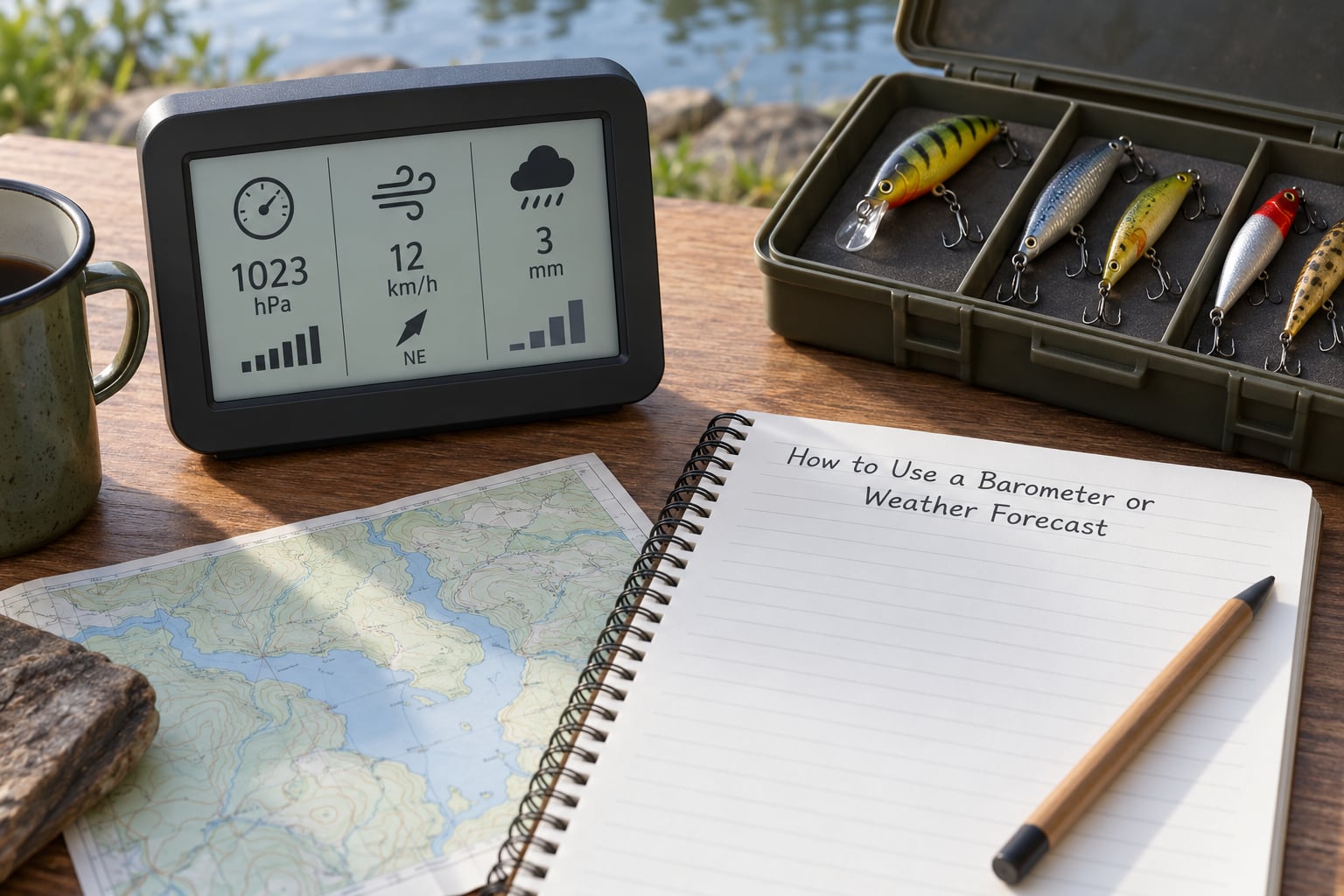
You do not need a boat instrument. A phone app, a desktop widget, or a cheap indoor barometer is enough, and the whole routine takes about a minute.
First, note the current reading and know the standard for your elevation, which is 29.92 inHg at sea level. Second, look at the change since yesterday at the same time, not the change since you last picked up the phone. Third, read the three-hour tendency if the display offers it, and pay attention to the arrow. Fourth, check what is coming: rain, wind shift, a temperature drop of 10 degrees or more. Fifth, add what the water is doing, because surface temperature, clarity, and wind direction on your lake often override everything the atmosphere is doing.
Then use it as a filter. On a falling barometer with a southeast wind, I would start on the upwind end of a bay where the wind has been blowing and pushing bait. On a high clear morning with calm water, I would go straight to the deepest drop-off I know and be slow about it.
Logging is where this pays off. After a season of notes you will find your own lake has a baseline, and it may not match the national numbers. Some lakes sit 0.10 lower in a settled high than others, and the same reading can mean different things on two waters an hour apart.
How to Adjust Your Fishing Plan for Pressure Changes
Here is the practical translation. On falling pressure, work the wind-exposed banks and the shallow ends, use brighter lures with a quicker retrieve, and expect fish to commit rather than follow. A buzzbait or a chugger over grass that would be too loud on a stable morning is the right call here.
On rising pressure, slow down. Small natural baits, finesse presentations, and suspending lures with pauses and twitches match fish that are holding tight and picking booms carefully. Casting to the same spots matters more than ever because the fish are not moving far to feed.
On steady pressure, use the time for prospecting rather than guessing. Run your electronics and find new structure, because predictable fish are on predictable spots and a settled lake is a good excuse to learn a new one.
When a front is moving fast, shift the trip rather than the tactics. Fish the pre-frontal morning window and be off the water as the squall line approaches. A falling barometer is a severe-weather warning before it is a feeding cue, and a small boat on an open lake is a bad place to be when that line arrives.
Common Pressure and Fishing Myths
The first myth is that fish always feed before a storm. They often do, but a front can move faster than the bite does, and heavy rain turns the water off through silt and falling oxygen rather than through pressure. Treat the pre-frontal window as a real but limited opportunity.
The second myth is that a particular pressure number makes a particular lure work better. There is no evidence for that. What changes is fish depth, holding and aggression, and those changes simply make some presentations more likely to be seen.
The third myth is that high pressure is bad and low pressure is good. A settled high is often the best bass fishing there is once fish have had a day to adjust. What hurts is movement, not the number, in either direction.
The fourth is the opposite error, treating pressure as everything. Luresedge readers have logged trips that produced fish on supposedly terrible pressure, and a great many anglers on the same forums argue pressure changes too slowly to matter much. Both camps are partly right, which is why the logbook habit is worth more than any rule.
Other Conditions That Matter More Than Pressure
Water temperature sets how active fish are and when they start feeding before you see a bite. Dissolved oxygen can end a bite in a warm, still, algae-heavy lake faster than any front. Light penetration matters, which is why a cloudy falling-barometer morning is different from a bright rising one.
Wind moves water and concentrates bait, and a steady onshore wind is often the strongest single predictor of where fish will be. Rain and runoff raise levels, drop oxygen, and cloud the water. Moon phase matters more to some anglers than any barometer reading, particularly in clear shallow water.
Water clarity decides how far a fish can see a lure. Forage availability decides whether there is a reason to eat at all. And the spawn calendar sits over all of it, because fish on a bed are doing something other than feeding no matter what the air is doing.
One quick way to feel what the water is telling you: when a soft plastic is barely moving on a tight retrieve with no bite, that often signals fish holding tight and pressure sitting off. When the same bait flutters wildly over a wind-blown bank, that usually means fish are up and active in moving water.
Frequently Asked Questions
Is fishing better at high or low barometric pressure?
Neither number on its own. A falling barometer, especially a slow one, often puts fish feeding shallower and more aggressively before a front, while a settled high is productive once fish have adjusted and are holding on predictable structure. A barometer that is moving fast in either direction usually makes fishing tougher. The direction of change tells you more than the reading itself.
How fast does barometric pressure have to change to affect fishing?
Roughly 0.10 inHg over three to six hours is the threshold most anglers start noticing, and faster moves produce stronger responses. Check the three-hour tendency on your barometer: 0.02 inHg is a slow drift, while 0.06 inHg or more in three hours is a real front. Compare the reading with the same time yesterday rather than with the number five minutes ago.
Should I fish before, during, or after a storm changes pressure?
Before. The productive window is the pre-frontal period while pressure is still falling, and it often shuts down once wind and rain arrive. Fishing during a fast-moving front is a safety question, not a fishing one, and a falling barometer is a severe-weather warning. After the front, expect slow fishing for a day or two, then improving conditions once the barometer has been steady.
Does barometric pressure matter more for bass than for trout?
In practice, yes for most lakes. Bass often feed aggressively and move shallow on a falling barometer, so the effect is obvious. Trout are generally less dramatic about pressure swings and have a narrower comfort range, so a fast change more often just pushes them off feed. Both are affected more by water temperature and dissolved oxygen than by pressure itself.
Do I need a fishing barometer, or is a phone forecast enough?
A phone forecast is enough if you can see the pressure reading and its trend. Most weather apps show the current pressure, the three-hour tendency, and an hourly trend, which is everything you need. A dedicated barometer is a nice-to-have if you spend a lot of time on the water. The important habit is comparing the reading with the same time the day before.
Can barometric pressure explain a sudden loss of fish activity?
Sometimes, but rarely on its own. A fast-rising barometer can push fish into cover and cut the bite quickly. Just as often the cause is a temperature drop, a wind shift, rain clouding the water, or dissolved oxygen dropping in warm still water. Log the pressure with the wind, air temperature, and water conditions so you can tell which one did the damage.
Conclusion
Start with the trend, not the number. Check the pressure and how it has moved since yesterday, note the incoming wind and rain, then match that to your lake’s water temperature and clarity before you pick a spot. Pressure is one planning signal among several, and keeping a simple log of readings and results is how you find out which signal matters most on your water.