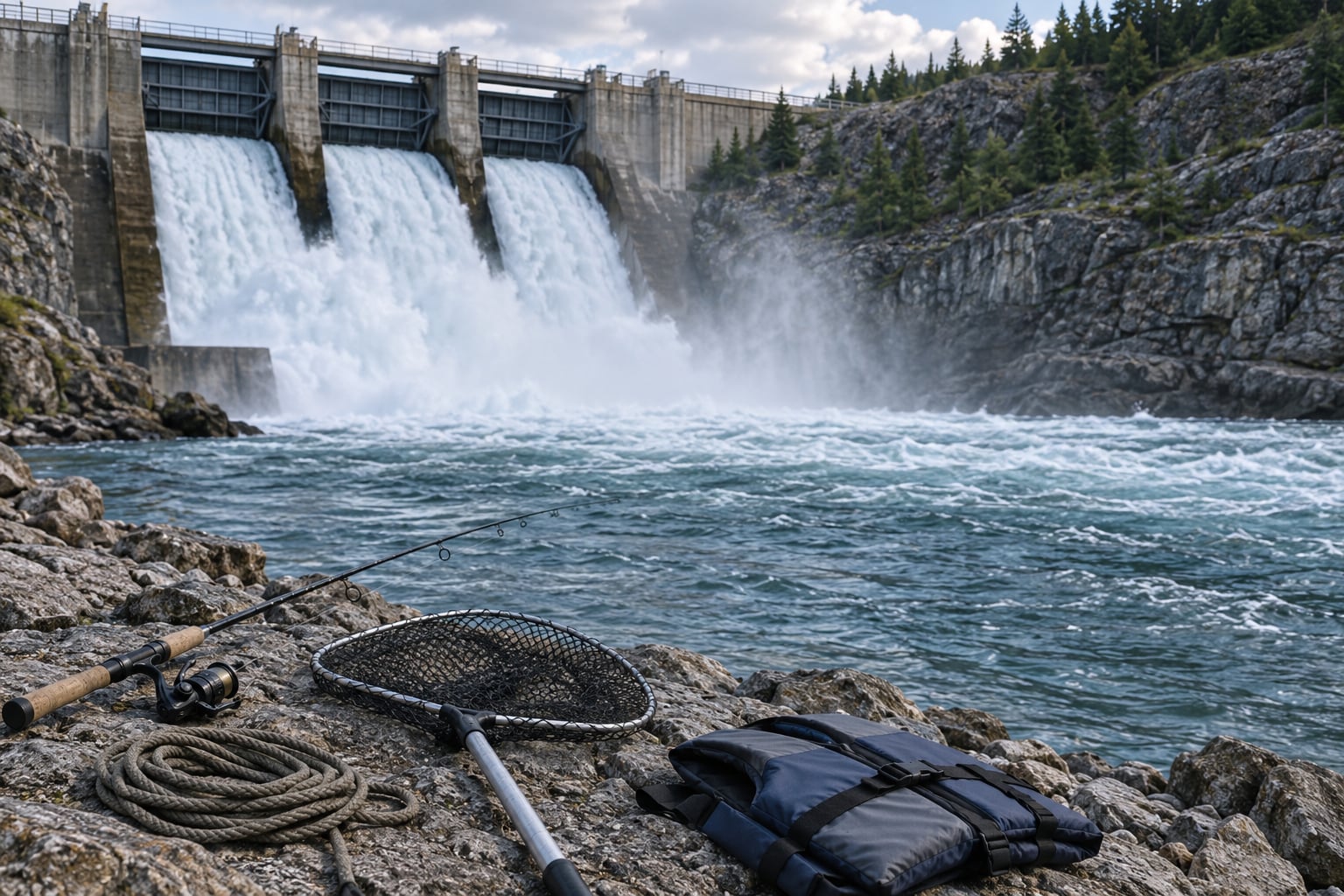
Learning how to fish a spillway safely comes down to a single habit: watch the water before you watch the fish, and never be standing where a sudden release could take you. Spillways hold some of the most productive water in a lake system, and they also hold the most dangerous current most anglers have ever seen. Nearly all of the real safety work happens before the first cast, and it takes about fifteen minutes.
Beginners usually arrive at a spillway asking about bait, and that is a fair question. But the folks who fish these places well all say the same thing first. Check the release schedule, read the water, choose a position with an easy exit, and put on a life jacket you could swim in.
The gear list is short, and the rules are stricter than anywhere else on the lake. Fifteen minutes of scouting decides whether the day goes well.
Table of Contents
What You Need
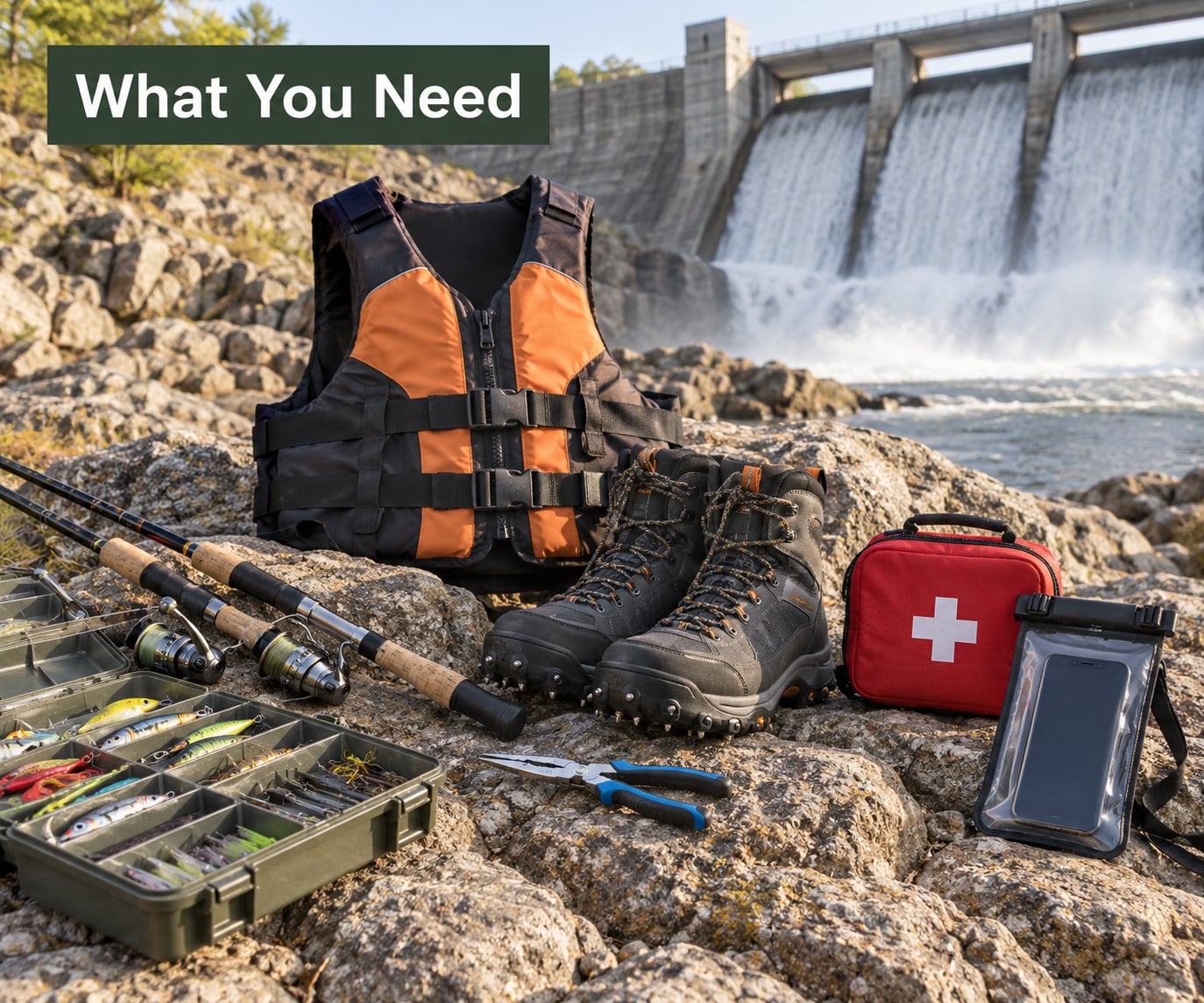
A spillway trip needs less tackle than most anglers expect and more safety gear than they bring. Here is the honest list.
- A properly fitted PFD. Not a flotation cushion, not an inflatable pack you have never inflated. A USACE-approved personal flotation device, buckled and tightened before you leave the truck, every single time. Cold water shock in deep water can make a bad decision in seconds.
- Sturdy footwear with good grip. Spike waders or wading boots for rocky margins, and closed-toe shoes with rubber soles on concrete. Wet spillway surfaces are algae-slick, and a slip on that apron usually means sliding toward moving water.
- A long, flexible rod with a reel you can control. Seven feet or longer gives you casting distance and, just as important, enough bend to steer a fish away from structure instead of pulling it into it. A baitcaster handles heavy baits; a spinning reel handles lighter ones. Most spillway anglers carry one of each.
- Line and leader matched to the current. Braid or heavier test line where the flow is pushing hard, and an abrasion-resistant leader because riprap eats everything. Do not run soft mono into rock.
- Bait or lure matched to the current speed. Details are covered in the step-by-step section below.
- Pliers, preferably with a line cutter and a jig release. Hook removals happen faster with them, which means less flailing with a fish in the water.
- A small first-aid kit and a whistle. The whistle is the part people skip. It carries far past the sound of a spillway.
- A charged phone in a waterproof dry bag, and offline maps. Cell service is often poor at the back of a reservoir, so download the area before you leave.
- The dam’s release schedule and a river gauge reading for that day. This is the least expensive item on the list and the one that keeps the most people out of trouble.
- Your state fishing license and any local permits. Dam areas are frequently under site-specific rules.
Leave the throw bag at home unless you are specifically equipped and trained for swiftwater rescue. It is not a beginner tool.
Step-by-Step: How to Fish a Spillway Safely
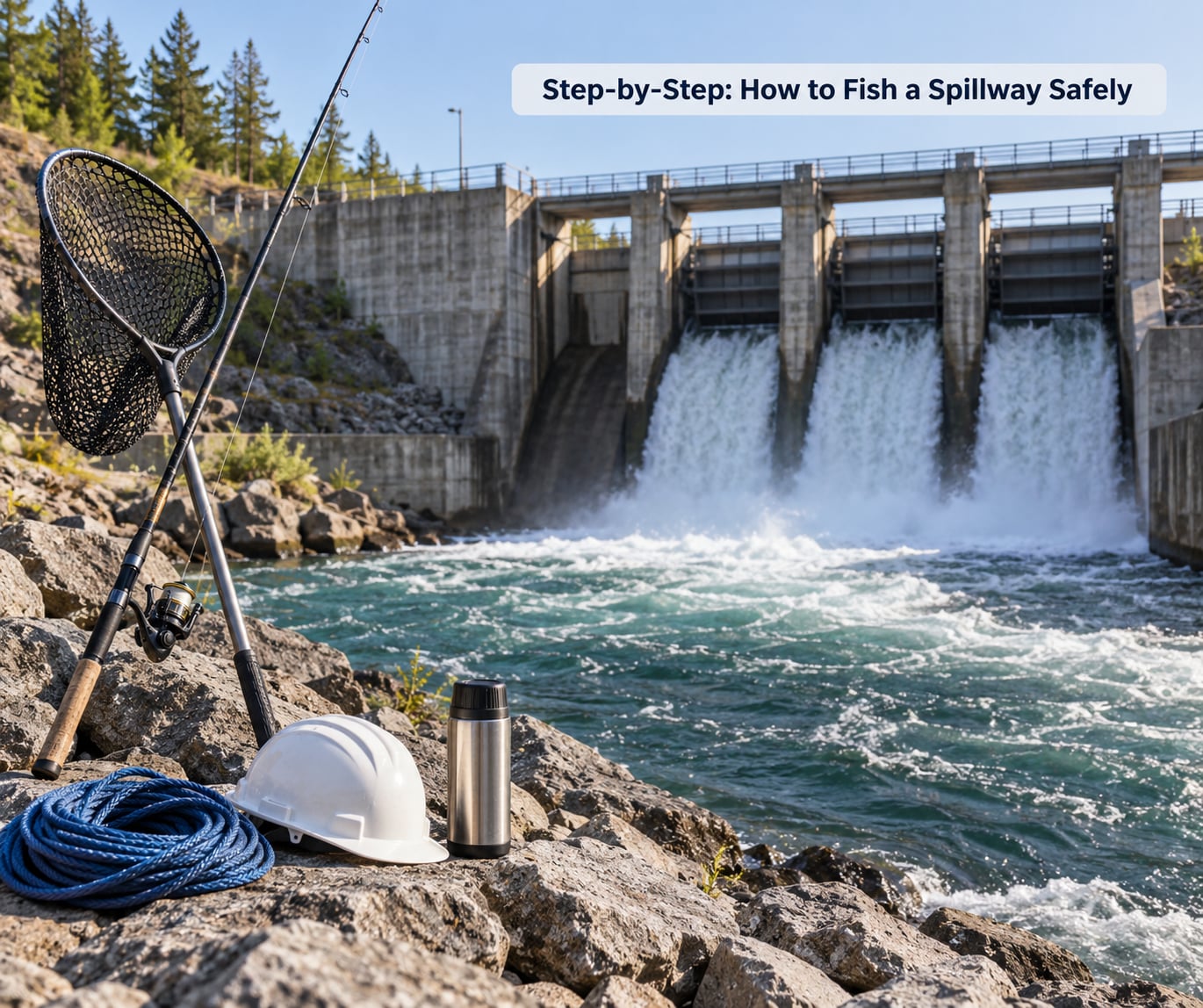
Six steps, in order. Each one has a hazard it is designed to prevent and a simple sign that tells you it worked.
Check Access and Conditions Before Approaching
Park where you can see the water without standing over it. Before you walk to the bank, find out how much water is moving and where it is going. The dam operator’s release schedule tells you the planned flow, and the nearest river gauge shows you what is actually happening right now.
On foot, look at the bank before you trust it. Watch for posted closures, warning signs, fences, and locked gates, because the areas that look easiest to reach are often closed for a reason. Note two escape routes before you commit to a spot: a path back to the vehicle and a stretch of bank that a grown person could run along quickly.
The sign this step worked is simple. You can name where you are going to stand and how you are getting back. If you cannot, you are not ready yet.
Choose a Stable Fishing Position
Set up downstream or beside safe structure, never on the spillway apron itself and never inside the outflow. The concrete below a spillway gate is the fastest water on the site, and it is the place where falls happen most often.
Flat ground, boulders with a flat top, or the upstream side of a riprap pile are all workable. Skip algae-covered concrete, undercut edges, loose rock that shifts under your weight, and anywhere you would have to step backwards to set your rod. A position that requires you to turn around on a wet slope is a position you will eventually fall from.
If you cannot find footing you trust, you do not wade. Fish the same seam from the bank, or do not fish it today. When your feet are planted and you can shift your weight without testing each boot, you are in the right place.
Select Gear and Tackle for Moving Water
Match your weight to the current, not to the fish. In slow seams near the tailwater, a slip bobber rig covers a lot of ground and the bobber still reads as a bite indicator. Anglers posting on r/catfishing recommend exactly that for gentle current. In a sand or mud bottom spillway pool, the same forum leans on a fish finder rig.
As the water speeds up, move to bottom-contact presentations. A Carolina-rigged jig with a fluke is a proven producer when a spillway is releasing, per anglers on r/bassfishing, and a popping cork with two jigs underneath is a well-worn spillway approach discussed on the Mississippi Hunting and Fishing Forums. The longer the rod, the better, because a soft tip keeps a heavy bait from slamming into you when the current loads the line.
Set the drag so a strong fish pulls line instead of stripping it, and keep enough rod to bend. If you cannot hold the rod butt in one hand while the line is under load, you have too little tackle for that water.
How to Fish a Spillway Safely From the Bank: Cast Without Exposing Yourself
Cast from a stable position with your feet planted and your back to a clear retreat path. Never back up to set a cast, and never turn to watch the lure land. If you cannot watch your own feet while the line is flying, the spot is wrong.
Pick targets that are downstream of you, not directly in the seam of a gate or a drain pipe. Look where your line is going before you cast. Downed branches, riprap, rebar, gate mechanisms, boats below, and other anglers’ lines are all real hazards, and a cast into any of them is how people get pulled into the water.
Watch your retrieve for the whole length of the line. Anglers on r/desmoines advise flicking the lure off snagged rock rather than pulling, and that habit keeps your rod pointed at the bank instead of at the current. The sign it worked is a clean drift and a clear path home.
Fight and Land the Fish Safely
Keep steady pressure, keep the fish pointed away from the structure, and let the rod do the work. A slack line gives a fish a chance to find a snag and a broken line. If the drag is running away with line and the fish is heading for rocks, give it. You will fish again this season either way, and the fish that swims away keeps its tackle to itself.
Use a long-handled net if one is within reach. If the fish is past netting depth, let it go. The only safe way to release a fish you cannot reach from the bank is to cut the line.
Never step into the water to land a fish. Never wade to a fish you can see. Wading at a spillway is the single most dangerous thing on this list, and the fact that other people do it regularly is not evidence that it works.
Leave Immediately When Conditions Change
Pack up the moment any of these show up: rising water, a current that suddenly pushes harder, thunder, visible lightning, darkness, new debris on the bank, dam staff or emergency vehicles on site, a new posted closure, or ground under your boots that has started to move.
Releases are not always announced in time. Some ramps close with little notice when the pool comes up, and a ramp that was solid on the way in can be under water on the way out.
The clearest signal that it is time to go is losing your ability to see the current clearly, or losing the exit route. Once one of those goes, the day is finished.
Common Mistakes
Almost every accident pattern at a spillway comes down to one of these. Each has a simple fix.
- Fishing alone. Fix: tell a person your location and expected return time, and fish within sight or earshot of someone else whenever you can.
- Standing on the spillway structure or apron. Fix: fish the bank downstream or upstream of it. There is no line, no lure, and no limit worth the concrete.
- Ignoring closures and signage. Fix: read every sign before you set your gear down. Dam area rules change with conditions and are enforced.
- Wearing a PFD that does not fit, or carrying one unbuckled. Fix: try it on with the straps tightened before you leave. A loose vest rides up over your face in current.
- Using tackle that is too light for the water. Fix: if the bobber sweeps away, the answer is a bottom-contact rig, not more weight on the bobber. Anglers on r/FishingForBeginners describe adding weight and still losing it to the current, and they still cannot feel the bite. That is a rigging problem, not a strength problem.
- Casting into obstructed water. Fix: pick a lane with a clear line path before you cast, and check the far bank for other anglers’ lines first.
- Entering the current to land a fish. Fix: bring a net long enough to reach from where you stand, or accept the loss.
- Assuming yesterday’s water is the same as today’s. Fix: check the release schedule and gauge on the drive in, not the night before.
One more worth naming: the recirculating current and the boil just below the spillway. Water accelerating through the outlet plunges into the tailwater pool and drives a rolling, recirculating flow that can hold a swimmer under and pull them back toward the dam face. Anglers on r/Fishing describe the hydraulic jump below a spillway as “SUPER dangerous,” and the Association of State Dam Safety likewise flags water flowing over dams and through spillways as a leading public hazard.
If you do go in, the federal low-head dam safety guidance is the standard to follow. Wear a PFD, never swim alone, and do not try to swim back up toward the structure. Move far enough downstream that the current is not pulling you back, get out where you can, and get to shore. Then call emergency services rather than treating it as a cold swim.
Frequently Asked Questions
Is it safe to fish from a spillway?
Fishing near a spillway can be safe if you stay out of the outflow, stay off the concrete apron, wear a fitted PFD, and know the release conditions. It is not safe to stand below an active gate, wade a boil, or fish alone. The water you can see is not necessarily the water that is there twenty minutes from now.
What should I wear when fishing a spillway?
A USACE-approved personal flotation device, buckled and fitted snugly, is the one item that matters most. Add footwear with aggressive grip, and spiked waders or wading boots if you plan to work rocky margins. Dress for water temperature rather than air temperature, since a fall into a cold spillway tailrace is the scenario you are actually preparing for.
Should I fish a spillway during rain or high water?
Usually not. Heavy rain upstream can increase outflow without much warning, and rising pool levels submerge ramps, access points, and low banks. If you are there when rain starts and the water begins to rise, finish the current fight, cut the line if a fish is deep, and leave. High water also means faster, deeper, and more powerful current at the seam.
What gear works best in a spillway current?
A long, flexible rod, a drag set so the fish pulls line instead of stripping it, and a bottom-contact presentation such as a Carolina rig, fish finder rig, or weighted jig. Slow current suits a slip bobber. Skip soft mono over riprap, and skip bobbers as your only bite indicator in fast water, because the current sweeps them away.
Can I walk into the water to land a fish?
No. That is the standard advice from every dam safety authority that publishes guidance, and the recirculating current below an outflow can hold a person under. Bring a long-handled net you can reach from where you stand, or let the fish go. Reaching into moving water for a catch converts a good day into a rescue call.
How do I know when a spillway is too dangerous to fish?
Leave when the water rises, the current visibly strengthens, the bank moves under your boots, the exit route is cut off, or you can no longer see the current clearly. Thunder, darkness, debris arriving, or dam staff on site are the same signal. If the outlet looks different from how it did when you arrived, trust the change and go.
How to Fish a Spillway Safely: Start With the Exit Route
If you take one thing from this guide, take this. Before you walk to the water, find out how to fish a spillway safely by identifying three things: where you are allowed to be, what the water is doing, and how you get back to the truck. Fifteen minutes of that stops you from ever needing the rest of the advice on this page.
Then add the equipment that does not leave your truck: a fitted PFD, grippy footwear, a long rod with a drag you can control, and tackle heavy enough for the current you are actually standing in. Fish the bank beside the structure, not the water in front of it, and leave the moment the water, the weather, or the footing changes. The fish will still be there next week, when the ramp is dry and the release is predictable.