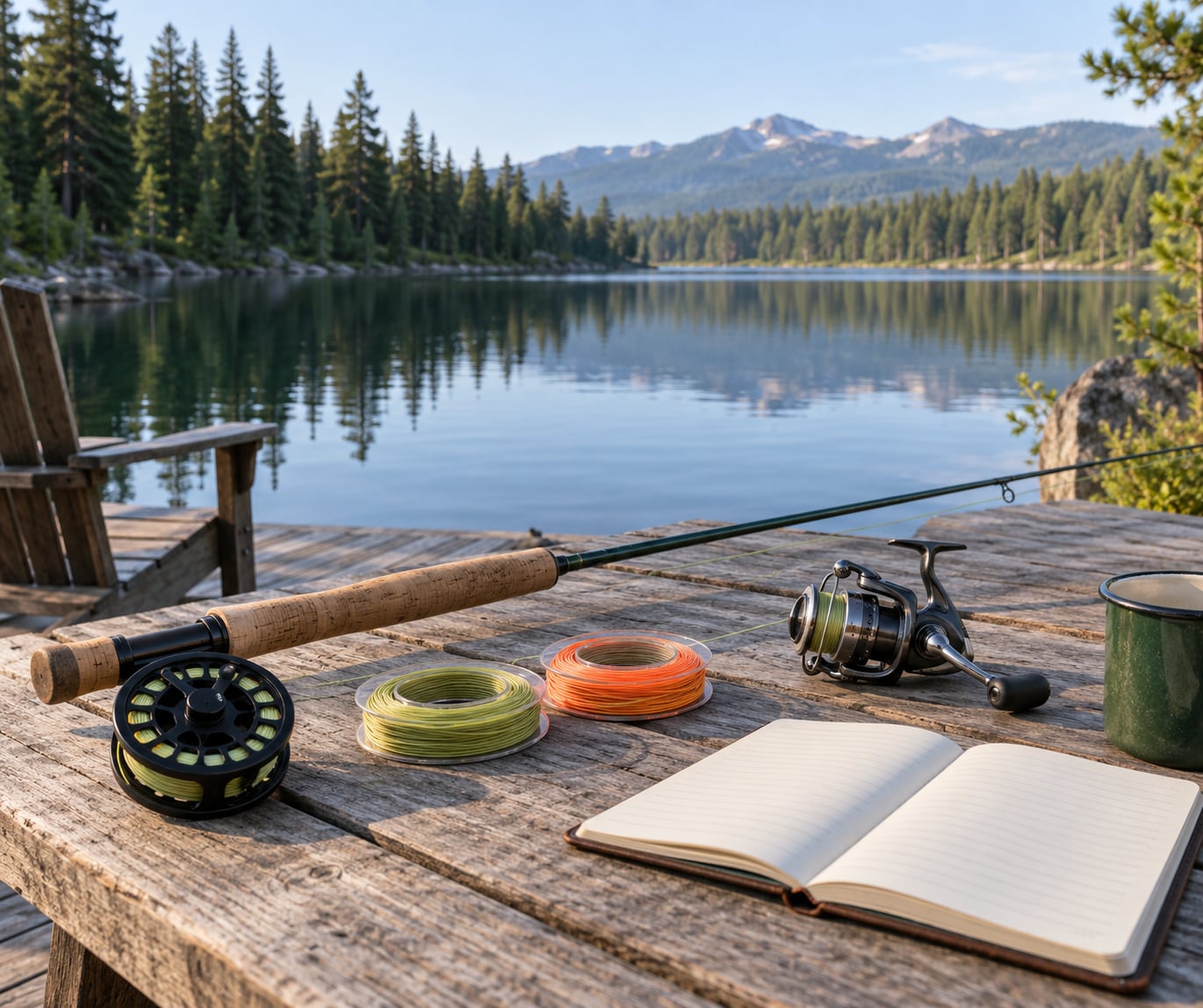
Most lake anglers need two or three fly lines, not a wall of spools: a weight-forward floating line for topwater and riseforms, a slow clear intermediate sinking around 2 inches per second, and a full sinking line at 3 to 5 IPS for deep water. Pick the weight to match your rod, choose the taper for the way you cast, and set the sink rate to the depth where the fish are holding. This whole process takes about 20 minutes at a shop counter, and the whole test happens in an afternoon on the water.
Table of Contents
- What You Need
- Step-by-Step
- Common Mistakes
- Frequently Asked Questions
- What fly line weight should I use for lake fishing?
- Is a weight-forward fly line best for lake fishing?
- Should I use a fluorocarbon fly line instead of PVC?
- What taper is easiest for beginners fishing a lake?
- How do I know if my fly line is the right weight for my rod?
- Does fly-line color matter when fishing clear water?
- Conclusion
What You Need
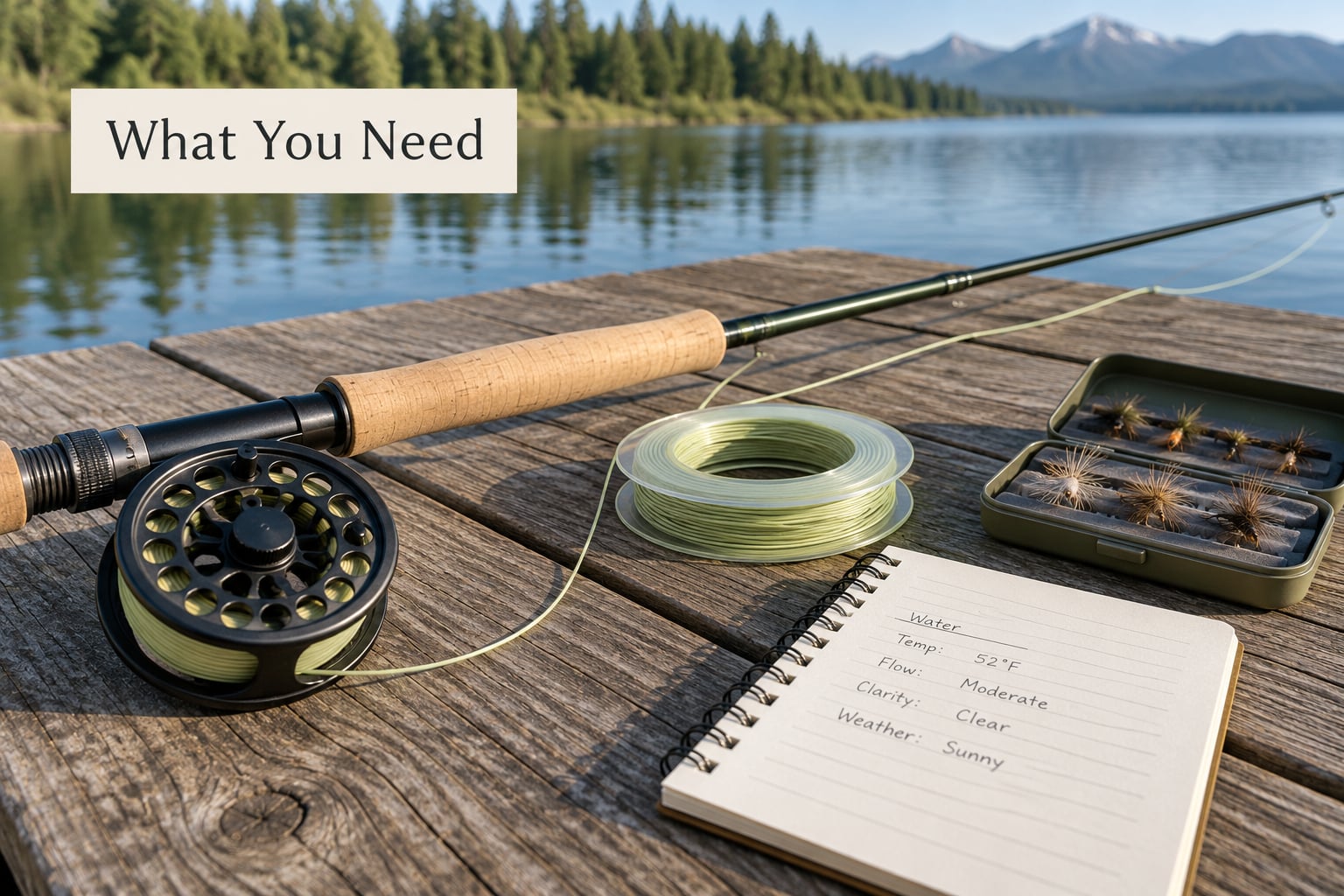
Before you touch a spool, four things have to be settled. Get these right and the choice becomes almost automatic.
Your rod weight. Nearly every modern fly rod is labelled with a weight class, usually 3wt through 9wt, printed near the reel seat or on the blank. That number tells you which line weights the rod was designed to throw. A 5-weight rod wants a 5-weight line, a 9-foot 8-weight wants an 8-weight line.
Your target species and where it lives in the water column. Bass pushing on top, trout rising to midges, panfish holding on the shoal, walleye hanging over a drop-off. Each of those fish wants the fly in a different part of the lake.
The depth band you will fish. Over a shoal you might be working 3 to 6 feet. Along a deep basin you could be dropping a fly 25 feet or more. Estimate the band before you buy anything.
The winds you expect. A steady onshore breeze adds distance demands that a rod’s printed weight does not advertise. This is the usual reason an angler ends up one weight heavy and calls it a mistake when it is actually a decision.
The difference between fly line backing and the main line
Backing is plain, uncoated braided or monofilament line that sits underneath your fly line on the reel. Its only job is to add volume so a thin line like a 5-weight does not wrap into a ball the size of a walnut when a trout runs.
The fly line itself is the coated line carrying your fly. Line weight, by the way the industry measures it, is the weight in grains of the first 30 feet of that fly line. A 6-weight line weighs roughly 24 grains per 30 feet, a 9-weight roughly 39 grains. That single definition explains why two different spools marked 6 can feel nothing alike.
Step-by-Step
Step 1: How to choose a fly line for lake fishing by rod weight
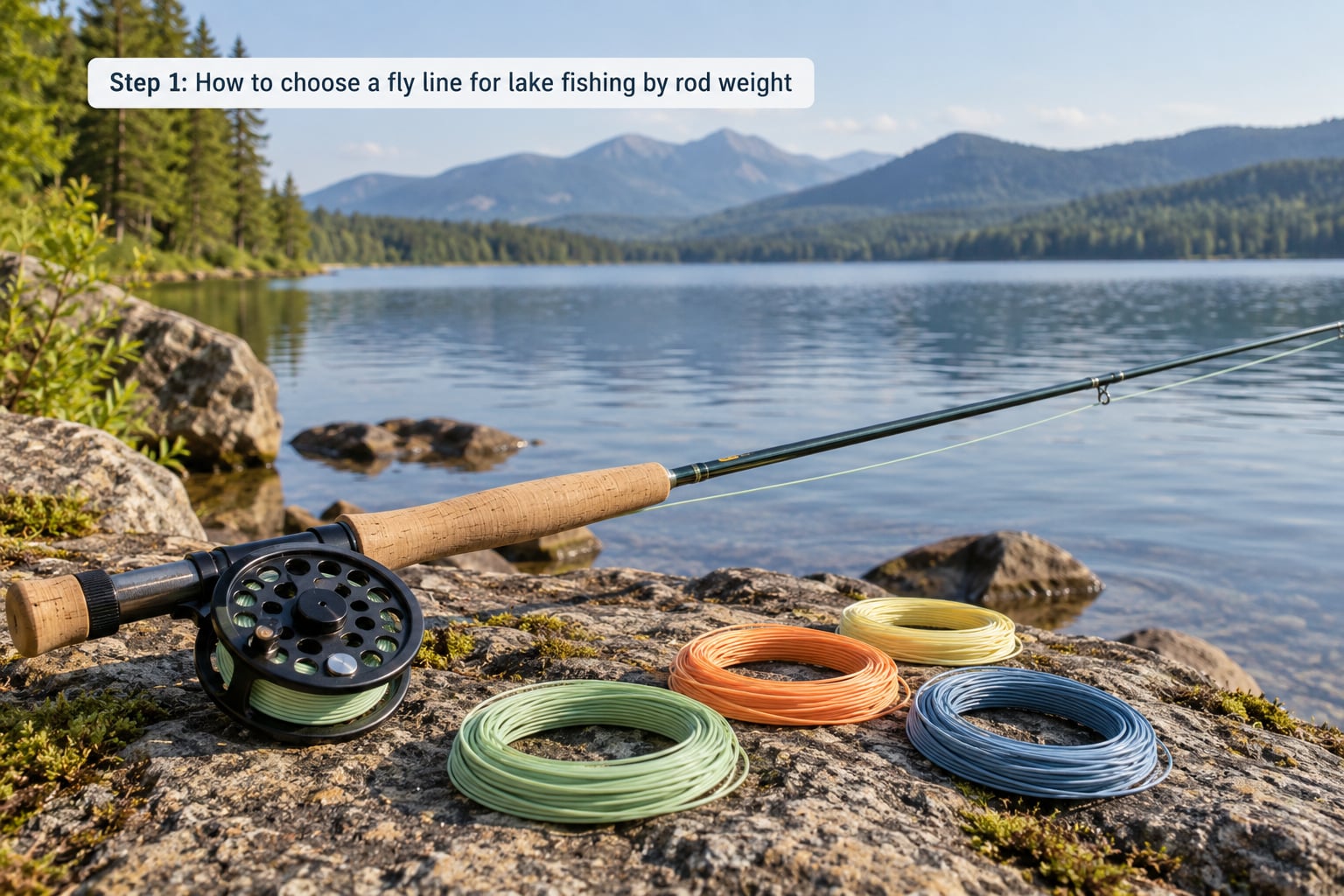
Start with the number printed on your rod and take the line weight that matches it exactly. That is the honest starting point, because the rod’s tip, stiffness and guide spacing were all designed around that number.
Rod action changes how forgiving the match is. A fast action rod can be loaded one weight heavier and still behave, so a 6-weight rod throwing a 7-weight line is a normal lake choice for distance. A slow action rod loaded heavy will feel sluggish and land badly. Stay at or below the printed weight there.
Keep the outfit balanced. The rod, line and reel should be rated for the same weight class, otherwise the reel sits too small and you will be fighting a loose drag when something big comes up. There is no prize for assembling a 5-weight rod with a 7-weight reel.
How to verify the result: cast the line on a lawn or open parking area before the trip. A correctly matched line slides through the guides with almost no resistance and lands with a soft tap. If the line feels like it is being dragged through each guide, the line is too heavy. If you can barely feel the line leave the tip, it is probably too light for the rod.
Step 2: Choose the right taper for the presentation
Taper describes where the line changes diameter. That shape is what turns a fly over head first on the water, which matters a great deal in a lake where every fish watching your fly has clear sightlines.
Weight forward (WF) puts all the mass in the first section, usually the first 20 to 30 feet. It lifts a big fly out of the water cleanly, casts accurately at distance, and is the standard choice for topwater poppers, foam and large streamers on a lake.
Double taper (DT) thickens in the middle and thins at both ends. It turns over softer flies like nymphs and small streamers, handles delicate tippets, and gives you the option to cut back the running line for a second head weight. For most all-around lake use this is the flexible choice.
Single taper (ST) is thin and light at the tip end with most of the weight in the back half. It presents nymphs and dries with less splash and gives a longer usable range for delicate tippet work in clear water.
Level (LV) is the same diameter end to end. It is simple and takes up very little room on a reel, which is why distance casters and European lake anglers like it. It is not the most delicate presenter, but it is steady.
Shooting head and short head lines are cut loose at the top and give you multiple heads on one reel. That is a large advantage on a lake where you may want one head for surface work and another for a sinking presentation without changing spools.
A practical lake rule: weight forward when you are throwing surface flies or heavy streamers at distance, double taper when you nymph, drop a dryfly or cast more than one fly. Anything more specialized is a refinement, not a requirement.
Step 3: Select a material for the water and your budget
Almost every fly line sold today has a PVC (polyvinyl chloride) core with coatings and additives layered on it. The core material matters less than the coating, because the coating is what slides through the guides, resists abrasion and decides how visible the line is.
Nylon is not a fly line core in any modern sense. It is a leader material. The common confusion is with fluorocarbon, which is wonderful for tippets because it is nearly invisible underwater and sinks fast, but it is heavy, stiff in a leader position and completely impractical as a fly line. Buy fluorocarbon as tippet and leave the fly line to coated PVC.
For visibility, hydrophobic coatings that shed water keep a floating line sitting on top instead of cutting a wake and sinking. Slickness additives reduce drag inside the guides, which helps a light line shoot and a thick line stay tidy. A textured finish adds grip so you can strip line with wet hands, but textured lines tend to feel rougher in the guides and, on lower-cost versions, can start cracking after a couple of seasons.
Budget lines usually get a thinner coating and fewer layers, which shows up as a line that stops floating properly after a handful of trips. Mid-range lines add slickness and better coating adhesion. Premium lines add the longest-lasting coatings, cleaner welds and often two-tone or colour-change markers that let you trim the running line and reset it in seconds. Most lake anglers do well with a solid mid-range line; the differences between tiers matter less than choosing the correct weight, taper and sink rate.
Temperature and sun are the enemies. Strong ultraviolet exposure and repeated hot-car drying slowly break down coatings, and a line that stops shedding water will sink when it should float.
Step 4: Match the line to clear, shallow or deep water
Sink rate is expressed in inches per second, usually abbreviated IPS, and it tells you how fast the line settles. Pick a rate that puts your fly in the band where the fish are, then adjust with the depth of the fly on the leader.
Here is the depth-to-sink-rate table I use when someone asks me to pick for them.
| Lake depth band | Sink rate to reach | Line type | Typical lake use |
|---|---|---|---|
| Surface film to 1 foot | Floats | Weight forward or double taper floater | Poppers, foam, risers, topwater bass and panfish |
| 2 to 6 feet | Hover or very slow, under 1 IPS | Mid tip or hover line | Riseforms, emergers, shallow trout and crappie |
| 6 to 12 feet | 1 to 2 IPS | Clear intermediate | Nymphs, small streamers, shoal fishing |
| 12 to 25 feet | 3 to 5 IPS | Full sinking | Deep trout, walleye, suspended bass |
| 25 feet and deeper | Faster sinker or multi-density | Full sinker, or long sinking leader | Deep basins, drop-offs, vertical lake fishing |
Uniform sinking beats a line that bellies in still water. On a lake the fish often see the line itself, and a straight, evenly sinking section tells them very little. A belly in a sink-tip line creates a visible curve in open water and is the reason many anglers lose fish that were already looking at the fly. Head-first sinking lines, hover lines and mid tips all present a straighter profile.
Clear water argues for clear intermediates, wet cel and darker sunk sections, since the line is only visible to fish when it is moving and a low-visibility section avoids that problem. Stained or dark water suits a brighter sunk section or a frog-coloured line that fish will not spook but you can still track.
Shallow water full of weeds is a different problem again. A fast sinking line piles line into the vegetation at the bottom of every drift, and you spend the day picking strands off your fly. In that situation a slower rate, or a floating line with a long sinking leader, keeps you out of the weeds.
Wind matters as much as depth. On a breezy lake you are casting 50 to 70 feet from shore, and most of that distance comes from line weight and taper rather than raw arm strength. Adding one weight of line head length or choosing a weight forward taper can get you there without a heavier rod.
Forum regulars make the same point repeatedly on lake threads: change the line rather than forcing one line to do every job. A floating line, a slow intermediate and a fast sinker cover nearly everything a lake can throw at you.
Step 5: Check the details before buying
Turn the spool over and read the label before you pay attention to any brand name. Most labels follow a readable code.
WF8F breaks into three pieces: WF means weight forward taper, 8 is the line weight, and F means floating. The same spool marked 8 would indicate a level taper, and a code ending in S or T tells you sinking or sink tip.
Wet Tip V 13-foot is the older style of label. Wet Tip indicates sinking, V is the taper, and 13 feet is the head length. Most modern lines print the head length instead, often somewhere in the 30 to 50 foot range, which tells you how much of the line you will be stripping at any moment.
Other details worth checking:
- Length. A 90-foot line fills a reel on most rods; a 100-foot line can help on a big lake with a large arbor.
- Diameter and colour changes. Look for a colour change or marking so you can trim the running line and get a fresh head section without stripping to the backing.
- Welded loops. A pre-welded loop saves time and produces a neater tie than a hand knot.
- Coating claims. Hydrophobic coatings and slickness additives are the two features that most directly affect how a line performs in guides.
- Warranty. Longer warranties are a reasonable proxy for coating and weld quality, since a weld failure is a manufacturing defect.
- Compatibility. Confirm the line weight matches the reel spool you actually own.
Step 6: Test the line before you fish
An afternoon on a quiet stretch of shore is the fastest way to find out whether the spool you picked is right. Nothing else substitutes for it.
Load the rod. Make a few false casts and check whether the line lifts the whole blank or whether only the tip moves. If the tip moves and the mid-section stays dead, go one weight heavier.
Test accuracy. Cast at something you can see, a log, a bucket, a patch of foam. A weight forward line should land within a few feet at 40 feet. If the tail is landing consistently behind you, your taper and weight are not being used properly rather than being wrong.
Strip line. Retrieve about 30 feet and see how it comes in. Tangles, kinks or stiffness at any point along the stripped section mean the line has a memory problem or a manufacturing defect, and it is worth taking back.
Check visibility. Hold the head against the sky and then against the water. If you can follow it easily against a bright sky, anglers fishing alongside you will see it just as well.
Watch for a take. Fish a slow figure-eight over a consistent target for five minutes. Any change in the line’s tension, a twitch you did not cause, or the line drifting sideways without your input, is a take. If you feel nothing at all through 20 casts, the line may be the wrong sink rate for that spot.
A successful test looks like this: the line loads the rod, lands where you aim, strips without tangles, sits at one consistent depth on the retrieve, and gives you a perceptible hitch when something eats. If you get all five, the line is doing its job.
Common Mistakes
Choosing by colour instead of visibility. Bright chartreuse is easy to see and easy for fish to see too. Pick the colour that suits the water, not the one that stands out against your jacket.
Copying another angler’s setup. A lakeshore thread where someone swore by a fast sinking line for a shallow shoal was probably fishing 8 feet of water, not 20. A mistake on someone else’s lake is often the right call on yours.
Over-weighting the rod. One size heavier is fine on a fast rod for casting into wind. Three sizes heavier means the line fights the blank, the reel is mismatched and the fly lands like a thrown brick.
Confusing line weight with leader size. A thicker line does not mean a bigger fly hook and it does not replace a heavy tippet. Leader and tippet choice is a separate decision from line weight, and the two are constantly mixed up on buying checklists.
Failing to test before the trip. The spool looks the same on the counter as it does on the water. Casting it for ten minutes on grass costs nothing.
Ignoring how the line ages. Washing fly lines in mild soapy water, rinsing and drying them in the shade at the end of a season can add a year or more to their life. Leaving a soaked line coiled tight in a hot car or a damp bag is what kills coatings early. Expect a well-used line to last around three to five years depending on storage, and to lose float long before that if you skip cleaning.
One more beginner tip: if you want to keep the setup small, a floating line with a sinking leader gives you most of the versatility of a second spool at a fraction of the cost. It is also the workaround lake anglers recommend most often when they do not want to buy two full lines at once.
Frequently Asked Questions
What fly line weight should I use for lake fishing?
Use the line weight printed on your rod and stay there for your first season. A 5-weight rod takes a 5-weight line, a 7-weight rod takes a 7-weight line. Going one weight heavier is common on a fast-action rod when you need casting distance in wind, but slower-action rods should not be over-weighted. Pair the line with a reel in the same weight class.
Is a weight-forward fly line best for lake fishing?
For topwater, foam, poppers and large streamers, yes, a weight-forward taper is the usual choice because it lifts heavy flies cleanly and casts accurately at distance. For nymphing and dry flies on a lake, a double taper or single taper presents more softly and handles light tippets better. Most anglers carry one of each rather than deciding which is better in the abstract.
Should I use a fluorocarbon fly line instead of PVC?
No. Fluorocarbon is a tippet and leader material, valued for being nearly invisible underwater and sinking quickly. It is far too heavy and stiff to fly-cast as a fly line. Fly lines use a coated PVC core with slickness and hydrophobic additives added. Use fluorocarbon as tippet at the end of your leader and a normal coated fly line above it.
What taper is easiest for beginners fishing a lake?
A double taper is the most forgiving all-around choice because it works for nymphs, dry flies and light streamers and can be cut back into a second head. A weight-forward is simpler still if you only fish surface lures and big streamers. Either is fine to learn on; avoid single-taper and shooting-head lines until you know which presentation you favour.
How do I know if my fly line is the right weight for my rod?
Cast it on grass and watch the blank. A correctly matched line loads the whole rod from tip to second guide and shoots without force. A line that is too heavy feels like it is dragging through every guide and lands hard; one that is too light barely lifts the tip. Line weight is defined by the weight of the first 30 feet of line, which is why two 6-weights can feel different.
Does fly-line color matter when fishing clear water?
It does, mostly for the sunk section. In clear water a clear intermediate, wet cel or dark olive sinking section gives fish less to react to. In stained or dark water, a brighter sunk section is easier for you to track without being obvious. The running line should stay visible to you regardless. Match brightness to how much light comes back off the lake, not to your own eyesight alone.
Conclusion
Choosing a fly line for lake fishing comes down to three decisions in order. Find the weight printed on your rod and match it. Pick the taper that fits your main presentation, weight forward for surface flies and double taper for everything else. Then set the sink rate to the depth band where the fish are holding.
Do this first: take your rod weight and the depth you expect to fish, pick one line from that table, then cast it on grass before it ever sees the lake. Three spools cover a season. One untested spool covers a wasted afternoon.