A backlash on a baitcaster clears fastest when you stop the spool first: press your thumb on the spool, hit the thumb bar, and pull the line gently outward until it stops at a loop. Pull the loop itself, not the running line, or turn the handle forward while holding the spool down. Almost every nest comes out in under five minutes without cutting anything.
A backlash, also called a bird’s nest, a rat’s nest or an overrun, is simply line piling onto the spool faster than it can leave the reel. Once the lure stops, slows or hits a branch, the spool keeps spinning and the slack line has nowhere to go but around the shaft. Anglers call the worst tier a professional overrun, and it is the version that ends with line buried down in the frame.
Time and difficulty: most fixes take two to five minutes and need no tools. A professional overrun can take ten minutes or a fresh spool, and the hard part is never the technique. It is keeping your hands gentle, because pulling hard on a tangle is what turns a loose loop into a permanent loop knot. I have buried more good line into knots that way than I care to admit.
Table of Contents
- 1What You Need
- 2Step-by-Step
- 31. Stop Casting and Secure the Line
- 42. Open the Side Plate and Remove the Tangle
- 53. Check the Spool and Its Free Movement
- 64. How to Fix a Backlash by Setting Spool Tension
- 75. Set the Drag and Test with Controlled Casts
- 8Common Mistakes
- 9Frequently Asked Questions
- 10Can I use a baitcaster after fixing a backlash?
- 11Do I need to replace the fishing line after every backlash?
- 12How tight should baitcaster spool tension be?
- 13Will lubricant help stop a baitcaster from backlashing?
- 14How can I tell if a baitcaster spool is damaged?
- 15Conclusion
What You Need
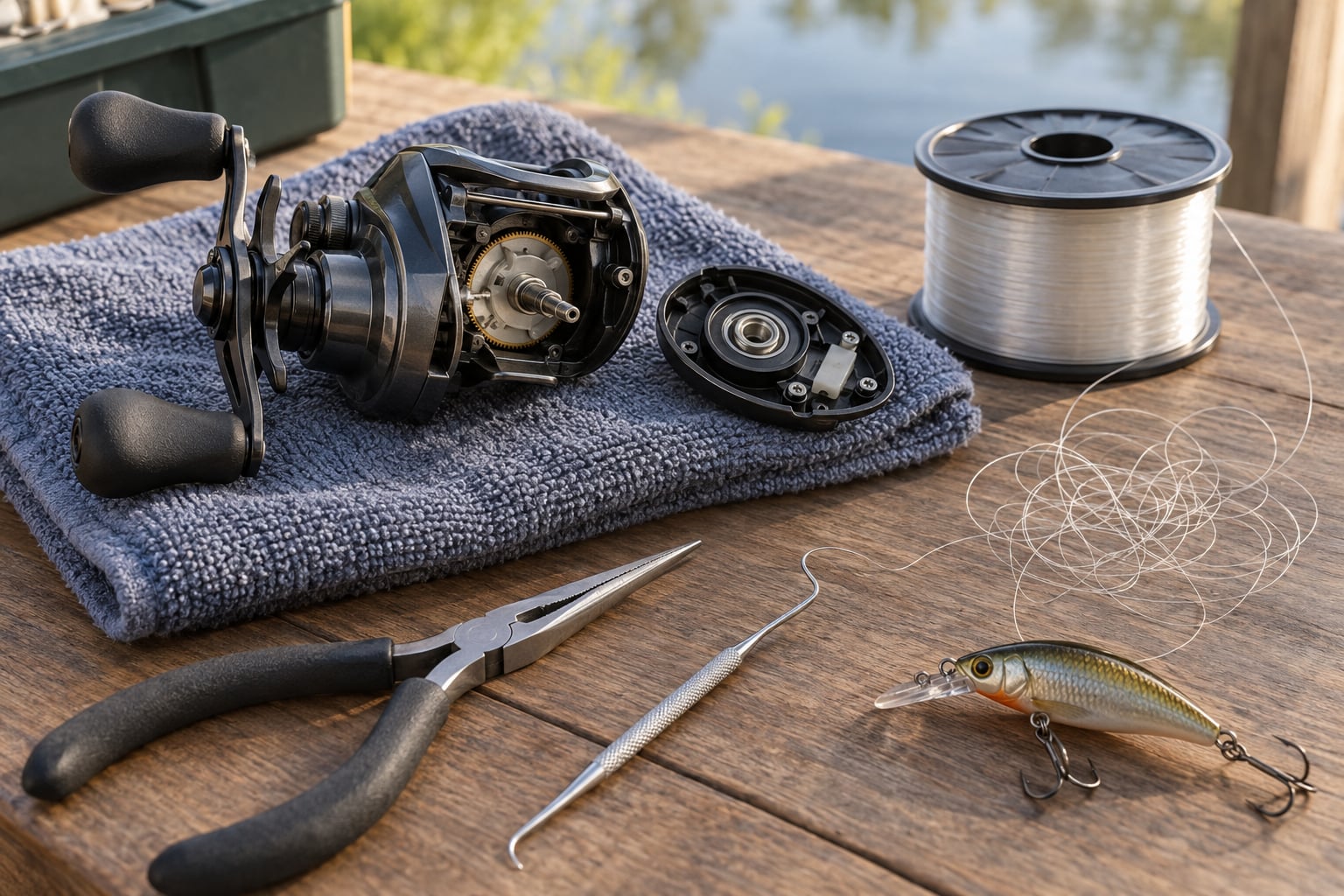
Most backlash fixes need nothing but your hands. A small kit of cheap tools just makes a deep nest quicker to clear.
- The reel itself, off the rod. A reel that stays on a rod while you work the tangle will fight you the whole time.
- Fresh line matched to its spool capacity. Overfilling or underfilling a spool changes how the line lays down and is a common cause of repeat tangles.
- A line cutter or small scissors. You probably will not use it, but you want it there so you are not improvising with a pocket knife when a braid nest turns ugly.
- A dental pick, a crochet hook or a line detangler. A pick gets into the gap between spool and frame where fingers cannot follow.
- Needle-nose pliers and a soft towel. Pliers for a tag end that will not budge, the towel to catch small parts if you open the side plate.
- The manual for your reel. Side plate removal differs a lot between brands and models, and the wrong screw is an easy way to lose one.
You do not need replacement parts for this repair. The only thing most anglers end up replacing is the line itself, and often only because pulling hard frayed it.
Line type changes how the tangle behaves once it is there, so it is worth knowing what you are dealing with before you start picking at it.
| Line type | How it tangles | How it responds to pulling | Best tool |
|---|---|---|---|
| Monofilament | Coils loosely, most forgiving of a sloppy spool tension | Slips before it knots, so slow and steady works | Fingers and a dental pick |
| Fluorocarbon | Stiffer, so loops sit higher and spring back | Holds a kink if bent sharp | Crochet hook |
| Braid | Digs into itself and into the metal base of the spool, and a bad nest can reach the frame | Tightens into a loop knot that will not come out, so a hard pull can cost you the line | Patience, plus a pick for the frame gap |
Step-by-Step
Match the method to how bad the tangle is. Most of the time you will be done in a minute with the thumb-and-handle method, and you only open the reel for the worst nests.
| Backlash type | What it looks like | Method | Time |
|---|---|---|---|
| Light overrun | One loose loop sitting over the running line, spool still spins freely | Thumb on the spool, pull the line gently until it hangs up, reel in and cast again | Under a minute |
| Deep nest | Layer after layer of loops filling the gap above the line | Thumb-and-handle forward turn, then pull each loop off the running line one at a time | Two to five minutes |
| Professional overrun | Loops piled over the spool lip, line packed into the frame, spool barely turns | Side plate removal and hand-picking, or cut the line and respool | Ten minutes or a respool |
1. Stop Casting and Secure the Line
The first move is stopping the damage, not fixing the tangle. If you are casting from a boat and the lure is in the water, give slack or bring it in first, because a spool still turning under load keeps feeding the nest.
Put your thumb firmly on the spool so it cannot spin, then press the thumb bar to engage the spool release. Keep that thumb pressure on while you work. If the spool is still racing, the nest is growing and you are now in a bigger problem than the one you started with.
Now pull the line outward slowly with your other hand until you feel it stop, which anglers call the hang-up. That resistance is a loop crossing over the running line, and that crossing point is the entire problem.
Checkpoint: the spool is stopped, the thumb bar is engaged, and the line is under light tension instead of slack.
2. Open the Side Plate and Remove the Tangle
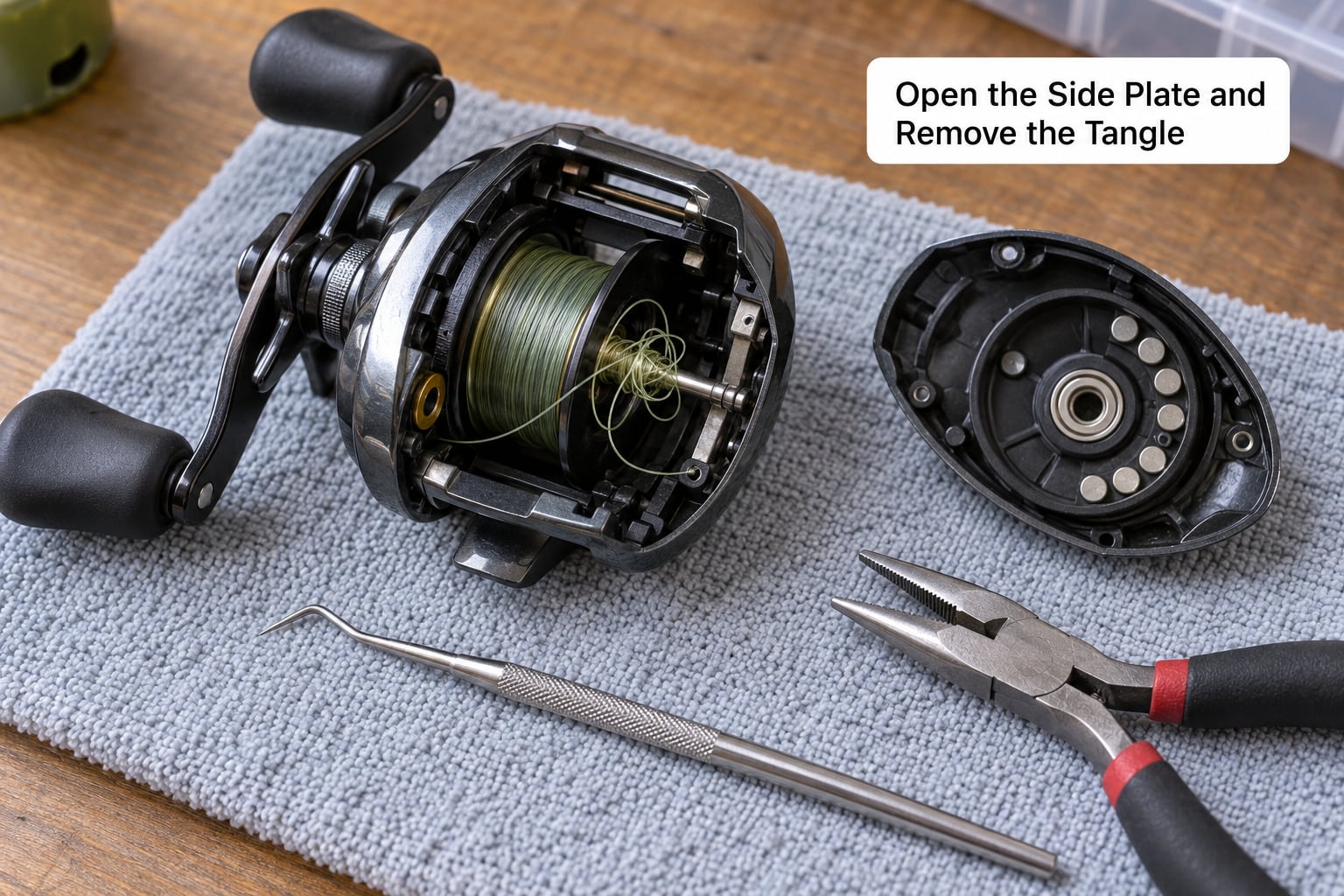
You do not open the reel for a normal overrun. Open it when the loops are packed down past the spool lip, when the spool will not turn by hand, or when line has wound under the spool and into the frame.
Most reels have one removable side plate and one fixed plate with the spool tension and brake controls on it. Find the plate that pulls straight off, usually held by two or three screws on the handle side. Work over a towel so a spring or a washer does not bounce into the grass.
Hold the spool in your palm as it comes free so it does not unwind the whole spool at once. Then peel the tangle off in layers rather than yanking it: lift each loop away from the running line with a pick, and keep the spool under control the entire time so nothing re-wraps while you work.
Checkpoint: the line lifts off the spool without resistance and the spool still spins freely by hand.
3. Check the Spool and Its Free Movement
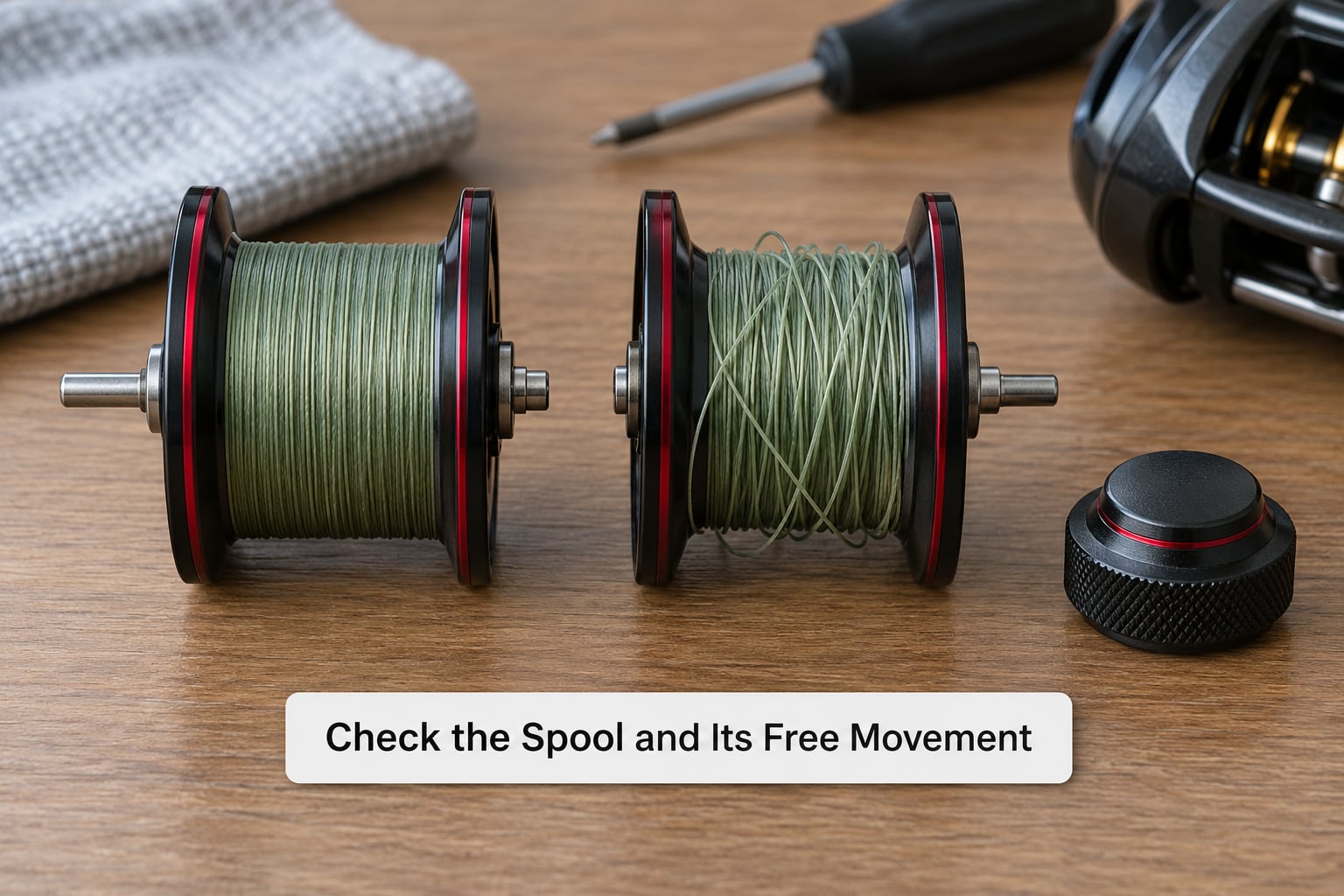
With the reel open, look at what the tangle left behind. Grit and sand pushed into the spool gap are common after a cast into weeds or mud, and a damaged spot in the line is a spot that will snap the next time the spool grabs it.
Confirm the drag is fully disengaged before you do anything else. A drag that is still on will fight your fingers and will tighten a loop into a knot. Then spin the spool by hand in both directions. It should glide and stop on the clicker, with no scraping, no hesitation and no wobble.
If it scrapes or catches, the problem is mechanical, not a backlash. Replace any line that looks kinked, flat or fuzzy, and check that the spool is seated squarely when you close the plate. A slightly mis-seated spool is a surprisingly common reason a reel keeps tangling after the first clean fix.
Checkpoint: the spool spins freely, the drag is off, and the line is smooth with no burrs.
4. How to Fix a Backlash by Setting Spool Tension
This is the step that stops the next one, and it is where most beginners go wrong. Spool tension is the drag on the spool shaft, and it should be set so the spool barely resists the weight of the lure you actually cast.
The drop test is quick. Let the lure hang off the rod tip and press the thumb bar. If the lure falls to the ground like a dropped stone, tighten the spool tension knob a quarter turn and test again. When the lure hangs there or drops a slow crawl, stop tightening.
Too little tension and the spool outruns the line every cast. Too much and the spool cannot stop cleanly on the retrieve, so the line slack builds up in front of it and wraps back. Adjust in small increments and re-run the test, because the feel changes with line diameter and with how much line is on the spool.
Brakes work alongside tension. Start with the magnetic brake wide open, cast ten times, then back it off slightly and cast ten more. Anglers on the fishing forums call this the 10-cast rule, and it gets you to a setting that fits your cast instead of one that is simply over-braked. Centrifugal brake pins matter most in wind, where a crosswind pushes the spool past the start of the cast.
Checkpoint: the lure hangs or crawls on the drop test, and ten controlled casts produce zero nests.
5. Set the Drag and Test with Controlled Casts
Put the reel back together, or snap the side plate home, and make sure the spool is seated properly before you close it up. A loose plate is how a clean reel turns into a jamming reel.
Set the drag for the fish you are chasing, not for the tangle. If you tightened the drag during the fix to get line moving past the spool, loosen it back now and set it properly. A drag left tight is a lure that breaks off on the first fish that pulls, which is a rough way to learn a lesson.
Re-wind the line under steady tension. Let the spool turn with your thumb as a light brake, keep the line snug on the level wind, and pack each layer down so the line sits even. Uneven packing is one of the least obvious reasons a reel keeps backlashing with settings that look correct.
Then cast short and close, at about half your normal power, and let the lure land in open water. Make ten of those before you cast across a bay. While the reel sits on the deck, pull a little slack past the line guide so the level wind feeds back to the same starting point for every cast, a small habit anglers swear by and rarely hear anywhere else.
Checkpoint: ten short casts with no overrun, a lure landing on the target and a drag that holds under a steady pull.
When to cut the line instead. Some tangles are not worth saving. If the line has wound under the spool and into the gap between the spool and the frame, if you cannot find a hang-up after several gentle pulls, or if any pull tightens a knot instead of freeing it, cut it. Line that has been down in that frame gap is usually done, and forcing it costs you the spool as well as the line.
Common Mistakes
- Pulling the running line instead of the loop. Pulling the running line just draws the crossing point tighter. Find the loop, pinch it, and pull the loop itself while the spool is held down, and the reel often frees itself and starts turning the other way.
- Pulling hard out of frustration. One sharp yank is how a loose bird’s nest becomes a loop knot, and on braid that knot is usually permanent. Slow hands save line.
- Opening the wrong side plate. The fixed plate carries the spool tension knob, brake controls and sometimes the drag access, and prying it off bends parts. The removable plate comes off with the spool tension and the spool itself.
- Setting spool tension with the drag locked. You cannot feel the spool drag with the drag wound down. Release the thumb bar and set tension on the free-spooling spool.
- Winding line on by hand in loose layers. Hand-wound line lays down uneven, and uneven line backlashes. Wind it on with the reel, under tension, packing each layer with a thumb.
- Using the wrong lubricant. Do not spray reel oil or WD-40 into the spool to fix a backlash. A slick spool makes the overrun worse. Oil goes on the handle bearings and the side plate seal, never on the line or the spool shaft.
- Going straight back to full-power casts. Test short and close first. A reel that survives ten easy casts will usually survive the long one, and if it does not, you have a setting problem worth finding while you are still near the truck.
Frequently Asked Questions
Can I use a baitcaster after fixing a backlash?
Yes, once the spool spins freely, the line shows no damage, and ten short test casts come back clean. Give the reel a full inspection before a long trip: check the side plate is seated, the drag is set for the fish you expect, and the line is not kinked where it crosses the spool lip. If the same cast keeps tangling after a clean fix, the problem is tension or brake settings, not the reel.
Do I need to replace the fishing line after every backlash?
No. Mono and fluorocarbon survive a clean untangle, though you should run your fingers along the line and look for flat spots, fuzz or kinks where it crossed the spool. Braid is the exception worth being careful with, because a loop knot in braid will not open up again. Replace the line if you had to pull hard, if the line was buried in the frame, or if you can feel a rough spot anywhere along it.
How tight should baitcaster spool tension be?
Set it so the lure you cast barely moves. Press the thumb bar, let the lure hang from the rod tip, and if it drops like a stone, turn the spool tension knob a quarter turn tighter and test again. When the lure hangs or falls in a slow crawl, you are there. Re-run the drop test whenever you change line, spool or lure weight, since all three shift the feel.
Will lubricant help stop a baitcaster from backlashing?
No, and it can make things worse. A lubricant on the spool shaft or spool barrel reduces friction exactly where you want the spool to slow down, so a slick spool overruns more easily. Lubrication belongs on the handle bearings, the clutch and the drag washers. A stuck or gritty spool that will not click over is a different problem, and that one is fixed with cleaning, not oil.
How can I tell if a baitcaster spool is damaged?
Take the side plate off and spin the spool by hand. It should glide smoothly and stop cleanly on the clicker, with no scraping, wobble or rough spot you can feel through your fingertips. Look for a bent shaft, a groove worn into the line groove, or a spool that rocks when the reel is closed. Any of those means the reel should go for service rather than back on the water.
Conclusion
Start with the reel off the rod. Thumb on the spool, thumb bar engaged, pull the line gently until it stops, and take hold of the loop rather than the running line. Check that the spool spins freely, set spool tension so your lure barely drops, set the drag properly, and make ten short casts before you fish for real.
Most backlashes are a reel telling you its tension is off or its brakes are wrong, and the five minutes spent tuning the settings after every tangle are what turn casting a baitcaster into the smoothest thing in your boat.