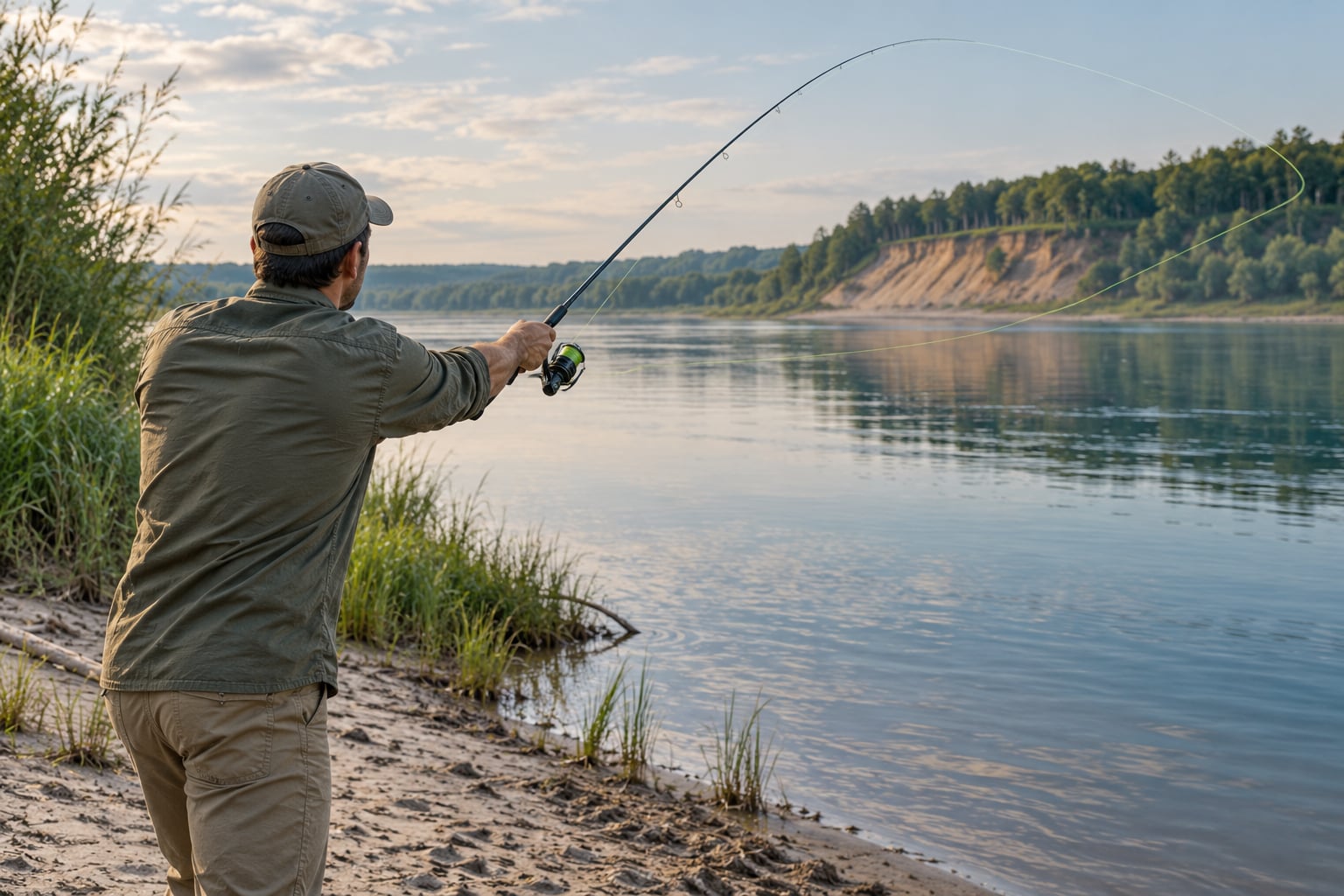
Most anglers who want to know how to cast farther from shore are not short on gear. They are short on three things: a rod matched to the weight they need to throw, line thin enough to actually shoot through the guides, and a power stroke that loads the blank instead of muscling through it. Fix those three and the same rod that was landing your lure at 35 feet will regularly reach 60 or more.
Below is a working setup guide, kept practical for 2026. No miracle claims, no 300-yard fantasies. The clock-face release model (release between 9 and 11 o’clock) and the push-pull motion are the two ideas that do most of the work.
Table of Contents
- What You Need
- Step-by-Step: How to Cast Farther From Shore
- 1. Choose a Rod and Reel That Help You Cast Farther From Shore
- 2. Use a Clean, Balanced Line Setup
- 3. Find a Clear, Safe Casting Position
- 4. Establish a Stable Stance and Grip
- 5. Load the Rod Against the Direction of the Cast
- 6. Time the Forward Cast With the Wind
- 7. Release Smoothly and Follow Through
- 8. Test and Adjust — How to Cast Farther From Shore Without More Gear
- Common Mistakes
- Frequently Asked Questions
What You Need
Longer rods and thinner line help, but they are not the whole answer. Rod length sets a ceiling, line diameter sets friction, and technique decides how much of that ceiling you actually reach. Here is what each piece of the setup controls.
Rod. A 7-foot spinning rod is a comfortable all-rounder for inshore work. From a bank or a beach, a 9- to 12-foot surf rod is where real distance starts, because a longer blank bends further through the power stroke and stores more energy. The trade-off is backcast clearance: a 12-foot rod needs roughly 12 feet of clear space behind you, which is often the hardest thing to find on a crowded bank. Match the rod’s lure rating to what you actually throw. A rod rated 1-4 oz trying to launch a 5 oz sinker is the single most common reason a cast falls short.
Reel. A spinning reel with a manual bail is the simplest reliable choice for beginners. Baitcasters cast farther per ounce of effort but punish an unfinished spool, which is why a lot of people start on a spinning setup and move up later. A long-foot surf reel in the 4000 to 6000 size range holds line and gives a smoother retrieve on heavy rigs.
Line and leader. Thin-diameter braid in the 20-30 lb range is the common long-casting choice, spooled to within an eighth of an inch of the spool lip. A fuller spool costs distance; an underfilled spool lets the spool overrun and twist. Monofilament has more stretch, so you lose some distance, but it stretches more and is kinder on terminal tackle. Whatever the line, add a shock leader 5-6 feet longer than the rod to protect the knot and the line from the sinker and the rocks. A long, bulky leader slows the line down, so tie it low-profile. The FG knot and the PR bobbin knot both sit small enough to keep speed up.
Terminal tackle. A 3-4 oz pyramid sinker slides through water cleanly, which helps it land farther than a bulky sinker of the same weight. Flyers are worse for distance. Match the weight to the rod, and the cast will improve more than any reel swap.
Safety. Behind every long shore cast is someone walking a dog, a tent, a low branch, or another angler. Check overhead clearance, check your footing on wet rock or a sloped bank, and never force a full-power backswing into a tight space. A slightly shorter cast is always better than a lure in someone’s windshield.
| Rod and setup | Typical lure weight | Realistic distance |
|---|---|---|
| 7 ft spinning, mono | 1/8 – 1/4 oz | 25-40 yd |
| 7 ft spinning, thin braid | 1/4 – 1/2 oz | 35-50 yd |
| 9 ft surf, braid | 1-3 oz | 50-80 yd |
| 10-12 ft surf, braid | 3-4 oz sinker | 80-120 yd |
| Baitcaster, matched spool | 1/2 – 1 oz | 30-55 yd |
Use that table as a yardstick, not a promise. Anglers who swap between spinning reels, baitcasters and three different rods often land in exactly the same spot as when they started, which is the quickest way to prove that most short casts are technique, not equipment.
Step-by-Step: How to Cast Farther From Shore
1. Choose a Rod and Reel That Help You Cast Farther From Shore
Pick a rod whose lure rating brackets the weight you want to throw, with the heavier end of the range no more than half the rod’s power. Beginners often assume the longest, heaviest setup is automatically best. It is not. A 12-foot heavy rod in the hands of someone who has not learned a smooth stroke simply lands a 4 oz sinker in the dirt at their feet.
You worked it out if the lure lands about 70-80% of the time without the rod feeling like it is fighting you. The gauge is honest feedback: a rod that is too light cannot load, and a rod that is too heavy will not bend enough to release its energy.
2. Use a Clean, Balanced Line Setup
Walk the line from the spool to the tip before you start. Look for fraying, obvious memory coils, or a section flattened against the guides. Old monofilament with tight coils in it throws like a spring, and that alone can cut a surprising amount of distance. Re-spool when the line looks like it has been sitting in a hot truck.
Then check the spool fill and the knot. Fill the spool to within an eighth of an inch of the lip; the empty wrap at the bottom costs you distance on every single cast. Re-tie the leader with a slim knot, and give the lure and the swivel a tug test before you walk to the bank. A rig that fails mid-cast gives back every yard you just gained.
3. Find a Clear, Safe Casting Position
Look at the whole arc, not just where you are facing. You need roughly the length of your rod behind your head and a few feet of side clearance, and that zone has to be free of people, canopies, and low limbs. On a bank with anglers spread out along it, a sidearm or backhand cast at 45 degrees is often safer than swinging straight up the shoreline.
Check the wind while you are standing there, because it decides your target line. When a long cast is not safe or not practical, use the alternative: a kite or balloon rig, a float-and-drift bait, or simply working a shorter piece of the bank. Chumming or drifting live bait often beats a record cast that lands nowhere useful.
4. Establish a Stable Stance and Grip
Feet about shoulder width, knees soft, weight balanced. On a sloping or uneven bank, turn your body so your back foot is slightly downhill and your stance is square to your target. A sideways stance with the off shoulder pointing at the target is a good option when the backcast space is tight, because it shortens the swing.
Grip the rod firmly in the reel seat with your thumb on the spool, and keep your other hand loose and relaxed. Death grip on the rod grip is the quiet reason many casts feel weak. A steady, repeatable setup is what makes the timing in step 6 consistent from one cast to the next.
5. Load the Rod Against the Direction of the Cast
Let out 12-18 inches of line and make sure the lure is clear of everything. Then take the rod back in one smooth movement, stopping when the tip is around the 10-11 o’clock position behind your head. Many beginners over-rotate, forcing the tackle past what the blank can comfortably load, and the cast collapses from there.
The rod should bend into a smooth arc through roughly the middle third of the blank. The rod is a spring, and a spring that is slowly stretched past its range gives back less. If the backswing feels heavy and the tip is pointing at the ground behind you, you have gone too far back.
6. Time the Forward Cast With the Wind
Start the power stroke by rotating your hips and shoulders, not by swinging your arm. On a surf rod or a heavy sinker, use push-pull casting: pull the rod back toward your hip with one hand while the other hand pushes the butt forward. That two-handed motion gets heavy terminal tackle out further than an arm-only swing, and it takes pressure off your elbow.
Watch the clock face as the rod comes through. Releasing at 12 o’clock produces a high rainbow that the wind can blow back at you. Releasing at 9 o’clock drives a low, fast line but puts the lure into the water short. Releasing between 10 and 11 o’clock is the distance spot. With a headwind, release slightly higher and earlier to give the lure time to fight into the wind; with a tailwind, release a touch later and lower so you are not pitching it out of the back of your own gust.
7. Release Smoothly and Follow Through
The release is a pinch, not a snap. Pinch the line against the spool lip or the frame with your fingers and let go cleanly, rather than opening the line off the spool in one yank. On a spinning reel, close the bail with your free hand after the lure is airborne, or use a manual bail rod and open it again once the lure is out. Cranking the bail shut while the line is still loose is the most common cause of wind knots.
Keep the rod pointing at the lure through the flight and lower it as the line comes in. That follow-through is what keeps the line tight and helps the lure land with its hooks facing the angler. A high, awkward follow-through is fine on the sand, less fine over other anglers’ lines.
8. Test and Adjust — How to Cast Farther From Shore Without More Gear
Measure instead of guessing. Tie a rubber practice plug or a small weight to a different line, mark out 40 and 60 feet on a clear piece of ground, and cast ten times. Note the release position that works, how the wind felt, and where the plug landed.
Then change one variable at a time. Release a quarter turn later, or drop the line a half-size, or fill the spool a little higher. Casting harder is almost never the right variable, and smoothness is what beats strength. The anglers who cast well are not stronger; they cast the same 3 oz sinker on a longer, smoother stroke with less effort. A few short sessions of measured practice will do more for your distance than any upgrade, and it costs nothing.
Common Mistakes
Almost every short cast traces back to one of these. Find the symptom you are actually seeing, then work the fix beside it.
| Symptom | Likely cause | Fix |
|---|---|---|
| Cast falls well short every time | Muscling the stroke, late release, or a lure too light for the rod | Slow the stroke, release at 11 o’clock, and add a slightly heavier lure |
| Line stops, spool barely turns | Spool underfilled or line too thick for the guides | Fill to within 1/8 in of the lip; go one size thinner on line |
| Bird’s nest on a baitcaster | Spool overrunning at the start of the stroke | Turn the tension knob down, start with the reel close to the rod, keep your thumb on the spool |
| Wind knots on a spinning reel | Slack line piled on the ground, or cranking the bail closed mid-cast | Keep the line snug between casts and close the bail by hand |
| Line twist after every cast | Slack line heaped on the bank while the lure was in the water | Retrieve until you feel the lure, then lay the line straight in a pile and pick it up end first |
| Lure lands well but off target | Release at 12 o’clock creating a rainbow | Release lower, between 10 and 11 o’clock, and pick a flatter target line |
| Nothing improves after practice | Rod and lure do not match | Check the rod’s lure rating against what you are actually throwing |
| Shoulder and elbow ache | Arm-only swings with a heavy rod | Use push-pull technique, take a full pause between casts, and stop casting when it hurts |
One more shore-specific habit: before you start, look behind you. Casting past another angler’s line is how you lose friends, and swinging into a guy’s rod is how you lose rods. When the bank is busy, move to a clear stretch, angle your backhand cast to avoid the traffic, or accept a shorter cast and fish the water in front of you.
Frequently Asked Questions
How far can I realistically cast from shore?
Most anglers plateau at 40-60 yards, and that is a good day at the bank. A 7-foot spinning rod typically lands a light lure at 25-40 yards, a 9-foot surf rod with braid puts 1-3 ounces out to 50-80 yards, and a 10- to 12-foot rod can reach 80-120 yards with a 3-4 oz sinker. Judge your own distance against your setup, not against someone else’s rod.
What rod length is best for casting farther from shore?
For bank and pier fishing, a 9- to 12-foot surf rod is the range where distance becomes practical. Nine feet is the sweet spot for most people because it still fits in a car and still allows a decent backcast on a normal bank. Move to 10-12 feet only if you have the clearance behind you, since a long rod needs a long clear swing.
Does heavier fishing line cast farther?
No. Thicker line creates more drag through the guides and more wind resistance, so a lighter or thinner line of the same strength flies further. That is the case for 20-30 lb thin-diameter braid spooled to within an eighth of an inch of the spool lip. Strength still matters for what you are hooking, so match test weight to the fish and the structure.
Should I use a heavier lure to cast farther?
A slightly heavier lure usually helps, because more mass carries momentum through the air, and aerodynamic sinkers slide through water better than flat pyramid types. But going far past your rod’s rating is the fastest way to feel like you are casting an anchor. Stay near the middle of the rod’s weight rating and let the stroke do the work.
Is it better to cast with the wind or against it?
It depends. With a tailwind, release slightly later and lower so the line does not balloon up. With a headwind, use a slightly heavier lure, release a touch earlier and higher, and keep the rod tip moving to keep the line straight. Casting hard into a strong onshore breeze will tangle you more often than it will reach the fish.
How can I cast farther without getting tangled?
Line management causes most tangles, not the line itself. Keep a light tension on the line between the cast and the retrieve, close the spinning bail with your hand rather than your foot, and pick slack line up off the ground end first. On a baitcaster, back the spool tension knob off a quarter turn until it stops overrunning, then bring it up slowly.
If you take three things from this guide, make them these. If you want to know how to cast farther from shore, fill the spool properly and check the line for memory before anything else, because that costs you distance on every cast and costs nothing to fix. Then practise the release at 11 o’clock with a practice plug and a marked 40-foot line, so the timing becomes something you can feel rather than guess at. Only after that is a longer rod or a different reel worth thinking about.