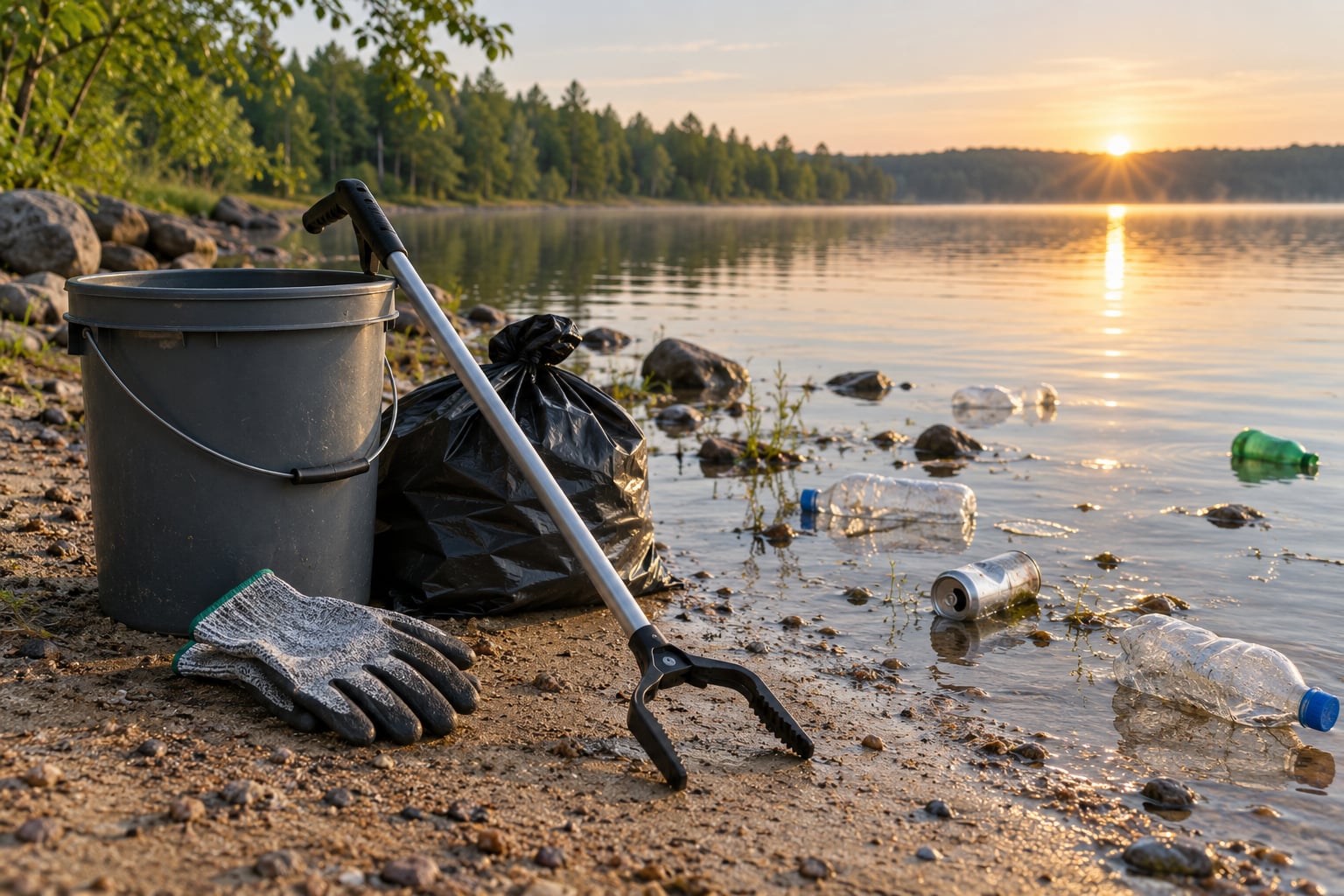
To pick up trash safely at a shoreline, wear cut-resistant gloves, use a long litter grabber instead of your hands, work in short stretches from solid ground, and leave needles, chemicals and anything tangled in wildlife alone. A 60- to 90-minute session with a bucket and a rigid bag for glass covers most of what washes up on a typical lake shore, and the difficulty is low once the gear is in your hand.
The reason people get hurt is rarely dramatic. It is a syringe hidden under a weed mat, a shard of glass under a sandal strap, or a fishing hook snagged in monofilament they tried to bite through. Cleanup volunteers in places like the Bayside beaches and the Detroit River talk about the same finds, usually discovered by someone who reached into a hole without looking first.
Plenty of litter comes from ordinary recreation rather than a storm, which means a shoreline that looked fine last year can be a tangle of bottle caps, line and plastic strays after a single weekend. The method below works whether you are walking a riverbank alone or organizing a small group, and it scales down to a twenty-minute walk if that is all the time you have.
Table of Contents
- What You Need Before You Approach a Littered Shoreline
- Step-by-Step: How to Pick Up Trash Safely at a Shoreline
- Common Mistakes Cleaners Make on a Shoreline
- Safety Tips for Children, Pets, and Crowded Areas
- Frequently Asked Questions
- What do I need for a shoreline cleanup?
- Is it safe to pick up broken glass with gloves?
- What do I do if I find a needle or syringe on the shore?
- Should I pick up fishing line and hooks I find in the debris?
- What gets found most often during a shoreline cleanup?
- Can I clean up a shoreline alone without organizing an event?
- Conclusion: The First Five Actions
What You Need Before You Approach a Littered Shoreline
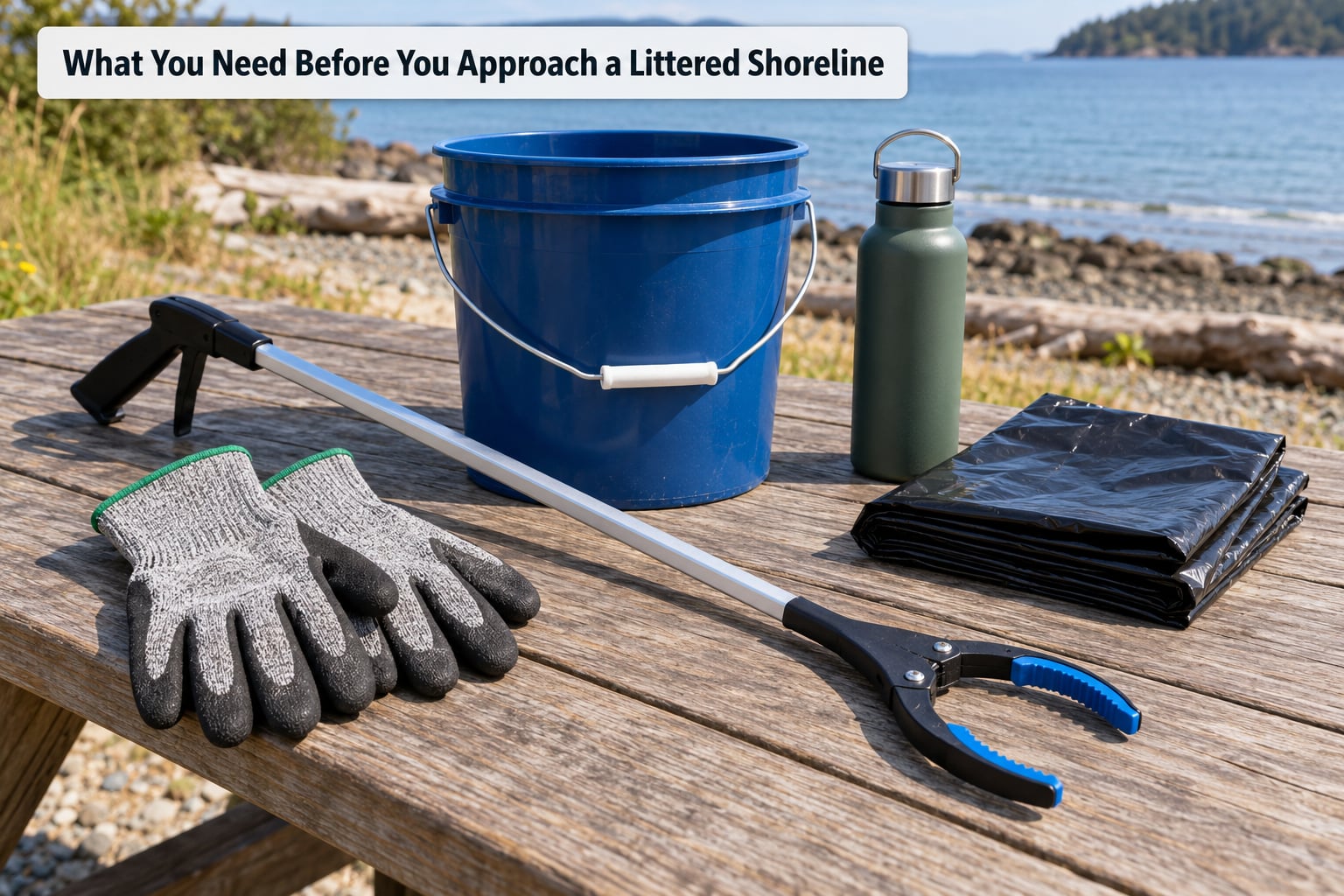
Almost every injury trace back to a missing item rather than a wrong technique. Pack the protection first, the containers second, and only then think about extras.
- Cut-resistant gloves. Thin nitrile keeps your hands clean but does nothing against a shard. A coated or cut-level work glove is the one that matters on a debris field.
- A long litter grabber or picker. Most shoreline cleanup hands out a simple clamping picker, and it keeps your fingers out of the pile entirely.
- Closed-toe shoes with grip. Lace-ups, not sandals. Wet rocks and algae-coated slabs are the main cause of slips.
- A rigid bucket with a handle for cans, bottles and other non-sharp items, so nothing heavy lands on your feet inside a soft bag.
- A second stiff-sided container for broken glass, ideally a wide-mouth jar or a reinforced bag that a shard cannot slice through. A thin trash bag alone is not enough.
- Water, a snack and sun protection. A full hour in open sun dehydrates faster than most people notice.
- A small first aid kit with antiseptic wipes and a few sterile dressings. You will want them for nicks from branches, not for anything serious.
- A phone, a charged battery and a water-safe bag for the container once it is full. You should be able to call for help if you get hurt or stranded.
Before you leave, check who owns the shore. State parks, tribal land, wildlife refuges and some municipal parks require a permit or limit group size, and a few ban organized cleanups entirely. A quick call to the local solid waste department also tells you where glass and household waste are accepted, which decides the whole disposal plan.
If you find a persistent pile of unknown material, that is a good day to bring a different tool rather than a different attitude. Municipalities will often send a crew for dumping sites and abandoned waste; the shoreline part you can do yourself.
Step-by-Step: How to Pick Up Trash Safely at a Shoreline
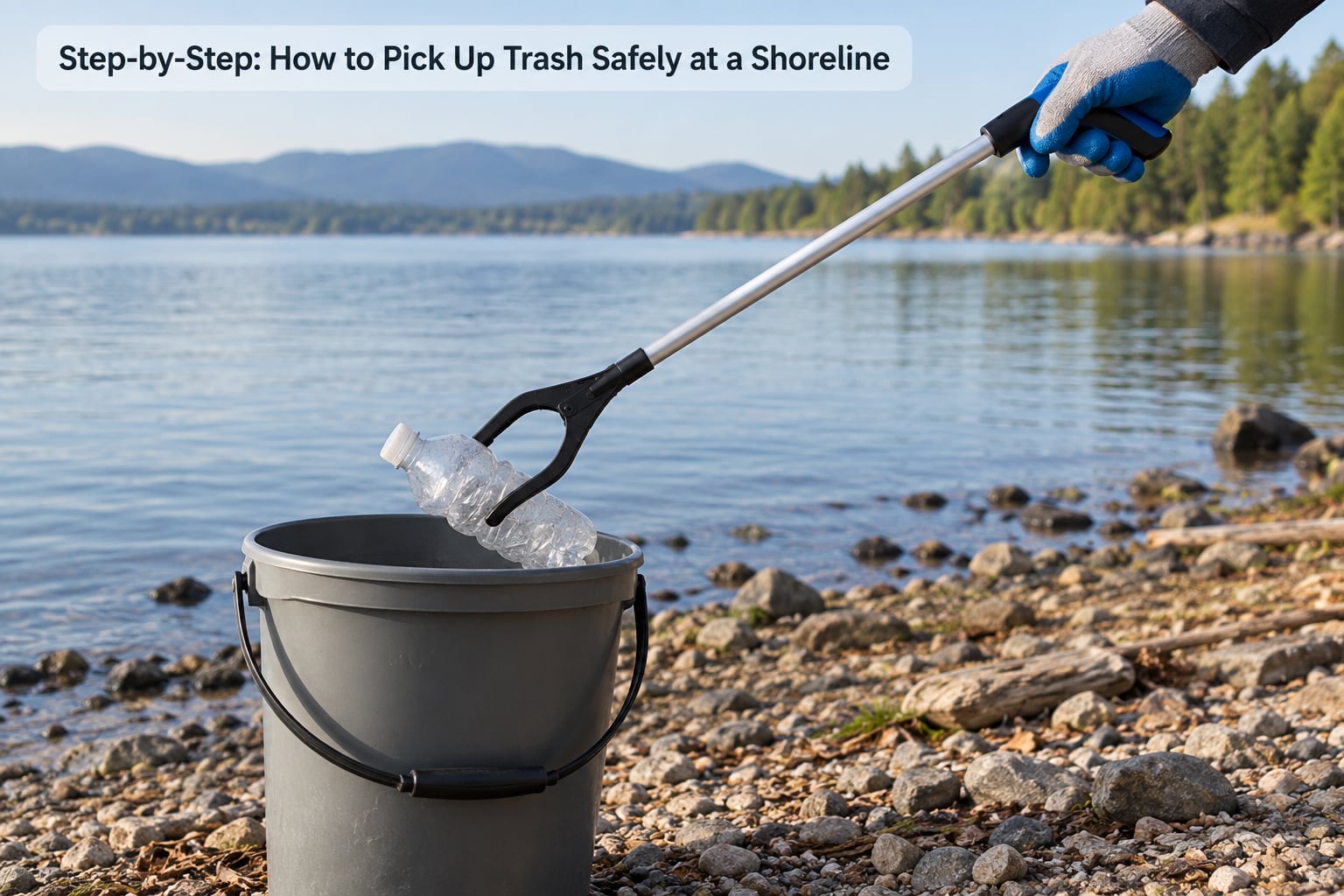
The order below takes about an hour and a half, and every step exists to prevent a specific injury.
- Survey before you start. Walk the stretch once without picking anything, note footing, waves, private property lines, nesting areas and any cluster of unknown waste.
- Dress for the job. Gloves on, closed-toe shoes on, water within reach. Do not start collecting in sandals or a wet swimsuit.
- Work in 20-minute rounds. Pick with the grabber, never pinch-lift with your fingers, and rest before your back and hands start complaining.
- Sort as you go. Everything soft or sharp into the rigid container, ordinary litter into the bucket, and no picking in the same hand that touches a water bottle.
- Skip anything dangerous. Needles, chemicals, dead animals and anything entangled in an animal or a nest stay exactly where they are.
- Bag it, haul it off, wash up. Tie both containers shut, take them to a proper disposal point, then clean your hands and gear.
How to Assess the Shoreline Before You Start
Read the ground twice. A shoreline that looks walkable from the parking lot can turn into a mud shelf that swallows a boot, and a bank that drops off quietly is exactly where a wave comes from behind you.
Check access points and your exit. If you have to scramble down a steep bank to reach the water, plan the climb out before you fill a bucket, because a heavy bucket is a very different problem than an empty one.
Look at the water itself. Wind, swell and an incoming tide all change the ground, and a rising level can cut off a low stretch you walked along ten minutes earlier. On an ocean beach, work the tide window and never turn your back on the water while your attention is on a bottle cap.
Scan for the things that make this a safety job instead of a chore. Needles cluster in beach litter and around public areas, and wildlife can be nesting in the same drift pile you are about to disturb. Rotten or chemical-smelling containers, containers with no opening, and anything leaking or stained get marked and stepped around.
Tell somebody your plan. Name the stretch you are walking, the time you expect to be back, and what to do if you are late. On remote water, that one phone call is the cheapest safety gear you will ever buy.
How to Pick Up Trash Without Cutting or Puncturing Yourself
Position matters more than strength. Hold the grabber with the handle lower and the claw above the item so it closes around the trash, not around your fingers. Small things like bottle caps and cigarette filters are the ones that slip through, and they also hide the sharp bits.
Keep the grabber tip pointed away from your body, and never put it down in the sand where a later reach can land on the point. When the claw closes on something heavy, tip it into the bucket rather than lifting straight up.
Never reach into a hole, under a mat of weeds, or into a hollow log without looking first. That is the exact scenario that put a needle in a cleaner’s hand on one of the beaches volunteers describe, and no glove is thick enough to make blind reaching safe.
Treat broken glass as a separate stream. Pick up small fragments with the claw and drop them straight into the rigid container. If a piece is buried in sand, sweep sand over it and pick up the whole layer rather than chasing a single fragment, and never crush glass to hide it.
For line and rope, cut it with a small knife or shears, not with your teeth. Monofilament is nearly invisible when it is wet, and the hook underneath is not. Lead sinkers and weights are dense enough to be worth a special effort, but only with a claw or pliers, never barehanded.
Change how you lift. Squat down with the load close to your body, keep your back roughly straight and drive up with your legs, which are far stronger than your lower back. Rushing and twisting while carrying a full bucket is how a two-hour cleanup turns into a week of stiffness.
How to Protect Wildlife and the Lake Ecosystem
Not everything organic is waste. Driftwood, shells, seaweed and waterlogged plants are biomass, and most of them are habitat and food for insects, birds and fish. Leaving the larger piles in place is usually better for the lake than carrying them to a landfill, and clearing only the plastic and metal from a shoreline is a good general rule.
Some items need extra thought because of what they do to animals rather than who picks them up. Monofilament, rope, net fragments and six-pack rings entangle birds and fish, and line can cut deep without the animal noticing. Getting those out of a shore is one of the highest-value things a cleanup accomplishes.
Check for wildlife before you reach into anything. Disturbed nests, bird colonies, an active den or a stranded or dead animal all mean stop and call the local wildlife agency instead of handling it yourself. Dead animals may carry disease, and in many places they must be handled by someone with training and equipment.
Batteries, propane cylinders, oil containers, pesticides and sealed chemical drums are not shoreline litter. Do not put them in a bag, and do not open them. A leaking or hissing container is an immediate reason to back away and call emergency services or your local environmental line, and handling it yourself can cost far more than the cleanup saved.
On larger bodies of water, be careful not to move between aquatic beds where invasive species are known, and never empty a bucket of lake water on land. Rinse gear and boots away from the shore before you leave so you do not carry anything from one lake to the next.
How to Bag, Sort, and Dispose of the Trash
Bag as you go rather than sorting on the ground at the end. Loose cans and bottles roll, and a hundred of them scattered across wet sand take longer to collect than the picking did. Fill the bucket halfway, not to the rim, because a full bucket tips when you squat.
Double-bag glass. Put the shards in a rigid container first, then seal that container inside a heavier bag so nothing can reach the outside layer.
Recycling rules on a shoreline are not the same as the ones in your kitchen. Local facilities often reject anything that held liquid or food, along with anything a child or an animal could get into. When in doubt, a single mixed bag that your solid waste department accepts is better than four sorted bags it refuses.
Take everything with you. A full bag left on the bank is a new piece of litter and usually washes back into the water, and it can tear open and scatter. Weight matters less than people think; what matters is that the load closes and stays closed for the trip home.
Route hazardous finds to the right place. Household batteries, propane cylinders and paints usually belong at a household hazardous waste facility, and sharps belong to your public works or sanitation department. A five-minute call before you go tells you where that is on your specific lake.
Finish with soap and water, wash your gloves separately from your laundry, and rinse your gear and boots away from the shoreline. If you took data notes, add the counts to a marine debris tracking program so your walk contributes to something bigger than your own bin.
Common Mistakes Cleaners Make on a Shoreline
- Using bare hands or thin disposable gloves. They feel cleaner and they protect nothing. Cut-resistant work gloves are the baseline, not an upgrade.
- Reaching into holes, mats and hollow logs. Use the claw to move the covering, look, and only then reach with a tool.
- Grabbing fishing line with your teeth or hands. Cut it with shears, lift it with a claw, and check for the hook underneath.
- Putting glass straight into a thin trash bag. A shard rides against the film and cuts straight through. Use a rigid container and bag over it.
- Filling a bucket all the way. Half-full is stable and light enough to lift with your legs.
- Bending from the waist for every item. Squat instead, and give your back a break every twenty minutes.
- Picking up containers with unknown contents. Do not open, squeeze or sniff anything. Mark the spot and report it.
- Leaving filled bags on the bank. Haul them out. Most of what gets left behind comes back into the water.
Two more habits worth building: work with the wind at your back so smells and loose bags blow away from you rather than into your face, and stop before you are tired. Fatigue is when technique degrades, and technique is the entire safety margin.
Safety Tips for Children, Pets, and Crowded Areas
Children can help, and the rules are about range rather than enthusiasm. Give each child one clear zone away from the water’s edge and away from any adult’s grabber swing, set a time limit of 20 or 30 minutes, and have one adult responsible for counting heads and hands at all times.
Give kids a job that matches their age. A child with a bucket collecting caps and wrappers a few paces from the shoreline is having a good time and helping. A child with a grabber, in water, near broken glass, is a supervision problem.
Tell children the no-touch rules in plain words: nothing sharp, nothing with a wire or a string, nothing that smells funny, nothing fuzzy moving. Post the shoreline rules on the bucket so the adults remember them too.
Keep pets on a lead the whole time, and remember they will drink from puddles and chew anything they find. A leashed dog that stays back from the water’s edge is fine; an off-leash dog is a cleanup participant in name only.
In a crowd, pick a distinct working area and stay visible to children and to other walkers. Stay clear of boat launches, where a bucket behind a moving trailer is a real hazard, and check for broken glass in any area where people walk barefoot before you leave it.
Work in pairs rather than alone on remote water, especially in cold weather, since hypothermia and hypothermia-like chilling happen quietly. And stop outright for lightning, a rising storm, surf you cannot read, or any water level that has reached the route you planned to walk out on.
Frequently Asked Questions
What do I need for a shoreline cleanup?
For a solo or family cleanup you need cut-resistant work gloves, a long litter grabber, closed-toe shoes with grip, a rigid bucket, a second stiff-sided container for broken glass, water, a small first aid kit and a phone. Add a permit and a call to your local solid waste department if the shore is public land or if you plan to collect more than a few bags.
Is it safe to pick up broken glass with gloves?
Gloves help, but they are not the answer. Most cuts come from a shard hidden in sand or grass that gets squeezed in a thin bag and bursts through the film. Use the grabber to lift fragments into a rigid container, sweep up the surrounding sand with the glass, and double-bag the container itself. Skip large or deeply buried pieces and report the location instead.
What do I do if I find a needle or syringe on the shore?
Leave it in place, note the location, and do not put it in your bag or bucket. Step away, keep children and pets clear, and report it to your local public works, sanitation or public health department, since most run needle collection programs and some host drop-off days. Handling it yourself puts you in contact with a bloodborne pathogen for no gain to the lake.
Should I pick up fishing line and hooks I find in the debris?
Yes, because monofilament, line, net fragments and six-pack rings entangle and sometimes kill birds and fish. Cut the line with shears rather than pulling or biting it, lift it with the grabber, and check the tangle for a hook before it goes in the bag. Small lead sinkers and weights are worth picking up too, using pliers or a claw rather than your fingers.
What gets found most often during a shoreline cleanup?
Cigarette filters, bottle caps, plastic fragments, food wrappers and beverage containers dominate almost every count, along with a smaller stream of fishing line, hooks and bait tubs near access points. Because most of it is small and light, the work is slow rather than heavy, and a grabber plus a bucket suits the material better than gloves and a wheelbarrow.
Can I clean up a shoreline alone without organizing an event?
Yes, and most informal cleanups are solo. Pick a short stretch near where you already walk, carry a grabber and a small bucket, and stay on ground you could walk back along. Tell somebody your route and return time, do not enter the water, and haul everything out the same day. Group events add permits, data collection and coordination that a solo walk does not need.
Conclusion: The First Five Actions
Check the conditions before the gear, because wind, waves, footing and permission decide whether a stretch is worth working at all. Then put on cut-resistant gloves and closed-toe shoes, carry a grabber, and treat your hands as the tool you are protecting.
Pick with the claw, squat instead of bending, sort sharp waste into a rigid container, and haul it all off the same day. Leave needles, chemicals, dead animals and nesting areas to the people equipped for them, and finish with soap and water. That sequence is what makes shoreline cleanup safe as a regular habit rather than a one-time event, and since this guide was written for 2026 it holds as the rules around access and disposal change from lake to lake.