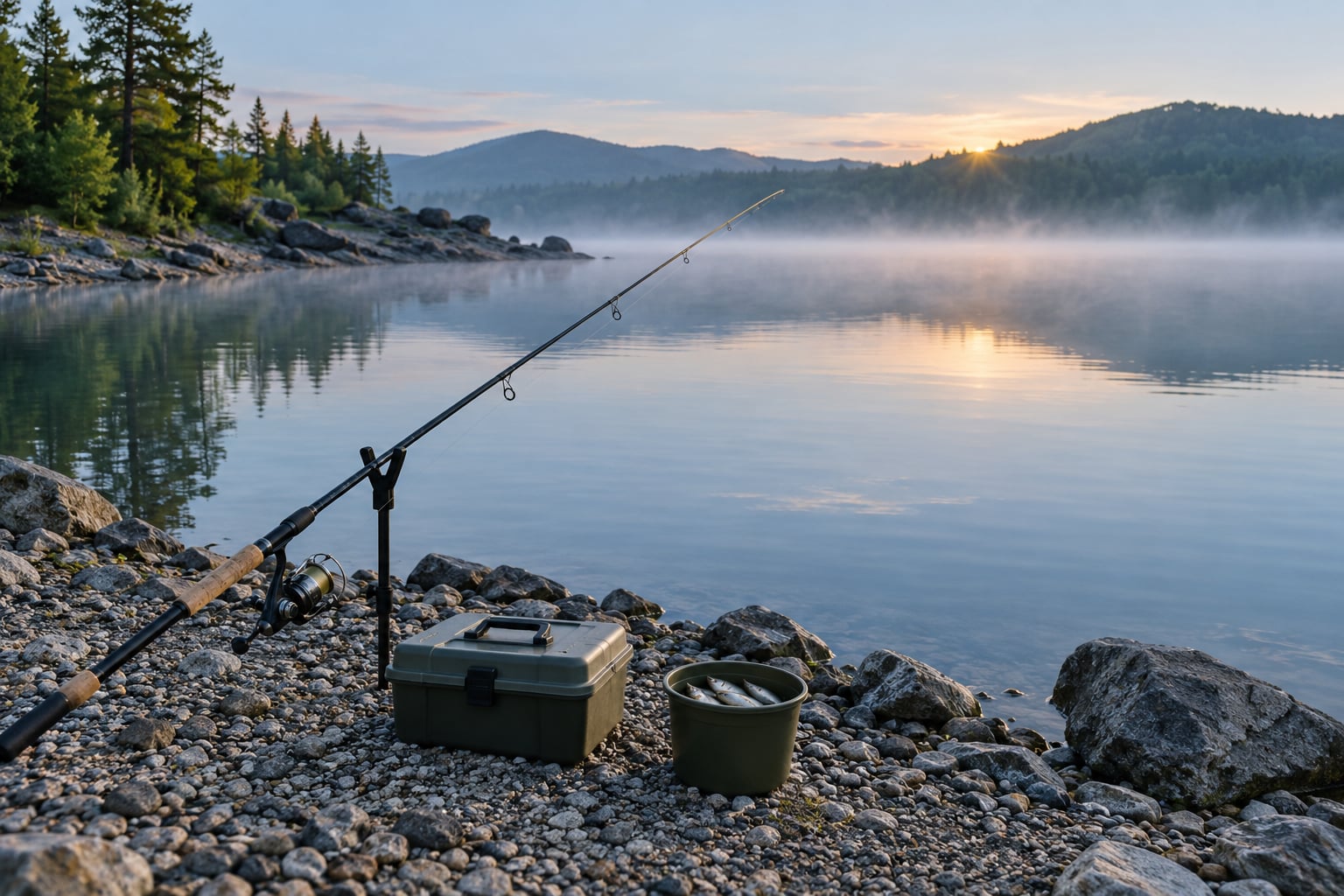
You can catch walleye from shore. They feed in water as shallow as 3 feet along a bank in low light, and on a good evening a jig-and-soft-plastic or a slip-bobbered leech will produce fish you never had a boat to reach. Learning how to catch walleye from shore is mostly about picking the right structure within your casting range, then being there at the right hour with a controlled presentation.
That takes about nine decisions, and I walk through each one below: what to bring, where to stand, when to show up, how to rig, how to work the water, and what to write down so your next trip goes faster. No boat, no waders, no trailer.
Table of Contents
- What You Need
- Step-by-Step
- 1. Choose a Walleye-Friendly Shoreline
- 2. Fish the Right Time of Day and Season
- 3. Match the Gear to the Conditions
- 4. Select the Right Bait or Lure
- 5. Set the Hook for a Slow, Controlled Bite
- 6. Work the Water Instead of Casting Once
- 7. Adjust for Wind, Current, and Clear Water
- 8. Fish Through the Bite and Land the Fish
- 9. Record and Improve Each Shore Session
- Common Mistakes
- Frequently Asked Questions
- Conclusion
What You Need
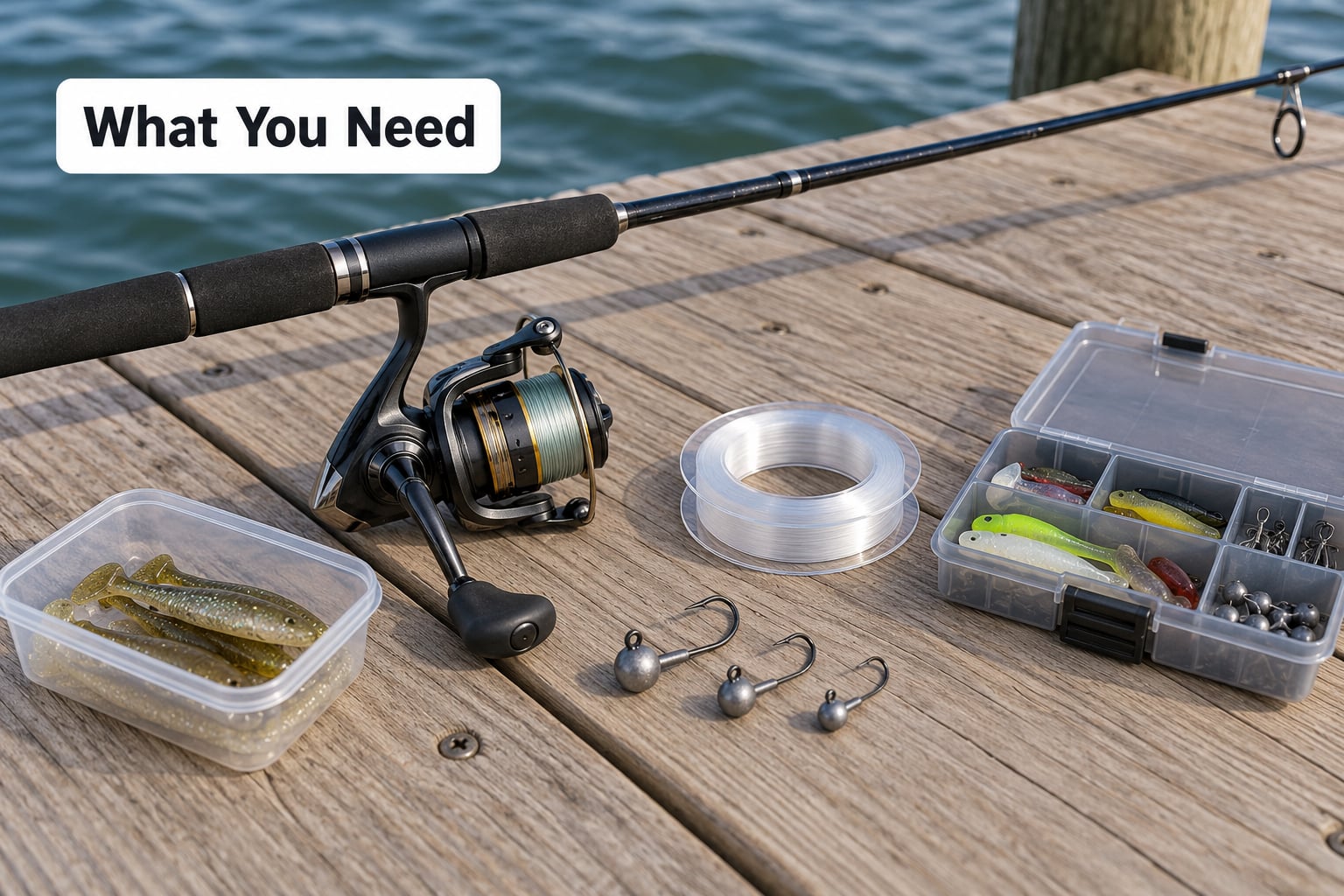
A shore walleye setup is not a shore bass setup with a different lure. The rod has to throw far enough to reach a drop-off and stay soft enough to feel a pickup in the dark. Here is the list, split into what you genuinely need and what is nice to have.
What to bring
- Rod: a 6 ft 10 in to 7 ft medium-power, fast-action spinning rod. Graphite feels the bite; that length covers the 20 to 30 yard casts most shorelines demand.
- Reel: a spinning reel with a smooth drag and a sealed bearing, size 2500 to 3000. Put a drop of grease on the spool and expect to clean it after every trip in sand.
- Line: 10 to 20 lb braided mainline. Braid casts farther, sinks faster than mono, and shows bites, which matters more than people think.
- Leader: 3 to 5 ft of 8 to 12 lb fluorocarbon, tied to a barrel swivel. Fluorocarbon is nearly invisible underwater, which is worth something in 3 feet of clear water.
- Hooks and jig heads: 1/8 to 3/8 oz weighted jig heads in plain chartreuse, white or black, plus offset hooks for live bait.
- Soft plastics: 3-inch paddle-tail swimbaits, curly-tail grubs, and a few flukes for the shallow-weed edge.
- Live bait: a net of fathead minnows or shiners, a few nightcrawlers, and a leech if the lake is known for them. A small bucket with a lid keeps them alive on a warm afternoon.
- Terminal tackle: slip bobbers, egg-shaped floats for 3 to 10 feet, a three-way swivel for the sliding sinker rig, split shot, and a couple of sinkers around an ounce.
- Footwear and clothing: neoprene waders only if you plan to enter the water. Otherwise, boots with grip and layers you can strip off at midday. A shell jacket matters more than any gadget when the wind comes up.
- A mapping or sonar resource: a phone with a lake chart app, or a portable fish finder if you fish the same water often. Depth at the end of your cast is the single most useful number you can know.
Optional extras: polarized sunglasses, which are the cheapest advantage a shore angler can buy, a spotlight or headlamp for night work, a rubber-mesh net, and a second rod so a wind change does not end the trip.
Step-by-Step
Nine steps, in the order they happen on a good shore trip. Each one tells you what to do, why it works, and what tells you the presentation is right.
1. Choose a Walleye-Friendly Shoreline
Pick structure that sits inside your casting distance, because a shore angler is limited by reach, not by ambition. Rock points, riprap banks, channel edges, weed lines, the flats in front of a point, and any spot where the bottom type changes from sand to rock or rock to weeds are worth walking to. The change in bottom type is called a transition zone, and it usually comes with a 4 to 12 foot drop that walleye patrol.
Water type changes the search. On a lake, look for weed edges and rock shelves. On a reservoir, the riprap banks and the flats beside them hold baitfish all season. On a river, fish the seams, eddies and current breaks where fast water slows and food collects.
You will know the spot is right if baitfish are visible near the surface at dawn or if you can find the drop inside one cast. Walk the bank before you commit: look for exposed rock, cormorants working a seam, a channel that runs close to the bank, or a spot where the wind is pushing water against shore. Anglers on the Boundary Waters forum make the point that the reason a spinnerbait harness works from a bank position is that you can hold one spot for a long time, and that changes which rig makes sense.
2. Fish the Right Time of Day and Season
Walleye feed hardest in low light, so dawn and dusk are your two best windows and the night in between is often better than either. Their eyes are adapted to dim, deep water, which is why bright noon shallow fishing so often goes nowhere. A flat, overcast afternoon is nearly as good as low light because it dims the surface without killing your visibility.
Wind extends the window. When wind blows a shoreline, it pushes baitfish against the bank and churns the water, and shore anglers often find that a bite window which is normally an hour at sunrise and an hour at sunset runs most of the day. Some anglers also report better luck on larger fish on sunny days with mixed cloud rather than under solid overcast, which is worth remembering when the two conditions fall in the same week.
Season shifts the depth. In spring, fish the spawning run and the shallow flats beside a point. Through summer they hold deep near the drop-off during the day and move up at night. In early fall they push onto the riprap and the weed edge. On the Great Lakes, shore fishing stays productive into November in mid-30s water, which is how people fish Lake Erie from a bank three days before Thanksgiving.
3. Match the Gear to the Conditions
Start with a 7 ft medium-power fast-action spinning rod, 10 to 20 lb braid, a 3 to 5 ft leader at 8 to 12 lb, and jigs from 1/8 to 3/8 oz. That combination covers the overwhelming majority of shore situations between 3 and 15 feet of water, and it is the setup the search engines keep pulling for a reason.
Change it when conditions change. A heavy wind and a long cast argue for the lighter side of the braid. Structure, current and casting past a snag argue for the heavier side. For finesse fishing over a weed edge in clear water, drop to 8 lb fluoro and a 1/16 oz jig head. For a slip bobber drifting in a river seam, the weight has to be enough to keep the bait on the bottom, and that is usually a split shot or a small sinker rather than more line.
Most lost fish come from gear that is too heavy to feel. A medium-heavy rod with 12 lb mono has no tip movement left, and anglers on the Michigan sportsman forums describe losing fish on exactly that setup. Sensitivity is not a luxury here; it is how you know a walleye picked up your bait.
4. Select the Right Bait or Lure
Match what the walleye are eating that week. If shiners are skittish on the surface, use a 3-inch paddle-tail swimbait on a 1/8 to 1/4 oz jig head. If the lake runs on crawfish, work a darker jig with a curly-tail grub. If perch are the pressure point, a perch-pattern shad or a crawler harness earns its place.
The four presentations that carry most of the shore fishing:
- Jig and soft plastic in 3 to 12 feet, for rock, gravel and sand structure. Drag it, then pause. Let it sink until you feel bottom, then lift and drop.
- Slip bobber with live bait a few feet off the bottom, for fish holding above structure and for water where the bottom is uneven enough to snag a sliding sinker.
- Sliding sinker live bait rig in 10 feet or more, where a bobber would be too visible and the current will carry the rig along a seam. Three-way swivel, sinker, and a minnow or small chub pinned above the weight.
- Spinnerbait or spinner-worm harness for a stationary bank position, retrieved with a steady lift and drop, which covers a lot of water in a short window.
Hard baits earn their place in low light and in wind. A shallow-running crankbait or a stickbait pulled parallel to a rock shelf covers ground fast. A blade bait or spoon works well at dusk because the vibration carries when visibility drops.
On the number one question anglers ask: a weighted jig head with a paddle-tail swimbait is the most reliable single shore presentation. Everything else is a variation on presenting something fish-shaped and soft in front of a fish that strikes once and barely moves the bait.
5. Set the Hook for a Slow, Controlled Bite
Walleye pick up bait, hold it in the mouth, and decide. A strike often looks like a bump, a tap, or the bobber quietly sinking rather than a pull. Watch the line where it enters the water, not the rod tip, and give every bump a full count before you touch anything.
Set the hook when you lift the rod, not when you see the tip move. That one habit catches more fish than any other in this article, because it converts the soft pickups into hooks. Keep the line tight enough to feel pressure and loose enough that the leader is not dragging on the bottom, which is where hooked walleye get lost. A 3 to 5 ft leader also lets a fish run once without taking your mainline with it.
Watch for a change in the retrieve too. A walleye swimming with your bait makes it feel heavier and slower, and it is a better cue than anything you see through the dark.
6. Work the Water Instead of Casting Once
A cast is the start of the work, not the end of it. Cast parallel to the shoreline rather than straight out whenever you can. A parallel cast holds a consistent depth along a drop-off for 20 or 30 feet, while a cast straight out gives you one depth at one spot. On a riprap bank, casting along the rock beats casting into it.
Once the bait is down, keep it in the zone. Drag slowly, then pause, then lift and drop. Mix in a few lifts of 6 to 12 inches to change the lure’s height in the water column. If the current is moving, a slip bobber or a sliding sinker gives you a slow drift across the productive strip for free.
Move only when the spot has failed you. Cast to a new angle, change depth by a foot or two, or shift 10 yards along the bank. Most anglers quit a spot that still had fish on it, and most empty presentations are not proof of empty water.
7. Adjust for Wind, Current, and Clear Water
Wind and current are conditions to use, not obstacles. Turbid water blinds a walleye and disorients the baitfish it chases, so a wind-blown bank can be the best water on the lake. Cast into the wind when you can, which is also how the wind carries your bait back toward you and keeps it in the strike zone longer.
For a moving current, add weight until the bait stays on the bottom, and shorten the leader to a few inches if the swing is tying you off. For clear water and low light, go lighter on color and lean on the lure’s profile and vibration. A dark lure against a pale bottom reads better than a bright one in a light, and a light lure works against a dark bottom in low light. For water so clear you can see the fish, thin the line and shorten the leader before you change the lure.
When the wind is dead flat and the water is glassy, fish shallower and smaller, and work areas where structure breaks the surface: a rock top, a stump field, a canal edge. Fish that cannot hide in open water will use whatever shadow exists.
8. Fish Through the Bite and Land the Fish
The first real bite of the evening is the one most people rush. Slow down. Keep the rod pointed at the line, watch the bobber, and wait for the second move before you commit. Walleye frequently bump bait they are not ready to take, and striking on the bump teaches you to miss the real one.
When you hook up, reel with control. A walleye fights with runs, not with steady pull, so a firm drag and a moderate rod give you the angle to stop it before it finds rocks. A shore angler cannot chase a fish, so once it comes close, work it in on a tight line. Have the net open and in the water before the fish is at your knees, use a rubber-mesh net because the mesh is gentler on the fish and on your hands, and keep the fish in the water until you have the net.
For release, minimize handling. Wet your hands, do not touch the gills, keep the fish in the water if the regulations call for it, and check the local creel and slot rules before you start. Protected slot limits and seasonal closures vary by state and by water, and the fine for guessing is not worth the fish.
9. Record and Improve Each Shore Session
Write down the trip while you are still remembering it accurately: the spot, the date, the wind, the cloud cover, the water temperature if you know it, the depth where you were catching fish, the presentation, the retrieve, the time of the first bite, and how many fish you landed. Six lines per trip is enough.
Patterns show up fast. You may find that your best bite always comes in a 40-minute window right at sunset, or that every fish came off a jig in 5 feet while the live bait produced nothing. Most anglers fish the same lake the same way for years and never notice the pattern sitting in their own notes.
Common Mistakes
Nearly every frustrating shore trip comes down to one of these, and each has a simple correction.
- Fishing open water instead of structure. If you are casting over a flat bottom with nothing nearby, the fish have no reason to be there either. Fix: move 10 yards until you are casting at a drop, a rock or a weed edge.
- Believing walleye only live in deep water. The best proof that the deep-water rule is wrong is an angler on r/FishingForBeginners describing walleye coming up into 3 feet of water along the bank to eat baitfish. Fix: work 3 to 6 feet along a wind-blown bank at dawn and you may catch the same fish.
- Too much line and too heavy a rod. You will not feel the pickup and the fish will break off. Fix: move down to 8 to 12 lb braid or mono and a medium-power rod.
- Casting past the drop-off. The fish are on the shoulder, not in the deep. Fix: cast short of the edge at first, then step up a few feet at a time.
- Retrieving too fast. A drag-and-pause or a lift-and-drop matches how a walleye takes a baitfish. Fix: halve your retrieve speed and add a pause on every second or third lift.
- Striking on the first bump. Walleye pick up and hold. Fix: wait for the commit and set the hook on the lift of the rod.
- Ignoring the wind and the current. Both put fish in front of you. Fix: cast into the wind, add weight until the bait holds bottom, and let the current drag the rig for you.
- Fishing one spot for hours. A shore angler has no mobility, so a dead spot stays dead. Fix: change depth, angle, or lure before you leave, and move 10 yards before you pack up.
Frequently Asked Questions
Can you really catch walleye from shore?
Yes. Walleye regularly feed in water as shallow as 3 feet along a bank, particularly at dawn, dusk and through the night, and on a wind-blown shoreline they push even tighter to the structure. A weighted jig with a paddle-tail soft plastic or a slip bobber with a live minnow is enough. The only real constraint is your casting distance, so choose your spot with that in mind.
What is the best rig for shore fishing walleyes?
A jig and soft plastic for structure in 3 to 12 feet, and a slip bobber with live bait a few feet off the bottom when the fish are holding above the drop. Add a sliding sinker live bait rig for 10 feet or more, and a spinnerbait or spinner-worm harness when you are parked on one spot and want to cover a lot of water with a lift-and-drop retrieve.
What is the best bait for shore fishing walleyes?
Live bait still wins for numbers: fathead minnows, shiners, nightcrawlers and leeches all produce. For artificial lures, a 3-inch paddle-tail swimbait on a 1/8 to 1/4 oz jig head is the most dependable shore presentation, with a crankbait or stickbait for covering water fast at dusk. Match the color and size to the forage in the lake: shiners, perch or crayfish.
What is the best month to fish for walleye?
It depends on the water, but September and October are the most reliable months for shore fishing because walleye are feeding hard along riprap banks and weed edges. May and June bring the shallow spawn. November is worth planning on the Great Lakes, where bank anglers fish plugs and rattletraps in mid-30s water. Summer is workable at night and around structure rather than at midday.
What time do walleyes bite the most?
Dawn and dusk, and often the whole night in between. Their eyes are built for dim, deep water, so a flat overcast afternoon performs almost as well as low light. Wind on the bank extends the window, and a shoreline that receives a steady blow can produce all day. Sunny days with mixed cloud sometimes outperform solid overcast when you are after larger fish.
Why are walleye so hard to catch?
Most of the difficulty is expectation. They hold deep and tight during bright hours, they strike once and barely move the bait, and they refuse bait that has been parked in one spot for a long time. Add fishing pressure and the fact that many shore anglers are catching sauger and thinking they have walleye, and the low success rate makes sense. Fish low light, fish structure, and set the hook on the lift.
Conclusion
Start with four things on your next trip. Find a shoreline where the structure sits inside your casting distance: a rock point, a riprap bank, a weed edge or a channel in 3 to 15 feet. Arrive before sunrise or an hour before sunset, and stay through the low light. Tie on a 7 ft medium-power rod with 10 to 20 lb braid, a 3 to 5 ft leader, and a 1/8 to 1/4 oz jig head with a paddle-tail swimbait, then drag, pause, and set the hook on the lift.
Afterwards, write down what happened while it is still fresh. Your own log will tell you more about your lake than another season of guessing does.