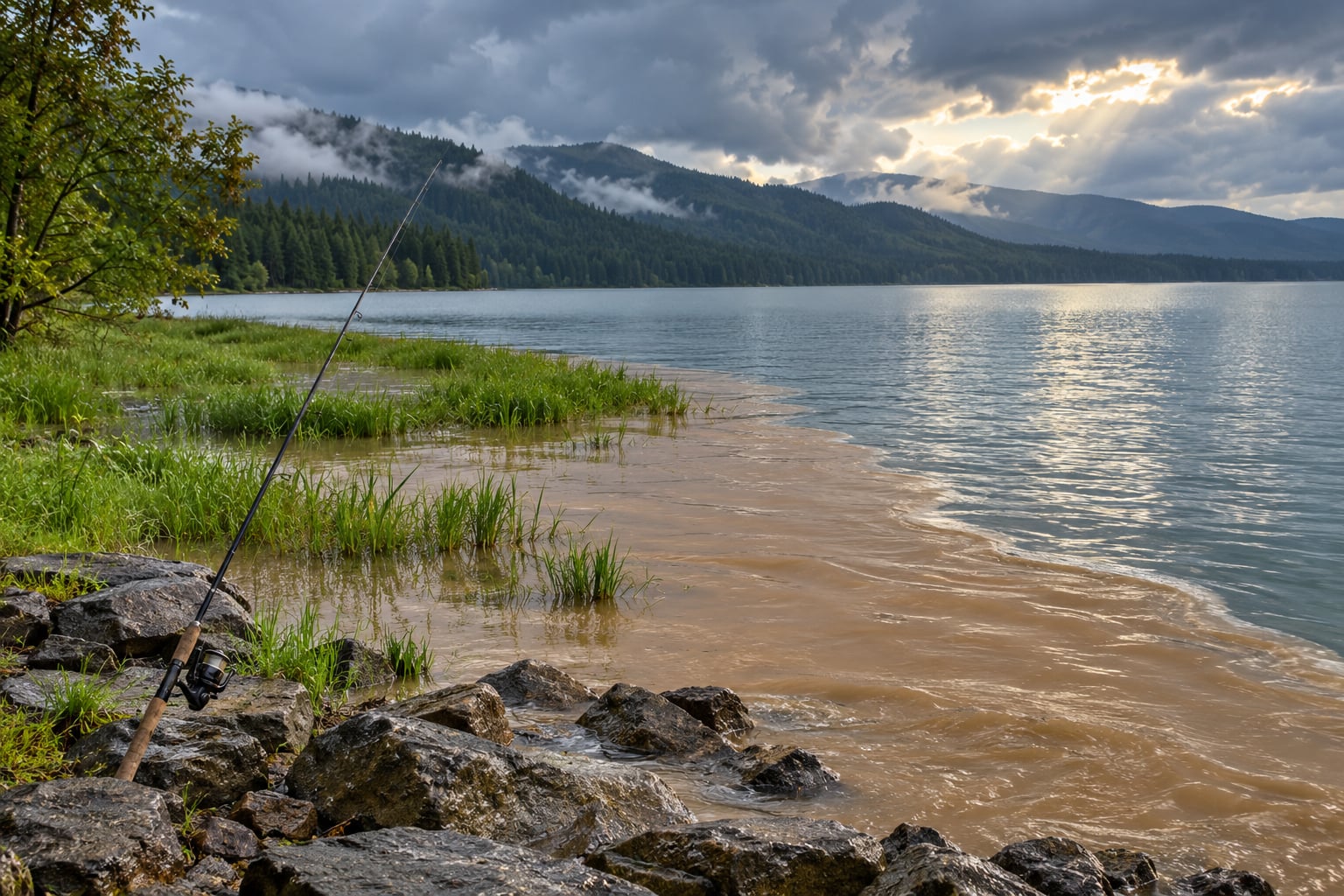
Learning how to fish a lake after heavy rain is less about picking a lucky lure and more about reading water that just changed. Runoff pushes stained water into the lake, forms a mud line, floods the grass and shifts where baitfish and bass are holding. Fish the edge where things meet, match your lure to clarity, and you will usually do better than you would have the day before.
Rain moves fish because it moves everything else. Nutrients, terrestrial insects, minnows pushed out of ditches and a rising water line all arrive at the same time, and a few hours later fish are stacked in the places that received it.
The catch is that the same storm that creates the fishing also makes the trip less predictable. Banks soften, boat ramps go slick, submerged logs surface, currents strengthen at inflows and the forecast can turn in twenty minutes. Most anglers who waste a post-rain day do not pick the wrong water. They show up at the wrong time in the wrong condition with the wrong presentation.
Give yourself half a day of daylight to work through the sequence below, and expect to move more than you would on a calm day. Here is the order that works for me: verify the access, find the water that changed, match the presentation to clarity and current, then adjust on contact rather than on theory.
Table of Contents
What You Need
Post-rain fishing is mostly about preparation, because the conditions you need to judge are different on every trip and most of them are not visible from the truck.
- A phone with a weather radar app and a lake level gauge page. Radar tells you whether the cell is still moving over you or has exited, and the gauge tells you how fast the water is rising. A rising lake means a flooded shoreline you have never fished, and a stable one means the flooded cover will be gone by evening.
- Life jacket and a whistle, worn not carried. Bank collapse and cold runoff water are the two ways people get hurt around lakes after storms. Wear it from the moment you leave the vehicle.
- Boat with a shallow draft, plus a paddle. Rising water floods trees and brush. If you run a propeller boat, you will be grounded in places you need to reach, and you will find out when the prop hits a submerged limb at idle speed.
- A local lake map or a mapping app with contour detail. You need to find the feeder creeks and the shallow shelf that will be covered in a few feet of water. Those spots are usually not on the recreational map you are used to.
- Extra terminal tackle, and a way to see below the water. Current and stained water lose hooks and line, and visibility at the bank changes by the hour. Bring a spare set, and a depth finder if you have one.
- Bottom sounding or a paddle and electronics for shore anglers. After a rain the best water is often over drowned vegetation that you cannot see at all. Find the edge instead of guessing at it.
- Rain shell, spare dry layer, towels, a dry bag for your phone and keys. Wet gear decides the rest of the day more often than the fishing does.
- A soft plastic, a chatterbait or spinnerbait, a jig and a crankbait. Four lures cover nearly every after-rain situation. Vibes and noise for stained water, a slower plastic when the water clears, a jig around flooded wood.
- A thermometer and a notebook. The water temperature and the clarity are the two variables that decide the pattern. Write them down, because next month it will be a different lake and you will want to know what worked in which combination.
Step-by-Step: How to Fish a Lake After Heavy Rain
Check Current Conditions and Access Before You Leave the Ramp
Most post-rain trips are decided before the boat is in the water, and the first decision is whether you fish at all. Pull up the radar, the lake level trace and the local closure notices together, because they rarely look good in isolation but they do together.
Compare the current level to where it sat a week ago. A lake up two or three feet has a new shoreline worth working, but it also means the ramp is shorter than usual, submerged trees are in the way and a formerly safe bank is now undercut. Walk the bank before you set anything down. Soft mud under your boots, a bank that has receded a foot from the high water mark, fresh bark stripped from the trees above you, or a shoreline littered with fence posts and dead stock are all signs to move somewhere else.
Check the inflow for the same reason, just harder. Runoff does not arrive evenly. A creek that was ankle deep can push a fast, cold, log-filled seam across the mouth of a bay, and standing in that current with a rod overhead is how good days end badly.
Know your closures too. Many states shut a lake or a stretch of it after a flood, sometimes for weeks, and a conservation harvest that lets you keep more than the limit while the water is high is not a loophole, it is an invitation to a fine. If the water is still rising, if thunder is audible, or if the ramp is under current, come back later. A stacked deck is easy to fix; a swept boat is not.
Look for Water That Has Recently Changed
The productive water after rain is the water that is different from the rest of the lake, and it is usually found at a boundary.
Start at the inflow. Feeder creeks and storm drains concentrate the entire event: cooler water, more oxygen, new food, and baitfish flushed out of ditches and culverts. Anglers targeting catfish go here the first night after a storm with cut bait on the bottom of the channel, and it works because the current is delivering rather than because the fish are hiding.
Next find the mud line, where the stained runoff meets the clearer water of the main lake. It can sit a quarter mile from the creek mouth, it moves through the day, and it is the single most productive thing to find on a stained lake. Fish the clear side, tight to the edge, with the lure barely in the dirt. Anglers report their best results exactly here, and the reason is simple: the fish can see the lure and the baitfish cannot see the fish.
Then work the flooded edge. A rise of two feet submerges the grass line, the bases of willows and the lower limbs of shoreline trees, and those are cover types full of ambush fish. On a lake that has flooded recently, treat the new waterline the way you would treat a bank you have never seen and expect the fish to have no idea is there.
Natural lakes and reservoirs behave differently here, and the difference is worth knowing. A reservoir collects runoff from a large watershed, so inflows arrive in volume and the water turns quickly. A natural lake usually has smaller, steadier feeders and holds clarity longer, so the mud line is narrower and often lasts less than a day. In a man-made impoundment, the new waterline runs mostly along riprap and dead timber, so your flooded cover is wood, not grass. Check where the water actually came from before you drive to the other side of the lake.
Crappie anglers will tell you the opposite instinct is right for that species. Where bass and catfish push toward the inflow, crappie often move away from it and back to the main lake, because the current and the silt push them off the structure they hold. Watch one and decide from the fish.
Match the Lure and Presentation to the Conditions
Match the lure to water clarity first, then to the strength of the current, then to depth. The order matters, because a lure that is right for the clarity and wrong for the depth will still fail.
Below about a foot of visibility, sight is out of the question. Your lure has to be found by vibration and noise, which means a chatterbait worked slowly along the bottom, a spinnerbait with a wide blade rolled slowly through the water column, or a jig and trailer pitched and dragged over cover. Bulk, thump and noise travel; color barely registers. Black, blue-black and chartreuse that is visible against stained water are the safe defaults. In nearly zero visibility, treat a plastic as a road-runner.
When visibility runs from one to three feet, you are in the range where the edge matters most. Fish the mud line with a slower, softer plastic, and hold the lure just below the seam so the fish is looking at it in the last clear water it can still see.
Above three feet, the lake is close to normal. The presentation drops back to a slower, more deliberate pace, shallower lures start to matter again, and the fish that were pressing against flooded cover start to move back to structure with more defined edges.
Now the variable that trips people up: the temperature of the rain. Warm summer rain on a warm lake usually leaves the bite going, and topwater plugs can be astonishing during a downpour, with a buzzbait walked across a flooded grass line while the rain is still falling. Cold rain, especially behind a front, drops the water temperature, stacks the cloud cover and usually ends the bite for a day or two. A blue-black half ounce jig pitched quietly to stumps and laydown timber is the most commonly reported post-rain producer, and quiet matters more than color on that pattern.
Retrieve speed should follow current. Strong water at an inflow demands a slow, deliberate presentation and a heavy lure, and anything light will simply be swept out of the strike zone. In slack water off a mud line, a stop-and-go cadence with longer pauses usually pulls fish off cover they are otherwise ignoring.
Read Bites and Adjust Quickly
Post-rain bites are often soft. Fish are feeding but the water is loud, the current is moving your line and the fish are looking at you through silt, so the tell is more subtle than a clean strike.
Learn your line’s resting position before you cast, because a line that is bowing in the current will look like a bite for a full trip. Light strikes, a line that twitches once and stops, and a weight that comes back a foot heavy usually mean you are drifting off the seam, your lure is riding over the fish, or the pause is too short. Fixes, in order: shorten the pause, slow the retrieve by about a third, and shift the lure from suspended to bottom-contacting along the mud line.
Adjust on a clock rather than a feeling. In the first couple of hours after the rain stops, fish the inflows and the tops of flooded points while the water is still mixed. As the water settles, concentrate on the mud line and the flooded edge. Later in the day, if a cold front is moving through, the fish go deep and the productive pattern drops to ledges and steep banks close to structure. If the sun comes out on a clear day with no front, expect a tough bite and use a slower, deeper, quieter approach. Time of day matters more than usual here, because the low light of an overcast post-rain morning is doing a lot of the work for you.
Hour-by-Hour After the Rain Stops
| Window | Where to fish | What to use |
|---|---|---|
| 0 to 2 hours | Inflow channels, creek mouths, tops of flooded points | Heavy weighted lure, slow retrieve, cut bait on the bottom for catfish |
| 2 to 8 hours | The mud line, both sides of the seam | Chatterbait, spinnerbait, jig and trailer, tight to the clear water |
| 8 to 24 hours | Flooded grass and drowned timber along the new shoreline | Jig pitched to stumps, soft plastic worked into laydowns |
| 24 to 48 hours | Secondary points, ditches, backwater edges, then deeper structure | Slower plastics, crankbait, tighter to cover as the bite cools |
If a cold front is arriving in the next day, treat the last 24 hours as the whole window and fish harder in the first one. If the front is already past, the productive water is deeper and the lures are smaller and slower.
Common Mistakes
Fishing a bank that is about to fall in. The mistake is assuming a bank you used last month is still the same. The fix is to look at the high water mark before you fish. Fresh mud, exposed roots, undercut edges and a receding water line mean the ground moved, so move somewhere else.
Launching into a rising lake without a plan for the new shoreline. The fix is to check the gauge the night before and again that morning, then target the new waterline rather than the spots you know. The flooded edge is the whole event; the old spots are secondary for a day.
Using the lure you always use. The fix is to match the clarity. Below a foot of visibility, go to vibration, noise and bulk. In stained water, slow the lure down rather than speeding it up, because the fish are not tracking anything fast and neither should you.
Fishing the inflow and expecting crappie. The fix is to split your day by species or accept a slower catfishing and bass trip. Catfish, bass and most gamefish get pushed to the inflow. Crappie often leave it. Which one you are after determines where you sit.
Moving too fast after a quiet start. The fix is to give a spot at least fifteen minutes with a slow retrieve before you move on, and to work one small area completely rather than covering the lake at a skim. Post-rain fish are concentrated, not spread thin, and the concentration is usually smaller than you think.
Staying out when the weather turns. The fix is the 30-30 rule: when you see lightning, count thirty seconds before you hear thunder. If the thunder comes first, leave the water, and stay off it for at least thirty minutes after the last thunder. There is no version of a good bass day worth that risk, and no lure you cannot fish another morning.
Frequently Asked Questions
Is it safe to fish after heavy rain?
Usually, with conditions checked first. The risks after heavy rain are bank collapse, fast cold water at inflows, submerged debris, and lightning, not the rain itself. Check the forecast and radar, look at how high the water has risen, walk the bank before standing on it, wear a life jacket from the vehicle, and stay off the water entirely under the 30-30 rule once thunder is audible.
How long should I wait after rain before fishing a lake?
You rarely need to wait at all, but the pattern changes through the day. Fish inflows and the tops of points in the first couple of hours, move to the mud line as the water settles, and work flooded cover through the afternoon. A cold front arriving changes the equation entirely: fish the first window hard, because the bite often shuts down for a day or two behind the front.
Are fish more active after heavy rain?
It depends entirely on what happens to the water. Runoff brings oxygen, food and pushed-off baitfish, so bass often feed hard in the first few hours, and catfish work the inflow channels that night. Behind a cold front, the same rain can end the bite for a day or two. Warm rain on a warm lake usually keeps feeding. Cold rain usually shuts it down.
What is the best lure for fishing after rain?
In low visibility, you are not choosing a color, you are choosing vibration and noise. A chatterbait worked slowly along the bottom, a spinnerbait with a wide blade rolled through the column, and a jig and trailer pitched to stumps all travel well through stained water. Black, blue-black and chartreuse are the safest colors. In a half ounce jig, quiet beats loud.
Should I fish during or after a storm?
During a mild rain, warm summer conditions are often the best fishing of the window. Topwater plugs walked over flooded grass can be extremely productive while the rain is still falling, since the fish cannot see you and the water is churned up. Once there is lightning, stop. The 30-30 rule applies, and no bite is worth being caught outside on open water.
Can I fish a lake when water levels are rising?
You can, with more care than usual. Rising water floods new cover that is usually excellent, and it creates the mud line that concentrates fish. It also means submerged trees near the surface, a slick or shortened boat ramp, undercut banks, and stronger current at every inflow. Watch your depth finder, stay out of the current near creek mouths, and re-check your route as the level keeps climbing.
Conclusion
Know how to fish a lake after heavy rain and the first move is never the cast. Check the radar, the lake level and your access, then decide honestly whether the water is safe to be on.
Once you are on the lake, work the water that just changed: inflows first, then the mud line tight to the clear side, then the flooded edge along the new shoreline. Match the lure to the visibility, slow the retrieve down, and give each spot long enough to prove itself before you move.
Everything else is adjustment. Watch your line against the current, change the pause before you change the lure, and be off the water the moment thunder follows lightning.