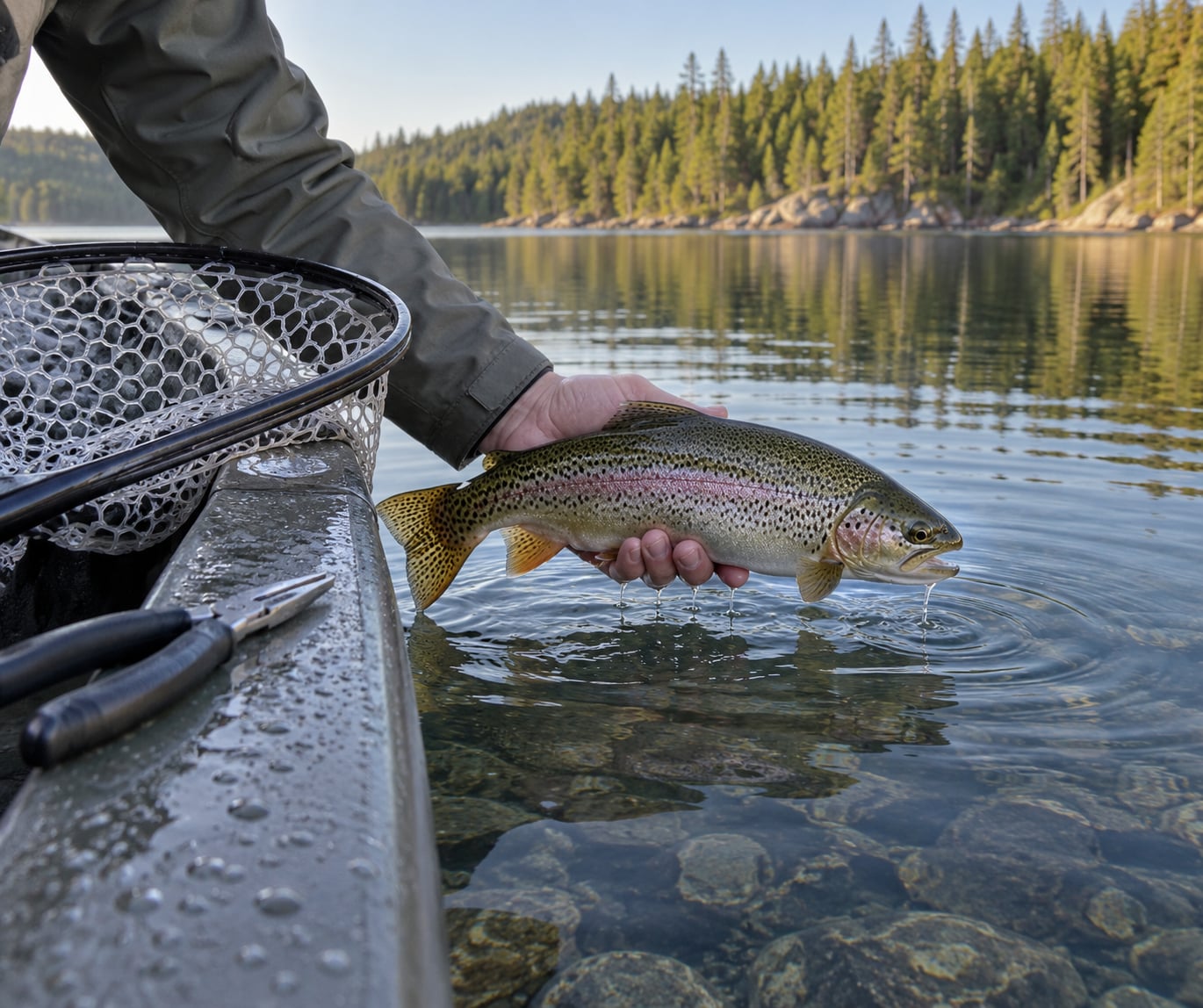
The safest way to release a fish without hurting it is to keep it in the water as long as you can, wet your hands before you touch it, support its whole body with both hands, and let it go only when it swims away strongly. Most damage happens in the ten seconds between the hook coming out and the fish going back in.
That sounds obvious, and most anglers do most of it by accident. The fish spends longer out of the water than anyone realises while somebody admires their own grip-and-grin photo, and the slime coat comes off on dry palms, and the fish is dropped a foot from the surface instead of lowered into it.
Here is what is actually going on physiologically. A fish’s skin is covered in a mucous layer that seals it against salt water, bacteria and parasites. Take that layer off with dry hands, a rubber net with nylon mesh, or a fish lying on the deck, and the fish is now an open wound. Add compressed gill filaments that lose their ability to move water across them the moment they dry, and you have a fish that has roughly minutes of useful life after release. Get it back in quickly and most of those fish live. Leave it out for the photo and a growing share do not.
Nothing here is complicated. It is a sequence, and once you run it the same way every time it stops being a decision you have to think about. The whole thing should take under a minute from hookset to swim-away if you do it well, and about five minutes of that is the fight and the landing.
Table of Contents
- What You Need
- Step-by-Step: How to Release a Fish Without Hurting It
- Step 1: Prepare the Release Area Before Unhooking
- Step 2: Wet Your Hands and Support the Fish Correctly
- Step 3: Remove the Hook Quickly and Gently
- Step 4: Decide Whether the Fish Can Be Released
- Step 5: Return the Fish to the Water Carefully
- Step 6: Let the Fish Recover Before Letting Go
- Step 7: Check Your Gear and Follow Release Rules
- Common Mistakes
- Frequently Asked Questions
- Final Release Check
What You Need
You do not need a boat full of specialist gear. You need somewhere to land the fish without dragging it, wet hands, and a way to get a hook out in under ten seconds.
| Item | What it does | When it matters |
|---|---|---|
| Soft knotless rubber landing net | Scoops the fish without scraping off the slime coat | Every fish you do not hook up and hand-land |
| Hook remover or long-nose pliers | Backs the hook out along its entry path instead of tearing upward | Any fish that is not landed in the net |
| Line cutters | Cuts the leader close to a deeply hooked fish so the hook stays in | Bait fishing, where swallowing is common |
| Wet hands plus a wet towel | Keeps your hands and the fish’s skin wet | Always. The towel is for the times your hands are dry |
| Shallow, clean water nearby | Gives you somewhere to unhook and revive without moving the fish far | Before you ever lift the fish out |
Skip the gloves. Anglers wear them because dry hands feel wrong, and the gloves make it worse. Cotton or neoprene across a fish’s skin drags the mucous layer off in strips, and the fish does not care how good your intentions were. If your hands are freezing, wet them anyway.
On nets, ignore the arguments. One popular page says never net a fish, another says always use a net, and both are half right. The real rule is about the mesh. A standard nylon net scrapes the slime coat like a cheese grater. A soft, knotless rubber net on a hoop gentler than the fish’s own dorsal fin will not hurt it, and landing a fish by hand in moving water is where people fall in. Net the fish.
Weight the tackle so you can land the fish instead of fighting it. A spinnerbait a trout runs with in three seconds, netted on the first attempt, leaves the fish with energy left to recover. Horse it for twenty minutes and you are releasing a fish that has already lost.
Step-by-Step: How to Release a Fish Without Hurting It
Step 1: Prepare the Release Area Before Unhooking
Get the release spot sorted before the fish is anywhere near the boat. Whether that is knee-deep water beside the bank, a shallow bay, or the edge of a current seam, you want to be able to put the fish in good water without dragging it across gravel to get there.
Stage the rest of your gear first. Reel in, net ready, pliers and line cutters in the same hand that holds the fish, and a clear path into the water. A fish that has been beaten in the water and then reeled in while you fumbled for pliers has already lost your best minute.
Step 2: Wet Your Hands and Support the Fish Correctly
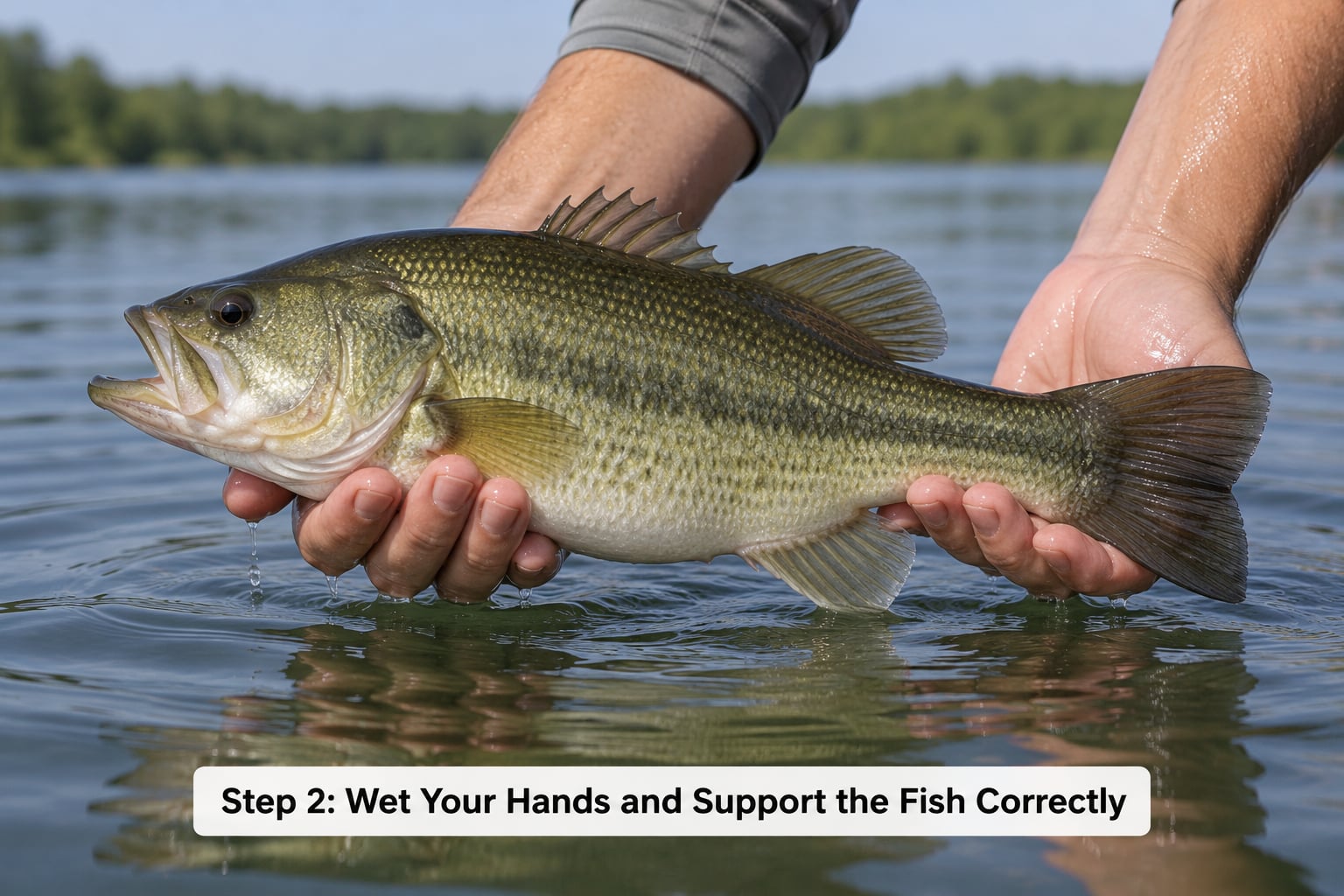
Wet your hands in the water before the fish comes up, every time. Then support the fish horizontally with two hands, one cupped under the belly just behind the pectoral fins and one under the tail section, and keep it level with the water.
Never hold a fish by the jaw alone, and never at a steep upward angle. A lower-jaw grip taken at a high angle puts the whole weight of a bass on a hinge that is not built to hang from, and that is how fish end up with broken or dislocated jaws. If you use a lip grip at all, it is a bass or pike, the fish is horizontal, the angle is low, and the grip goes on the outside of the lip rather than crushing through it.
Never grip the gill plates. They are delicate fans, and squeezing them injures the fish more than most hooks do. Experienced anglers working pike and muskie sometimes support them around the gill plate area for a very short time on big fish, but that is a controlled handling technique, not a shortcut, and it is not something to imitate with a trout.
Sturgeon, tuna and other fish with internal organs that can collapse under their own weight need a full cradle every time. Trout and salmon, the classic catch-and-release species, are fine cradled flat with the head slightly up. Catfish have venomous dorsal and pectoral spines, so your wet hands go on the body, nowhere near the spines. Bass, panfish and most lake species take the belly cradle without argument.
Whatever the species, you never lift a fish clear of the water, swing your arm back, and drop it. Everything you have just protected comes off in the impact.
Step 3: Remove the Hook Quickly and Gently
The best unhooking happens with the fish still in the water. If the fish is in a net in shallow water, work the hook out while the fish is submerged, using the net as a cradle rather than a bag. Slide your wet hand under it, support it, and back the hook out along the path it went in.
The motion matters more than the tool. Grasp the eye of the hook with pliers or a hook remover, twist it slightly to break the barb’s hold, and roll it back and down out of the mouth. Pulling straight up or yanking fights the barb and rips flesh, which is worse than a small puncture wound. Most hook wounds come from impatience, not from the hook.
If the barb is crimped flat, the job is easier still. Debate about barbless versus barbed is real and mostly not settled, but every fisheries agency guideline points the same direction: barbless hooks, or barbs pressed flat, are the least damaging choice when the fish is going back.
If the hook is deep, in the gullet, past the jaw hinge or swallowed, stop. Put the pliers down and cut the leader close to the hook, then release the fish. Digging a deep hook out tears the gill arch or the gut wall, and the injury from that surgery is far more likely to kill the fish than the hook itself. Many experienced anglers treat this as settled and do not even hesitate.
A fish that bleeds a little from a deep hook wound is not automatically dead. A small trickle of red from the gill arch usually stops within seconds, and hook damage far from the gills, the eye or the major blood vessels often heals. Bright red pumping blood means a serious arterial wound, and that is a different conversation.
Step 4: Decide Whether the Fish Can Be Released
Look at the fish before you decide, and decide on purpose. A fish that is upright, has steady colour in the gills, is breathing evenly and still has some fin response will nearly always recover if you put it in good water quickly. A fish that is limp, has pale or dark brown gills, no gill movement, or a distended body is in trouble no matter what you do.
Sturgeon and tuna get special mention because they carry their organs loosely, and the combination of a long fight and being hauled out can mean internal damage you cannot see. If the fish has been played for a long time and is a heavy-bodied species like those, weighing and keeping it is often the kinder call.
Some fish genuinely will not make it. If you can tell before release, ending it humanely and using it is a better decision than throwing a dead fish back to feed the herons. Do it deliberately, do it quickly, and do not pretend a fish that is already dead was a good release.
Step 5: Return the Fish to the Water Carefully
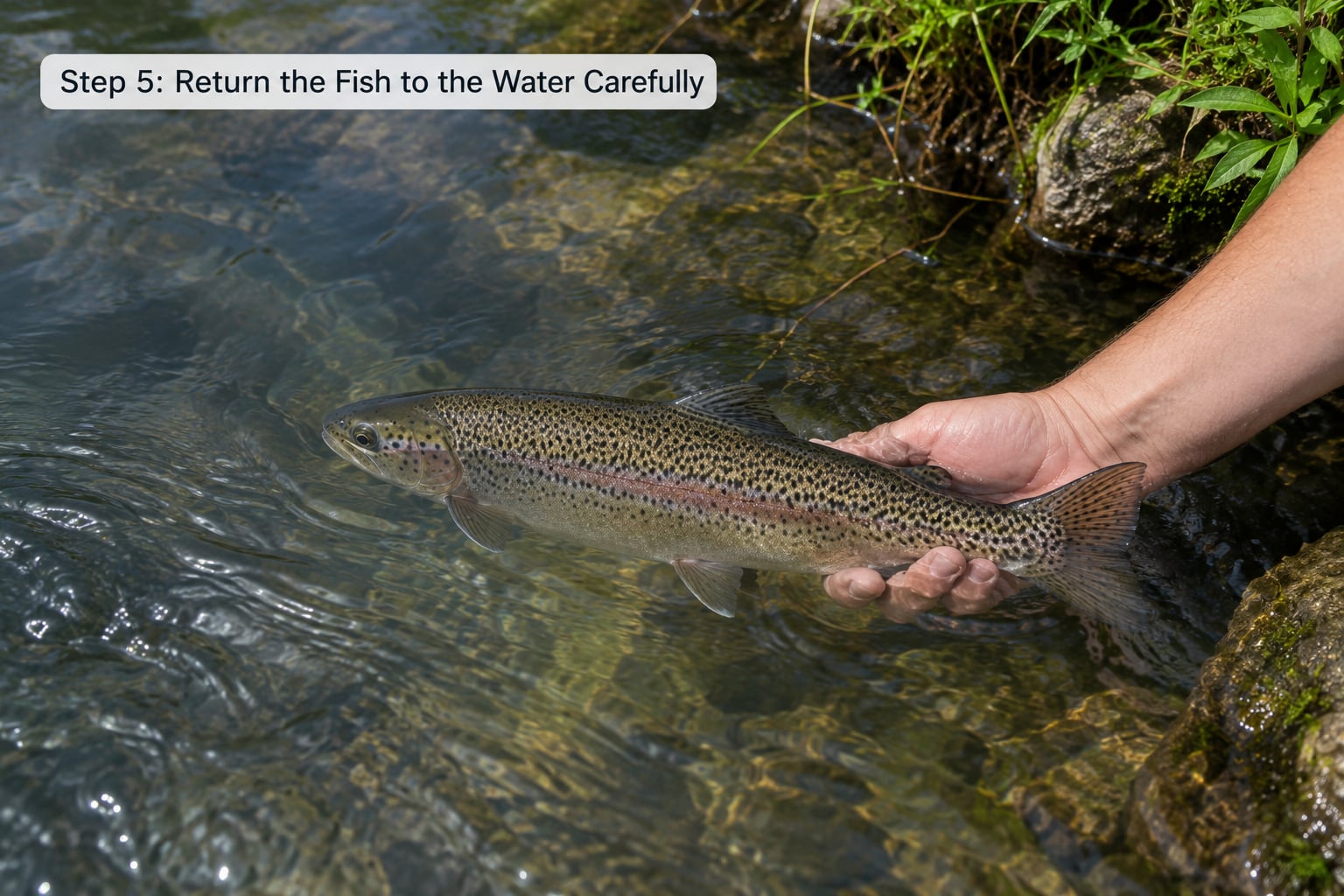
Lower the fish. Do not toss it, do not swing your arm back, do not drop it a foot onto the surface. Bring it down to the water, keep both hands under it, and let the water close over it while you still have the support.
In moving water, face the fish into the current with its tail pointing upstream so the flow pushes water over its gills and it can hold station. In a lake or pond where there is no current, move the fish gently back and forth, tail first, so water passes over the gills while the fish cannot accelerate. In an estuary, let the tide work and put the fish in water of the salinity it came from.
Do not force a spent fish into fast current, and do not release into the warm shallow back corner of a lake in July. Shallow water heats quickly and holds less dissolved oxygen, and a fish that cannot hold station in a dead calm will get picked off within hours. Move to the mouth of the bay, an undercut bank, or the cooler deeper edge nearby.
Step 6: Let the Fish Recover Before Letting Go
You are not finished when the fish leaves your hands. Watch it for a minute. A fish that is ready will right itself almost immediately, hold position against the current, and dart away on its own without a push.
A fish that needs more time will roll onto its side, or wobble repeatedly, or keep drifting. Keep it upright in the water and keep passing fresh water over the gills. In a river that usually takes a few seconds. After a long fight on a big cold-water fish, a couple of minutes is normal, and the fish will often push off while you are still holding the tail.
Two situations change the clock. In near-freezing air, exposed gill filaments freeze fast enough to stop working, so winter fish come out of the water for seconds rather than minutes. In hot water, the problem is the opposite. Above roughly 75°F, cold-water species such as trout, salmon and steelhead are already stressed, and every extra second of handling costs more than usual. Fish those waters at first light or after sunset in summer.
For photographs, the working limit is about ten seconds out of the water, done with wet hands, the fish held low and horizontal, and the camera already framed. Longer photo sessions are the single most common reason fish that looked like a good release later turned up dead.
Step 7: Check Your Gear and Follow Release Rules
Before you leave, look at the hook and the lure. A treble hook catches a lot of fish in the face and gills, and switching to a single hook on lures is one of the cheapest injury reductions available. Circle hooks with natural bait tend to hinge at the jaw and slide back out, which is why they are standard on many release waters. Crimp the barb if you will not change the hook.
Pick up the loose line. Trailing line left in the water is a lethal trap for everything else in the lake, not just your fish, and it is the one piece of litter that keeps killing after you go home.
Then check the rules for that specific water. Some waters are catch and release only, some have slot limits where a fish above a certain size must be released and one below it may be kept, and some have species seasons that close entirely. State DNR pages publish catch-and-release guidance for freshwater species, and the rules for 2026 are the ones that count on the water you are standing in. When a water is ambiguous, the number on the sign or the sign at the launch wins over anything written here.
Common Mistakes
Most released fish are lost to handling, not to the hook. Here are the errors that show up again and again, with the fix for each.
- Dry hands and gloves. Both strip the slime coat. Wet your hands in the water before the fish is in them, every single time.
- Squeezing too hard. A closed-fist grip around a fish’s midsection crushes ribs and organs. Support the weight with open palms, not fingers.
- A long photo session. Ten seconds, wet hands, fish low. Everything beyond that trades a fish’s life for a picture you already have.
- Tossing the fish back. A fish dropped onto the water loses its coat and can injure itself. Lower it with both hands.
- Pulling a deep hook out. Tearing through gill arch or gut wall does far more damage than the hook. Cut the leader, leave the hook in place.
- Releasing into strong current. A spent fish cannot swim upstream out of a seam and ends up pinned against rock. Use slack water at the seam or a quiet eddy.
- Putting the fish on the deck, grass or rocks. Never. The surface is where the slime coat dies.
- Weighing when measuring will do. A hanging weight or a sling fights the fish and adds handling time. A soft tape against a measuring board, then straight back in the water, is gentler.
- Gripping the lower lip at a high angle. A low angle on a horizontal fish. Any more upward than that and the jaw is on the line.
One last habit worth building. Whatever you change, change one thing at a time, because the mistake you cannot find is the one that is costing you fish. Keep wet hands in your head from the moment the fish is on. After that, the rest is mechanical.
Frequently Asked Questions
Should I release a fish immediately after catching it?
Get it back in the water as fast as you can, but not before the hook is out or the leader is cut. Ideally you unhook it while it is still submerged in shallow water, then revive it upright in the current until it swims away strongly. A fish released in ten seconds with a clean release survives far better than one rested for a minute on the bank first.
Is it better to use a barbless hook when I plan to release the fish?
Yes, barbless hooks are the least damaging choice, and crimping the barb flat on a standard hook is close to the same result. The tradeoff is that barbless fish often need a firmer set and the hook can come out and be re-hooked deeper. Research on hooking injury and state fisheries guidance both point the same way, so use barbless or crimped barbs whenever the fish is going back.
What should I do if the hook is deeply embedded in a fish?
Cut the leader close to the hook and leave the hook in the fish. Deep hooks sit near the gill arch or in the gut, and digging them out with pliers tears tissue that the hook alone would not have damaged. The hook rusts or is absorbed over time, and the fish has a much better chance than it would after surgery in the mouth. Never cut into the mouth, gills or flesh to reach it.
How do I stop a fish from jumping or twisting while I unhook it?
You cannot fully stop it, and trying to wrestle a thrashing fish is how injuries happen. Reduce the thrashing instead. Keep the fish supported horizontally in the water, work the hook out fast rather than slowly, and resist pulling the line tight while the fish has slack. Wading anglers who fight a fish to hand get far calmer unhooking than anglers who land it into a tight net.
How long should I hold a fish underwater after release?
In moving water, hold a spent fish upright in the current until it can hold its own, usually a few seconds to a couple of minutes. In a lake or pond with no flow, move it back and forth gently so water passes over its gills. Release it once it swims away under its own power, and if you have to push it, it is not ready yet. In freezing air, keep total air exposure to seconds.
Final Release Check
How to release a fish without hurting it comes down to a habit, not a technique. Wet hands, unhook in the water, two hands under the body, low and slow back into good water, and hands off until the fish swims away without help.
A release is not done when the fish leaves your hands. It is done when it is upright, breathing, holding position and gone. Everything before that, including the parts that feel like a small kindness to you, is still work the fish has to survive.