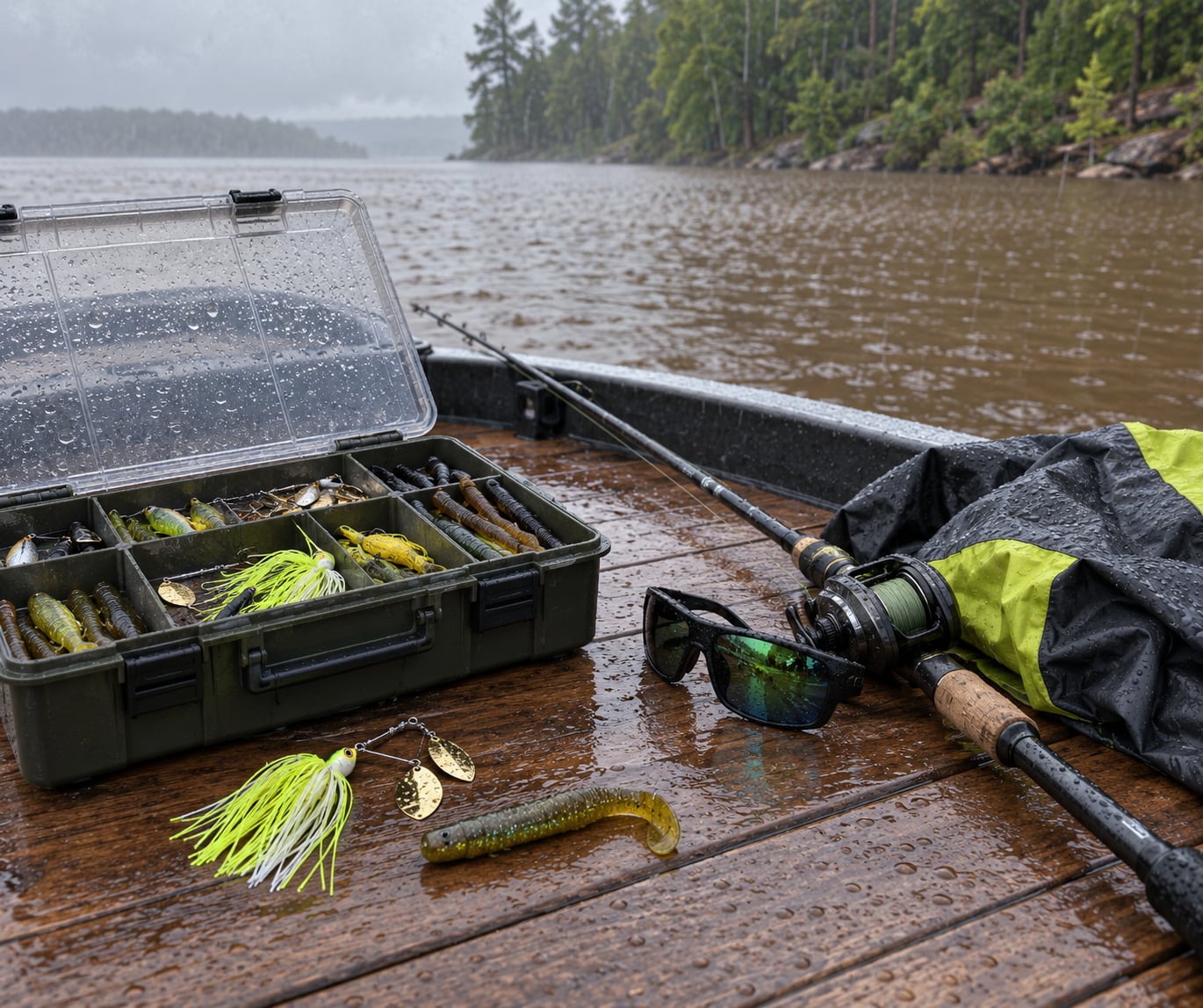
Bass in muddy water are usually easier to catch, not harder. When visibility drops below a foot or two, largemouth stop hunting with their eyes and start hunting with their lateral line, so the lure that pushes the most water and makes the most noise wins. A Colorado-blade spinnerbait, a rattling flipping jig, or a lipless crankbait fanned over the right cover will out-produce the small finesse lure most anglers reach for when they get spooked by stained water.
The trap is switching to tiny, quiet lures at the exact moment the fish can no longer see. Learning how to catch bass in muddy water comes down to reversing that instinct. Work the steps below in order and the stain becomes one of the easier conditions on the lake.
Table of Contents
- What You Need
- Step-by-Step
- Common Mistakes
- Frequently Asked Questions
- What is the best bait for catching bass in muddy water?
- Are dark or bright colors better for bass in stained water?
- Should you fish fast or slow when the water is muddy?
- What lure works best for bass after heavy rain?
- Does muddy water make bass feed more aggressively?
- How can you tell if a bass is holding near structure in muddy water?
What You Need
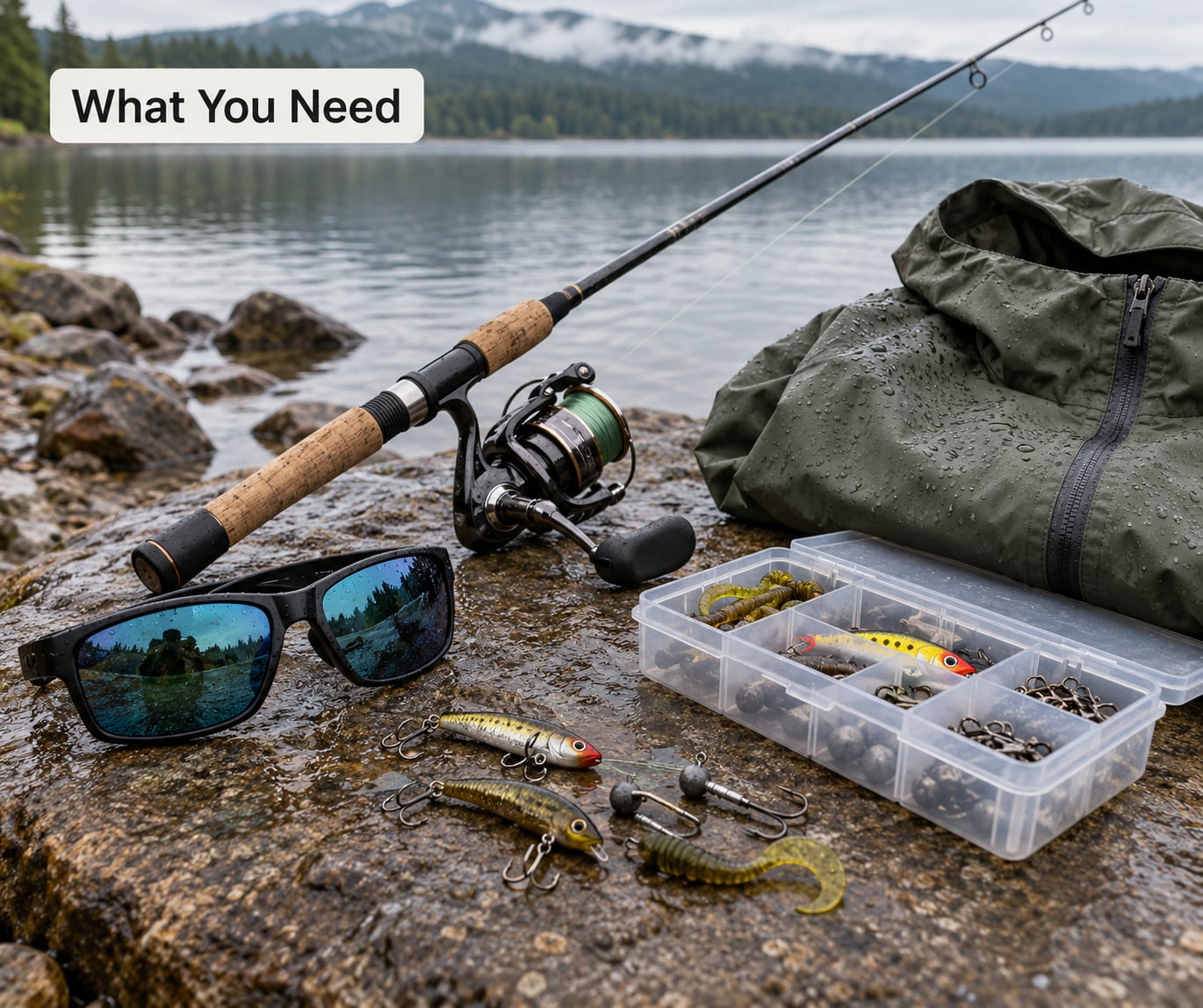
Tackle setup. A heavy or extra-heavy power rod in the 7-foot range gives you enough backbone to bury a hook when a bass runs through the pad, and a fast gear ratio helps you reel a tight hookset before a line-slack fish beats you there. Fluorocarbon or a 50 to 65 pound braid keeps the diameter low, which matters more than most anglers expect in 3 inches of visibility. If you use a leader, tie it on: a fluorocarbon leader between braid and a stout hook is the version most anglers land on.
Lures. Bring baits that make noise and move water rather than lures that rely on a fish seeing them. A spinnerbait with oversized Colorado blades, a chatterbait, a square-bill crankbait, a lipless crankbait, and a spoon each cover a different part of the water column. A jig head with a rattle inside the cavity adds an audible signal that carries further than the visual one.
Soft plastics. A paddle-tail swimbait, a creature bait with lots of appendages, and a straight or tapered worm rigged Texas-style give you a slow, quiet option for when the reaction baits go silent. Bulk and profile matter more than size here, and the appendages are what push water on a slow retrieve.
Terminal tackle. Wide-gap or weedless hooks, a few different weights, and a soft plastic you can reach without digging through the whole box. Expect to lose a few jigs in flooded brush, so bring spares.
Clothing and optics. Polarized sunglasses are the single most useful piece of gear in stained water, because they cut surface glare and let you pick out the darker shape of a submerged log or a grass edge. Rain gear matters too, since the best muddy-water window usually comes with the weather that created it. A handheld sonar is helpful when visibility is effectively zero, but it is a supplement, not a replacement for reading the bank.
One sizing note: on a small pond, a creek channel, or any water with heavy fishing pressure, dial the standard spinnerbait and chatterbait sizes down a notch. The vibration idea still applies, but a 3/8 ounce bait is usually plenty in a body of water where the biggest fish is a few pounds.
Step-by-Step
1. Read the Muddy Water and Find Productive Water
Stained and muddy are a spectrum, not a switch. Lightly stained water with a few feet of visibility still lets a bass color a lure at distance, while heavy turbidity from runoff can cut visibility to inches and put the fish entirely on feel. Decide which end of that spectrum you are fishing before you pick a bait.
Then ask where the water is going. Rising water after a rain event concentrates baitfish in the back of creeks and along flooded banks, and bass follow that concentration hard. Water that has just crested and started to stabilize is often even better, because the fish have been pushed into a smaller area and are now actively feeding on what got stranded. Once the water has been off color for three or four days and has started to drop, expect the fish to settle back into their summer structure and slow down with it.
Look for transitions rather than open mud. Creek channels feeding into a main lake, the edge of a flooded field, the seam where clear water meets stained water, a wind-blown bank pushing dirty surface water into a pocket, and the drop-off where a muddy flat falls off into deeper clear water all concentrate feeding bass. Wind matters as much as the rain: a strong south or west blow pushes surface debris and stained water into the lee shore, and that is usually the most productive water on the lake. If you only learn one thing about how to catch bass in muddy water, learn to work the edge where the two water colors meet.
2. Match the Bite to the Conditions
Different water states call for different levels of noise. The table below is the shorthand I keep in my head, and it covers most of what a boat box needs to hold.
| Water state | Bait to lead with | Why it works | Retrieve |
|---|---|---|---|
| Rising and very stained | Colorado-blade spinnerbait, rattling jig with a bulky plastic | Maximum vibration and audible noise; fish are aggressive and moving | Steady and fast with a pause or two |
| Stabilizing, moderate stain | Chatterbait, square-bill crankbait, paddle-tail swimbait on a jig | Works both the column and the cover as the fish settle | Consistent medium retrieve |
| Falling or stable, tannin stain | Lipless crankbait, spoon, Texas-rigged creature bait | Fish are less aggressive and hunting closer to structure | Slow, with long pauses |
| Heavy rain, actively pouring | Chatterbait tight to a bank, weighted soft plastic | Fish are holding tight and reacting to contact rather than chasing | Crawl it along the cover |
| Small pond or creek channel | Downsized spinnerbait, 1/8 to 1/4 ounce jig head | Keeps the vibration signal at a size the pressured fish will take | Slow and deliberate |
Natural bait is never wrong in stained water, and a chunk of bluegill or a shiner on a jig head gives you a profile the fish recognize from birth. The practical limitation is that you only get one or two chances per cast before the bait is gone.
3. Use Scent and Contrast That Bass Can Detect
Two separate problems live inside color and scent. Scent is a chemical signal that works at any visibility level, so a small amount of garlic or fish attractant on a soft plastic costs you nothing and sometimes produces a strike you would not have earned on the profile alone. Apply it to the body of the bait, not the jig head, because a scented metal head mostly just fouls your fingers.
Contrast is the other problem. A lure needs to break the silhouette in front of it, and in heavy turbidity a small natural-color bait simply disappears into the background. Bigger and bulkier is the reliable answer, which is why large dark plastics with blue flake, craw or creature bodies work so well in the murk. A solid dark profile in black, blue-black, or purple reads as a shape rather than a color, and that is what carries through stained water.
On very bright, sunny, high-light days, flip that and go high-contrast: chartreuse, white, or any bait that throws light. Visible is not the same as natural, and in low visibility the fish rarely have the option of being picky.
4. Fish the Right Depth and Cover
Stained water hides the fish from you, and it also hides your lure from the fish. The answer is to get the lure close enough that it is inside the strike zone without relying on the fish tracking it in from 30 feet.
Work the banks and the transitions between depth changes: a flooded bank line, the drop where a shallow flat ends, a creek channel, submerged timber, rock, a fallen tree, dock pilings, and any standing vegetation that flooded when the water came up. Those edges are where a bass has both an ambush position and a quick escape route.
Match the rig to the depth. In shallow flooded grass or brush, go weedless with a weighted soft plastic and a wide-gap hook, or a Texas rig with the hook tucked completely inside the bait. On a steep drop-off, a lipless crankbait or a spoon held off the bottom will run the column. In a creek channel, a jig-and-paddle-tail combo lets you work the edge of the channel as it drops off. Floating baits are worth a mention too, since a bass holding underneath will occasionally come up for one even in a stained lake.
5. Present the Bait So Bass Commit
How you move the bait matters as much as what it is. In low visibility, the fish cannot watch your lure, so it tracks the signal and reacts when the signal gets close enough to be threatening. Three presentations cover almost everything.
A consistent, medium-speed retrieve tells the fish the bait is alive and heading somewhere, and it gives the lateral line a repeating pattern to lock onto. Pauses change that: a stop-then-go sequence mimics a live baitfish that got scared, and the hesitation in the vibration is often what triggers the follow-up strike. Dragging or hopping the bait along the bottom produces intermittent noise and contact, which works well along a bank line in stained water.
Erratic movement is the third option, and it is the most useful one in heavy turbidity. Twitching, jerking, and sudden direction changes create bursts of vibration that a sight-feeding fish would never react to but a lateral-line hunter will. The closer you are to cover, the more erratic you should be.
6. Watch for Bite Subtle Signs and Set the Hook
Muddy water produces light bites, and most of them are missed by anglers who are waiting for a violent head shake. Watch the line, not the lure. Weight on the line that was not there a second ago, a hitch or stumble in the retrieve, the tip dipping while the rod stays still, or the lure suddenly changing direction with no help from wind or current all mean a fish is evaluating your bait.
When you feel one, stop the retrieve and let the fish load up. Let the rod do the work. The most common mistake in stained water is reacting to the hesitation by sweeping the rod early, which pulls the lure out of a fish’s mouth before it ever turned the corner.
7. Adjust When Nothing Is Biting
When the bite goes quiet, change one variable at a time and give each change a real chance. Ten minutes of a different retrieve is worth more than twenty casts of a different lure. That troubleshooting habit matters more in muddy water than anywhere else, because the feedback loop is slower when you cannot see what is happening below the surface.
Location. If you have not moved in an hour, move. Fish follow the stained water, the wind and the current, and the productive spot is rarely where the last one was.
Depth. A rising lake can push the fish onto a shallow bank line that was a foot under water last week. Try a different depth band before you change lures.
Presentation. If you have been working a reaction bait hard, drop the speed or switch to a slow Texas rig. Loud baits make neutral fish disappear.
Size and color. Go bigger and darker in heavy stain, and smaller in a pressured pond. That goes against the instinct most anglers have, which is to shrink the bait when the water gets dirty.
Time of day. Low light and overcast skies favor a high-contrast lure in bright water. Bright sun on a dark bottom favors a dark lure.
Effort. Working one good spot with three different baits beats running and gunning over ten mediocre ones. Stained water slows the feedback loop, so patience pays more than it does on a clear morning.
Common Mistakes
Shrinking the lure when the water turns. This is the single most common self-inflicted error. A small finesse bait needs a fish to see it, and a fish in heavy turbidity cannot. Bulk and noise are what make a lure findable.
Defaulting to topwater poppers. Poppers and jerkbaits are sight triggers. You can catch bass on top in muddy water with a noisy, larger surface bait worked with pauses and splashes, but a silent popper sliding across stained water is an offer nobody accepts.
Fishing too deep. Shallow flooded cover and banks are the first places to go when water rises, and the deep water that held fish last week may be empty. Cover the top half of the water column first.
Ignoring wind and current. The stained water and the loose cover are usually on the same side of the lake. Positioning yourself on the wrong side of the wind costs you the whole day, and so does ignoring the direction the current is pushing your lure.
Changing five things at once. New lure, new color, new depth, new spot, new retrieve. If the bite comes on, you will not know what did it. Change one thing, give it a fair test, then move to the next.
Quitting on the first spot. Fish in stained water are often a little harder to find but much easier to catch once found. The old rule of thumb still holds: move only after a spot has genuinely had a fair working, and move to better structure rather than to random water.
Frequently Asked Questions
What is the best bait for catching bass in muddy water?
The best bait in muddy water is the one that makes the most noise and displaces the most water: a spinnerbait with oversized Colorado blades, a rattling flipping jig paired with a bulky soft plastic, or a chatterbait worked tight to cover. Natural bait works too, but you get far more casts per trip with a lure. Match the size to the water, and downsize for small ponds.
Are dark or bright colors better for bass in stained water?
It depends on light level, not water color. On bright, sunny days with high light, chartreuse and white throw enough light to be seen. On overcast mornings or low-light evenings, go dark and solid: black, blue-black, purple, or a large dark plastic with blue flake. The rule is contrast against the background, and bulk helps in both cases.
Should you fish fast or slow when the water is muddy?
Fish medium and consistent while the water is rising and the fish are aggressive, then slow down as the water stabilizes and they settle. In stained water the fish is tracking your lure with its lateral line rather than watching it, so a steady rhythm that puts vibration within strike range beats a frantic one. Add pauses and erratic movement rather than simply speeding up.
What lure works best for bass after heavy rain?
A spinnerbait with big Colorado blades while the water is actively rising, since the fish are aggressive and moving onto flooded cover. Once the water crests and stabilizes, switch to a chatterbait, a square-bill crankbait, or a weighted soft plastic worked along the bank line. Flooded grass and shallow structure hold the feeding fish during the whole event.
Does muddy water make bass feed more aggressively?
Yes, usually. Rising muddy water means more food in the system: baitfish pushed out of shallow cover, insects and craws displaced, and oxygen dropping in the shallows. Bass feed harder in stained water than they do on a clear calm morning. The exception is after several days of stable off-color water, when the fish have adjusted and go back to a slower pace.
How can you tell if a bass is holding near structure in muddy water?
You usually cannot see the fish, so you read the structure instead. Look for a break in the bottom type, a dark shape under the surface, the edge of a grass mat, a submerged log, or current seams and debris lines. With polarized glasses you can often pick out the shadow before the fish moves. If visibility is under a few inches, go by depth changes and wind-blown cover and trust the pattern.
If you remember one thing, make it this: muddy water is a location and presentation problem before it is a lure problem. Find the stained edge, the wind-blown bank or the flooded structure where the fish are stacked up, then give them something bulky and noisy on a retrieve that puts vibration inside the strike zone. Work one spot properly, change one variable at a time, and the water color stops mattering.