
Fish usually don’t stop eating at midday. They stop chasing. Bright overhead sun removes the ambush advantage gamefish rely on, warm surface water holds less oxygen, baitfish tuck into shade instead of moving openly, and boat traffic peaks. The same fish are still feeding, just harder to find and far lazier about committing to a lure.
If you’ve ever put in a full morning of catching and then watched it fall apart after lunch, you already know the shape of the problem. It’s not that the lake turned off. It’s that you were working the water one way in the morning and kept working it that way at noon.
Table of Contents
- Why Fish Stop Biting in the Middle of the Day: Light, Heat, and Oxygen
- What Other Conditions Can Trigger a Midday Fishing Slowdown?
- Do Different Fish Species Bite Better at Midday?
- How to Tell Whether Fish Are Present but Not Biting
- What Can You Do When the Bite Slows at Midday?
- Frequently Asked Questions
Why Fish Stop Biting in the Middle of the Day: Light, Heat, and Oxygen
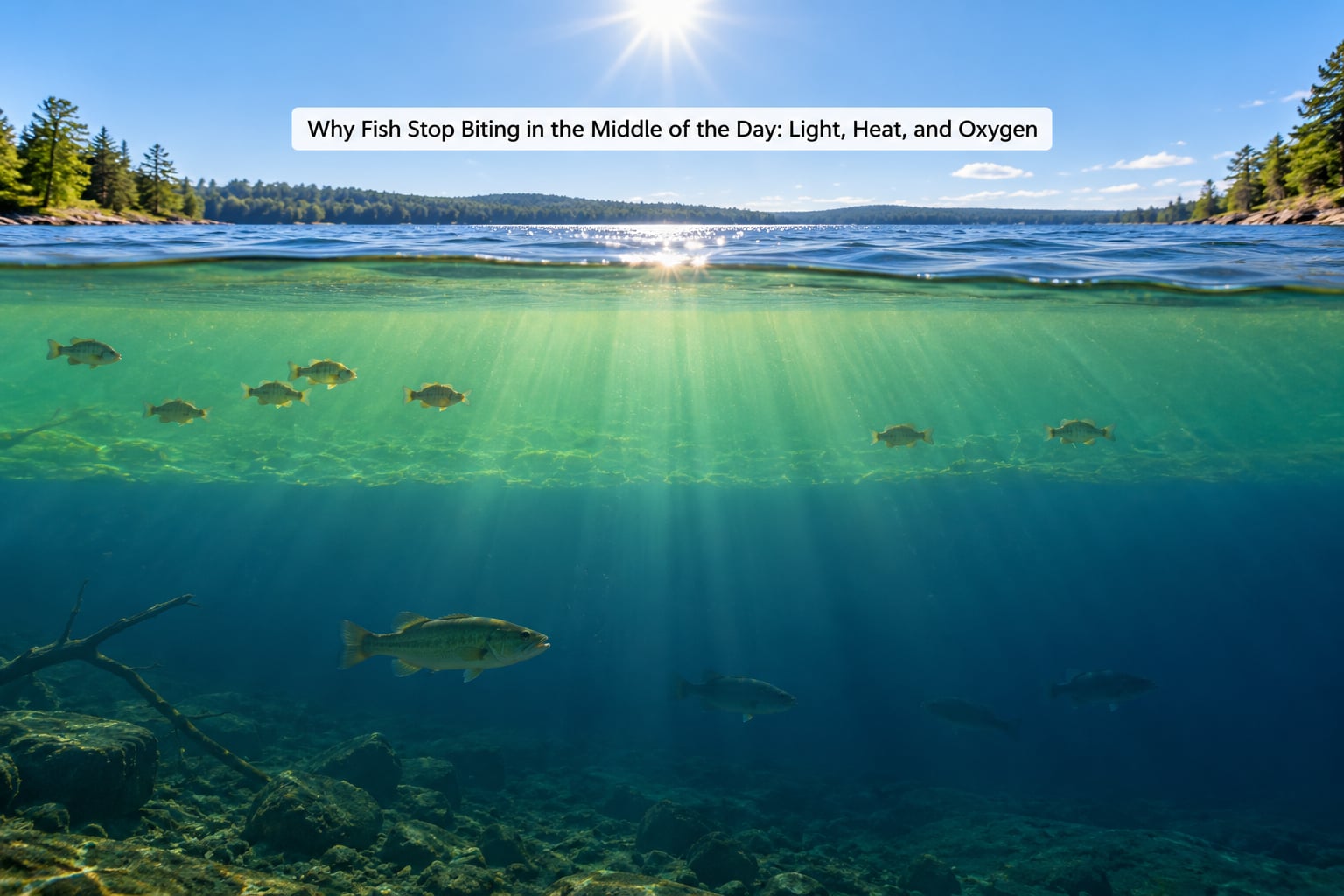
Three things change on your lake between 10am and 2pm, and they rarely change one at a time. Light gets harsher and more vertical, surface water gets warmer, and a warm surface layer holds less oxygen. Stack those together and the answer to why fish stop biting in the middle of the day is usually a combination of all three rather than a single culprit.
The useful mental model is that fish are not hiding. They relocated. In the morning you found them by casting at visible structure and watching for cruising bait. At noon they’re holding tight to shade, sitting a foot or two under a thermocline, or pinned behind a stump in 12 feet of water. Same fish, different address.
How Sunlight Changes Fish Behavior
At low sun angles, light comes in at an angle and everything has a shadow side. As the sun climbs, shadows shorten and disappear, and the whole lake turns into one bright, even, exposed stage.
That matters because gamefish are ambush predators. Striking a lure is a decision made in a split second, and a predator needs visual separation between itself, the bait, and the surface. Flat overhead light erases that separation. It also makes fish visible from above, to birds and to anglers at the same time.
Clear water makes the problem sharper, not softer. On a stained lake with green water, light scatters and the effective depth of vision is short, so a fish can’t see far enough to spook easily. On a clear flat-bottom reservoir, line visibility might be 30 feet or more, and a wary fish will refuse a lure it can see sitting in open water.
Shade becomes structure. A dock, a standing tree, a deep drop-off that puts the bottom in shadow, the shaded side of a rock wall — these hold fish because they cut the light rather than because the fish is hiding from predators alone. The shadow line at the edge of a shaded flat is one of the most reliable midday spots on any lake.
How Heat and Dissolved Oxygen Slow the Midday Bite
Warm water holds less dissolved oxygen than cold water. That’s basic physics, and it’s why a shallow weedy lake in July can be genuinely tough on fish while a deep reservoir barely notices summer. Add the fact that water heated from above releases oxygen as it warms, and the top few feet of a lake often hold the least usable oxygen at exactly the time the sun is strongest.
Fish are cold-blooded. Their metabolism, digestion and activity all track water temperature, so as the surface warms, their feeding slows into what anglers call a feeding band. Below that band they still eat, but they conserve. That’s the whole explanation for fish stop chasing but keep eating — a fish sitting at 80 degrees isn’t looking for a fight with your crankbait, but it will pick off a small baitfish drifting past its nose.
As the water warms, fish also descend. On a stratified lake you often get a warm, oxygen-poor surface layer sitting on top of cooler, better-oxygenated water, with a transition between them called the thermocline. Fish commonly sit just below that layer, where they get cooler water without descending into the cold. The best midday depth is frequently tied to the thermocline rather than to any fixed number of feet.
There’s a seasonal flip to this. In spring the surface warms fast and the shallows become the best water on the lake. In late summer and fall the surface cools, turnover mixes the water column, and the pattern reverses. Working a shallow summer pattern in October is working the wrong layer for the lake’s current temperature, not because midday changed.
What Other Conditions Can Trigger a Midday Fishing Slowdown?
Light and temperature explain most midday slowdowns, but a handful of other conditions either add to the problem or occasionally cancel it out. The table below covers the ones worth checking before you decide the fish are gone.
| Condition | What it does to the bite | What to look for |
|---|---|---|
| Cloud cover | Softens light, usually improves midday fishing | Overcast or foggy afternoons are noticeably easier than bluebird ones |
| Wind on the surface | Rough water breaks up light and sightlines, often a strong midday help | Light chop on a normally clear lake wakes up a dead midday |
| Approaching storm | Can tighten the bite right up to the squall line | Fish feeding hard just before rain, then stopping as it hits |
| Cold front | Drops water temperature and often pressure together; usually kills the bite | Barometer falling steadily, wind shift to north, surface churning |
| Barometric pressure | Rising pressure tends to firm up fish; falling pressure before a front is variable | Trend matters more than the number on any single reading |
| Water clarity | Clear water amplifies the slowdown; stained water softens it | Compare a fish you can see at 30 feet with one you can barely spot at 10 |
| Current and tide | Moving water concentrates forage and usually helps; slack water slows the bite | Current running between structure and a nearby edge rather than flushing over it |
| Baitfish movement | Baitfish sitting still in shade means gamefish stop chasing entirely | Birds working a surface pocket, or a pod of baitfish pinned under a dock |
| Spawning activity | Can produce either the most aggressive fishing of the spring or a protective shut-down | Females guarding a bed, or a cluster of fish milling over gravel |
| Boat traffic and pressure | Shallow clear water gets hammered between 11am and 3pm | Constant engine noise in the shallows you’re working |
Read the table as a stack, not a list. A calm, clear, hot, cloudless, heavily trafficked shallow lake is the worst midday combination there is. The same lake with a southeast wind and an overcast sky can fish well at noon.
One community detail worth knowing: anglers on bass boards and fishing forums often describe heavily-hit fish stopping to feed as a defense mechanism, which produces no-bite cycles of roughly 20 to 30 minutes rather than a full-day shutdown. So if you’re catching fish at 11am and then getting nothing for half an hour, that gap may not mean the bite is off. Wait it out before you abandon the spot.
Do Different Fish Species Bite Better at Midday?
Midday is not equally hard for everything in the lake. Species differ in the temperature range they feed best in, how much light they tolerate, and how low their oxygen tolerance goes. The temperature numbers below are the ranges experienced anglers describe for consistent feeding; a fish outside its band is still alive and still eating, just not chasing.
| Species | Feeding temperature band | Midday behavior |
|---|---|---|
| Largemouth and smallmouth bass | Approximately 60-80F | Move deep, tight to the shade line and the deepest cover on the lake |
| Trout | Approximately 50-65F | Least likely to feed at midday in heat; seek seeps, inflows and deep cold pockets |
| Walleye | Approximately 60-75F | Already light-sensitive, so they hold on deep structure and feed around it |
| Crappie | Approximately 65-80F | Spend midday suspended or hanging over structure; bite best when a small bait is held still |
| Bluegill and other panfish | Approximately 65-85F | The most likely species to keep feeding through midday, often right next to cover |
| Catfish | Approximately 70-90F | Strongest midday bite of any common lake species; become active in the hottest water |
| Pike and pickerel | Approximately 60-75F | Hang in shade and weed edges; ambush rather than chase |
The pattern across that table is worth stating plainly. Warmwater fish tolerate midday better than coolwater fish. Catfish and panfish can genuinely improve as the day heats up, while trout in a warm shallow lake can shut down almost completely. If you’re locked into a midday window on a lake with a strong catfish or panfish population, the answer isn’t to force the bass pattern — it’s to fish the species that like the heat.
Depth tolerance matters too. A lake with a soft muddy bottom holds more oxygen in the sediment and tolerates heat better than a lake with a lot of rock and gravel, which can go anoxic in shallow coves during a heat wave. If a shallow cove feels empty at noon, that may be why, and no amount of lure adjustment fixes it. Move to the main basin.
How to Tell Whether Fish Are Present but Not Biting
Beginners with day jobs often tell themselves the bite being off means they are doing something wrong. Sometimes it is. The difference is usually visible if you run a fixed order instead of randomly casting at everything.
Check the water first. Read the surface temperature on a thermometer or a fish finder. If it’s already past the species’ feeding band, you are not chasing a bite today, you’re chasing a cooler layer of water.
Check the oxygen where you are. A dissolved oxygen meter is cheap and it settles arguments. Readings below about 5 mg/L are enough to push fish out of a warm pocket, and readings above 7 mg/L mean a shallow flat will usually hold fish even at midday.
Then check for signs rather than guessing. Working birds, a boil on the surface, a pod of baitfish you can see or a few fish hanging under a piece of cover. Repeatedly catching small fish of the wrong species is still fish activity, not an empty lake.
Next, verify your tackle before you blame the fish. Check that the hook is not buried, the line is not dragging, and the lure is not sitting nose-down. A lure hanging motionless with its belly full of water is a common reason for “no bite all day,” and it has nothing to do with light or temperature.
Finally, test the presentation. One slow, quiet cast of the smallest bait you own, allowed to sit motionless for 30 seconds, tells you more than twenty fast aggressive ones. Anglers say repeatedly that when the bite is off, the smallest bait you can carry or a live bait is what recovers the session. If that works, the fish were there and the problem was matchability. If it makes no difference, you are in the wrong place at the wrong depth.
What Can You Do When the Bite Slows at Midday?
Work down this list in order. Each move tests one explanation, and the result tells you which cause is actually in play.
- Move to shade. The shaded side of a dock, a standing tree line, a deep wall with the bottom in shadow, the shaded edge of a flat. If a single move fixes the bite, light was the main cause.
- Go deeper or find the thermocline. Drop below the warm surface layer and look for the transition where the temperature drops. If the bite comes back at 18 feet and dies at 8, temperature is the cause.
- Drop to the smallest bait you own. Natural bait, a small jig, or a light spinnerbait worked slow. This covers fish that are feeding but no longer chasing.
- Slow everything down. A longer pause, a slower reel, a softer plastic. Midday fish are in a conserving mode and react to low-energy presentations.
- Target a different species. If the lake has panfish or catfish in it and you’ve spent the day on bass, this is the cheapest fix available.
- Wait it out and return to the morning water. The evening pattern usually rebuilds within an hour or two of sunset, and often runs well past it. Many anglers report that the after-sunset bite is the best of the whole day.
If you only have a midday window, work in this order: check the species table and fish what likes the heat, go to a wind-blown bank or a shaded edge, get as deep as the structure allows, and fish the smallest slow bait you have. That is the sequence experienced midday anglers converge on, and it works on water most beginners haven’t fished before.
One thing worth knowing if you fish at midday because of work: some anglers argue peak bite windows can fall in the middle of the day around tide changes or moonrise and moonset, not just at dawn and dusk. It’s not a reliable planning tool, but it explains a few midday sessions that defy every other rule.
Frequently Asked Questions
Is barometric pressure the main reason fish stop biting at midday?
Usually not. Pressure explains a bite that is off all day or right after a front, not one that switches off around 11am and rebuilds after 4pm. That pattern points to light, temperature and dissolved oxygen. Read pressure as a trend rather than a number, and treat a steady rise with a north wind as a bad sign for the whole day.
Should I move deeper or find shade when the midday bite slows?
Try shade first, because it’s the cheaper move and it often works in a single cast. If fish are hanging on structure but ignoring everything, drop deeper until you find cooler water, ideally just below the thermocline. If shade and depth both fail, the problem is likely presentation or species rather than location.
Can cold water cause fish to stop feeding during the day?
Yes, but the mechanism is different. In cold water, metabolism slows and fish feed less overall, though they are often willing early and late because the light is low. Overcast winter midday fishing can be productive precisely because the light stays soft. In cold water, expect shorter, slower bursts rather than the midday shut-down you see in summer heat.
How long should I wait before changing lures or locations?
Give a spot about 20 to 30 minutes of committed effort before leaving, since fish that were feeding often cycle off and come back. If you get nothing there, change location before you change lures. If you keep catching fish of the wrong size or species, that’s location. If you get nothing at all across several spots and depths, then go smaller and slower.
What time of day do fish usually become active again?
Most lakes start rebuilding in the last hour or two of daylight and stay strong into dusk, often for an hour after sunset. In summer, feeding activity typically fades between 10am and 2pm and returns as the surface cools. In spring and fall the windows are wider, and coolwater species like trout can feed well into the afternoon.
Start with light, temperature and oxygen, in that order. Check the water temperature against the band for your target species, look for shade and depth, then drop to the smallest slow bait you own before you decide the lake is dead. Fish stop chasing at midday far more often than they stop eating, and the ones that are still feeding are usually somewhere a shade line and a cooler layer of water overlap.