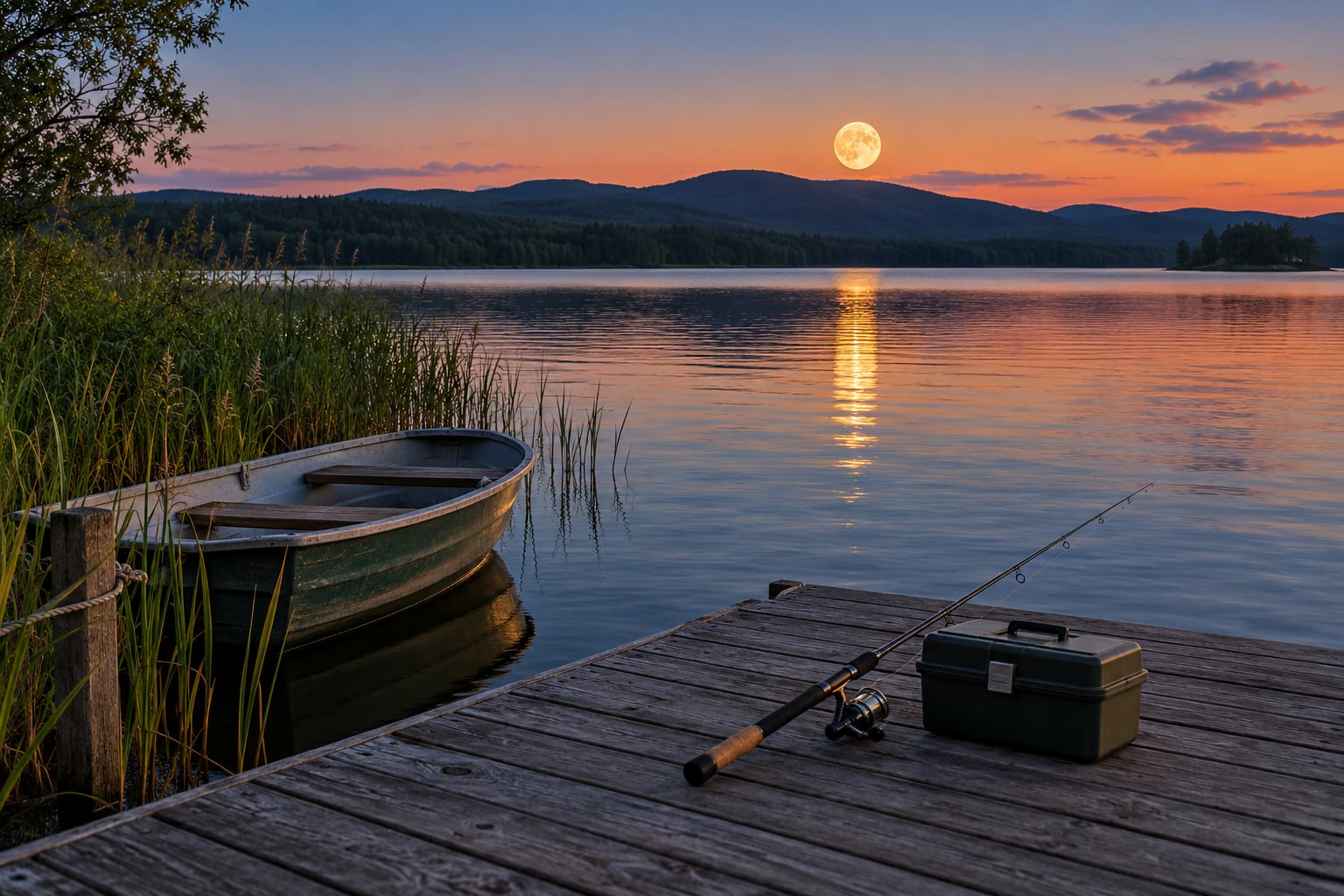
The honest answer on how moon phase affects lake fishing: it changes the light level at your bank, which nudges when baitfish move and when predators commit to feeding, and it decides how well you can see your own line at midnight. That is a planning clue, not a switch you can flip for a full day of fish. On a lake with no meaningful tide, the moon’s influence is real but small.
The reason it gets argued about so loudly is that anglers plan entire weekends around a lunar calendar, then either catch well or catch nothing. The bite gets blamed on the moon when water temperature, a passing front and wind did most of the deciding. Sorting out which part of the moon actually matters takes an hour of reading and saves whole wasted Saturdays.
Table of Contents
- Does Moon Phase Affect Lake Fishing?
- How Moon Phase Affects Baitfish and Predators
- What Happens During Each Moon Phase?
- Which Fish Are Most Affected?
- Why Local Conditions Matter More Than the Moon Alone
- How to Plan Fishing Trips by Moon Phase
- Common Moon-Phase Fishing Myths
- Frequently Asked Questions
- Is fishing better on a full moon or a new moon?
- Which freshwater species are most likely to react to moon phases?
- Do fish feed at night during a full moon?
- Does barometric pressure matter more than the moon for lake fishing?
- Should anglers use a moon-phase calculator for inland lakes?
- How does the moon phase affect fishing in non-tidal lakes?
- What Should an Angler Do First?
Does Moon Phase Affect Lake Fishing?
Yes, but indirectly and modestly. Moon phase changes how much light reaches the water at night, which shifts baitfish depth and movement, affects how easily predators see both prey and anglers, and lines up with spawning activity. Lakes have no real tide, so treat the lunar calendar as one input among several rather than the deciding factor.
Split the question into three pieces and the argument mostly dissolves. First, light. Second, movement of bait and the timing of feeding windows. Third, the angler sitting in the dark at two in the morning. The first two are fish biology and the third is a human factor, and the third is honestly the strongest and least discussed.
How Moon Phase Affects Baitfish and Predators
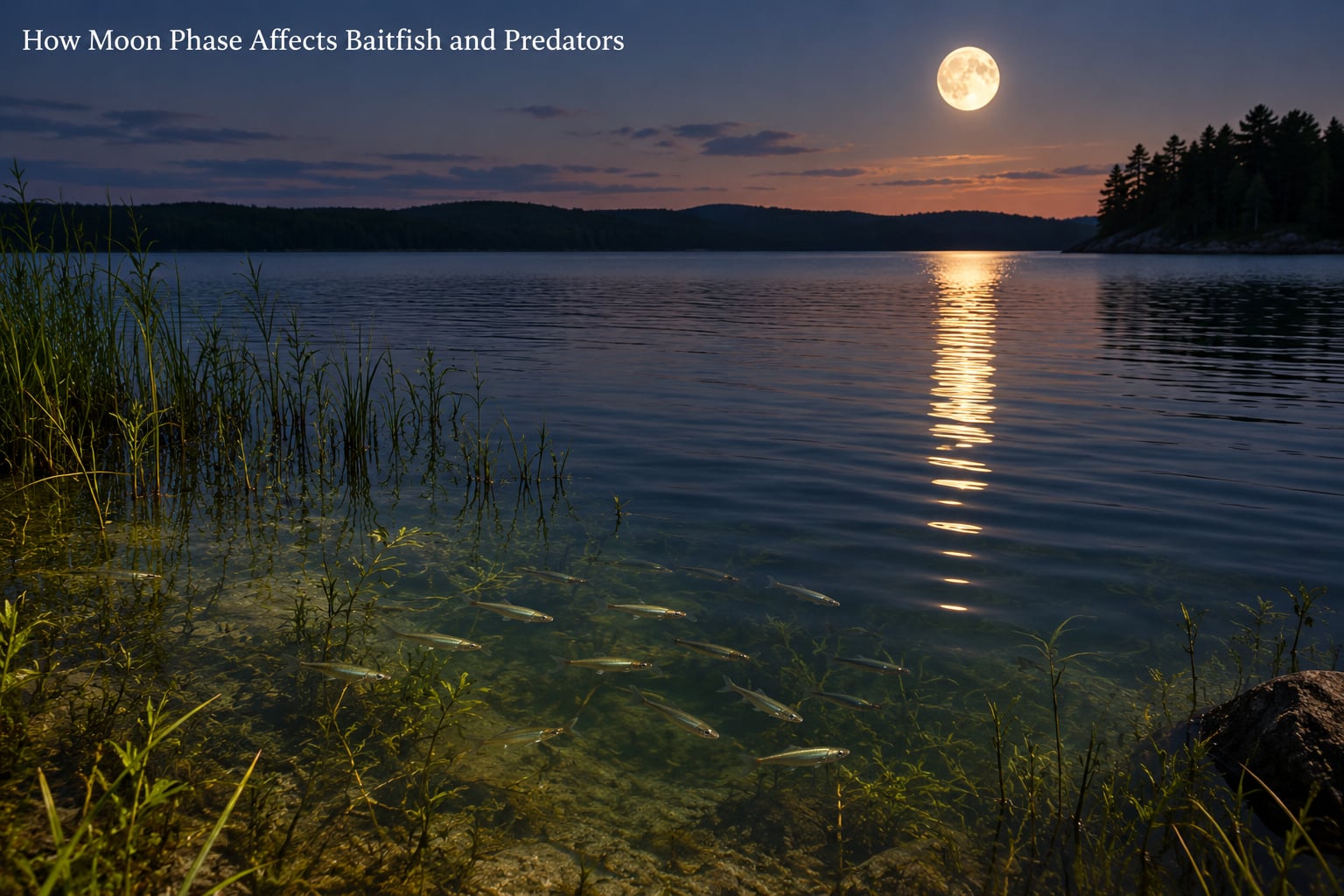
Nobody has ever watched a fish and seen it react to gravity. The proposed mechanisms are all indirect, and it helps to keep them sorted by how much evidence sits behind each one.
Night-time light levels
This is the mechanism with the most support. Under a new moon the water goes genuinely dark, and baitfish that avoid being silhouetted against a bright sky have little reason to stay shallow. Predators that hunt by sight lose their edge and push toward structure, or shift to sound and smell. Under a full moon the picture flips: baitfish can be seen against the lit surface, so they drop deeper or hang in shade, and the predators that can still make out a shape go hunting.
Baitfish behaviour and movement
Small forage species respond to light changes faster than big predators do. Minnows and shiners commonly shift depth by a few feet between a bright-moon night and a dark-moon night. When those baitfish move, everything above them in the food chain adjusts within a day or two, which is why a strong lunar effect shows up as timing rather than as a sudden change in how many fish live in the lake.
Tidal movement, where it exists
On salt water, moving water is the dominant mechanism and the moon phase sets its strength. Inland lakes have tides on the order of centimetres, and a lake with an outflow or dam release can show more water movement in an afternoon than the moon produces all month. Anglers who transfer tidal thinking to a lake are usually reasoning from the wrong model.
Pressure and internal timing
Fish do keep circannual and circalunar rhythms, and barometric pressure swings genuinely do move feeding activity. The honest position is that a lunar influence through pressure or biological clock is plausible and hard to separate from ordinary weather noise in real lake data. Treat it as a background hum, not a control panel.
What Happens During Each Moon Phase?
The lunar cycle runs about 29.5 days and splits into eight named phases. Illumination is the share of the moon’s lit half visible from Earth, and at night that is roughly how much natural light reaches open water on a clear night with no cloud cover.
| Phase | Illumination | Night light | Typical opportunity | Best target |
|---|---|---|---|---|
| New moon | 0% | Darkest | Slow daytime feeding, tight night windows near structure | Panfish, crappie, catfish in cover |
| Waxing crescent | 1 to 49% | Low, growing | Baitfish starting to move shallow, feeding picking up | Bass on grass and points, perch |
| First quarter | 50% | Moderate | Balanced, dependable mid-range activity | General angling, low-pressure wind days |
| Waxing gibbous | 51 to 99% | Bright and rising | Increasing night light, bait hugging deeper edges | Predators working drop-offs and weed lines |
| Full moon | 100% | Brightest | Strong night bite for many anglers, easier to see and cast | Walleye, muskie, bass at night, catfish |
| Waning gibbous | 99 to 51% | Still bright | Often the most productive stretch, bright nights with settled weather | Predators, topwater at night |
| Last quarter | 50% | Moderate, falling | Declining light, fish distributing back out | Mid-lake and channel fish |
| Waning crescent | 49 to 1% | Lowest | Dark nights, cautious fish, sound and smell matter more | Lake trout, night walleye, catfish |
Two cautions on that table. Cloud cover erases the entire lighting column, because a heavy overcast on a full moon is darker than a clear new-moon night. And the moon’s position in the sky moves about fifty minutes later each day, so the phase says nothing about whether the moon will actually be up during your fishing window. Check moonrise and moonset separately.
How Moon Phase Affects Lake Fishing on a Full Moon
A full moon raises night light to its annual maximum. That helps anglers see, cast and walk, and many predators use the same bright surface to hunt baitfish that scatter shallow. Anglers who fish nights often plan around it deliberately, picking clean, well-lit access points and working deeper edges where bait concentrates instead of chasing open shallows.
There is a real cost. Predators that can see a silhouette are better at avoiding a lure, and light makes it easier for a fish to spot anything moving near the surface. Anglers who prefer dark nights report better results on the waxing and waning crescents in the same water on the same week. Both camps can be right on the same lake.
One more detail worth knowing: baitfish activity often tracks moonrise and moonset specifically rather than the calendar phase. The window just before a full moon rises is a common angler favourite, and moon overhead or moon underfoot times mark when the moon crosses the local meridian or sits opposite the sun. Those two clock events are the parts of a solunar table that mean something concrete.
Which Fish Are Most Affected?
Species respond differently because they hunt in different ways, at different depths, and on different schedules. Sight-feeding predators at the surface tend to show the strongest response to night light. Fish that hunt by smell and sound in the dark barely care.
| Species | Lunar response | Phases that most often pay off | Notes |
|---|---|---|---|
| Walleye | Moderate | Full moon and waxing gibbous nights | Low-light feeder; bright nights compress activity into tighter windows near structure |
| Muskie | Moderate | Full moon, waning gibbous | Big water and big baitfish concentrate activity around moonrise and moonset |
| Northern pike | Mild | Full moon nights | Ambush predator, often more driven by water temperature than phase |
| Largemouth and smallmouth bass | Mild to moderate | Waxing gibbous through full, night trips | Spawn timing overlaps the waxing half of the cycle in many northern lakes |
| Crappie | Weak but repeatable | Waning crescent and new moon | Very sensitive to light levels; tight to cover either way |
| Trout | Weak | None consistently | Cold-water behaviour is driven by temperature and oxygen far more |
| Channel catfish | Weak | Full moon nights | Olfactory feeder; any bright night simply means better angler conditions |
| Panfish | Moderate in spring | Dark and bright nights alike | Spawn and warming water dominate; phase mostly changes where they sit |
Read that table as a starting hypothesis for your own water, not a rule. A shallow, clear, northern lake with a strong baitfish forage base will show bigger lunar swings than a deep, stained southern reservoir with a threadless forage base. Same phase, same species, different water, different result.
Why Local Conditions Matter More Than the Moon Alone
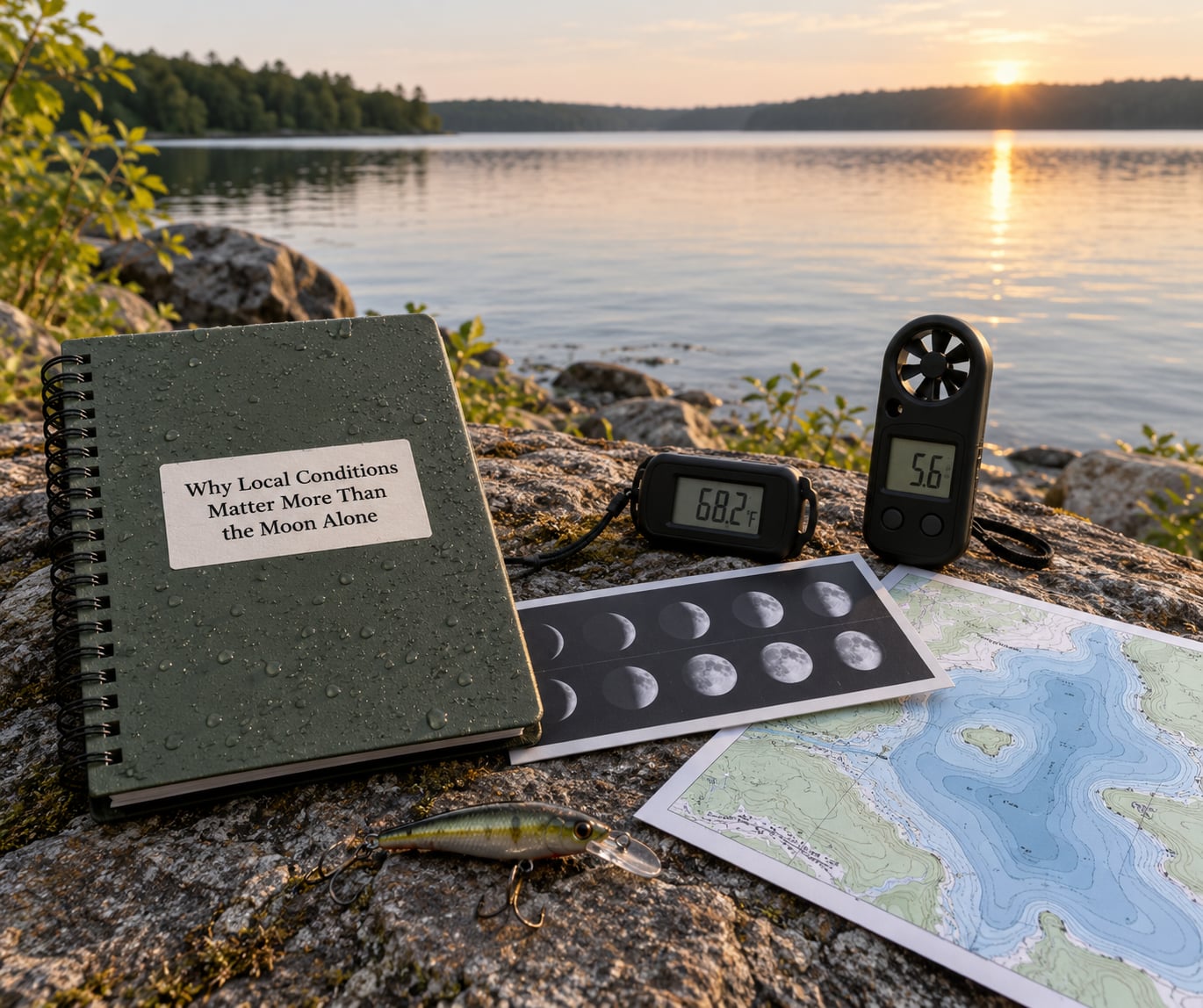
Roughly speaking, four fifths of a productive fishing decision is species plus water plus structure. The moon sits in the remaining fifth alongside temperature and timing. A few local variables will happily reverse a lunar expectation.
Water temperature and the spawn window
Temperature sets metabolism, oxygen demand and where baitfish live. When a lake is on the move from 50 to 58 degrees, nothing about the moon matters as much as where the forage went. Lunar effects show up most clearly during that transition, and least clearly in stable cold water.
Wind and fronts
Wind pushes baitfish into the windward half of a lake, churns the surface and makes low-light feeding worse for everyone. A cold front with falling pressure usually suppresses feeding before, during and shortly after it passes. A bright full moon the day after a front will not rescue a bad window.
Barometric pressure
Rising pressure in the 30-plus range and a steady drop ahead of a squall both quiet fish down, and anglers usually notice the pressure pattern more reliably than they notice phase.
Clarity and dissolved oxygen
In clear water, light penetrates deep and a bright night pushes bait further down, which can make a lunar response obvious and predictable. In stained or heavily forested lakes, the surface goes dark early regardless of phase, and light stops being a useful variable. Warm, algae-heavy shallows also drop oxygen overnight, pushing fish to cooler structure and muddying any clean lunar story.
Water level and current
On a dam-controlled lake, a release schedule will move baitfish and any small current effect more than the moon will. If the lake you fish has an outflow, check the release report before you trust a lunar chart.
Your own conditions
Bright moon nights are easier and safer to fish, but they expose you and your lure. Anglers who cannot comfortably see a bank line in the dark, or who cannot safely find their way along a shoreline at night, will produce their best numbers on a moonless trip even when the calendar favours the other choice. Nobody scores that as a losing moon.
How to Plan Fishing Trips by Moon Phase
Use phase as the first filter for where and when to be on the water, then confirm with real conditions. Here is the practical version.
| Lunar window | Best time of day | Target areas | Tactics | Backup conditions |
|---|---|---|---|---|
| New moon | Dusk into early night | Heavy cover, brush piles, inside bends | Slow bottom fishing, dark lures, lantern or headlamp | Overcast afternoon; steady light rain |
| Waxing crescent to first quarter | Afternoon and dusk | Grass edges, points, shallow bays | Topwater, flipping, live bait in transition water | Light south wind, no front in the forecast |
| Waxing gibbous | Late afternoon and first two hours of dark | Deep edges near bait concentrations | Medium-depth crankbaits, live bait off ledges, slow bottom | Clear night, moderate pressure steady |
| Full moon | Moonrise through midnight, plus the following dawn | Rock points, drop-offs, weed edges, deep bays | Night fishing with a headlamp, larger baits, slower retrieves | Thin cloud cover, mild stable pressure |
| Waning gibbous to last quarter | Dusk, plus moonrise if the moon rises late | Mid-lake, channels, deep structure | Artificials at depth, trolling, jigging | Clear night, moderate steady pressure |
| Waning crescent | Any light, but best with a lantern | Deep structure and weed edges | Bottom fishing, slow verticals, scented baits | Dark and still; no bright moonlight to compete with |
Read the last row as needing calm and steady pressure. Bright nights only produce fish when the air is settled, and that condition, not the light, is what you are really looking for.
A two-part planning method
Part one is lunar. Pick the window, note when the moon rises and sets, and choose an access point and target species that suit that light level. Part two is real conditions. Check surface temperature trend, wind, pressure and the forecast, then let those override the lunar plan.
A workable rule: if temperature and wind look right, go, whatever the moon is doing. If they look wrong, a bright moon will not save the trip. Forum anglers say the same thing in different words, with the weather always as the final word. Walleye anglers on walleyecentral.com frequently report that solunar timing lines up better than chance, while adding that weather can flip it entirely.
Track it yourself. A simple notebook of date, moon phase, moonrise time, temperature, wind and catch per hour turns a debate into your own dataset after one season. That is far more useful than any table you did not collect yourself.
Common Moon-Phase Fishing Myths
Myth: fish only bite on a full moon
Not true, and the folklore is recent. Named catch-data studies across several species have shown small effects at best, often under five percent improvement. Some anglers on angling forums insist the full moon consistently produces fish month after month, and some insist they never fish near it. The catch studies are more persuasive than either camp.
Myth: every species follows the same lunar schedule
Wrong. A crappie that hugs cover under bright light and a catfish that hunts by smell in the dark have almost nothing in common. Fish species, forage base, water temperature and lake type produce far more variation between lakes than the moon does between weeks.
Myth: lunar pressure always causes feeding
Pressure matters, and the moon’s contribution to it is one small input among many. Falling pressure ahead of a front suppresses feeding whether the moon is full or dark. Using the moon as a stand-in for pressure is a shortcut that fails on the days you most want it to work.
Myth: you can predict bite time from the moon alone
Solunar tables give dozens of minor activity periods a day. Most anglers only fish a dawn or dusk window, so most of that detail never gets used. The exceptions worth knowing are moonrise, moonset, moon overhead and moon underfoot, and those are worth checking even if you ignore the rest of the chart.
Frequently Asked Questions
Is fishing better on a full moon or a new moon?
Neither one is reliably better on a lake. A full moon gives you light to cast, see and walk safely, and it often puts predators on baitfish along drop-offs. A new moon pushes baitfish deep and tight to cover, which suits slow bottom fishing with a headlamp. Pick based on your tactics and your comfort fishing in the dark, then check temperature and wind before committing.
Which freshwater species are most likely to react to moon phases?
Sight-feeding predators show the strongest response because night light changes where baitfish hold and how visible a fish is to a predator. Walleye, muskie, crappie and bass at night fall into that group. Trout, channel catfish and bottom-feeding species show weak or inconsistent responses because smell, sound and water temperature drive their feeding far more than light level does.
Do fish feed at night during a full moon?
Often yes, but in tighter windows rather than all night. Bright moonlight makes a predator more visible to its own prey, so many fish either drop deeper or stay tight to structure and feed on shorter bursts. The best full moon activity often clusters around moonrise and moonset rather than lasting the whole dark, and thick cloud cover removes the effect entirely.
Does barometric pressure matter more than the moon for lake fishing?
On most freshwater lakes, yes. A cold front with falling pressure usually suppresses feeding before, during and shortly after it passes, and steady high pressure quiets fish down. The moon contributes to tidal pressure but on an inland lake that contribution is tiny, so treat barometric pressure, wind and a warming or falling temperature trend as the stronger signals when you plan a trip.
Should anglers use a moon-phase calculator for inland lakes?
Use it, but for the clock rather than the calendar. A calculator tells you the phase, moonrise and moonset, and the times the moon is overhead or underfoot for your specific date and location, and those times are genuinely useful for planning a night session. The phase itself matters far less than temperature, wind and pressure, so never let a lunar calendar cancel a trip that conditions favour.
How does the moon phase affect fishing in non-tidal lakes?
It affects fishing mainly through night-time light rather than water movement. Lake tides measure centimetres, far too small to reorganise where baitfish sit, so the phase matters only as it changes brightness after sunset. In clear, shallow lakes with a strong forage base that light change can visibly shift fish depth. In deep, stained lakes with poor forage it makes almost no difference at all.
What Should an Angler Do First?
Check the moon phase for a timing clue, not a verdict. Note moonrise and moonset for your dates, because that clock is the part you can actually act on.
Then verify the real conditions: surface temperature trend, wind, pressure and the forecast for your window. Pick the species those conditions favour, not the ones the calendar favours.
Identify likely forage areas for that species on that lake, and match tactics to the light you will actually have. If you only keep one habit from this, keep a log of phase, moonrise, temperature, wind and catch per hour. After a season you will not need anyone’s opinion about how moon phase affects lake fishing, because your own lake will have told you.