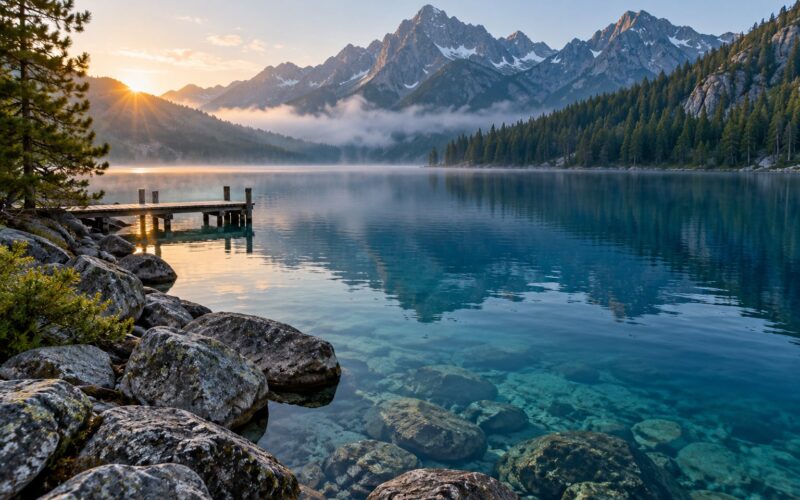
There is no official rule that makes a pond a lake. The difference between a pond and a lake comes down mostly to depth and sunlight: in a pond, light reaches the bottom everywhere, while in a lake some depths stay dark year round.
Here are the key differences in short form, before we get into the details.
- Depth and sunlight: a pond is shallow enough that sunlight reaches the bottom across the whole basin. A lake usually has a dark zone where light never arrives.
- Size: ponds are usually smaller and lakes larger, but no agreed acreage number separates them. A Maine pond covers 8,939 acres and a lake in the same state covers 467.
- Temperature: pond water tends to mix and stay fairly even. Deep lakes layer into warm surface water, a thermocline, and cold bottom water in summer.
- Plants: rooted aquatic plants can grow over the entire bottom of a pond. In a lake they crowd the shallows and stop where light fades.
- Fish: ponds lean toward bass, bluegill and catfish. Lakes can add trout and other cold-water species that need deeper, cooler refuge.
- Waves and use: big open lakes build wind waves and erosion. Ponds usually stay calm, which suits kayaks, wading and shore fishing.
- Regulation: many states treat both the same. Michigan draws a line at more than 5 acres and deeper than 9 feet for its own water classifications.
Every one of those lines has exceptions, which is exactly why the question comes up so often. This guide reflects 2026 reference sources and state rules, and it gets refreshed as those change.
Table of Contents
- 1Difference Between a Pond and a Lake at a Glance
- 2Size and Depth: How Big Is a Pond Compared With a Lake?
- 3Water Source and Water Movement
- 4Ecology and Wildlife
- 5Recreation and Practical Use
- 6How Does the Difference Between a Pond and a Lake Affect Visitors?
- 7Which Should You Choose?
- 8Frequently Asked Questions
- 9What is the main difference between a pond and a lake?
- 10Is every pond smaller and shallower than a lake?
- 11Can a pond have fish and be good for fishing?
- 12Which is better for boating, a pond or a lake?
- 13Are ponds warmer than lakes in summer?
- 14How do I tell whether a body of water is a pond or a lake?
- 15Conclusion: Start With the Feature That Matters Most
Difference Between a Pond and a Lake at a Glance
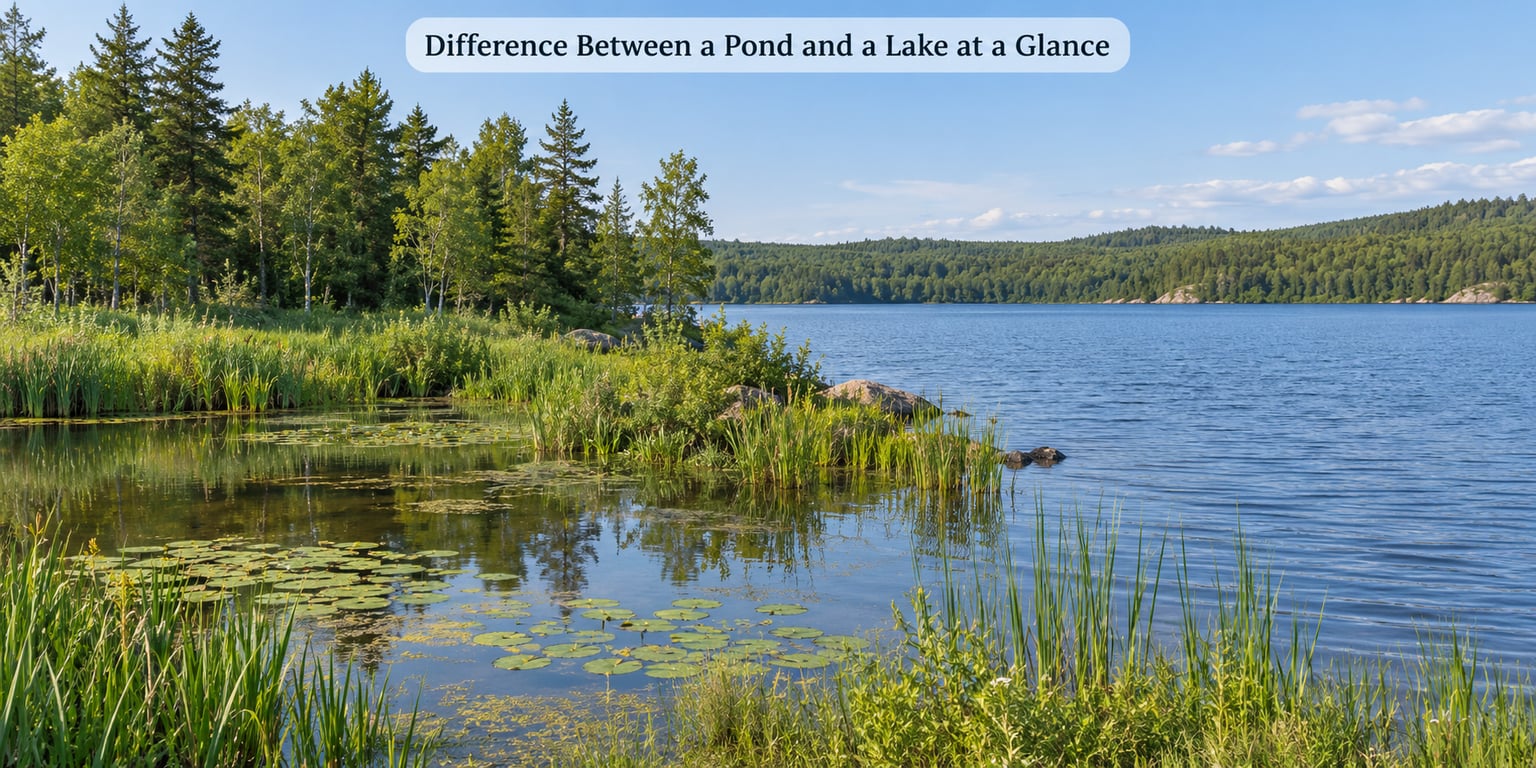
The table below covers the differences that matter most for anyone standing on the bank. Every row describes the usual case rather than a hard rule.
| Feature | Pond | Lake |
|---|---|---|
| Typical size | Under about 20 acres is the rule of thumb most guides use | Anything larger, though plenty of small lakes exist and some ponds are huge |
| Maximum depth | Often 5 to 15 feet | Frequently 30 feet or more, though shallow lakes exist |
| Sunlight | Reaches the bottom from shore to shore | Fades with depth and leaves a dark aphotic zone |
| Summer temperature | Mixed water, often one even temperature | Layered: warm epilimnion, thermocline, cold hypolimnion |
| Rooted plants | Across the whole bottom, including the middle | Limited to the littoral shallows around the edge |
| Fish profile | Largemouth bass, bluegill, catfish, carp | Those species plus trout, perch and others needing depth |
| Wave action | Minimal, shoreline erosion is slow | Real wind waves that move sand and undercut banks |
| Best suited to | Wading, shore fishing, kayaking, birding | Boating, water skiing, swimming, open-water fishing |
One caution about reading too much into that grid: the categories overlap completely. Plenty of lakes are shallow, and plenty of ponds are deep enough to hide fish in the dark.
Size and Depth: How Big Is a Pond Compared With a Lake?
Size is the number people reach for first, and it is the least reliable one. No single authority sets a cutoff, and the thresholds that do circulate contradict each other.
- Under 5 acres: Michigan uses more than 5 acres along with a depth test for how its waters are classified and regulated.
- Under 10 acres: a widely repeated figure that shows up in state boating registration rules and general reference texts.
- Under 20 acres: the number most pond and water-feature guides quote, because it keeps the definition useful for property owners.
- Under 5 hectares: about 12 acres, offered as a general rule of thumb by limnology references.
Pick any two of those and you have a contradiction, which is why anglers on fishing forums keep asking which number is the real one. The honest answer is that all of them describe local practice rather than biology.
New England makes the point better than any definition can. Great Pond in Maine covers 8,939 acres, while Keoka Lake in the same state covers 467. Elsewhere in that region, Unity Pond is also called Lake Winnecook, and Silver Lake also carries the name Kitts Pond. Settlers in the 1700s applied “pond” to standing water that was tidal or brackish in their home country, “lake” to inland fresh water, and “meadow” to anything grassy, so the names arrived carrying meanings that no longer match the water itself.
Depth is the better dividing line because it decides what happens inside the water. A typical pond runs about 5 to 15 feet at its deepest. Once a basin passes roughly 20 to 30 feet, the bottom stops getting enough light for plants to root, and the definition flips toward lake.
Here are three concrete examples that show the spread:
- A neighborhood retention pond might cover half an acre and reach 8 feet. Sunlight hits the bottom everywhere.
- A small inland lake might cover 40 acres and reach 35 feet, with a thermocline you can feel while boating and dark water below it.
- A glacial lake can run to hundreds of thousands of acres with depths measured in hundreds of feet. Rules and currents there operate at a different scale entirely.
Water Source and Water Movement
Ponds and lakes form the same way, by collecting water in a basin with no outlet. The difference is what fills them and how hard the water moves.
Ponds are usually fed by a spring or seep, a small creek, groundwater, and rainfall. They are shallow, so wind keeps mixing the whole column from top to bottom. That movement is why pond water tends to hold one workable temperature instead of layering.
Lakes take the same sources and add bigger ones: major rivers, tributary inflows, groundwater discharge, and direct rainfall over a large surface. When a lake is deep enough and the wind is light, the water stops mixing and separates into layers.
- Epilimnion: the warm surface layer that takes the most sun and the most wind.
- Thermocline: a narrow band in between where temperature drops fast, often several degrees in a few feet.
- Hypolimnion: the cold bottom layer that never warms much during the summer.
This is called thermal stratification, and the science of it belongs to limnology, the study of inland water. Fish feel it. Trout and other cold-water species drop into the hypolimnion where dissolved oxygen stays usable, while bass patrol the warmer surface layer.
Movement matters for boating too. On a small pond, a strong afternoon breeze chops the surface and you will feel it in the hull, but the water stays shallow and predictable. On a big lake, the same wind builds longer waves, and the fetch across open water can undercut a bank or turn an afternoon paddle into a slog.
Ecology and Wildlife
Both water bodies support fish, amphibians, birds, insects and plants. The composition shifts with depth and light.
Because light reaches the bottom of a pond, rooted aquatic plants can take hold across the entire basin. Those plants oxygenate the water during the day and give cover for bluegill, young bass and crustaceans. The downside of an all-shallow basin is that it can turn over completely on a still night in July, and warm water holds less oxygen than cool water, which is when fish kills happen.
Lakes split their habitat into zones. Sunlit plants hug the edge, and that ring of shallow water is where most of the fishing and most of the bird life concentrates. Under it, open water. Below that, the dark zone where sunlight never reaches and only cool-loving species with high oxygen needs survive.
- Warm-water species such as largemouth bass, bluegill, channel catfish and carp tolerate the temperature swings of a shallow pond.
- Cold-water species such as brook trout, lake trout and rainbow trout need water that stays cold and oxygen-rich, which means depth.
- Amphibians and dragonflies often do better at a pond, because the soft muck and dense plant growth give them places to breed and hunt.
- Waterfowl use both, but ponds with shallow vegetation are prime feeding habitat.
- Algae behave differently too. Shallow ponds can green up fast in warm weather, while a large lake tends to stay clearer and stratify instead.
So when someone asks whether a body of water is healthy, the honest test is not the name on the map. It is how much light reaches the bottom and how the water behaves when the wind drops.
Recreation and Practical Use
Where you go matters more than what you call it, but the label still predicts what you will find.
Fishing. A pond usually means you can cast to structure from the bank, work the weed line, or wade with a fly rod. Lakes reward people with a boat, a depth finder and time to find a drop-off, and they hold the bigger trout and pike that ponds cannot keep.
Boating. Power boats, water skis and tubing need room, a launch ramp and enough depth to keep a propeller clear. That is a lake job almost everywhere. Kayaks, canoes and paddleboards suit ponds well, and short ponds can be circled comfortably even in a breeze that would stop a larger craft.
Swimming. Both can work. A pond with a gradual sandy edge is often the easier swim because you can walk out and stand up. A lake needs a beach, and you should check water quality and rules before you go in.
Camping and scenery. A small pond sits next to you, which makes it a good campsite companion for kids and dogs. A lake is the destination itself, the open water and the horizon.
Wildlife watching. Pond margins are dense and close. Lake edges need a boat or long lens, but a lake mixes open water, marsh and forest edge in one place.
How Does the Difference Between a Pond and a Lake Affect Visitors?
Once you know which one you are looking at, the planning gets easier. Access and launch conditions differ first: ponds are often walk-in with a shallow shoreline, while lakes usually have a formal ramp that may need a permit or a sticker.
Water clarity follows the same split. Light reaching the bottom of a pond keeps the water clear enough to spot a cruising bass, while deep lake water can go murky with algae or stained by dissolved organic matter from the surrounding watershed.
Shoreline habitat matters for where you stand. A pond’s plants grow all the way across, so fish hold along edges and in the middle. On a lake, structure concentrates along drop-offs, points and weed beds at the shallow margin.
Temperature changes how you dress and when you fish. A warm pond in July can be uncomfortable to wade by late afternoon. A lake offers a cold layer you can fish in summer, though you may have to find it with a thermometer rather than see it.
Before you go, check the local rules. Size limits, species seasons, whether motors are allowed, and whether the water is navigable are all decided by state agencies, and several of them draw a line that treats a pond differently from a lake. Michigan is a common example: more than 5 acres and deeper than 9 feet puts a water body into the state category that carries its own protections.
Which Should You Choose?
Choose a pond if you want easy shoreline access, shore fishing, a calm paddle, a shallow swim for kids, or close wildlife watching. Ponds are forgiving. You can arrive with a rod and a net and have a good afternoon.
Choose a lake if you want a boat ramp, open-water boating, tubing or water skiing, colder water in summer, more varied fish habitat, and a trip that takes most of the day.
The honest caveat is that local conditions override the label. A deep 3-acre pond can hold trout. A shallow 60-acre lake can be all weeds and no relief. Decide which feature matters most to you, then find out what the specific water body actually is like before you pack.
Frequently Asked Questions
What is the main difference between a pond and a lake?
The main difference between a pond and a lake is depth and light. A pond is shallow enough that sunlight reaches the bottom everywhere, so rooted plants can grow across the whole basin and the water stays mixed. A lake is usually deeper and has a dark zone where light never reaches, which splits the water into separate temperature layers.
Is every pond smaller and shallower than a lake?
Usually, but not always, and the exceptions matter. Size alone proves nothing: a Maine pond covers 8,939 acres while a lake in the same state covers 467. Many shallow lakes exist too. Depth is the better test because it decides whether light reaches the bottom and whether plants can root across the basin.
Can a pond have fish and be good for fishing?
Yes. Ponds regularly hold largemouth bass, bluegill, catfish, carp and trout. What makes ponds productive is that sunlight reaches the bottom, so rooted plants grow across the basin and give young fish cover and oxygenated water. A shallow pond does not have the cold deep refuge that trout need in hot summer weather.
Which is better for boating, a pond or a lake?
A lake, almost always. Power boats, tubing and water skiing need open water, a ramp and enough depth to keep a propeller clear of the bottom. Kayaks and paddleboards suit either, though short ponds are calmer and easier to circle. Check whether motors are permitted on small ponds before you go.
Are ponds warmer than lakes in summer?
Ponds warm faster and more evenly because the whole water column mixes. Deep lakes develop a warm surface layer, a thermocline, and a cold bottom layer that barely warms all summer. So a pond may feel warm throughout while a lake can be uncomfortably warm on top and strikingly cold a few feet down.
How do I tell whether a body of water is a pond or a lake?
Look at the vegetation. If rooted plants and a clear weed line run all the way to the far bank, you are probably on a pond. If plants stop in a ring near shore and the middle goes dark, it is a lake. A depth test and a temperature reading confirm it: uniform temperature means a pond, layered temperature means a lake.
Conclusion: Start With the Feature That Matters Most
Ponds and lakes overlap in size, depth, formation and habitat, so the two names are broad descriptions rather than rigid categories. Decide first whether you care most about shoreline fishing, boating, swimming, camping, wildlife or open scenery, then check what the specific water body actually offers before you go.