Algae blooms in lakes happen when microscopic algae get enough nutrients, sunlight, and warm water to multiply faster than anything eats them. Phosphorus and nitrogen act as fertilizer, and calm, sunlit, poorly circulating water lets the resulting scum stick around for weeks.
Most of what you see is a natural process that people have made worse. Knowing what causes algae blooms in lakes tells you whether the answer is a cooler week of weather, a missing buffer strip on your lawn, or a septic system that needs attention.
Table of Contents
- 1What Causes Algae Blooms in Lakes?
- 2The Main Algae Bloom Triggers at a Glance
- 3How Nutrient Pollution Fuels Rapid Growth
- 4How Warm Water and Sunlight Help Algae Multiply
- 5How does nutrient pollution fuel what causes algae blooms in lakes?
- 6Why Calm, Shallow Water Makes Blooms Last Longer
- 7How Weather, Drought, and Storms Change Bloom Risk
- 8How Invasive Species and an Unbalanced Ecosystem Contribute
- 9What Makes a Bloom Green, Red, or Brown?
- 10When Does an Algae Bloom Become a Health or Wildlife Risk?
- 11How Can Lakes Prevent or Limit Harmful Algae Blooms?
- 12What Should Anglers, Boaters, Campers, and Visitors Do?
- 13Frequently Asked Questions
- 14Are all algae blooms harmful?
- 15Can algae blooms make lake water unsafe to drink?
- 16How long does an algae bloom usually last?
- 17Does boiling lake water remove cyanotoxins?
- 18Should I let my dog swim in a lake with an algae bloom?
- 19Conclusion
What Causes Algae Blooms in Lakes?
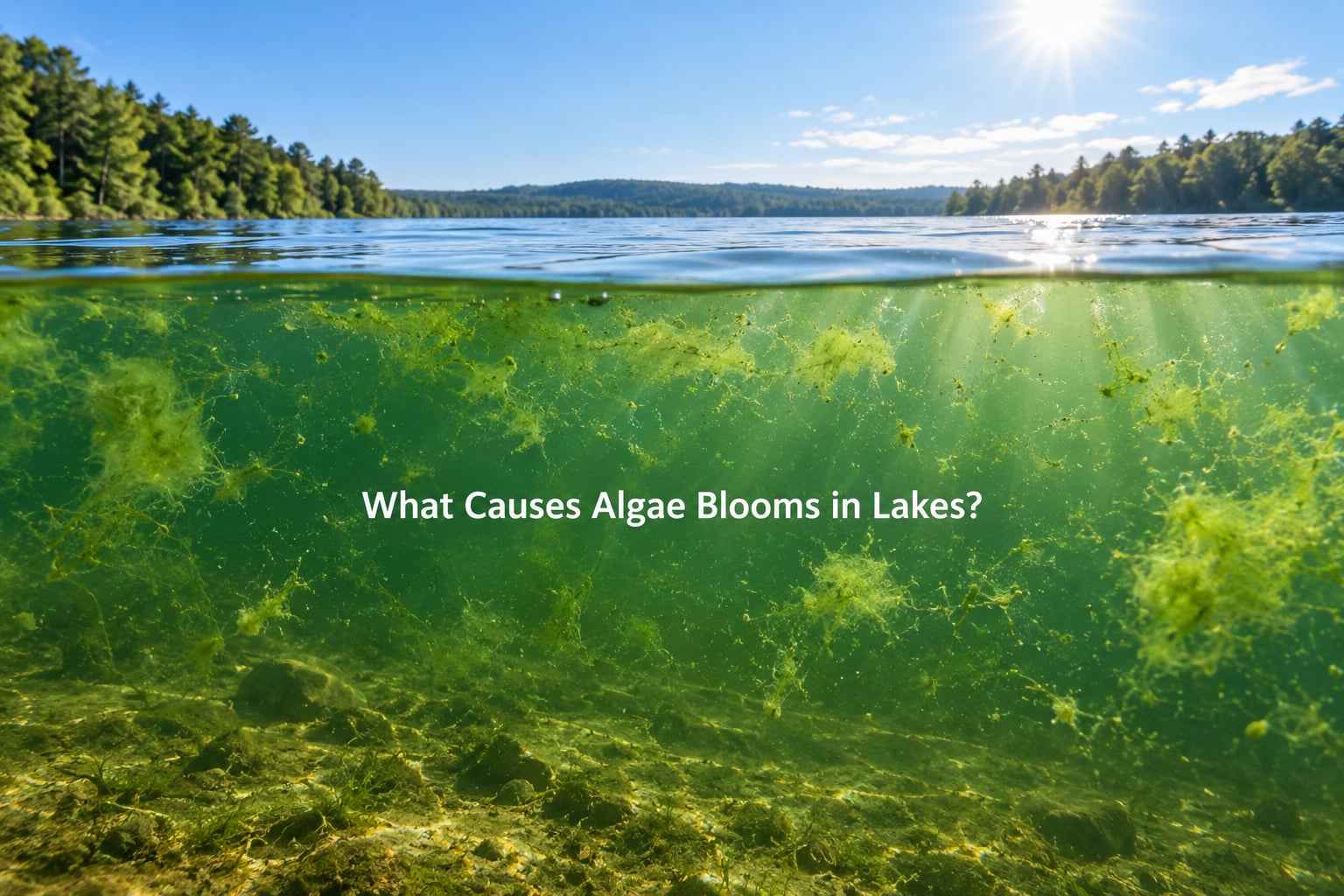
An algal bloom is a sudden population explosion. Algae are single-celled organisms that reproduce by splitting, and under the right conditions one cell can become millions in a matter of days.
Three things normally hold algae in check: a shortage of one nutrient, a shortage of light, and grazers such as zooplankton, snails, and filter-feeding mussels that eat it. Blooms form when a lake loses at least one of those limits while the water stays warm and still.
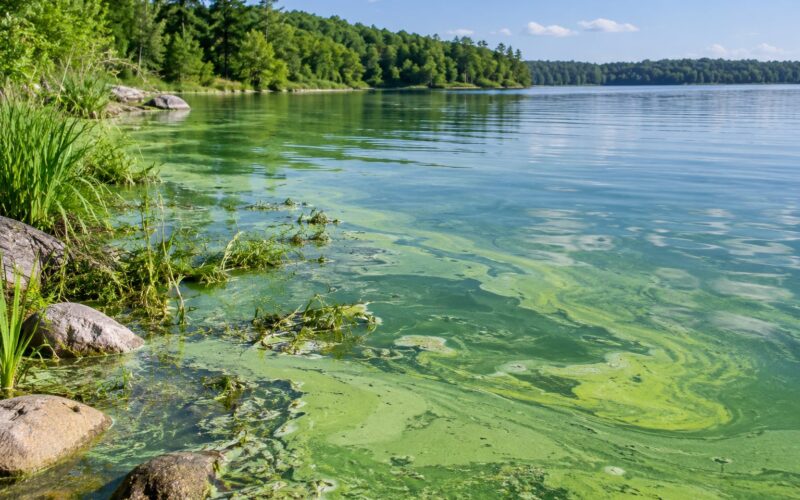
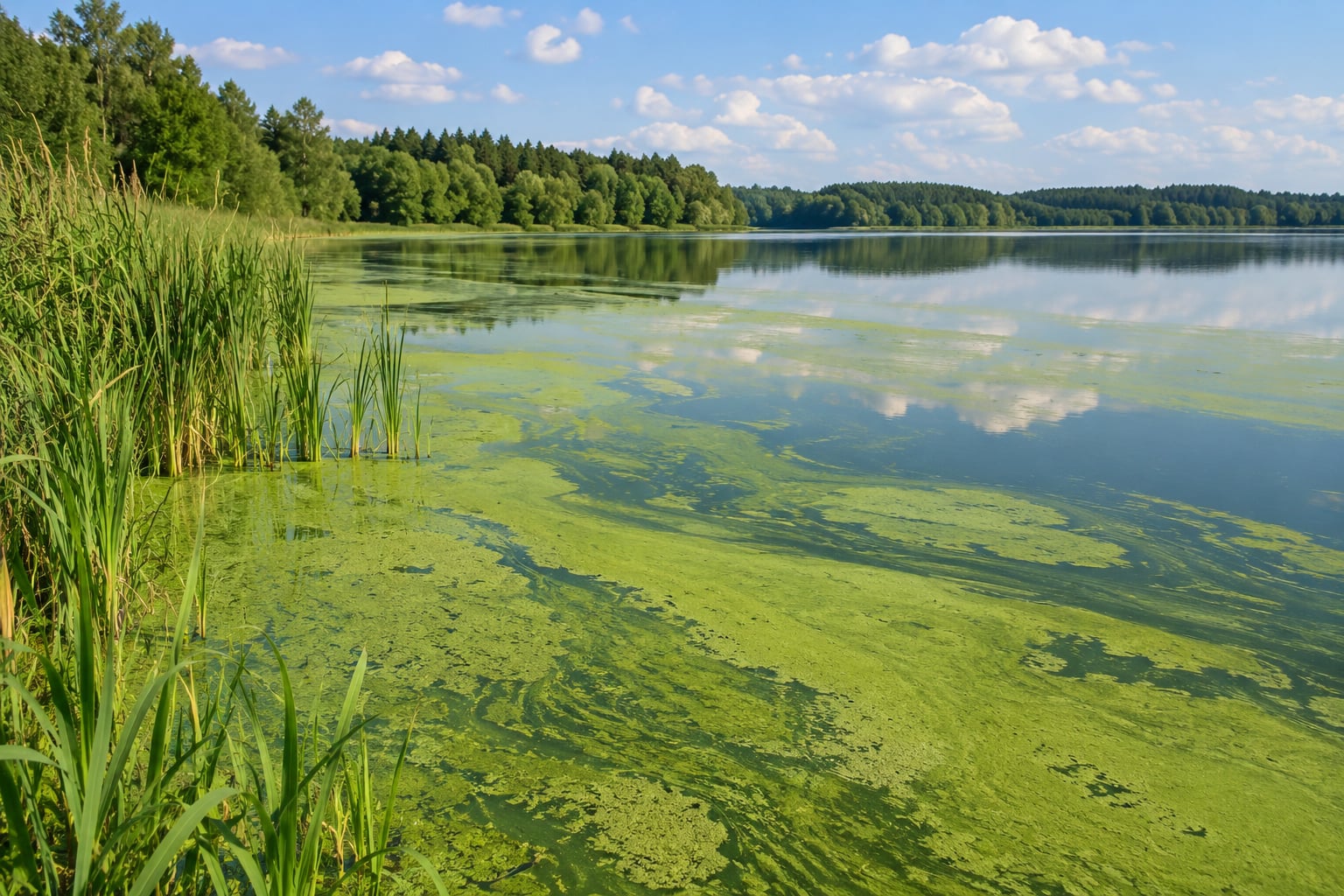
Not every bloom is a problem. Filamentous green algae and duckweed look messy but are generally harmless. The ones that matter most in freshwater lakes come from cyanobacteria, which are bacteria rather than true algae, and are often called blue-green algae because of their color.
Cyanobacteria can produce toxins, and dense growth blocks sunlight from underwater plants, which then die and decompose. Decomposition consumes dissolved oxygen, and oxygen-depleted water is what kills fish.
The Main Algae Bloom Triggers at a Glance
| Trigger | How it contributes | Where it matters most | Typical example |
|---|---|---|---|
| Excess nutrients | Removes the natural growth limit so cells divide unchecked | Lakes in agricultural watersheds or with urban or septic inputs | A reservoir that turns green weeks after heavy rain washes farm fields |
| Warm water | Speeds photosynthesis and growth rates of most species | Shallow lakes in summer, especially July and August | A pond that stays clear in May and greens up by midsummer |
| Strong sunlight | Supplies the light algae need; clear water lets it reach deeper | Shallow, low-turbidity lakes with few rooted plants | A clear lake whose green color starts in the sunlit shallows |
| Calm or stagnant water | Prevents mixing that would disperse and dilute the bloom | Protected coves, shallow basins, areas behind dams | Scum that stays in one corner of a lake for the whole summer |
| Invasive filter feeders | Strip plankton and change nutrient cycling in the water column | Lakes colonized by zebra and quagga mussels | A lake whose bloom severity rose years after an invasion |
| Reduced flushing | Lets algae and their nutrients accumulate rather than leave | Reservoirs, shallow ponds, long residence-time lakes | Impoundments that keep blooming long after the watershed rains stop |
How Nutrient Pollution Fuels Rapid Growth
Phosphorus and nitrogen are the two nutrients algae need in the largest amounts. In most freshwater lakes, phosphorus is the growth-limiting nutrient, which means whichever nutrient is scarcest sets the pace of growth. Add the scarce one and the whole system accelerates.
Nitrogen is usually the secondary limiter in freshwater, but that flips in coastal and marine waters, where nitrogen typically controls growth. That is why the same fertilizer can behave differently in a lake and in an estuary.
| Factor | Phosphorus | Nitrogen |
|---|---|---|
| Role in freshwater lakes | Usually the primary limiting nutrient | Usually the secondary limiting nutrient |
| Common sources | Fertilizer, manure, septic effluent, eroded soil, detergents | Fertilizer, manure, wastewater, septic effluent, atmospheric deposition |
| Typical system it limits | Lakes and reservoirs | Estuaries, coastal waters, some acidic lakes |
| Where it hides | Binds to soil and sediment; released by low oxygen | Soluble and easily washed into lakes |
The sources are mostly ordinary human activity. Fertilizer on lawns and cropland washes off during rain. Manure from livestock and poultry yards carries both nutrients. Failing or poorly maintained septic systems and wastewater discharges add nutrients directly. Shoreline erosion releases phosphorus already bound to soil.
Smaller sources add up too: pet waste, waterfowl droppings, decaying leaves and aquatic plants, road salt and detergents, and even rainfall that picks up nitrogen from the air.
The full sequence, usually called eutrophication, runs in a predictable cascade.
- Nutrients enter the lake from runoff, discharge, or sediment release.
- Algae multiply faster than grazers can remove them.
- The growing bloom shades out submerged plants, which stop growing and die.
- Dead algae and dead plants are broken down by bacteria.
- Bacteria consume dissolved oxygen as they work, sometimes dropping it to hypoxic or anoxic levels.
- Fish and invertebrates suffocate, and the lake smells of rotten eggs from sulfur compounds released in the oxygen-free water.
Warm water makes the whole chain worse. Colder water holds more oxygen, so the same decomposition event strips out less of it in spring than in August.
How Warm Water and Sunlight Help Algae Multiply
Algae are photosynthetic, and their growth rate rises with temperature up to a species-specific optimum. Surface water in most temperate lakes passes that threshold for a stretch of midsummer weeks, which is why blooms cluster in July and August.
Light is the second lever. Sunlight only penetrates as far as the water is clear, so nutrient-rich water that stays clear lets algae grow throughout the column. The moment algae themselves cloud the water, growth is confined to the sunlit surface, which is exactly where the visible scum forms.
Warm surface water also sits on top of cooler water below without mixing, a pattern called thermal stratification. The warm upper layer, the epilimnion, is where the bloom lives. The cool lower layer, the hypolimnion, loses oxygen because it is sealed off from the atmosphere and from photosynthesis.
Heat is not the only driver, though. Some cyanobacteria grow well in cool, nutrient-poor water, which is why an alpine lake or an early spring pond can bloom without anyone nearby fertilizing it.
How does nutrient pollution fuel what causes algae blooms in lakes?
It removes a natural brake. Algae need phosphorus to build cell membranes and nucleic acids, and nitrogen to build proteins and chlorophyll, and in a clean lake one of those runs out long before the population can explode.
Extra phosphorus and nitrogen from runoff delete that limit, and when light and temperature are already favorable the population can double in a day. Picture a reservoir downstream of farmland: weeks after a heavy rain, a plume of phosphorus-laden runoff arrives, the reservoir stays calm and sunlit, and green paint spreads outward from the inflow.
Why Calm, Shallow Water Makes Blooms Last Longer
Moving water disrupts algae. Wind-driven wave action pushes surface scum against a shore and breaks mats apart, and currents carry nutrients and cells through the lake so nothing concentrates.
When the water is still, algae stay where they are and keep drawing on the same local nutrient supply. A sheltered cove can look pea-green while the rest of the lake stays blue.
Depth matters as well. A shallow lake has a smaller volume, warms quickly, and offers more surface area per unit of water, so a given nutrient load goes a longer way. A deeper lake circulates and turns over more completely as the seasons change, redistributing algae and oxygen instead of letting them settle out.
Lake depth is only part of the story. Fetch, the length of the open water the wind can work across, decides how much mixing actually occurs, so two lakes of the same depth can behave completely differently.
How Weather, Drought, and Storms Change Bloom Risk
Bloom risk tracks the weather closely because weather controls temperature, mixing, and nutrient delivery all at once.
Warm spells extend the growing window. A run of hot, still days lets an existing bloom expand faster than grazers can thin it.
Drought cuts two ways. It shrinks inflow, which reduces flushing and concentrates what is already in the lake, and it raises the average temperature. Both favor algae.
Heavy rain does something different. Runoff delivers a fresh slug of fertilizer, which is why blooms often appear in the days after a storm rather than before it. At the same time, turbid flood water can lower light and physically disperse existing mats.
Longer-term warming trends extend the season at both ends and make storms harder to predict, so the reliable window for blooms keeps growing.
How Invasive Species and an Unbalanced Ecosystem Contribute
Filter-feeding mussels, especially zebra and quagga mussels, change a lake’s chemistry. They strip plankton out of the water and waste nutrients back into the water column in forms algae can use, and their droppings settle where they can release phosphorus from sediment.
Removing grazers makes things worse. Filter feeders that eat zooplankton, like golden shiners and some non-native carp, let algae slip through the food web, and shoreline clearing removes the rooted plants that shade the water and absorb nutrients.
Still, invasive species are usually a contributing factor rather than the main one. In most nutrient-enriched lakes, cutting the nutrient input does more than any biological workaround.
What Makes a Bloom Green, Red, or Brown?
Color is a pigment signature. Green scums are typically green algae or chlorophyll-producing cyanobacteria, red-brown or rust-colored water often comes from dinoflagellates or iron-stained tannins, and blue-green or paint-like films typically point to cyanobacteria.
Some species concentrate red pigments at the surface, turning a bloom strawberry-milkshake pink, which is how the red tide in coastal waters gets its name.
Brown water is often not an algae bloom at all. Pea-soup browns with a swampy smell are usually dissolved organic matter from runoff and decaying vegetation, and they leave a stain on a dock but no film.
Color cannot tell you whether toxins are present. Only testing of a water sample can do that, which is why official advisories exist.
When Does an Algae Bloom Become a Health or Wildlife Risk?
| Warning sign | What it means | What to do |
|---|---|---|
| Surface scum, paint-like film, or clumped mats | Cells are concentrating, which can concentrate toxins with them | Keep people and pets out; do not break the mats apart |
| Foam that leaves a green or brown tint | Often cell material rather than ordinary soap foam | Avoid contact until local officials clear the water |
| Rotten egg or fishy smell | Sulfur compounds released in oxygen-poor water | Expect fish kills; stay out of the water |
| Dead or gasping fish along shore | Dissolved oxygen has fallen too low to support life | Report it to the local authority; keep pets leashed |
| Sudden loss of aquatic plants | Shading from the bloom has killed submerged vegetation | Note the location and timing for a bloom report |
| Unusual color in drinking water or a water flavor complaint | Cells or toxins may be present in treated water | Follow local boil-water and advisory instructions exactly |
Toxins produced by cyanobacteria can cause taste and odor problems, liver effects in animals, and illness in humans after swallowing water or generating aerosol while the bloom is disturbed. Public-health agencies such as the CDC and EPA publish guidance and issue advisories, and those local notices are the authority for a given lake.
How Can Lakes Prevent or Limit Harmful Algae Blooms?
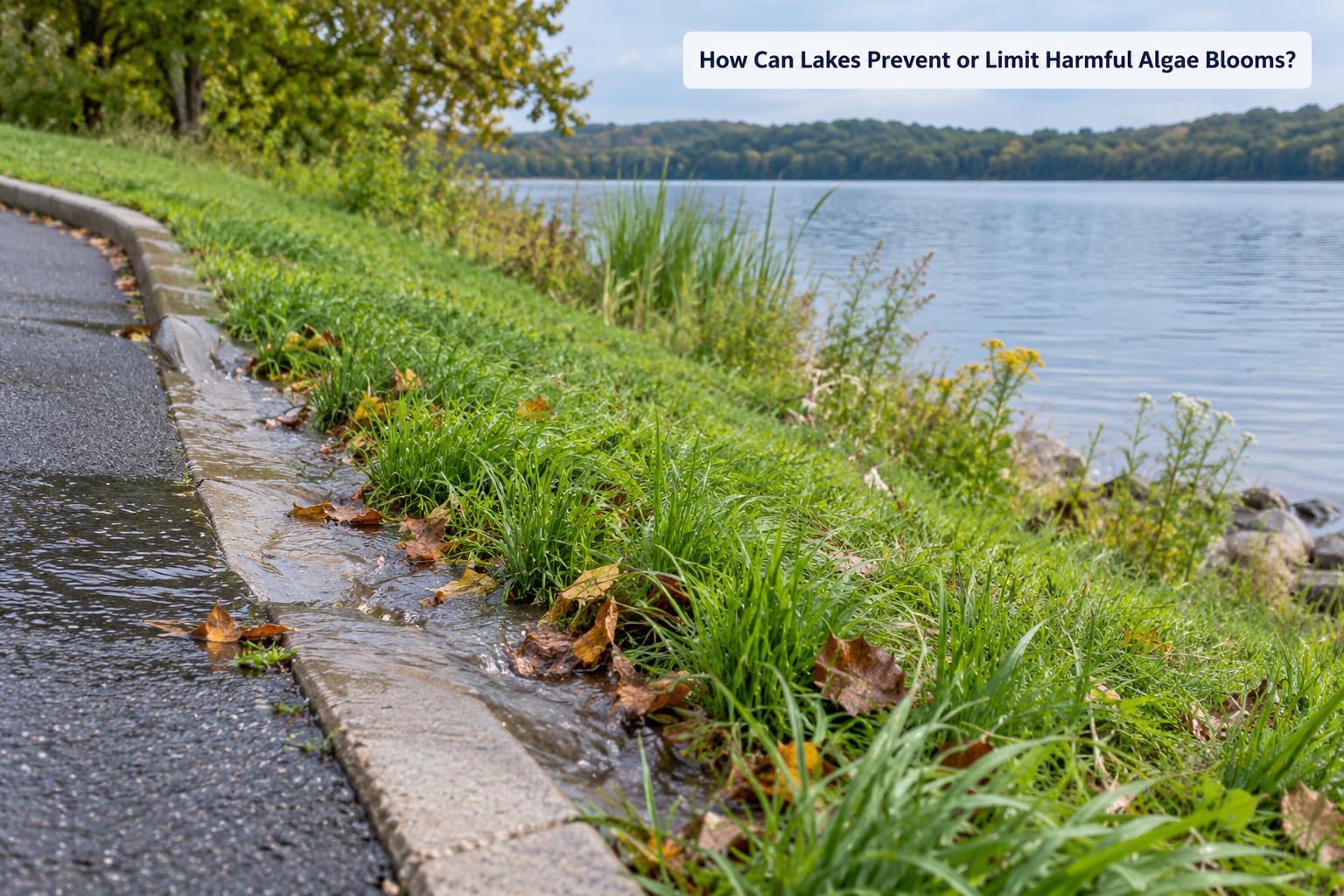
Prevention happens mostly in the watershed, not in the lake. Everything that keeps fertilizer, manure, and soil out of the water lowers the ceiling on how large a bloom can get.
Buffer strips and shorelines. A strip of native grass, shrubs, or trees between a lawn and the water slows runoff and traps sediment before it reaches the lake. Densely vegetated shorelines do the same thing and shade the water.
Nutrient management. Soil testing before fertilizing, avoiding fertilizer before rain, limiting application near water, and reducing soil disturbance all cut the load at the source.
Wastewater and pet waste. Working septic systems, avoiding dumping grass clippings in the water, and picking up after pets remove a surprising share of local nutrient input on smaller lakes.
Wetlands and shoreline buffers. Restoring wetlands and protecting existing ones gives water a natural filter before it enters the lake.
Lake-level action. For lakes that already carry a large internal nutrient load, aeration, phosphorus inactivation, harvesting, and dredging are used under a lake management plan. Dredging is expensive and rarely a complete fix on its own.
Aeration is a band-aid, and the season’s results show it. On a lake where the nutrient source is still in place, the green comes back thick the following summer. Fixing the input beats treating the symptom every year.
What Should Anglers, Boaters, Campers, and Visitors Do?
Check the local advisory before you go. State health departments, tribal environmental offices, and county health agencies post bloom notices and closures during the season.
Keep pets out of flagged water and out of any water with a scum. Cyanotoxin exposure through licking wet fur or drinking from a green-tinted puddle is a recurring and preventable problem, and your veterinarian is the right call if that happens.
Do not disturb mats while wading, boating, or fishing. Breaking a scum releases concentrated cells into the water and can raise exposure.
Follow posted rules on swimming, wading, fishing, and harvesting, and remember that a warning does not automatically mean you must abandon the boat. Officials distinguish between an advisory and a closure, and a boat launch is rarely the hazard.
Clean your boat trailer and drain live wells before moving between waters so invasive mussels and plants do not travel with you.
Frequently Asked Questions
Are all algae blooms harmful?
No. Many blooms are harmless, including filamentous green algae and duckweed that make water look messy without producing toxins. The ones that cause illness and fish kills usually come from cyanobacteria, also called blue-green algae, which can release toxins such as microcystin. Severity depends on the species present, how dense the bloom gets, and how long it lasts. Appearance alone cannot confirm toxicity, which is why local health agencies test samples before issuing advisories.
Can algae blooms make lake water unsafe to drink?
They can. Cyanobacteria can release toxins that survive standard drinking-water treatment, and decaying blooms produce compounds that cause taste and odor problems even when the water is treated to regulatory standards. Water systems monitor intake water and may issue advisories, boil-water notices, or switch to an alternate source during a bloom. Follow the instructions from your local water provider or health department exactly rather than filtering or boiling on your own, since household treatment may not remove these compounds.
How long does an algae bloom usually last?
Weeks to months. A bloom usually builds through summer as nutrients accumulate and temperatures rise, then fades when cooler autumn weather, wind, or a turnover event mixes the water and disperses cells. Conditions matter more than the calendar: a lake with a continuous nutrient supply can bloom every year, while a single cool windy week can knock one back quickly. If a bloom persists into fall or returns the same week each summer, that pattern usually points to an ongoing nutrient source worth tracking.
Does boiling lake water remove cyanotoxins?
No, and this matters. Many cyanotoxins are heat-stable, so boiling can concentrate them as water evaporates while leaving the toxins intact. Boiling also does nothing about other waterborne contaminants. If officials advise against drinking lake water during a bloom, the safe move is to use an alternate water source and follow the local advisory rather than treating it at home. The same caution applies to water collected for pets, livestock, or camp use.
Should I let my dog swim in a lake with an algae bloom?
Not when a bloom is present or an advisory is active. Dogs can swallow contaminated water or lick algae from their fur, and cyanotoxins can be serious for them even in small amounts. Keep your dog leashed at the shoreline, bring fresh water, and rinse off after any contact if officials have not advised against it. If your dog does drink from scum-covered water, watch for vomiting, weakness, or tremors and contact your veterinarian or an animal poison control line promptly.
Conclusion
Algae blooms in lakes happen when nutrients, light, warm temperatures, and enough calm water line up at the same time. Nutrients are the part people can change, and they matter most; temperature and weather mostly decide when a bloom peaks and how long it hangs around.
If you want to know whether a particular lake is affected right now, check the advisory posted by your state health department or local environmental agency before heading out. Avoid contact when warnings are active, keep pets away from scum, and do not disturb mats.
Over a season, the durable gains come from protecting shorelines, cutting fertilizer and erosion runoff, fixing nutrient sources, and supporting watershed-level nutrient reduction. If blooms come back the same week every year, that repeat pattern is usually a nutrient source that nobody has addressed yet.