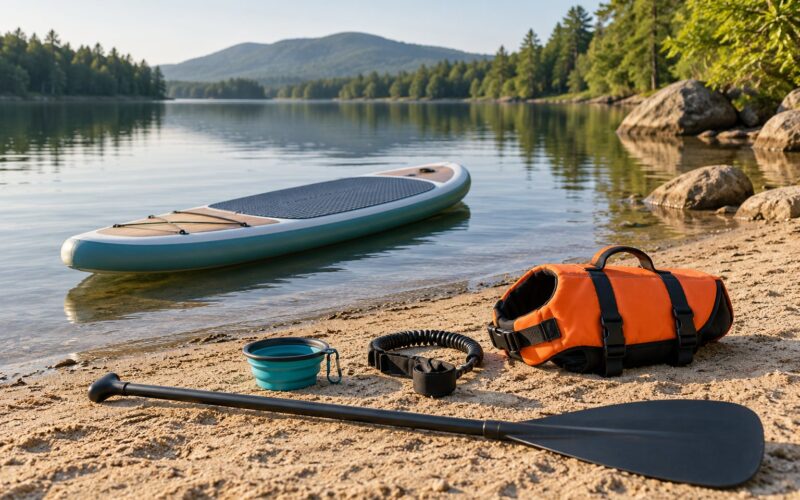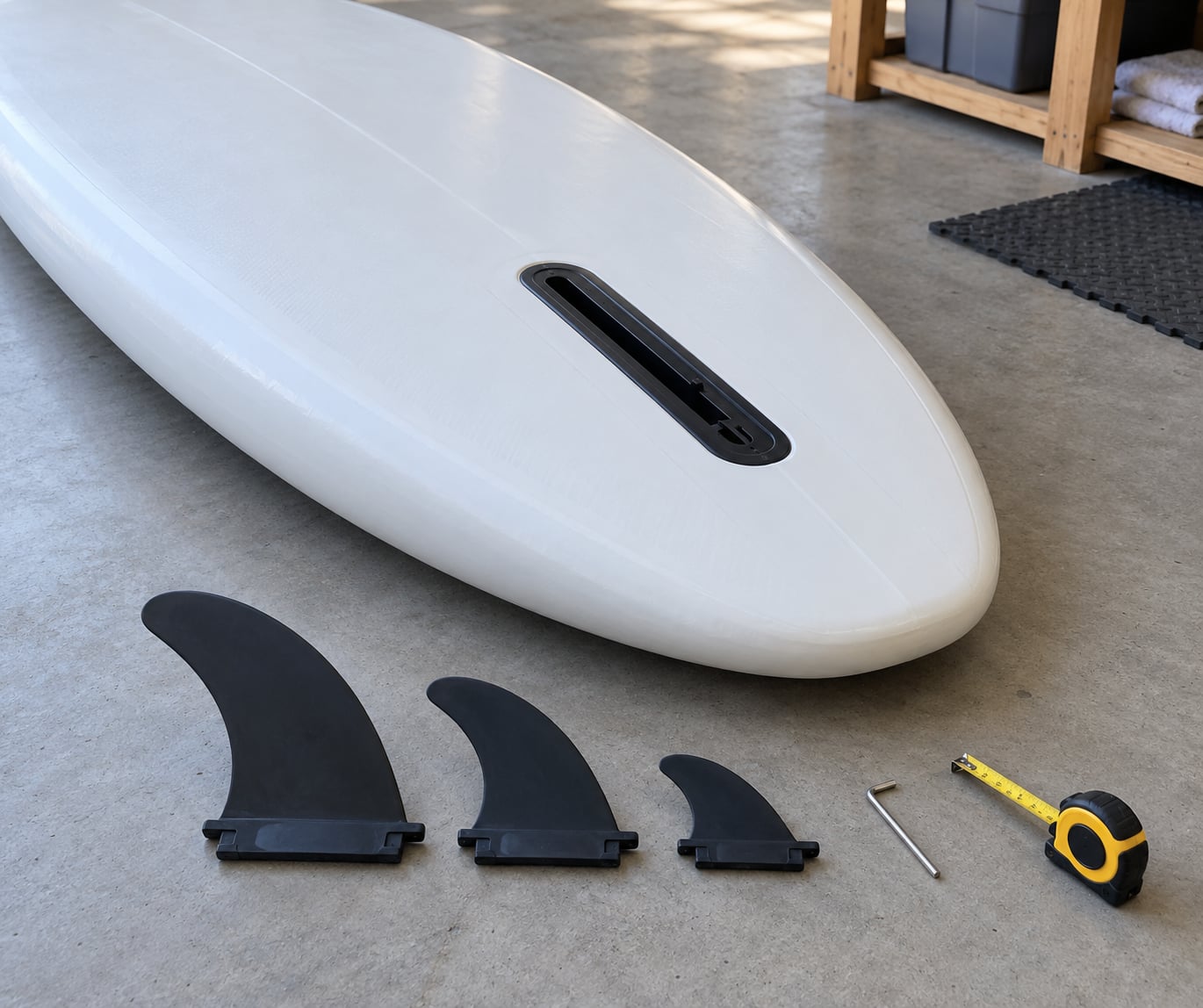
Choosing a paddleboard fin setup comes down to three things: how many fins your board’s boxes allow, what you want the board to do on the water, and which fin system the board was built with. Most paddlers on flat lakes and open water are happy with one long center fin for straight-line tracking. Side fins earn their keep in chop, wind and surf. Before you spend anything, identify your fin box and check the manufacturer’s sizing guidance, because a fin that does not physically fit its box is worthless no matter what its measurements say.
The whole process takes about twenty minutes once you have the board in front of you. Most of that time goes into identifying the box type, which is the step people skip and then regret when a new fin rattles in the wrong track. The rest of this guide is how to choose paddleboard fin setup once that box is identified: how many fins, how deep, what shape and what material, in that order.
Table of Contents
- 1What You Need
- 2Step-by-Step
- 3Identify Your Paddleboard’s Fin Box
- 4Choose One Fin or Two Fins
- 5Match Fin Shape and Size to the Water
- 6Use the Manufacturer’s Paddleboard Fin Setup Guidance
- 7Check Tracking, Turning, and Clearance Needs
- 8Install and Test the Fin Setup
- 9Common Mistakes
- 10Buying a fin before checking the box type
- 11Mixing systems to save money
- 12Defaulting to the largest fin available
- 13Ignoring the rider’s weight and gear
- 14Over-tightening the hardware
- 15Using the wrong fin in rocks, weeds or heavy surf
- 16Frequently Asked Questions
- 17Is a larger paddleboard fin always better?
- 18Should I use one fin or two fins on a paddleboard?
- 19What fin should I choose for touring and long-distance paddling?
- 20Can I replace the fin on an inflatable paddleboard?
- 21How do I know which replacement fin fits my board?
- 22What should I do if my fin is damaged in shallow water?
- 23Conclusion
What You Need
Gather these details before you shop. Each one narrows the choice, and two of them rule out entire categories of fins.
- Your board’s exact model and model year. Inflatable boards in particular get revised between seasons, sometimes with a different fin box.
- The fin box type. Turn the board over at the tail and look at how the fin attaches. See the first step below.
- The number of boxes and where they sit. One center box, or a center plus two side boxes, or three boxes in a row.
- The box dimensions. Measure the slot width and length inside the track, and the depth from the hull surface.
- Your intended water. Flat lake, open water, coastal chop, small waves, river, whitewater, or a mix.
- Your paddler weight plus gear. A 230-pound paddler in a wetsuit is a very different case from a 150-pound paddler in summer clothes.
- The manufacturer’s compatibility guidance. The owner’s manual or the support page for your model, which should list fin dimensions and approved systems.
- A tape measure or calipers and your phone, so you can photograph the box and check it against the spec sheet.
Step-by-Step
Work through these six steps in order. Compatibility comes first because it is the only step that cannot be worked around, and size comes last because size only matters once the fin fits.
Identify Your Paddleboard’s Fin Box
Name the box type and its dimensions before you look at a single fin. The two systems you will meet most often on paddleboards are the US Box, a sliding track with a center groove, and the US Side Box, a shallower track used for side fins on inflatable boards. Everything else is a variation on tabs, pins and slides.
How to check in about a minute: turn the board over, find the box at the tail, and look at how the fin connects. A rectangular slot with two raised rails and a center keyway is a US Box. A flat rectangular tray with two screw holes and a spring tab is Two-Tab or Flip-Lock. A fin that drops in and locks under the rail without a screw is Slide-In or Hook-and-Pin. A fin held down by a screw with a threaded insert is the oldest pattern of all, and it is sometimes fixed in place with no box at all.
| Box system | How the fin attaches | What fits it |
|---|---|---|
| US Box (Universal Standard) | Slides fore and aft along a keyway track, held by a screw or pin | Any fin sold as US Box or Universal |
| US Side Box | Short sliding track for side fins | Side fins in the matching US Side format |
| Two-Tab | Two rigid tabs drop into a recess, secured by a rear screw or lever | Fins made for that two-tab pattern |
| Flip-Lock | Fin drops in, a locking lever rotates and traps it | Fins in the flip-lock format |
| Slide-In | Rail hook engages, no screw needed | Matching slide-in fins only |
| Hook-and-Pin | Hook engages the rail and a pin locks it in | Matching hook-and-pin fins |
| FCS or Futures adapter | An adapter plate sits in the US Box track | Surf-style fins, via the adapter |
| Fixed | Fin bolted or glued straight to the hull | Nothing. You replace the board, not the fin |
You have the first result when you can say the box name, the slot dimensions and the number of boxes without guessing. Photograph the box from straight on. If the board is a fixed-fin model, stop here: there is no fin setup to choose, and no adapter will help.
Measure rather than assume. Match the board’s model number against the manual before you trust a retailer’s compatibility claim, and if the board is out of warranty or the manual is gone, ask the manufacturer with the serial number and a photo of the box. Ordering the wrong part can damage a proprietary box, and that is the one mistake on this list that is expensive to undo.
Choose One Fin or Two Fins
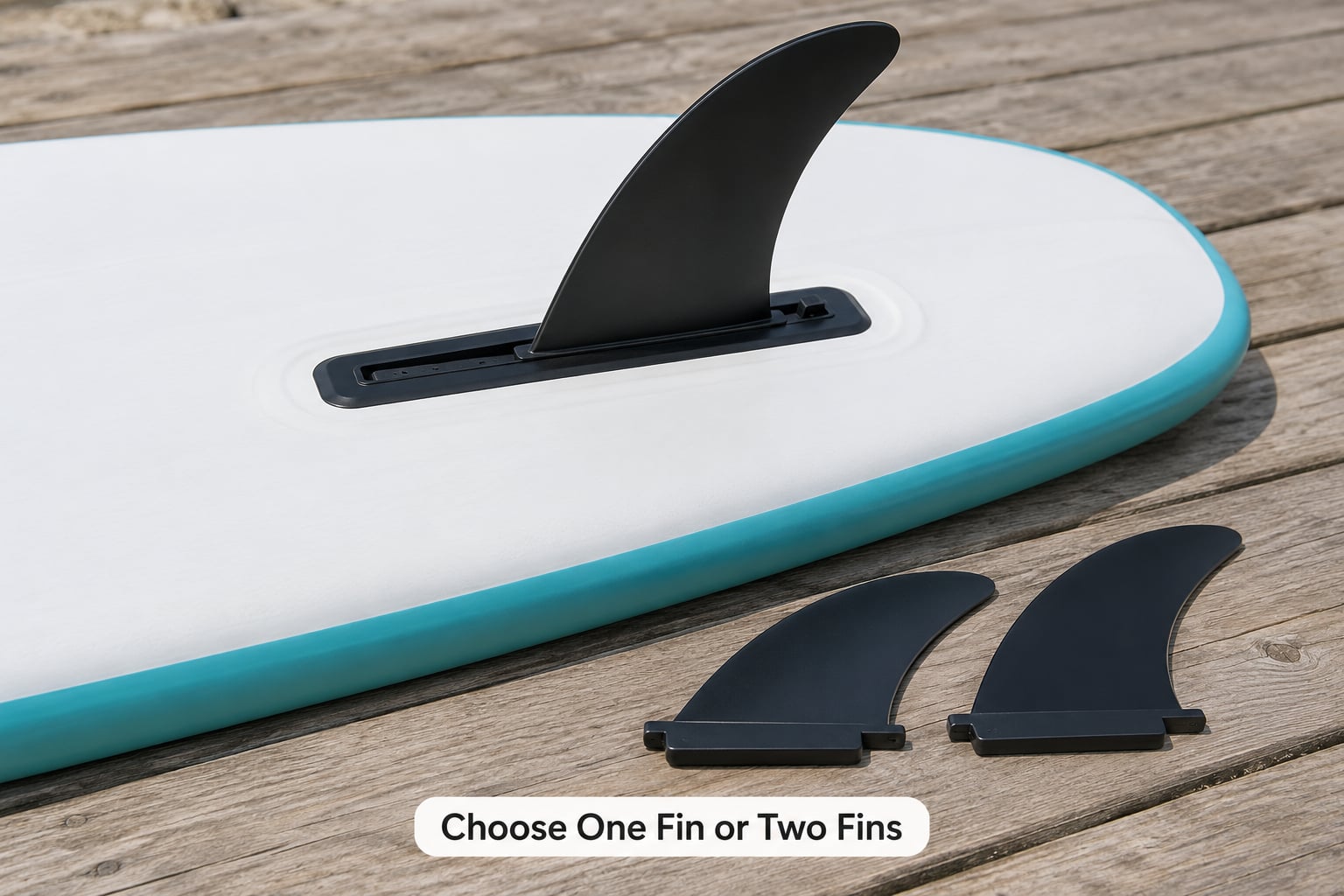
For flat water and cruising, one large center fin is enough, and adding small side fins mostly adds drag. Add side fins when you paddle in chop, wind, surf or choppy coastal water, where holding a rail through a turn matters more than top-end glide.
The words get used loosely, so it helps to know what each label means in practice. Practitioners on SUP forums are precise about it: a thruster is three fins of the same size, with the feel tuned by sliding the rear fin in its track. A traditional 2+1 is a larger center fin with smaller sides, often at an 80/20 or 70/30 size ratio. A twin is two equal fins with nothing between them. A quad is four, and it belongs on surf-specific boards with the boxes for it.
| Setup | Tracking | Turning | Best water | Watch out for |
|---|---|---|---|---|
| Single center fin | Best straight-line tracking of any setup | Loose in a hard turn, especially sideways | Flat lakes, open-water touring, racing | Board can slide out on a rail in chop |
| 2+1 (large center, small sides) | Close to a single fin | Holds through a carve better than one fin | Flat water with some chop, downwinder trips | More drag than a lone center fin |
| Thruster (three equal fins) | Very good, and easy to adjust by moving the rear fin | Lively and forgiving in surf | Chop, small waves, mixed-condition paddling | Heavier, more drag on flat water |
| Twin (two equal fins) | Good, slightly looser than one center | Quick and skate-like | Small surf, playful flat water | Needs two matching side boxes |
| Quad | Good in drive, soft at low speed | Very fast off the lip | Waves on a board built for it | Over-fins the board and costs speed |
One thing worth saying plainly, because it confuses almost everyone: the tiny side-bite nubs moulded into some inflatable SUPs are not really doing hydrodynamic work. They are cosmetic, and they add a small amount of drag. If your board has a center box, use the center box.
Your result here is a count, not a brand. If your board has one center box, your answer is one fin. If it has a center box plus two side boxes and you paddle in anything rougher than a calm lake, a thruster set is the safe default that forum regulars keep recommending for exactly this reason.
Match Fin Shape and Size to the Water
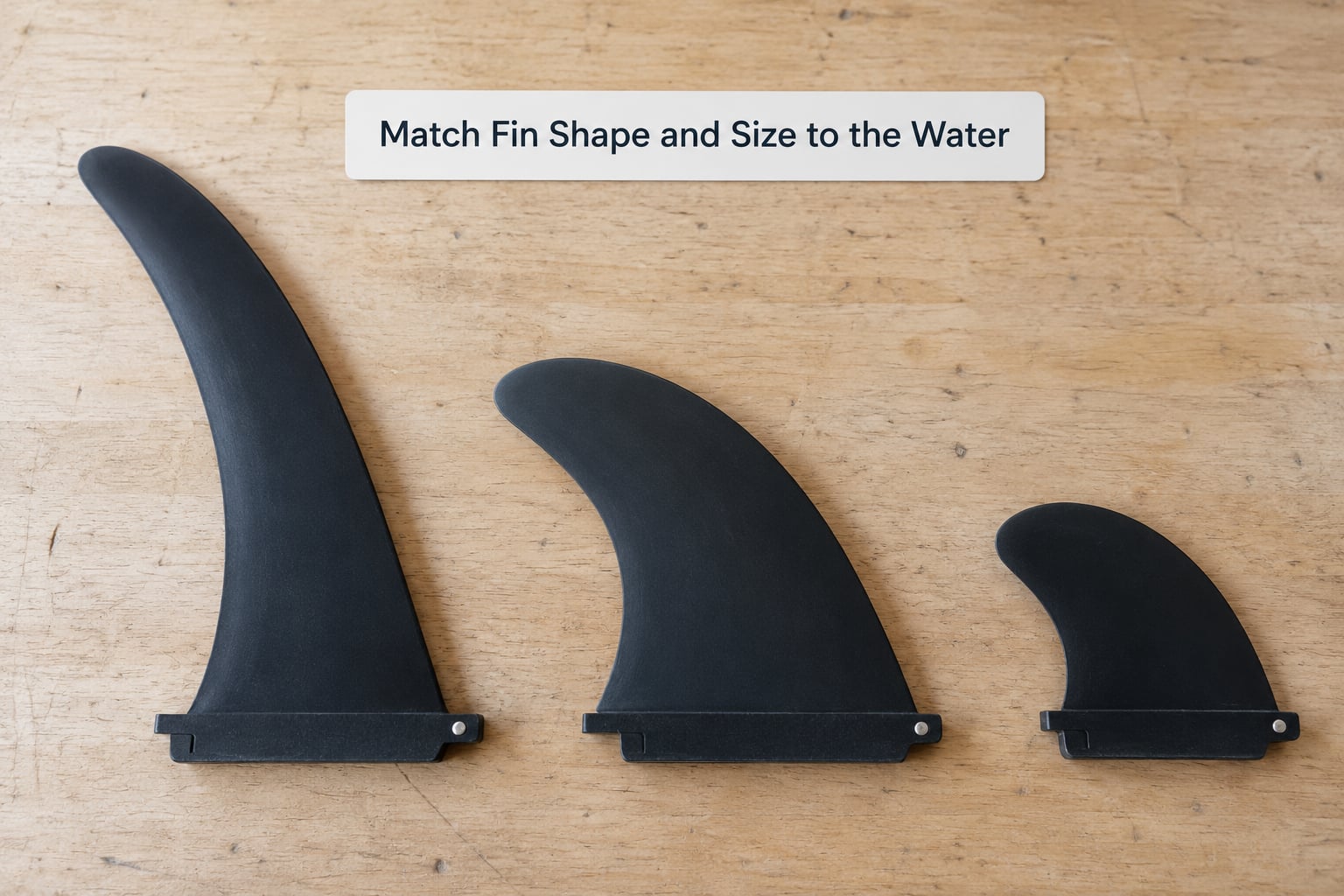
Bigger fins resist sideways motion more, which gives tracking and stability at the cost of drag and slow turns. Smaller fins do the opposite. That single trade-off explains most of what you need to know about how to choose paddleboard fin setup once the box question is settled.
Fin depth, the distance the fin protrudes below the hull, is the number to compare across brands. The full range runs from about 1.5 inches for whitewater to around 12 inches for racing, and most boards ship with a center fin in the 9 to 10 inch range.
| Fin depth | What you get | Suits |
|---|---|---|
| 1.5 to 4 inches | Almost no tracking, survives contact with rock | Whitewater, boulder gardens, very shallow runs |
| 4 to 6 inches | Quick turns, decent hold, shallow-water clearance | Rivers, weed beds, small lakes, surf on a short board |
| 8 to 10 inches | The balanced default: solid tracking, still turns | Flat lakes, general all-round paddling, beginners |
| 9 to 12 inches | Maximum tracking and glide, noticeable drag | Long tours, open water, downwind, racing |
Shape changes how a fin behaves at different speeds. Surf-style fins, sometimes called dolphin or flex fins, have an upswept profile that lets them pivot and flex, which is what you want in waves. Touring-style fins, often called hatchet fins, have a straighter leading edge and a longer chord, so they hold a line but punish slow, sloppy technique with drag. D-shape fins are short and deep with a wide base, a good middle ground for smaller boards. Keel fins are long and relatively shallow, giving tracking with less draft, which helps in water that gets shallow.
Material decides how much punishment a fin absorbs. Hard plastic is cheap, stiff and nearly indestructible on flat water, but it can snap on a rock shelf. Soft or gummy plastic flexes and absorbs impacts, making it the safe pick for rivers and rocky shorelines. Fiberglass and carbon composite layups are stiffer and lighter, which helps acceleration and speed but leaves less margin in shallow water.
Weight and board size matter less than most forums suggest, but not zero. On a long, narrow, high-volume touring board, a rider over 200 pounds with a loaded deck will make a smaller fin feel twitchy, so step up one depth category. On a short, wide, thick board, a big fin makes an already stable board feel like a barge, and a smaller fin suits it well.
Use the Manufacturer’s Paddleboard Fin Setup Guidance
Follow the sizing chart that came with your board, because the manufacturer already matched fin depth to board length, width and volume when the board was designed. It is the fastest correct answer available, and it beats any general rule of thumb on this page.
Charts normally vary fin depth by board length and by volume, and some list a separate recommendation for heavier riders. Read the column that matches your board, then adjust one step in either direction based on the water you actually paddle.
Never assemble a setup from parts of different systems. A Two-Tab fin will not sit properly in a US Box track even if it is the right length, and forcing it can crack the tabs. If you own fins in a different system, an adapter plate is the honest fix: a US Box to FCS or Futures adapter lets a surf fin sit in a paddleboard track so you can use a quiver you already own instead of buying a board.
Your result is a specific fin, in a specific depth, confirmed to fit your specific box. Write the part number down. You will want it again.
Check Tracking, Turning, and Clearance Needs
Bigger fins track straighter, turn later and draft deeper. Decide which of those three you care about most for the water you actually paddle, then pick the fin that gives it to you without giving you the other two in excess.
On a calm lake, prioritize tracking and pick the longest fin your board’s chart allows. You will cover more distance per stroke and stop correcting as much. In coastal chop or a crosswind, prioritize hold, which means more total fin area: keep the large center fin and add the side fins your boxes allow. On small waves, prioritize pivot and pick something a size down from your all-round fin, or a surf-style shape with flex. In shallow rivers and weed beds, prioritize clearance, which means a shorter fin or a flexible material, even at the cost of some tracking.
Flex matters as much as length in moving water. A stiff fin delivers force crisply on flat water and shudders when it slaps in a choppy sea. A flexing fin absorbs that load, and forgiving when you are balancing in a current.
Two adjustments cost nothing and change more than most people expect. Sliding the center fin back along its track increases tracking and slows the turn-in, and sliding it forward makes the board pivot sooner. Side fins fitted with a few degrees of toe-in, angled so their trailing edges point toward the centerline, grip better through a turn than parallel fins.
Wind and current are worth their own line of thinking, because fins cannot steer a board sideways. A fin resists lateral motion; it cannot stop a crosswind or a current from pushing you off line. In those conditions, expect to use corrective strokes rather than assuming a bigger fin will hold your course.
Install and Test the Fin Setup
Install the fin dry, on shore, and check it before the water. A fin that is loose, canted or dragging will waste a session and can damage the track.
Rinse the box with fresh water and clear any sand or shell fragments out of the track and out of the screw hole. Check that any tabs or plastic inserts are intact and sitting flat, because a warped tab is the usual reason a fin will not lock properly. Slide the fin in so it sits squarely and the base is flush with the hull, then tighten the screw or engage the lock until the fin no longer pivots by hand.
Tighten to the manufacturer’s specification rather than by feel. Over-tightening cracks the plastic around the insert in cold weather, and it is not recoverable on an inflatable. If the board uses a tool-less lock, close it fully and check that the release catches.
Then paddle a low-speed loop close to shore before you head out. Sit or kneel, drive straight for twenty strokes, and note whether the board tracks on its own or pulls to one side. A small pull is often nothing more than the board’s own center fin alignment. Finish with three or four direction changes each way, and listen for the fin slapping the surface, which means it is too large or too far back.
Your result is a fin that is secure, aligned, undamaged and matched to the conditions you just paddled. If something feels off, write it down with the water conditions. Practitioners who keep a simple log of fin changes against conditions end up tuning faster than anyone else, and it costs nothing but a note in your phone.
Common Mistakes
Almost every fin problem traces back to one of six mistakes. Each has a fix you can apply before you launch.
Buying a fin before checking the box type
The most common and most expensive error. A fin that is the correct depth but the wrong attachment style simply will not fit, and forcing it can crack the box. Fix: photograph the box, confirm the system name and the slot dimensions, then order.
Mixing systems to save money
Two-Tab, Flip-Lock, Slide-In and Hook-and-Pin fins are not interchangeable with each other or with the US Box, even when the lengths look identical. Fix: buy one system and stay in it. If you already own another system, use a proper adapter plate rather than adapting by force.
Defaulting to the largest fin available
A 12-inch fin on a short, wide board feels heavy and slow, and it will still snap in shallow water. Fix: start from the manufacturer’s chart for your board length and volume, then step up or down one category for your water.
Ignoring the rider’s weight and gear
A paddler at 230 pounds with a cooler and a dog on deck makes a small fin feel loose. Fix: use the heavier-rider column if the chart has one, or move up one depth category on a long touring board.
Over-tightening the hardware
Cracked inserts and stripped boxes come from cranking the screw until the fin feels like part of the hull. Fix: tighten until it no longer pivots, no further, and re-check it after the first paddle.
Using the wrong fin in rocks, weeds or heavy surf
A long rigid fin is a liability over a shallow sandbar, a weed bed or a boulder garden. Fix: drop a depth category and choose a flexible material for rivers and shallow lakes, and accept slower turns in exchange for not losing a fin.
A few habits keep a setup working. Rinse the box after every session on fresh or brackish water, since salt crystallizes in the track and stiffens the tabs. Keep a spare fin in the car if you paddle near rocks. Check the fin for cracks at the base after any hard contact, since a crack spreads quietly and then lets the fin snap off at the first strong stroke.
Frequently Asked Questions
Is a larger paddleboard fin always better?
No. A larger fin resists sideways motion more, which improves tracking and stability, but it also adds drag and drafts deeper. On flat lakes that trade is usually worth it. In shallow water, weeds or rocks, a shorter fin that will not snap is the better choice. Start from the sizing chart for your board, then adjust one depth category for your conditions.
Should I use one fin or two fins on a paddleboard?
It depends on your board’s boxes and your water. One long center fin is all a flat-water paddler needs and gives the best straight-line tracking. If your board has a center box plus two side boxes and you paddle in chop, wind or surf, use all three, since the side fins hold the board through a turn. A single fin on a choppy day feels loose on the rail.
What fin should I choose for touring and long-distance paddling?
Choose the longest fin your board’s chart allows, typically in the 9 to 12 inch range, and keep a touring-style or straight-edged shape that holds a line at a steady stroke rate. Longer fins cut wandering and save strokes over a long day. Bring a shorter fin as a backup for launches over sandbars, and slide the center fin slightly aft for a straighter glide.
Can I replace the fin on an inflatable paddleboard?
Yes, if the board has a removable fin box. Most inflatables use a US Box track or a US Side Box, and both slide-in replacement fins are sold for them. If your board has a fixed fin, there is nothing to replace. Check the model number against the manual first, and order the system your box actually uses, since proprietary boxes can crack if you force the wrong fin.
How do I know which replacement fin fits my board?
Photograph the underside of the board at the tail, note the box system name, and measure the slot width and length inside the track. Then match those numbers against the board’s specification page or the manufacturer’s support team. Board length and volume tell you the depth, and the box type tells you the attachment. Confirm both before ordering, and keep the part number for next time.
What should I do if my fin is damaged in shallow water?
Take the board out of the water and inspect the fin base and the box. A cracked or snapped composite fin usually cannot be repaired safely, so replace it. A cracked plastic tab or a stripped insert can often be cleaned and the fin refitted, but check the box for deformation first. Rinse in fresh water, dry fully, and avoid another shallow-water launch until the replacement is seated and secure.
Conclusion
Start where every good fin setup starts: turn the board over, name the box system, and decide what the water demands. Then use the manufacturer’s sizing chart to pick a fin depth that fits your board’s length, volume and your own weight, and add side fins only if your boxes allow them and your conditions need the hold.
Beginners on flat lakes should stop there. One long center fin in the range of 9 to 10 inches, matched to the board’s chart, is a complete and correct setup. Paddlers moving into chop, surf, rivers or long tours should go further: size up for tracking, size down for clearance, pick flexible material over rock, and slide the fin back and forth in its track until the board behaves the way you want.