If you want to know how to paddle a kayak straight, the whole technique fits into three landmarks: plant the blade near your toes, keep it close to the hull as you pull, and lift it out at your hip. Equal strokes on both sides, a relaxed grip, and eyes on a distant target do the rest. It takes about an hour of practice on calm water to feel the difference.
Most beginners who can’t hold a line aren’t weak. They’re pulling the paddle too far back, using their arms instead of their torso, or looking down at the water instead of ahead. Those three habits account for most of the weaving you see on a first outing, and all three are fixable in a single session.
A fair number of paddlers also get advice that ignores the boat. A short recreational kayak is supposed to turn easily, and a rental hull with a half-set skeg will never track like a long touring boat. Knowing which problem you have saves weeks of frustration.
Table of Contents
- 1The seven techniques in short
- 2What You Need
- 3A boat that suits the water
- 4A paddle that fits you
- 5Safety kit and the right conditions
- 6Step-by-Step: How to Paddle a Kayak Straight
- 71. Start With a Stable Position
- 82. Set the Paddle for Efficient Forward Motion
- 93. Use Equal Strokes on Both Sides to Paddle a Kayak Straight
- 104. Look in the Direction You Want to Travel
- 115. Make Small Steering Corrections
- 126. Practice Until the Path Stays Steady
- 13Common Mistakes
- 14The named errors worth watching for
- 15Frequently Asked Questions
- 16Why does my kayak keep turning when I paddle?
- 17What should I do if my kayak drifts sideways?
- 18Should I paddle harder to make a kayak go straight?
- 19How do I steer a kayak without a rudder?
- 20Is it better to look ahead or down at the water when kayaking?
- 21How long should a beginner practice paddling straight?
- 22Keep Your First Practice Session Simple
The seven techniques in short
- Sit square with your weight centred and your feet on the footrests
- Hold the paddle in a relaxed O-grip, knuckle of the lower hand in line with the blade
- Plant near your toes, pull beside the hull, exit at the hip — never past it
- Drive the stroke with torso rotation and your legs, not with your arms
- Alternate matched strokes so both sides deliver the same power
- Look at a distant fixed point rather than down at the water
- Correct early and gently with the rudder, a stern tap, or a lean
A note before you start: wear a properly fitted personal flotation device, tell someone where you are going, and begin on sheltered flat water. Straight-line practice is boring by design, so pick a calm morning and a small lake.
What You Need
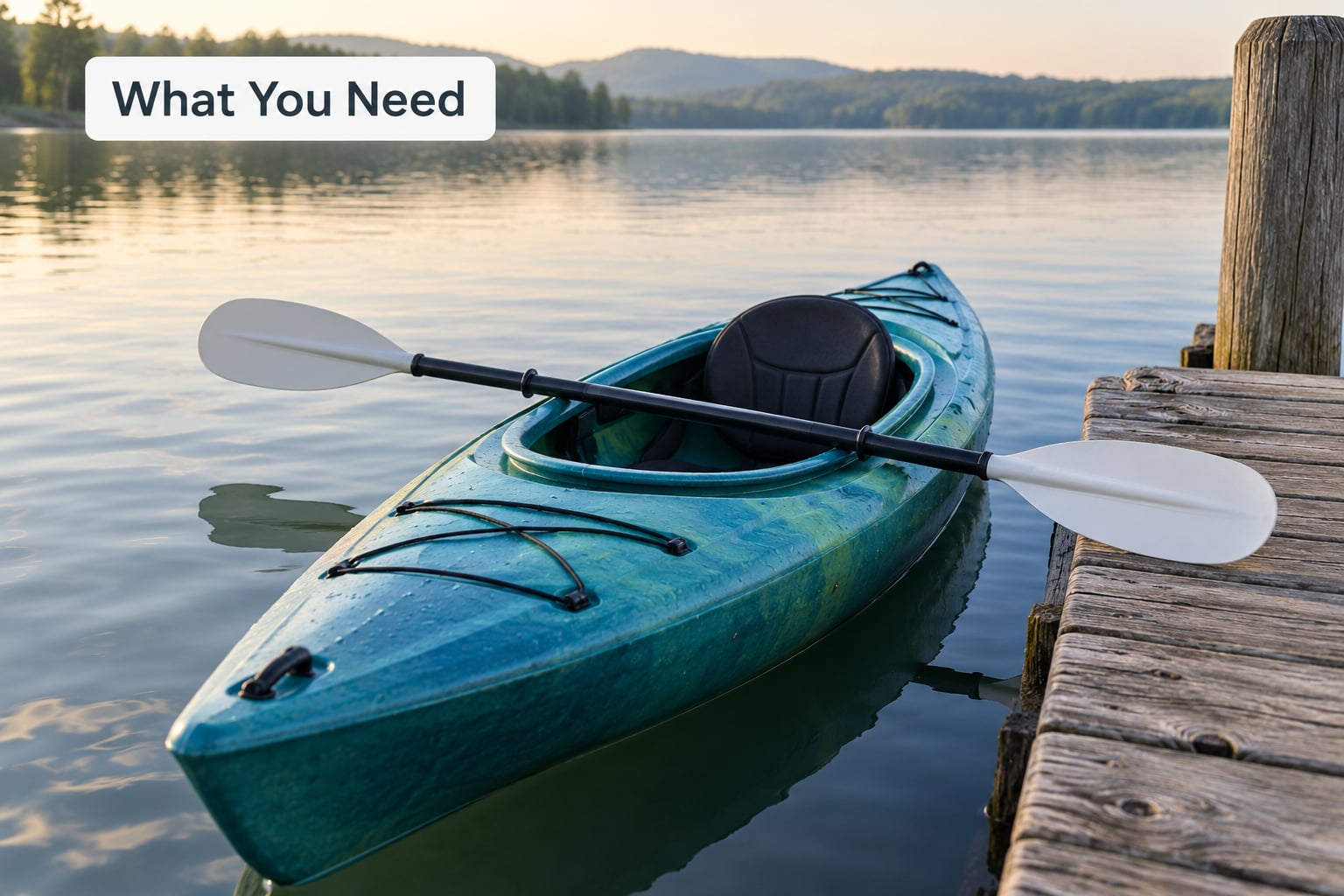
You need less than most guides list, and none of it needs to be expensive to start.
A boat that suits the water
Recreational kayaks are wide, stable and short, which makes them easy to get into and slow to turn. Touring kayaks are long and narrow, with a hull designed to glide in a straight line. Inflatable kayaks sit in between and are more forgiving of a beach launch than most hard shells.
If you are learning on a rental, ask whether the skeg or rudder is adjustable before you head out. A ten-second adjustment at the dock saves an hour of guessing on the water.
A paddle that fits you
Two numbers matter more than brand. Shaft length has to match your reach and the width of your boat, and the blade angle decides how comfortably you can switch sides.
A rough starting estimate is the 120 rule: multiply your height in centimetres by 1.2 to get a shaft length, then shorten it for a wide recreational kayak and lengthen it slightly for a narrow touring one. A paddler around 180 cm lands near 210 to 220 cm before adjustments. Treat that as a starting point and fine-tune on the water — hold the paddle in front of you with the shaft horizontal and the hands slightly wider than your shoulders.
On blade angle, an unfeathered paddle keeps both blades flat and level. It is slightly less efficient per stroke and easier on a beginner’s wrists. A feathered paddle rotates the blades 30 to 45 degrees, which reduces wind resistance on recovery and suits most paddlers once their stroke is consistent.
Safety kit and the right conditions
A buoyancy aid that fits you properly, a whistle, a paddle leash if your boat uses one, and a dry bag for keys and a phone. That is the kit.
For practice, choose a lake or sheltered bay with little boat traffic, no tide and no more than a light breeze. Crosswind is a good teacher, but it is a bad first lesson. Currents are worse: a spring tide through a narrow inlet can sweep a drifting kayak sideways faster than a beginner can correct.
Step-by-Step: How to Paddle a Kayak Straight
1. Start With a Stable Position
Sit centred in the seat, not slid forward or tipped back against it. Push both footrests down and place your feet flat on them with knees slightly bent. Your legs are part of the propulsion system, and a paddler with loose legs in front of the footrests is steering with a broken tool.
Set the seat height so your knees are bent and your thighs clear of the deck. If you are sitting with your legs almost straight, you have probably moved the seat forward to fix it, which pushes your weight too far forward and makes the bow wander.
Keep your spine tall, your shoulders down and your core lightly engaged. The image that helps most is the paddler’s box: shoulders and hips rotating together, everything above the waist doing the work. Push against the footrest on the side you are about to paddle to add a little leg drive.
2. Set the Paddle for Efficient Forward Motion
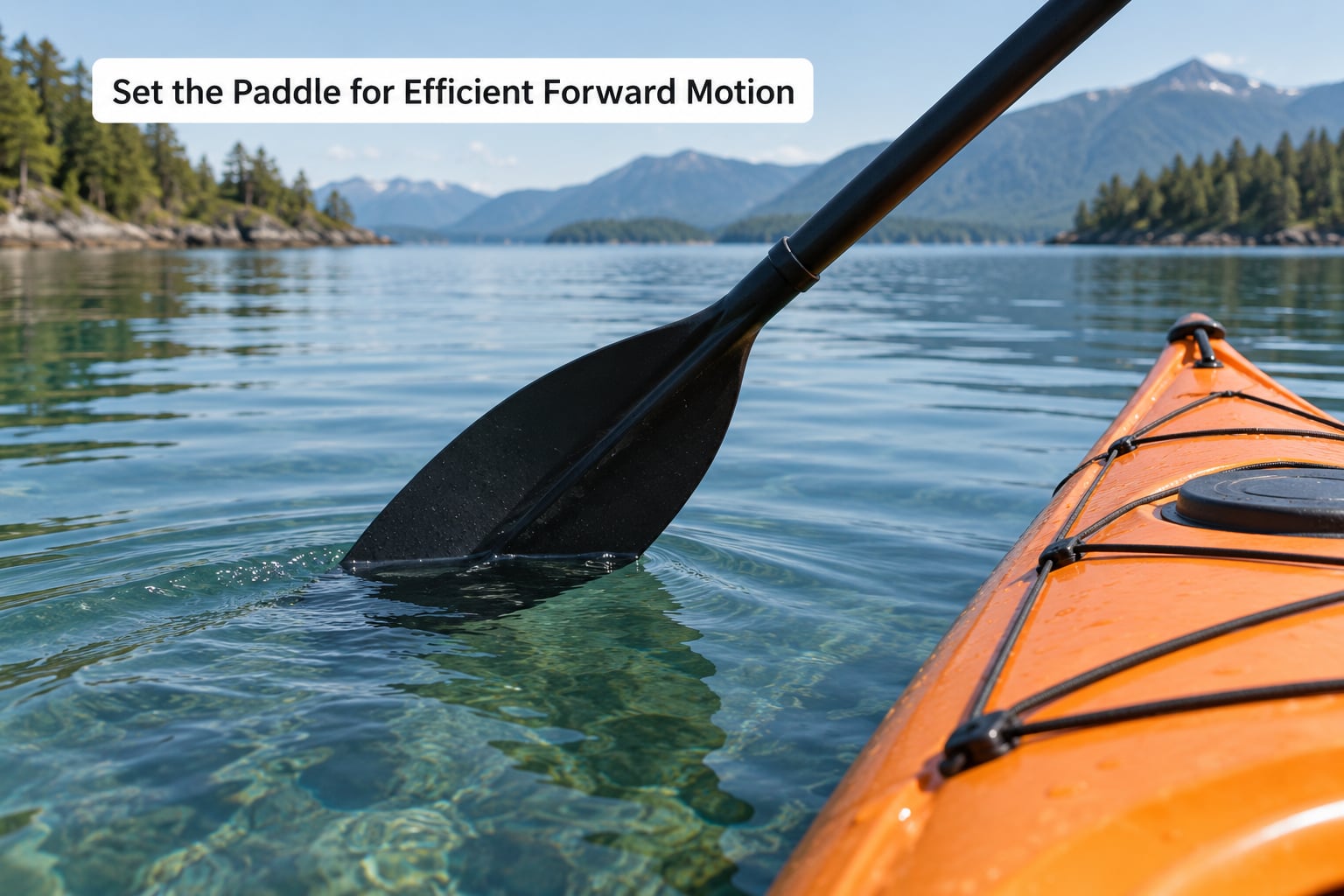
Grip the handle lightly. Make an O with your thumb and forefinger rather than clamping the shaft, and let the top hand come over the top of the blade rather than driving down on it. The knuckle of your lower hand should line up with the spine of the blade. If you can hear your fingers creaking, you are holding it too tight, and tired hands pull shorter strokes all afternoon.
The stroke has three phases, and beginners should learn them separately before putting them together.
- Catch: plant the blade fully, near the toes and as close to the hull as your hands allow. Fully submerged means the whole blade, not the tip.
- Power phase: rotate your torso and drive the blade back in a straight line beside the boat, keeping the power face square to the water. Keep the paddle shaft quiet while the shoulders do the work.
- Release: lift the blade out at your hip. Do not pull past it.
That last line is the one that changes everything. A blade dragged behind your hip acts like a rudder, pushing the stern one way and sending the bow somewhere else. It is the most common reason a beginner weaves, and it feels natural to keep going because it still moves the boat forward.
The sweep of the stroke should be short. If your blade lands out past your knee on the recovery side, you are reaching and twisting, which costs speed and adds yaw. Aim for a stroke length of roughly a paddle’s width and a cadence you could sing to.
3. Use Equal Strokes on Both Sides to Paddle a Kayak Straight
This is the core answer to the question, and it is less about strength than about geometry. A kayak tracks when the thrust from both sides cancels out. Every stroke adds a small sideways force, called sideslip, so one harder stroke than the other puts the boat on a permanent curve.
Count your strokes and try to finish a set with the blade entering near your toes again. Beginners often pull harder on their dominant side without noticing, and the boat settles into a gentle arc rather than a line.
Watch for one more habit: paddling one side with the top hand pushing over and the other with the top hand pulling across. Uneven blade angle across the two sides means uneven power, and the boat will not hold a line.
4. Look in the Direction You Want to Travel
Pick a point on the far shore — a rock, a dead tree, the end of a jetty — and keep your eyes on it. Kayaks steer toward where you look, mostly because your torso quietly follows your gaze and changes how you sit against the water.
Looking down at the blade kills the straight line in two ways. You lose your reference point, and your head weight shifts forward, which pushes the bow around.
Once you have picked a point, use it as a gauge. If the marker creeps toward one edge of your vision, your line is already bending, and a small correction now costs far less than a big one later.
5. Make Small Steering Corrections
Most corrections are tiny. Hold a rudder or skeg down for a couple of strokes, tap the stern, or lean a few degrees. Save the big movements for real obstacles.
- Rudder stroke: with the paddle held vertically, dip the blade beside the hull near your hip, squeeze it briefly and lift. Effective, fast and gentle if you keep it short.
- Stern tap: bring the paddle beside the hull and tap the blade flat on the water a little behind your hip. This yaws the stern and swings the bow toward you, which is the fastest way to change heading in wind.
- Lean: tilt the boat a few degrees toward the direction you want to travel. Leaning is usually faster than a corrective stroke and works well in light wind or current.
- Sweep stroke: a long arc beside the hull turns the boat quickly. Useful near rocks, wasteful on open water.
- Reverse stroke: blade in beside the hull, push forward and out. A gentler correction than a sweep when you need to slow down as well as turn.
Whatever you use, apply it briefly. Oversteering is how a straight-line wobble becomes an S-curve: correct one way, overcorrect, then correct back.
6. Practice Until the Path Stays Steady
Judge progress by the line, not by speed. A ten-minute routine on flat water does more for tracking than an hour of unstructured paddling.
- Target run: aim at a marker 100 to 200 metres away, paddle steadily and see how far off you finish. Repeat ten times and compare.
- Figure-eights: paddle a figure-eight through your own wake on the way back. It forces alternating strokes and smooth changes of direction.
- Out-and-back: time the trip to the marker and home. Strong wind or current shows up as a big difference between the two legs, and it teaches you to hold a crab angle into a crosswind rather than fighting it.
- One-thing fixes: when the line drifts, change one thing at a time. Adjust your position, or your stroke, or your gaze, then hold everything else steady so you know what worked.
Common Mistakes
Almost every curving kayak fits into one of a handful of patterns. Work down this list before you blame your boat.
| Symptom | Likely cause | Fix |
|---|---|---|
| Bow swings to one side no matter what | Stronger strokes on one side, or unequal seat position | Count equal strokes on both sides and check your footrest height |
| Smooth curve instead of a line | Pulling the blade past your hip | Release at the hip and shorten the stroke |
| Side-to-side weaving | Oversteering and correcting too hard | Use rudder or stern tap taps instead of sweeps |
| Slow, with tired shoulders | Arms-only power and a tight grip | Relax the grip, rotate the torso, push the footrest |
| Can’t stay aimed at a distant point | Looking down at the blade | Eyes on a fixed marker on the shore |
| Holds a line for two strokes, then wanders | Blades not fully submerged at the catch | Plant the whole blade near your toes |
| Drifts badly even when technique is clean | Hull length, skeg position, or seat too far back | Adjust the skeg, slide forward, or move to a longer hull |
The named errors worth watching for
The death grip. Clamping the shaft tires your hands and shortens your stroke by lunchtime. Loosen it until you could pull the paddle out with one hand.
Arms-only power. Bending at the elbow to drag the blade back is slower and wears your shoulders. Rotate from the hips and let the torso move the paddle.
Overreaching. Landing the catch out past your toes means you are twisting your spine instead of rotating it. Bring the catch back in.
Wide, sweeping strokes. A big arc across the bow pushes the nose sideways every time. Keep the stroke path tight beside the hull.
Leaning from the waist. Correcting by twisting your torso out of the seat over-corrects. Use the rudder, a stern tap or a small edge.
Ignoring wind and current. If the boat is consistently pushed off line, fighting it in a straight line wastes energy. Aim the bow slightly off the target and let the wind carry you back onto course.
Frequently Asked Questions
Why does my kayak keep turning when I paddle?
Most often it is technique rather than the boat. Paddle strokes of unequal power, pulling the blade past your hip, or an uneven seat position will all push the bow off line. Sit square, plant near your toes, release at the hip, and count matched strokes on both sides for a few minutes. If the drift survives clean technique with the skeg down, the hull itself is the likely cause.
What should I do if my kayak drifts sideways?
Stop adding power and start correcting. Hold the rudder or skeg down for two or three strokes, or tap the blade flat beside the hull just behind your hip to swing the bow back. A slight lean into the drift is faster than a sweep stroke. Fix the drift early and gently, because overcorrecting turns a small wobble into an S-curve.
Should I paddle harder to make a kayak go straight?
No. Harder strokes make the sideslip bigger, not smaller, and they tire out the side you favour. What straightens a kayak is symmetric, close-to-the-hull strokes at a steady cadence, plus brief corrections. Power comes from torso rotation and your legs pushing against the footrest on the side you are paddling, not from a harder pull with the arms.
How do I steer a kayak without a rudder?
Use the bow sweep, the reverse stroke, the rudder stroke and the stern tap. A rudder stroke is a brief squeeze beside your hip and is the gentlest option. A stern tap beside the hull changes heading fastest in wind. A sweep arc turns the boat quickest and is best reserved for obstacles, rocks and tight landings.
Is it better to look ahead or down at the water when kayaking?
Look ahead, at a fixed point on the far shore or the bow. A kayak tends to follow your gaze, so a distant marker gives you continuous feedback on your line. Looking down at the blade removes that feedback and shifts your head weight forward, which pushes the bow around. Glance at the water only when you are placing a stroke deliberately.
How long should a beginner practice paddling straight?
An hour of calm-water practice is usually enough to feel a real change, and most paddlers hold a decent line after two or three sessions. Run ten-minute target trips to a marker 100 to 200 metres away, then paddle figure-eights on the return. Judge the line, not the speed. Add wind and current only once flat-water tracking feels automatic.
If you only change one thing this week, make it the release. Exit every stroke at your hip, keep both sides matched, and keep your eyes on the shore.
Keep Your First Practice Session Simple
Start on sheltered flat water with a buddy, a fitted buoyancy aid and a clear shoreline. Sit square, feet on the footrests, spine tall, grip loose.
Paddle twenty strokes on each side without speeding up, exit at the hip every time, and pick one marker to aim at. When the marker stays put for a whole length of the lake, add a light crosswind. Only then move to current or a longer crossing.
If your line is still loose after a few sessions of clean technique, change the boat, not your effort. Check the skeg, slide forward in the seat, and try a longer hull. Good tracking is half technique and half equipment, and knowing which half is your problem is the fastest route to a straight line.