Fishing regulations are the legal rules that decide who can fish a waterbody, when, with what gear, and how many or what size fish they may keep. Learning how to read them takes less time than most anglers spend picking a launch site, and it protects the fish you drove hours to catch. Most of the confusion is vocabulary, not logic, so this guide breaks a rule book apart clause by clause.
I have read a lot of agency PDFs for lake guides, and the same handful of words show up in nearly all of them: creel, possession, slot, aggregate, special regulation waters. Once those click, a page of legalese takes about three minutes to decode.
Table of Contents
- 1What Fishing Regulations Mean
- 2Why the rules exist
- 3What a regulation actually covers
- 4Federal, state, tribal, local and lake-specific rules all apply at once
- 5What Fishing Regulations Mean and How to Read Them
- 6Step 1: Identify the agency that actually manages the water
- 7Step 2: Get the current rule book, not a cached download
- 8Step 3: Find the lake by its official name and waterbody number
- 9Step 4: Read the section in a fixed order
- 10Step 5: Read the back matter
- 11Step 6: Check for updates between your planning and your arrival
- 12A real rule line, decoded word by word
- 13How to Read Fish Limits, Seasons and Zones
- 14Creel limit, also written as bag limit
- 15Possession limit
- 16Minimum and maximum length limits
- 17Protected slot and harvest slot
- 18How a fish is measured, and why an inch matters
- 19Seasons, closures and zones
- 20Gear and bait restrictions
- 21Aggregate limits and sub-limits
- 22How to Tell Which Rules Apply to Your Lake
- 23Posted signs beat the printed book
- 24What to Do If the Regulations Are Unclear
- 25Document what you are actually looking at
- 26Check the official update pages, not social posts
- 27Ask the agency, in writing where you can
- 28Do not rely on other anglers, map labels or a fishing app
- 29A Simple Checklist Before You Fish
- 30Frequently Asked Questions
- 31Are fishing regulations different for every lake?
- 32Do I need a fishing license if I only fish from a public access point?
- 33What happens if I accidentally catch a fish over the legal limit?
- 34Can a county or local rule be stricter than the state rule?
- 35How do I find the current rules if a lake has several names?
- 36Are temporary closures included in the official fishing regulations?
- 37Conclusion
What Fishing Regulations Mean
A fishing regulation is a rule issued by a government agency that controls harvest on a specific body of water. In plain terms it answers four questions: who may fish, when they may fish, how they may fish, and what they may take home.
Why the rules exist
A fishery only works if the population can replace what anglers remove. Regulations exist to protect the mid-size and large, highly fertile spawners that produce the next generation, so there is always something worth catching next season.
Limits also spread the resource. Without a creel limit, the most aggressive angler on the lake takes everything, and the lake quietly stops producing fish worth having. Size limits and slot limits do the opposite work of bag limits: they let you keep fish, but steer which sizes you keep.
What a regulation actually covers
Almost every rule set, from a state DNR to a national park, touches the same list of things:
- Who. License requirements, exemptions for children, residents versus non-residents, and endorsements for specific species or waters.
- When. Open and closed seasons, spawn closures, creel limits measured from midnight or from a staggered start time.
- Where. Geographic zones inside one lake, buffer zones along tributaries, protected sections, and boundaries between states, tribal lands and federal ground.
- How many. Daily or creel limits, possession limits, sub-limits and aggregate limits.
- Which fish. Minimum length limits, maximum length limits, protected slots, harvest slots and catch-and-release waters.
- How. Number of lines and hooks per angler, artificial-lure-only sections, live bait restrictions and net limits.
- Access. Boat ramp closures, shore fishing closures, night closures and fish cleaning station requirements at some parks.
Federal, state, tribal, local and lake-specific rules all apply at once
There is rarely only one agency involved. Your state wildlife agency sets the baseline for waters it manages. Federal agencies cover their own ground, which includes national parks, national wildlife refuges, national forests and some reservoirs. Tribal departments regulate waters inside reservation boundaries. County and city ordinances can add access and shore-fishing rules on top.
Marine and coastal waters fall under a different set of bodies, including NOAA Fisheries and regional commissions such as the Atlantic States Marine Fisheries Commission. Those do not apply to an inland lake, which is why saltwater anglers and lake anglers often read completely different rule books.
When two rules seem to conflict, follow the more specific and the stricter one. A waterbody-specific note printed for a single lake always beats the statewide default, and a federal land manager’s rule applies inside their boundary even when the state book is more generous. When you cannot tell which is which, that is a question for the agency, not something to guess at on a boat ramp.
What Fishing Regulations Mean and How to Read Them
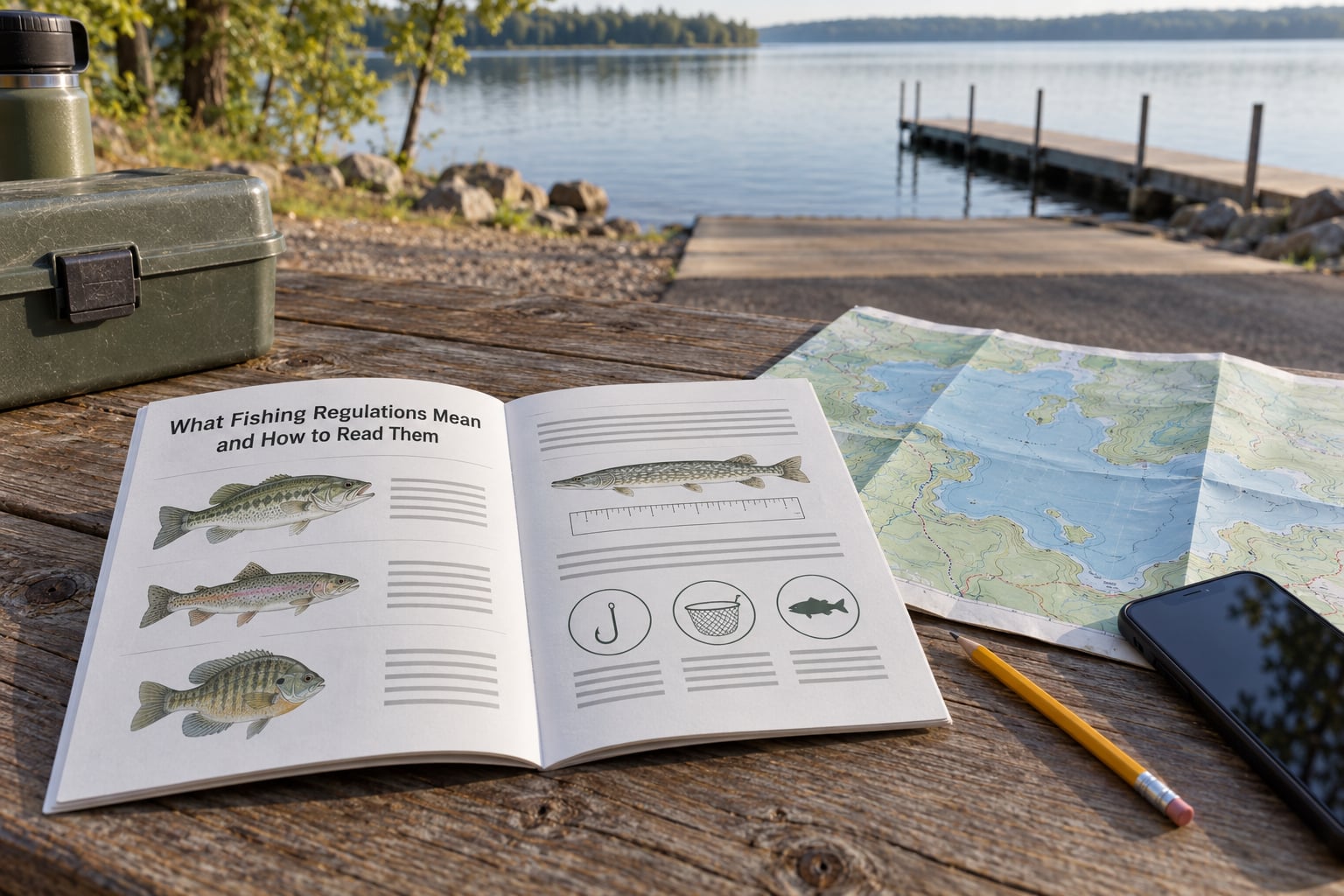
Here is the decoding order that works every time: agency first, then the current rule book, then the lake section, then effective dates, then zones, limits, seasons and exceptions. Following it in that order means you never act on a rule that has already been replaced.
Step 1: Identify the agency that actually manages the water
Start with the state you are standing in, not the state you drove from. For most inland lakes that is the state department of natural resources, department of fish and wildlife, or wildlife commission. Check whether the waterbody sits inside a national park, refuge or forest, because those set their own rules inside the boundary.
Step 2: Get the current rule book, not a cached download
Search results are full of last year’s PDF still sitting on someone’s blog. Go to the agency’s own regulations page and look for the current-year booklet, then check the published date on the inside cover. If your download and the agency page disagree, the agency page wins.
Step 3: Find the lake by its official name and waterbody number
Printed books are indexed by waterbody number and by region, not by the name on your map app. Reservoirs are the usual trap: one lake can carry a project name, a common name and a different county, and only one of those matches the book. Pull up the agency’s lake finder and match the number before you read anything else.
Step 4: Read the section in a fixed order
Inside the entry, read effective dates first, then boundaries and zones, then species limits, then seasons, then gear and bait, then special notes. Agencies put the override in different places, and the note at the bottom of a page has quietly ended more arguments than the limits themselves.
Step 5: Read the back matter
Special regulation waters, catch-and-release sections, sub-limits and gear exceptions are often in a separate table at the back of the book. If a lake feels strangely strict, that table is usually why.
Step 6: Check for updates between your planning and your arrival
Regulations can be amended mid-season. Before you leave, check the agency’s news or closure alerts page, and again at the boat ramp.
A real rule line, decoded word by word
This is the shape agencies use most often. The numbers are illustrative of the wording, so match the pattern rather than the digits.
Daily creel limit of 6 largemouth bass. Only 2 may be 16 inches or greater. Possession limit: 6.
- “Daily creel limit of 6”. Six fish of that species, counted over the state’s defined day, per angler. Not per boat, not per group.
- “Only 2 may be 16 inches or greater”. A sub-limit. Of the six you keep, two can be large fish and four must be smaller than 16 inches measured the way this lake measures.
- “Possession limit: 6”. You may not have more than six of that species on hand at any moment, including fish already in your freezer at home.
Nowhere in that line does it say you must catch six. It is a ceiling, not a target.
How to Read Fish Limits, Seasons and Zones
Every rule you will meet is a variation on one of these types. The table below is the fastest way to see which one you are looking at.
| Limit type | What it caps | When it resets | Typical wording |
|---|---|---|---|
| Daily or creel limit | Number of fish kept per species, per angler | At midnight, or at the staggered start time the state uses | “Daily limit of 6” |
| Possession limit | Number of fish of a species you have on hand | Never resets until you take fish home or give them away legally | “Possession limit not to exceed 6” |
| Aggregate limit | Total of two or more similar species combined | With the daily or possession clock | “Aggregate limit of 10 trout, any species” |
| Minimum length limit | The smallest fish you may keep | Every fish | “All fish must be 14 inches or greater” |
| Maximum length limit | The largest fish you may keep | Every fish | “No fish over 28 inches” |
| Protected slot | A size range you must release | Every fish | “Protected slot 13 to 16 inches” |
| Harvest slot | The only size range you may keep | Every fish | “Harvest slot 18 to 27 inches” |
| Season or closure | When the species may be taken at all | Opens and closes on set dates | “Closed April 1 to June 15” |
| Zone or area rule | Where the other rules change inside one lake | By location, not by date | “Upper basin: catch and release only” |
Creel limit, also written as bag limit
A creel limit is the maximum number of fish of a species you may legally keep in one day. “Bag limit” means exactly the same thing and is the more common wording on freshwater agencies; “creel” is the older legal term you will still see in statute text. Both are counted per angler, not per boat.
Possession limit
A possession limit is the maximum number of fish you may have on hand at any one time, including fish stored in a cooler, a livewell or a freezer at home. It is the limit that catches people, because the fish in the freezer came from last weekend and still count against today.
The two limits are not always the same number. Where they are, the daily limit has effectively stopped being a daily limit, which is exactly the confusion anglers report from states like Minnesota. Where the possession limit is written as a multiple, such as twice the daily limit, you can legally hold two days of fish. Read that multiplier carefully before you plan a two-day trip.
Minimum and maximum length limits
A minimum length limit says every fish smaller than the number must be released. A maximum length limit, used on some trout and bass waters to protect the biggest spawners, says anything above the number must go back. When a lake lists a range, it is a minimum and a maximum together: keep the fish between them.
Protected slot and harvest slot
A protected slot is a length range inside which every fish must be released. A harvest slot is the mirror image: you may keep only the fish that fall inside that range. The wording tells you which one you are reading, so look for the words “protected” or “harvest” before you assume anything.
Slot limits exist to protect the fastest-growing age classes. Bass anglers have discussed the reasoning at length over the years on angler forums, and the logic holds up: if you remove every fish in the productive middle range, the lake loses the breeding stock and only the slow-growing giants remain.
How a fish is measured, and why an inch matters
Length limits are worthless if you measure the wrong distance. The measurement method is written into the regulation, usually once in a definitions section, and it changes the number enough to flip a legal fish into an illegal one.
| Measurement | Where you start | Where you stop | Typically used for |
|---|---|---|---|
| Total length | Tip of the snout, mouth closed | End of the longest tail fin | Bass, trout, many game fish |
| Fork length | Tip of the snout | Centre of the fork in the tail | Salmon, trout, where the tail flexes |
| Standard length | Tip of the snout | End of the anal fin | Species measured in research and tagging |
Measure with the mouth closed and the fish lying on its side against a flat surface, without stretching the tail. A fish straight on the bank will read two inches larger than it is; a ruler pressed against a curved tail will read short. If the fish is close to the line and you have any doubt, release it. Anglers on the forums are near-universal about that default, and it is the cheapest risk reduction available.
Seasons, closures and zones
An open season is the window when a species may be taken. Everything outside it is a closed season, including the spawn closure that protects nesting and breeding fish. Some closures are date-based only; others are tied to temperature, water level or a stage on a river gauge.
A zone changes the rules by place rather than by date. Typical zones are catch-and-release sections at a river mouth, a no-wake buffer around a nesting area, or a protected upper basin of a reservoir. Zone boundaries are drawn on the agency map and repeated in the printed book, and they are the reason a rule can change while your boat is still on the ramp.
Gear and bait restrictions
Gear rules are usually written as counts per angler: one line per angler, two hooks per line, six hooks total in some trout waters, and a ban on multiple lines or treble hooks with more than one point. Bait rules are written per water: artificial lure only on catch-and-release sections, and restrictions or bans on baitfish used for bait in waters where invasive species are the concern.
Aggregate limits and sub-limits
An aggregate limit combines similar species into one number. If the trout aggregate is 10, then the cutthroat, rainbow and brown together count toward 10. A sub-limit is a cap on one species inside a broader limit, and it is the clause people miss, because the total is still available after the sub-limit is filled.
How to Tell Which Rules Apply to Your Lake
Most tickets happen because the angler and the rule book are talking about different pieces of water. Matching them takes five checks.
- Match the official name and waterbody number. Use the agency lake finder rather than a map app or a satellite image. The agency’s name for the water is the one that appears in the book.
- Check the county. A reservoir can span two counties and sit in three towns. The county tells you whose local ordinances may apply and where you report a tip.
- Identify the section or arm. Large reservoirs are broken into named sections with different limits. Know which section you plan to fish and what its boundaries are.
- Find the access point on the map. Some ramps sit in one zone and the water you are working sits in the next. The ramp is the easy part to check.
- Check overlapping boundaries. State line, tribal land, national forest and national park boundaries all change which rules apply, sometimes within a mile.
For anyone travelling between states, the rule change happens at the state line, not at the trailer. A license from one state does not carry over, the creel limits differ, the season dates differ and the minimum lengths differ. Before a multi-state trip, check the current rules for each state you will fish rather than assuming the last one is close enough.
Posted signs beat the printed book
The sign at the boat ramp and the sign at the access point are the most authoritative and most ignored source on any lake. Anglers on fishing forums consistently report that the posted sign is what they had read first and what they would have got wrong without it. Read the sign fully, including the fine print about the section you are entering, and photograph it. If the sign and the book disagree, take the stricter rule and call the agency to sort it out.
What to Do If the Regulations Are Unclear
When a line does not make sense, work through it in this order rather than guessing.
Document what you are actually looking at
Note the agency, the publication or effective date of the document, the page number and the exact clause. Save the page or take a picture of it. Six months later, “the book said six” is not a useful memory, but “page 34, table 3, clause 2” is.
Check the official update pages, not social posts
Mid-season amendments, emergency closures and temperature-triggered changes appear on the agency’s news and closure pages. Social media posts and forum threads are useful for spotting an issue, but they are not the source of truth, and last season’s thread is routinely wrong about this season.
Ask the agency, in writing where you can
Regional offices and the license office answer rule questions by phone and email, and a one-line question with the lake name and species gets a straight answer. Fisheries management staff at the agency are the people who wrote the clause, so they are the right call for wording you cannot decode.
Do not rely on other anglers, map labels or a fishing app
Well-meaning advice at the ramp is frequently out of date or drawn from a neighbouring waterbody. That is not a criticism of anyone; rules genuinely change, and last year’s booklet looked identical. If two sources disagree, the agency is the tiebreaker.
A Simple Checklist Before You Fish
Six checks, five minutes, and most of the mistakes I have seen anglers talk themselves into are gone. Run it at home and again at the ramp.
- The water. Official lake name, waterbody number, county and the specific section or arm you will fish.
- The agency. The state wildlife agency page for your state, plus any federal, tribal or park rules that apply to that shoreline.
- The species. Daily limit, possession limit, sub-limits, aggregate limits and any slot or size range for each species you plan to target.
- The season. The dates your species is open, any spawn closure in effect, and any temporary closure or advisory posted since you last checked.
- The gear and license. Line and hook counts, bait rules for that section, and a valid license with any endorsement the species or water requires.
- The measurement. Which measurement method this lake uses, and a ruler or board in the boat so you are not guessing on the bank.
Two small habits finish the job. Empty your freezer of fish before you leave home if you are within possession limits, and count your catch as you put it in the cooler rather than at the end of the trip.
Frequently Asked Questions
Are fishing regulations different for every lake?
Usually not, but waterbody-specific notes do override the statewide default. A single reservoir can be split into sections with different creel limits, size limits or gear rules, and a national park or tribal section follows its own rules inside the boundary. Read the general section first, then check for a special regulation entry for the exact lake or section you are fishing.
Do I need a fishing license if I only fish from a public access point?
In most US states you need a license to fish from a bank, a pier or a public access, not only from a boat. The exemption people hear about usually applies to children under a certain age, or to fishing from private property without equipment. Some waters are also license-free, and a valid license from another state often works for a non-resident visiting for a short trip.
What happens if I accidentally catch a fish over the legal limit?
Release it and keep fishing. Most states treat a fish over the limit as one you may not possess, so the correct action is to release it as soon as you identify it. Penalties range from a warning and a small fine to a license suspension for repeat or deliberate violations, and conservation officers do check coolers at ramps. One honest mistake handled well is far cheaper than a fish in a plastic bag.
Can a county or local rule be stricter than the state rule?
Yes. County and city ordinances can add shore-fishing closures, access restrictions, night closures and gear rules on top of the state regulations, and a federal land manager’s rules apply inside its own boundary. When a local rule is stricter, follow the stricter one. When the two genuinely conflict rather than one simply adding to the other, contact the state agency before you fish.
How do I find the current rules if a lake has several names?
Use the state agency lake finder rather than a map app, then match the waterbody number and county instead of relying on the name. Reservoirs commonly carry a project name, a historic name and a local name, and only the agency’s version appears in the regulation book. If you cannot match the number, take the section heading from the map to the regional office and ask which entry applies.
Are temporary closures included in the official fishing regulations?
Sometimes, sometimes not. Emergency closures, temperature-triggered shutdowns and short-term restrictions are often issued outside the printed book and posted on the agency news or closure alerts page, and they can start and end between editions. Check that page before you leave and read the posted signs at the access again when you arrive, because the printed booklet will not always mention an active closure.
Conclusion
Start with the waterbody, not the rule: identify the lake by its official name and waterbody number, then pull the current rules from the agency that manages it. Read effective dates, zones, limits, seasons and exceptions in that order, measure every fish the way that rule specifies, and release anything you cannot confirm is legal. That single habit removes most of the risk, and the rest is knowing which source to trust when the book and the sign disagree.