To turn a kayak quickly, plant the paddle blade wide on the side opposite your intended turn and sweep it in a long arc to the stern while you rotate your torso. Add a reverse stroke near the bow when you need a tighter, faster correction, and tilt the boat onto its edge if the turn still feels lazy.
The whole thing takes about a minute to learn badly and a season to learn well. Most beginners can paddle straight for thirty seconds and then fight the boat for the rest of the paddle, and that fight is almost always technique rather than boat size.
A 19-foot sea kayak can turn as quickly as a 12-foot recreational boat in the hands of someone who sweeps properly. Drop the rudder and beginner forum threads fill up with people describing the same moment: steering got easier once they stopped leaning on it. Boat length sets your turning radius; it does not set your ceiling.
Table of Contents
- 1What You Need
- 2Step-by-Step: How to Turn a Kayak Quickly
- 31. Set Your Position for a Faster Turn
- 42. Sweep on the Opposite Side to Turn a Kayak Quickly
- 53. Add a Reverse Stroke to Pull the Bow Around
- 64. Rotate Your Torso Instead of Bracing
- 75. Use Edging and a Cross-Bow Stroke When Needed
- 8Common Mistakes
- 9Frequently Asked Questions
- 10What is the fastest way to turn a kayak?
- 11Should I use a sweep stroke or a reverse stroke to turn a kayak?
- 12How do I turn a kayak toward the left or right?
- 13Can wind or current stop a kayak from turning quickly?
- 14Conclusion
What You Need
You do not need expensive kit to practise this. You need a boat that floats, flat water, and enough room to swing the stern without hitting anything.
- A kayak with reachable foot pegs. Set them so your weight sits over your hips with your back upright and your knees lightly bent. This is the single biggest change most beginners can make, and it comes before any stroke change.
- A paddle matched to your height. Hold it with the top hand on the shaft or the T-grip and your lower hand about a handspan above the blade. Too short and you cannot get the blade out far enough for a wide arc.
- A properly fitted PFD. Every session, including drills in flat water near a dock.
- Dress for the water, not the air. If there is any chance of immersion, wear the thermal protection you would wear on the actual paddle. Wet clothing turns a cold water landing into a serious problem.
- Calm, flat water with room to practise. A sheltered cove or a lake morning with no wind works best. Add a buddy for your first few sessions.
Two pieces of jargon worth knowing before you start. Rudder is the hinged blade at the stern you push down with your foot to swing the bow; skeg is a small fixed fin under the hull that stops it from sliding sideways. Rocker is the curve in the keel line, and more rocker means a boat that turns sooner and tracks worse. Tracking is how straight a boat runs on its own, which is the opposite skill and the one most beginners are chasing first.
Check whether your boat has a rudder, because that changes how you approach a turn. A rudder is excellent at speed and nearly useless at a standstill. Everything below works whether you have one or not.
Step-by-Step: How to Turn a Kayak Quickly
Before the detail, the short version. There are four moves that cover almost every turn you will ever need on flat water:
- Wide sweep stroke for a controlled turn that keeps you moving. Your default at speed.
- Reverse sweep for a fast, tight correction or a turn on the spot when you are already stopped.
- Edging to tilt the hull onto its side so it carves instead of skidding.
- Rudder or bow rudder for a quick heading change while you are making real speed and need to hold a line.
1. Set Your Position for a Faster Turn
Most slow turns are setup problems, not stroke problems. Sit with your hips back against the seat, your knees pressing lightly into the foot pegs, and your spine upright rather than slumped forward.
Move forward on the seat only slightly. Too far back and your weight drags the stern, which fights every sweep. Too far forward and the bow feels heavy and wants to run on. Find the spot where a small ankle movement tips the boat noticeably, and stay there.
Look where you are going. Where your eyes point is where the boat tends to follow, and paddlers who stare down at their own bow end up cutting corners without meaning to.
2. Sweep on the Opposite Side to Turn a Kayak Quickly
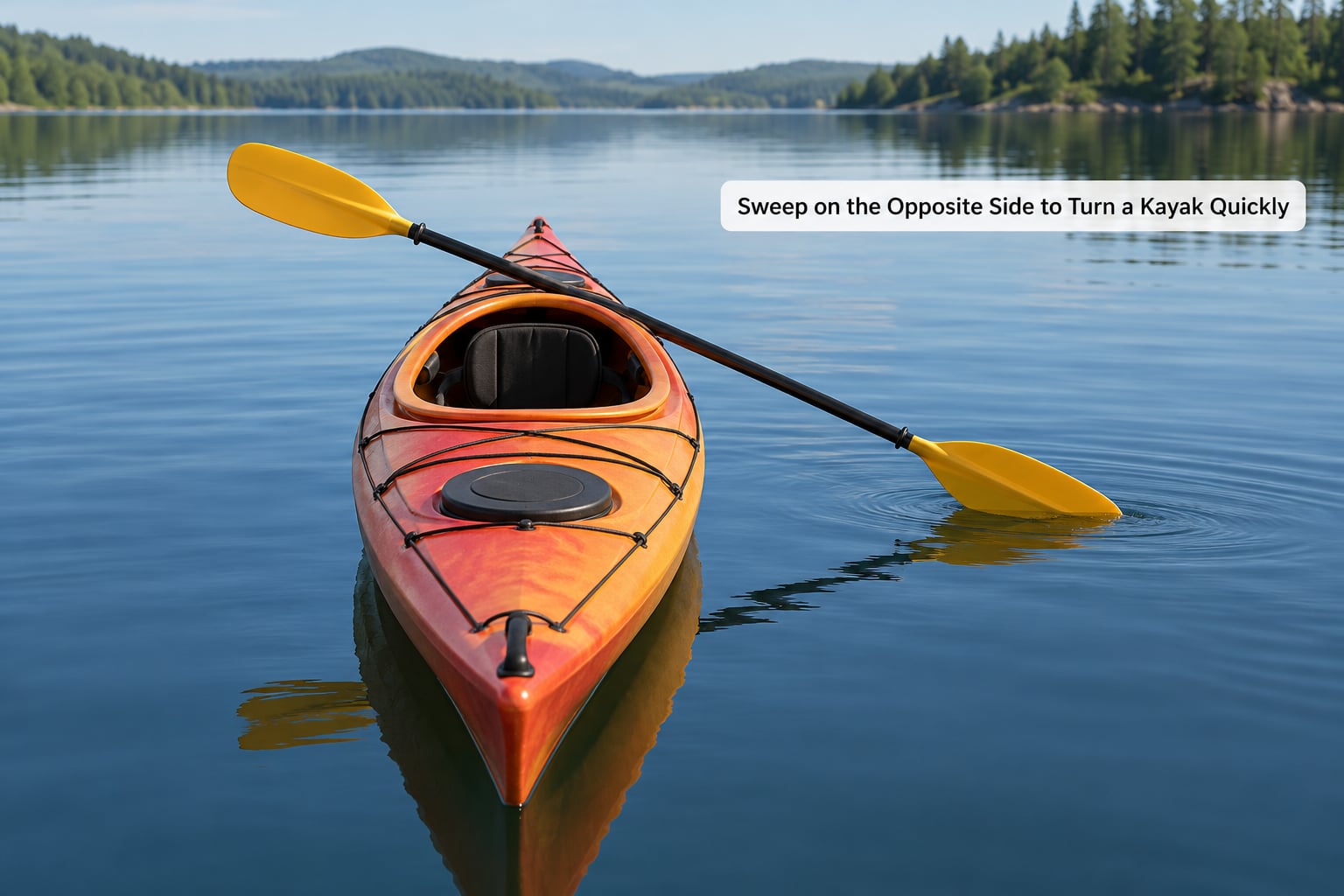
This is the correction that confuses most new paddlers. To turn away from you, you sweep on the side you want to travel toward, which means the blade goes down on the opposite side of the boat and arcs around. Pushing water on the far side pushes the bow toward you and pulls the stern after it.
Here is the sequence in five steps.
- Reach wide. Extend the paddle out to the side, blade angled forward about 45 degrees, and plant it fully before you apply any force. An unfinished plant is where most of the power is lost.
- Catch at the ankles. The blade should enter roughly beside your lower leg, not up near the bow. Too far forward turns the stroke into a bow draw; too close to the hull wastes the whole arc.
- Rotate your chest toward the paddle. Your top hand crosses slightly past the centreline and your shoulders follow. This is where the force comes from, not your arms.
- Sweep all the way to the stern. Think about pulling the blade just behind your hip as the boat rotates under you. The arc should feel like a rainbow drawn from your ankles back to the seat.
- Slice out cleanly. Lift the blade toward the surface at the finish so it releases rather than dragging. Dragging blades cost you speed you need for the next correction.
One sweep should give you 20 to 30 degrees of heading change on a typical recreational boat. If you need much more, that is two sweeps, not one violent one.
3. Add a Reverse Stroke to Pull the Bow Around
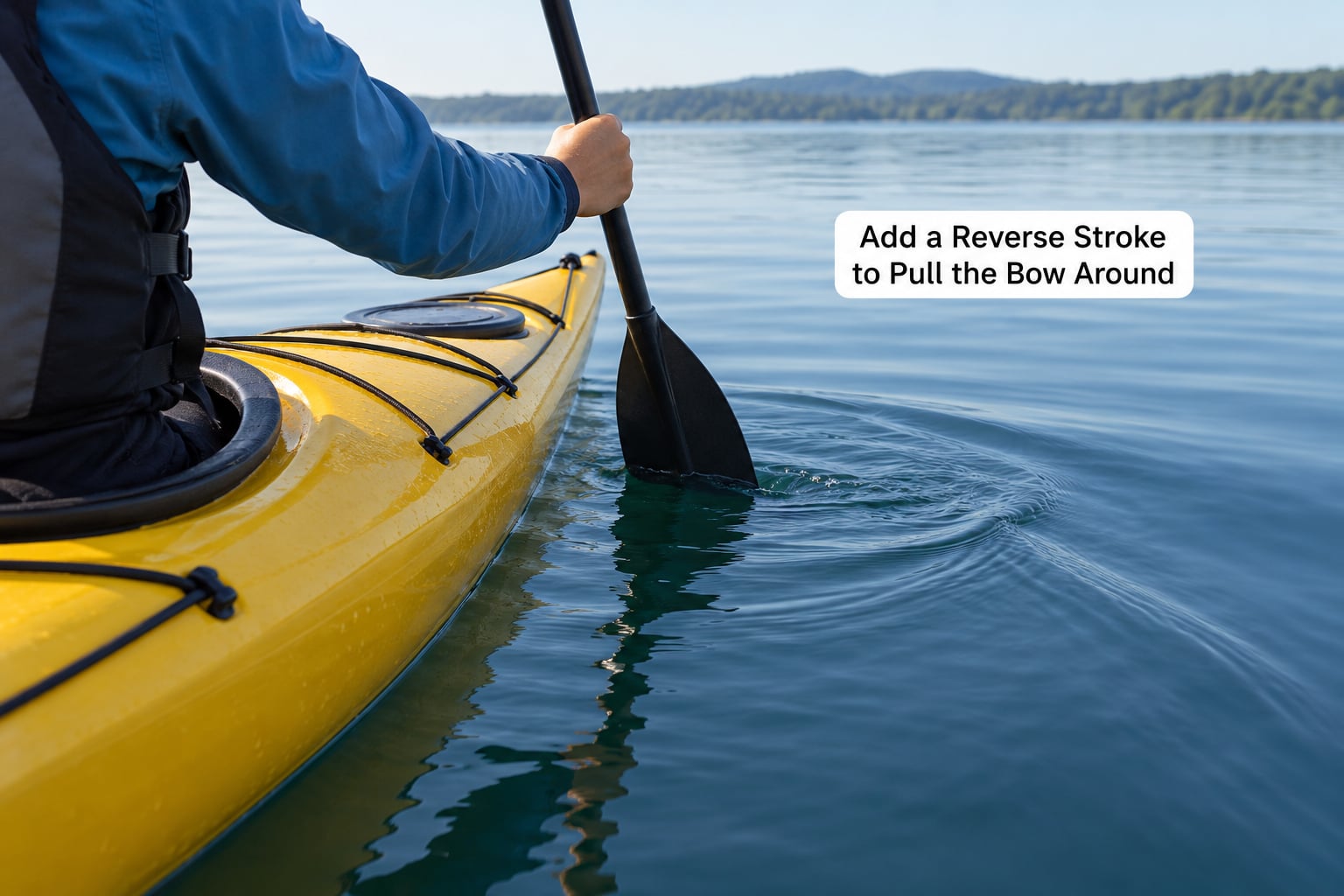
The reverse sweep does the opposite job. Instead of pushing the stern around, it pulls the bow toward you, and because the bow is the lighter end it turns faster. That makes it the fastest correction in the boat and the right tool for tight channels, a rock you did not expect, or any situation where you are already stopped.
- Plant high. Bring the blade down beside your hip, almost vertical, with the leading edge angled slightly forward.
- Pull toward the cockpit. Draw the blade back about six inches, then let it go. This is a jab, not a full sweep.
- Finish as the boat comes around. Once the bow is heading where you want, release and switch to a forward sweep on the other side to settle the line.
You can also do a static draw. Plant the blade straight out to the side and hold your arm rigid while you push the boat away from it, which spins the kayak nearly in place. It is the slowest and least graceful method, and it is the only one that works when you have almost no room at all.
4. Rotate Your Torso Instead of Bracing
Arms tire in about fifteen minutes. Torso does not, because it is attached to a much bigger muscle group. If your shoulders are staying square to the boat through the sweep, you are working far harder than you need to for the same turn.
Keep your hips and legs quiet and rotate from the lower ribs upward, the way a golfer turns through a shot. Your head stays level and your eyes keep looking down the line you want. It feels like more effort for the first few sessions because your arms are no longer compensating, then it becomes the default.
5. Use Edging and a Cross-Bow Stroke When Needed
Edging means tilting the boat onto one edge. It is what turns a kayak sideways rather than letting the hull skid, and it is how you sharpen a turn on a wide or flat boat, or one carrying speed you do not want to lose.
- Raise the inside knee slightly to start the tilt from your hips rather than your shoulders.
- Keep the paddle low and steady in the water on the outside as a brace and a lever at the same time.
- Increase the tilt gradually and let the hull carve. Too much edge at once in rough water is how beginners end up swimming.
A cross-bow draw is the sharper version. Plant the blade across the boat near the bow, pull it toward the cockpit, and the bow swings sharply toward you. It is a stationary move, so it costs you all your speed, which is why it belongs in tight water and not out on open lake.
One warning worth taking seriously: edging reduces your stability. Do it progressively, keep your recovery stroke ready, and skip aggressive edging on rough water until you have practised it.
Common Mistakes
Sweeping on the wrong side. This is the single most common beginner error and it is why people believe they are bad at steering. Check yourself the next time you turn: which side did the blade go down on? It should be the side you are turning toward.
Braking to turn. Sweeping the paddle back across the stern or stabbing it behind you stops the boat and then drags it sideways. It feels like steering and it is actually two slow manoeuvres instead of one fast one.
Over-correcting. Overturning sends you past your line, which sends you back the other way, and the boat ends up oscillating. Make smaller corrections on the way through rather than big ones at the end. Two 20-degree sweeps beat one 60-degree panic.
Paddling too close to the hull. A short arc makes the stroke weak and it teaches the boat to spin rather than turn. Push the reach out to the side and let the blade work its way back.
Pulling with the arms. Shoulders square to the boat, elbows locked, blade wobbling. Rotate your torso and let the arms follow.
Deploying the rudder at low speed. A rudder needs water flow over it. At a standstill it does nothing, and the habit of reaching for it teaches you a turn you cannot execute when you need it most. Practise sweeping so you have a reliable option when the rudder is useless.
Turning late instead of early. A kayak at speed needs room to swing the stern. Begin the turn when you first see the obstacle, not when it is beside you.
If your boat will not hold a straight line, check three things in order before blaming the hull. First, your foot pegs and whether your weight is really over your hips. Second, whether your paddle is being used at an angle that pushes the bow sideways. Third, wind. A tailwind pushes the bow one way and a headwind pushes it the other, which is a well-known effect called weathercocking, and no amount of technique fully cancels it. Most of the “my kayak is broken” complaints trace back to a foot peg problem or a wind problem.
Frequently Asked Questions
What is the fastest way to turn a kayak?
A wide sweep stroke on the side opposite your desired turn, driven by torso rotation, gives the fastest turn while keeping your speed. When you need more, add a reverse stroke near the bow, which pulls the lighter end around quickly. At a standstill, a static draw or a kick off the hull turns you nearly in place.
Should I use a sweep stroke or a reverse stroke to turn a kayak?
Use the forward sweep for a controlled turn that preserves forward momentum, and the reverse sweep for a quicker, tighter change of direction. Sweeps work in open water and around obstacles at speed. Reverse sweeps suit tight spaces, stationary pivots and fast corrections where losing a little speed does not matter.
How do I turn a kayak toward the left or right?
Place the blade in the water on the side you want to travel toward and sweep it back toward the stern, rotating your torso as you pull. To go the other way, repeat on the opposite side. For a faster correction in either direction, add a reverse stroke near the bow and watch where your eyes point.
Can wind or current stop a kayak from turning quickly?
Strong wind, current, a heavy load or excess forward speed all reduce control and lengthen the turn. Start your turn earlier, use a firmer blade plant, and make smaller corrective strokes rather than one large sweep. In current, an eddy turn or a peel-out often beats trying to force a tight pivot against the flow.
Conclusion
Start with the wide sweep on the side opposite your turn, because it is the stroke you will use most and the one most beginners are doing backwards. Set your foot pegs so your weight is over your hips, rotate your chest instead of your arms, and finish the arc beside your hip.
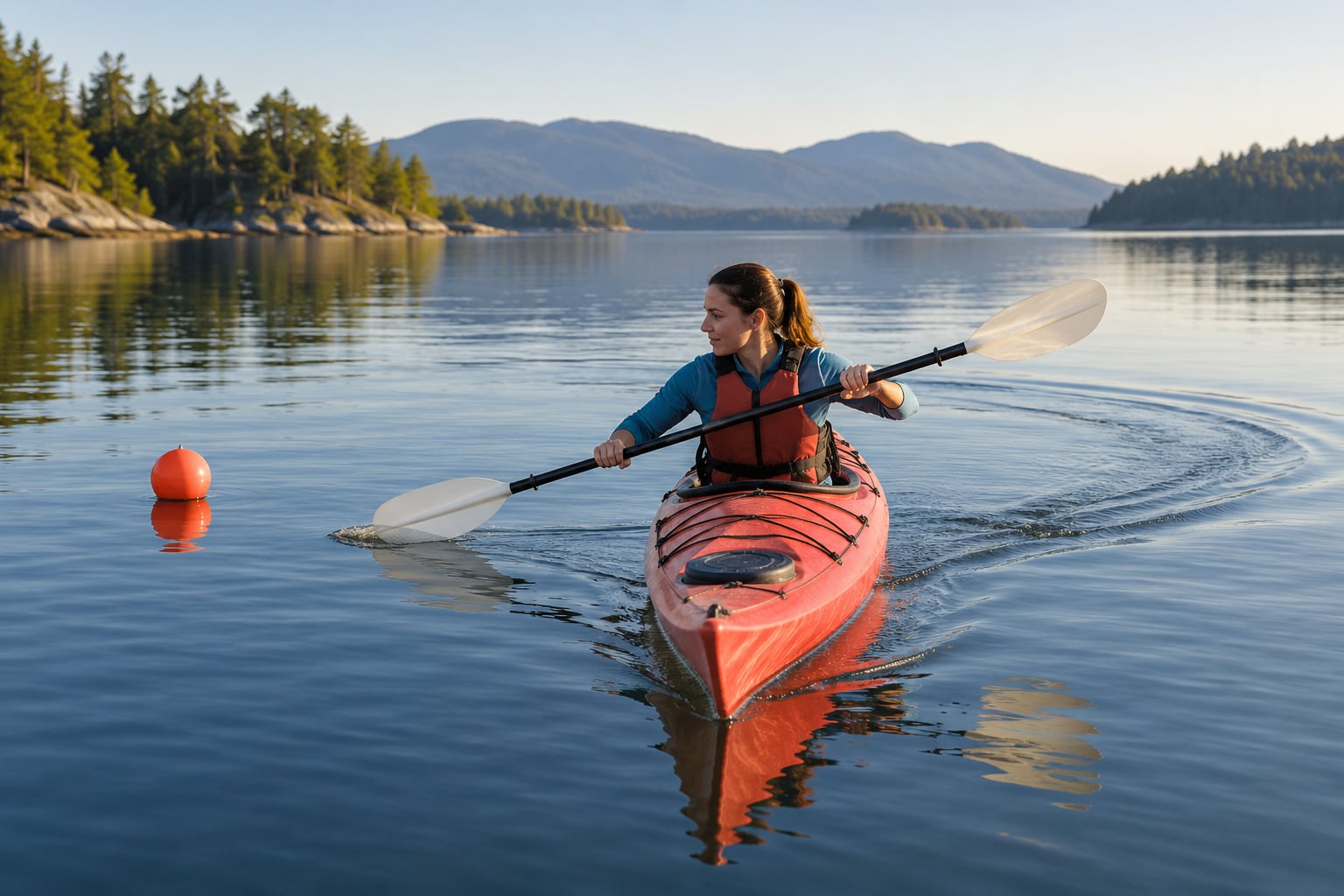
Then run one drill. Learning how to turn a kayak quickly is repetition, not talent: on flat water, pick a buoy or a patch of weed and sweep smoothly around it twenty times in each direction without touching the paddle to the hull. Twenty repetitions per side is roughly a week of casual practice, and after it the boat will feel like it turns when you think about it rather than when you argue with it.