If you are searching for how to transport a kayak without a roof rack, the answer is padding, cam straps, and bow and stern lines. Keep the hull off bare metal, anchor the straps to solid body points, and add lines at both ends so nothing slides or lifts. Most setups take about twenty minutes the first time and ten minutes after that.
Plenty of people never get their kayak to the water because the car has no crossbars, the kayak is too heavy to lift alone, and a permanent rack is a hole in the roof they do not want. That is a solvable problem, and the answer is not always a roof rack. A truck bed, a trailer, a temporary strap-on bar, or a foam block and door strap setup will all carry a kayak safely, as long as you know which one suits your vehicle and your hull.
Here is the whole job, method by method, with the safety checks that matter. 2026 is a good year to stop treating the roof rack as the only option.
Table of Contents
- 1What You Need
- 2How to Transport a Kayak Without a Roof Rack, Step by Step
- 3Choose a transport method that fits your vehicle and kayak
- 4Prepare the kayak and loading area
- 5How to place the kayak in a truck bed or inside the vehicle
- 6Secure the kayak with the correct tie-down points
- 7Check clearance, lighting and weather protection
- 8Inspect the setup before driving and after a short distance
- 9Common Mistakes
- 10Frequently Asked Questions
- 11Can I transport a kayak in my car without a roof rack?
- 12How do I secure a kayak in a truck bed without a rack?
- 13How far can a kayak extend past the back of my vehicle?
- 14Are bungee cords safe for transporting a kayak?
- 15Can an inflatable kayak fit inside a normal car?
- 16Is a trailer better than a temporary kayak rack?
What You Need
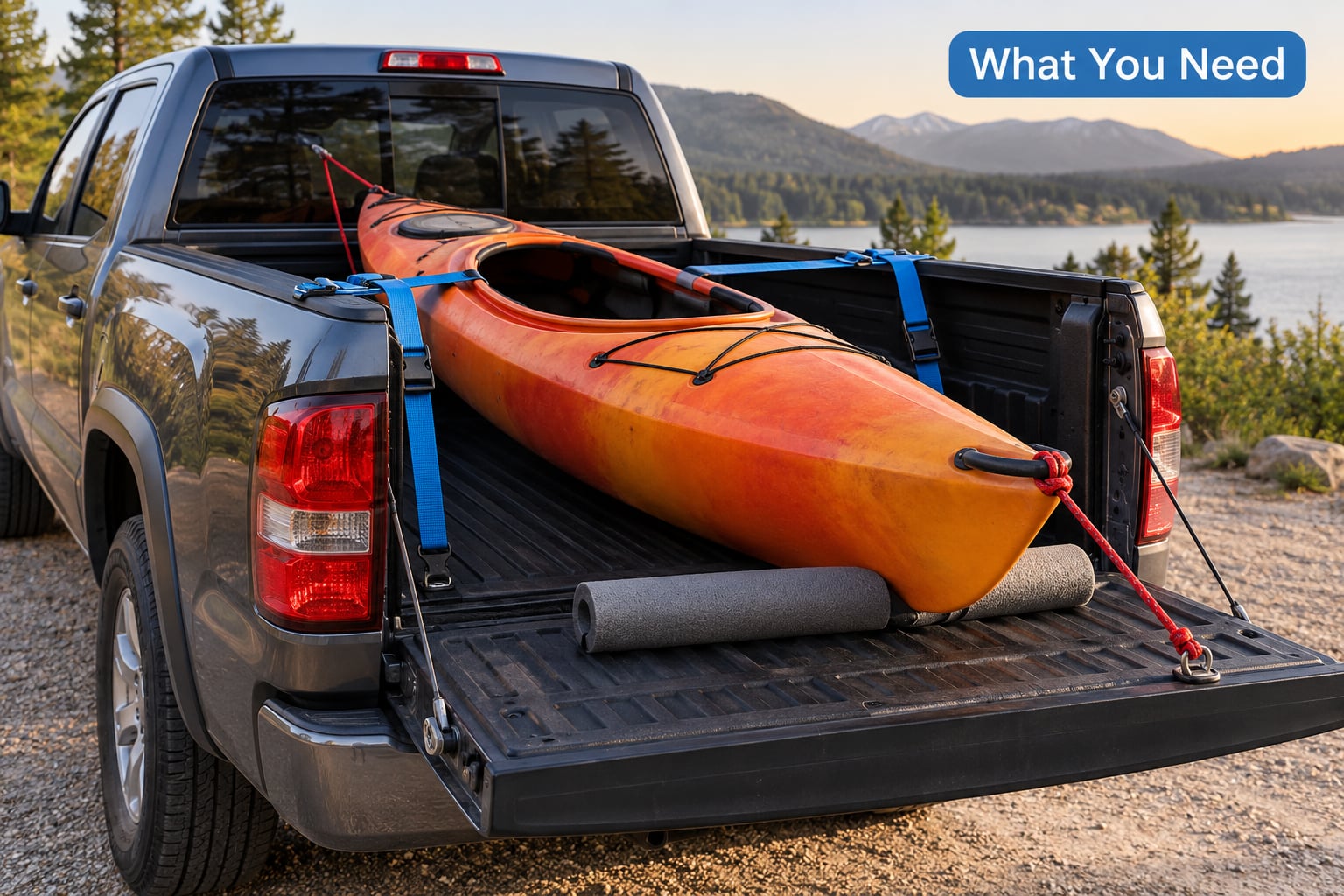
Four items cover the vast majority of no-rack transport. Everything after that depends on the method you pick.
- Padding for the contact points. Two foam blocks, two pool noodles, rolled yoga mats, or folded blankets. Pool noodles are the cheapest option and are what most paddlers on forums.paddling.com reach for first. Whatever you use, it goes between the kayak and the vehicle at every place the two would touch.
- Two cam straps minimum, three for a long kayak. Cam straps have a cam buckle you pinch closed and a narrow tail you feed through; they hold steady tension and do not creep the way bungee cords do. Get the 25mm width that most paddlers use, and check the working load limit printed on the strap.
- A bow line and a stern line. Short lengths of rope or dedicated kayak lines. The bow line goes to a hood loop, hood eyelet, or the frame under the hood. The stern line goes to a trunk anchor, a tow eye, or a strap through the vehicle structure. These are what stop fore-aft creep, and they are not optional on a rack-free setup.
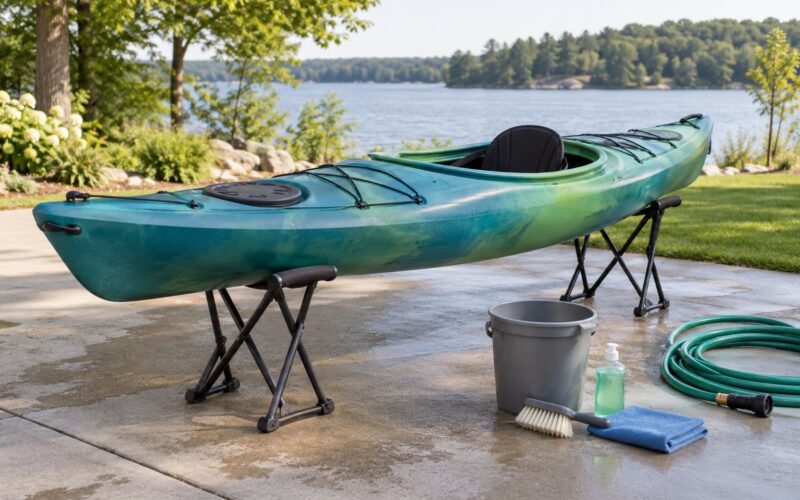
- Protection between kayak and paint. A blanket, a towel, or a strip of painter’s tape on the roof where straps cross it. Rubber door-jamb protectors stop the cam buckle from marking the paint on the way through the doors.
Optional, depending on method: a trailer hitch and hitch-mounted carrier, a rubber truck-bed mat or a bed rail, a tailgate cushion, interior rubber or carpet mats for a hatchback, a set of universal-fit temporary crossbars, and a kayak cart with wheels if the launch has a long carry.
One number to know before you buy anything. A strap-only roof setup works well for a recreational kayak in the 45 to 60 pound range, and stays sensible up to roughly 80 pounds. Fishing kayaks with pedal drives run 90 pounds and up, and that is where a truck bed, trailer, or proper temporary bar earns its keep. Check your vehicle’s roof load limit in the owner’s manual; a bare sheet-metal roof is not a designed cargo surface.
How to Transport a Kayak Without a Roof Rack, Step by Step
Choose a transport method that fits your vehicle and kayak
Match the method to the vehicle, not the other way around. Here is how the main options stack up.
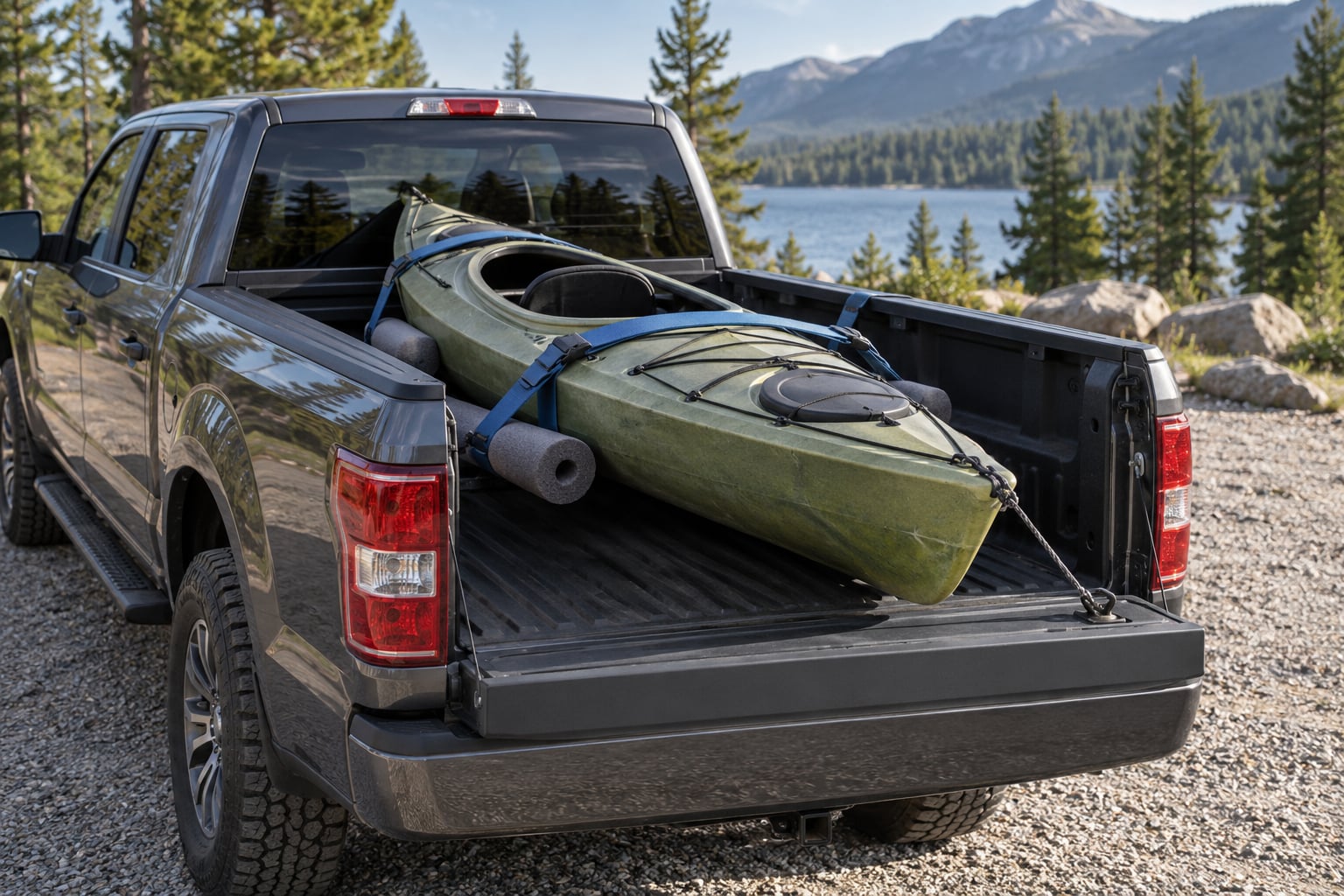
Truck bed. The most stable rack-free option there is. The bed gives you a flat surface, the rails give you anchor points, and you can slide the kayak to balance weight over the rear axle. Paddlers regularly report years of trouble-free truck bed trips with nothing but foam blocks and bow and stern lines.
Interior of the vehicle. Hatchback, wagon, minivan, and SUV with the seats folded. Clean, theft-proof, invisible, and it never touches your paint. The catch is length. Most sedans swallow a 10 to 12 foot kayak with the rear seats down and the trunk lid open; anything longer than that starts projecting into traffic.
Trailer. A hitch-mounted trailer or a small boat trailer is heavier to tow but keeps the kayak at road height, protects your vehicle entirely, and lets you carry two or three boats. You need a functioning hitch, a trailer with working lights, and the safety chains connected every time.
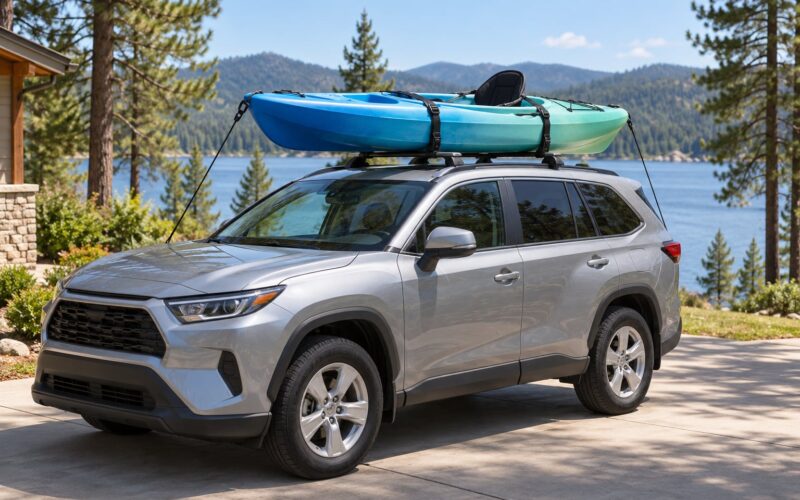
Temporary crossbars. Universal-fit bars that clamp to the door frame with a strap and lock into a hard point on the body. Not factory-installed, but far more rigid than padding alone, and the right answer for a heavy or full-size hard-shell kayak on a car with no rack.
Foam blocks and door straps on a bare roof. The budget method. Two straps looped through open doors pull down on the roof while the bow and stern lines handle the rest. Fine for short local trips and moderate speeds, less ideal for long highway runs at highway speed with a heavy boat. If you do this, the padding and the shake test are mandatory.
Kayak type changes the answer too. An inflatable deflates into a duffel and rides in a trunk. A folding kayak breaks into sections and does the same. A sit-on-top fishing kayak is wide, heavy, and awkward, so it wants a truck bed or a trailer. A full-size hard-shell touring kayak is long and wants either a bed or real bars.
Prepare the kayak and loading area
Strip the kayak before it goes anywhere. Remove seats, paddles, life jackets, tackle boxes, rod holders, and anything that can slide or catch wind. Loose gear under a strap is how a boat ends up abrading your roof two miles down the road.
Find the boat’s balance point and mark it. A production kayak is roughly symmetrical about its midpoint, and that is the point you want over your vehicle’s rear axle or the center of your roof. Slight nose-down on a roof setup is fine and actually helps water shed; a hard-shell should never sit with the deck taking your weight.
Prep the vehicle next. Wipe the roof or the bed down so grit does not end up between the hull and the paint. Lay your padding out in position before the boat comes off your shoulder, and put your protection strips where the straps will cross. If you are running straps through open doors, open both doors fully, drop the windows a few inches if the manual allows it, and check that no door seal or hinge is pinched in the path.
How to place the kayak in a truck bed or inside the vehicle
In a truck bed: lay padding in the bed at the front of the cargo area, set the kayak’s center on the bed floor, and let the bow or stern rest on a foam block at the tailgate. A 12 foot kayak in a 6 foot bed will extend roughly 3 to 4 feet past the tailgate, which is normal. Close the tailgate if it latches over the hull; do not rely on the tailgate as a restraint. Block forward motion by laying a bow line to a bed rail or to a front-mounted line under the hood.
Inside a minivan or SUV: fold the second and third rows, slide the kayak in nose first, and rest the bow against the front seats or the folded seat backs. A blanket between the hull and the seat frame prevents rattles and stops the boat sliding forward under braking. Strap it to two interior tie-down loops or seat-belt anchors.
In a hatchback or wagon: feed the stern in first and let the kayak ride diagonally from the cargo floor toward the passenger footwell, which buys you 6 to 10 inches of extra length. Keep the driver’s view of the mirrors and the rearward sightline clear.
In a sedan: possible for a 10 to 12 foot kayak with the rear seats down and the trunk open, but only with the trunk lid properly tied back and a red flag on any load extending past the bumper. Longer boats do not fit, and no amount of diagonal trickery changes that.
Know when to stop. If the boat is blocking your mirrors, sticking into your passenger space, or resting where you cannot tie it to something structural, choose a different method. An interior load that cannot be properly anchored is less safe than a strapped roof, not more.
On a roof with padding: set the foam blocks or pool noodles about a third of the boat’s length from each end, set the kayak on top, and center it. Deck up or hull up is a matter of taste and strap access; what matters is that the strap crosses solid deck or hull, not a cockpit rim or a rail that will cut into the webbing.
Secure the kayak with the correct tie-down points
Anchor to structure, not to trim. Door jambs, tow eyes, the frame under the hood, bed rails, and factory tie-down loops are all acceptable. Plastic bumpers, exhaust tips, and body panels are not, and a strap on any of them will slide off or melt.
With two cam straps, run each one up through the open door, over the padding, across the kayak, down the other side, and back through the opposite door or around a rail. Before you close the cam buckle, give the loose tail a quarter twist. That small spiral of slack kills the harmonic vibration that makes bare strap setups buzz annoyingly at speed and it stops the strap from chattering against the roof. It is the single least-known trick in this whole method.
Pull the cam buckle until the strap is snug and the padding compresses slightly, then take the strain. Do not overtighten. A cam strap cranked hard enough to bow the roof panel will dent metal and squash foam, and foam that is crushed stops doing its job. Snug, firm, and no hard spot is the target.
Add the bow line to a hood loop or hood frame and the stern line to a trunk anchor or tow point. Both, always. Then trim the stern line so the kayak stays in place without lifting the bow: pull until the line is just taut, not tight, and back off a finger’s width. An over-tensioned stern line is the classic way to lift a boat off its foam blocks and concentrate the whole load onto one point.
Tie off every loose strap tail by rolling it and clipping it, or tuck it behind the buckle. A 3 foot tail flapping over the roof at speed sounds like something broken and becomes a loose projectile if it frees itself.
Finally, do the shake test. Put both hands on the kayak and push hard in every direction: forward, back, side to side, and up. Nothing should move more than a few millimeters and no strap should shift on the padding. If it moves, tighten one notch and repeat. This is the check that separates a working setup from an optimistic one.
Check clearance, lighting and weather protection
Measure total height before you leave the driveway. A sedan with a kayak on a bare roof can sit close to 7 feet 6 inches, which is under many garage clearances but over plenty of low branches, drive-through canopies, and car wash arms. Add a bed-loaded boat’s height to your tailgate and rear bumper numbers for the same reason.
Confirm the plate and lights are visible. If the kayak sits above your plate or blocks a brake light, the load is over the legal line in most places and unsafe regardless. Overhang rules differ by state, and anything projecting past the rear of the vehicle commonly requires a red or orange flag during daylight and marker lights at night. Check with your state motor vehicle agency before a long drive rather than guessing.
Protect against what the trip throws at you. Rain on a composite hull is harmless, but a black hull heats noticeably in sun, so a light-colored towel or the boat’s own cover keeps it cooler and reduces UV fading on deck lines. Road grime and bug splatter will etch plastic if left, so wipe the hull down after highway miles. If rain or spray is expected, plug the scuppers so water does not sit in the hull on the roof, and note that a little sloshing inside adds weight you did not plan for.
Inspect the setup before driving and after a short distance
Run the same six checks at three points in the trip: at the launch before the engine starts, after about five minutes of local road driving, and again after you hit highway speed.
- Push on the kayak in all directions and confirm nothing shifts. This is the shake test again.
- Check every cam buckle is fully closed and the loose tails are tied off.
- Look at the strap where it crosses the hull or roof. Any sign of digging, fraying, or a hard edge means stop and re-pad.
- Confirm the bow and stern lines are taut but not lifting the bow.
- Walk around the vehicle and check tire clearance, especially with a bed-loaded boat, and confirm the tailgate and hatch are either closed or properly tied.
- Verify the plate, mirrors, and lights are still visible and unobstructed.
Straps lose tension on a long run as webbing settles and vibration works the buckle, so a check after 20 or 30 minutes of highway is the one people skip and the one that matters most. Re-run the checks at every fuel stop. If a strap has crept, tighten the cam buckle rather than adding a third strap in a hurry.
Common Mistakes
Most no-rack failures are the same handful of mistakes. Each one has a simple correction.
Using bungee cords alone. Elastic ropes stretch, shrink with age, and store energy that lets the boat creep. Use cam straps for anything touching the vehicle, and keep bungees for gear inside the hull.
Anchoring to plastic trim or a bumper. A strap on a plastic fascia will slide off within a mile. Move it to a door jamb, tow eye, bed rail, or frame member.
Overtightening. Cranking a cam strap until the roof bows dents the panel and crushes the padding, which is the very thing protecting your hull. Pull to snug, then stop.
Leaving the boat loose. If you cannot do the shake test in good conscience, the setup is not finished. Two straps and two lines is the floor, not a starting suggestion.
Ignoring overhang rules. Extending well past the bumper without a flag or lights is illegal in many states and dangerous everywhere. Check your state’s rule and add a flag and lighting if the load projects past the vehicle.
Blocking lights or the plate. A kayak above your plate or over a brake light fails inspection in plenty of states. Reposition or switch to a bed or trailer.
Carrying a full-size kayak through an open window. The driver needs both hands, a clear side view, and working airbags. A long hull out a window creates drag, blocks the mirror, and puts fiberglass at eye level in a crash.
Forgetting the wind and the weather. Roof-mounted boats change aerodynamics and cost you fuel economy, and crosswinds hit a tall, narrow hull harder than most paddlers expect. Slow down in a gust and re-check the lines.
One last safety tip: treat every strap as a load-bearing part of the vehicle. If you cannot see the anchor, you cannot verify it, and an anchor you cannot verify is not an anchor.
Frequently Asked Questions
Can I transport a kayak in my car without a roof rack?
Yes, if the kayak fits. Fold the rear seats, lay a blanket or rubber mat down, slide the kayak in nose first, and strap it to interior tie-down loops or seat-belt anchors. Most sedans take a 10 to 12 foot kayak this way with the trunk open. If it blocks your mirrors or cannot be anchored to something structural, use a foam block and door strap setup on the roof instead.
How do I secure a kayak in a truck bed without a rack?
Put foam blocks or a bed mat under the hull, center the kayak over the rear axle, then use two cam straps over the bed rails into solid bed anchors. Add a bow line to a front bed rail or a line under the hood so the boat cannot slide forward. A 12 foot kayak in a 6 foot bed will extend past the tailgate, so check your state’s overhang and flag rules before driving.
How far can a kayak extend past the back of my vehicle?
There is no single national number, because overhang limits are set state by state. Practically, keep the extension modest and always shorter than your stopping distance allows. Any load projecting past the rear of the vehicle commonly requires a red or orange flag in daylight and marker lights at night, and a blocked license plate can be pulled over. Check your state motor vehicle agency rules before a highway trip.
Are bungee cords safe for transporting a kayak?
No. Bungee cords stretch under load, tighten in cold weather, go slack in heat, and fray where they cross sharp edges. They will not hold a kayak through highway vibration. Cam straps with a ratcheting buckle are the standard choice because they hold steady tension and do not creep. Save bungees for stowing gear inside the hull, and never use elastic rope as a structural tie-down on a moving vehicle.
Can an inflatable kayak fit inside a normal car?
Almost always. Deflated and folded, most inflatable kayaks pack into a duffel bag that fits in a sedan trunk, under a rear seat, or in a hatchback cargo area. Deflate it fully, dry it out to prevent mildew, and pack it in a bag so it cannot slide around. That also frees up your gear straps, since you no longer need a roof setup for the boat itself.
Is a trailer better than a temporary kayak rack?
For a heavy or full-size hard-shell kayak, usually yes. A trailer keeps the boat at road height, spreads the load over the hitch and trailer frame, protects the vehicle entirely, and often carries two or three boats at once. A temporary strap-on bar setup is lighter, cheaper, and fine for a recreational kayak. Choose the trailer if you drive long distances, tow a heavy fishing kayak, or carry more than one boat.
Measure your kayak first, then pick the method that fits your vehicle and your hull, and secure it with two cam straps and a bow and stern line anchored to solid structure. Do the shake test before you turn the key, and check everything again after the first stretch of highway.