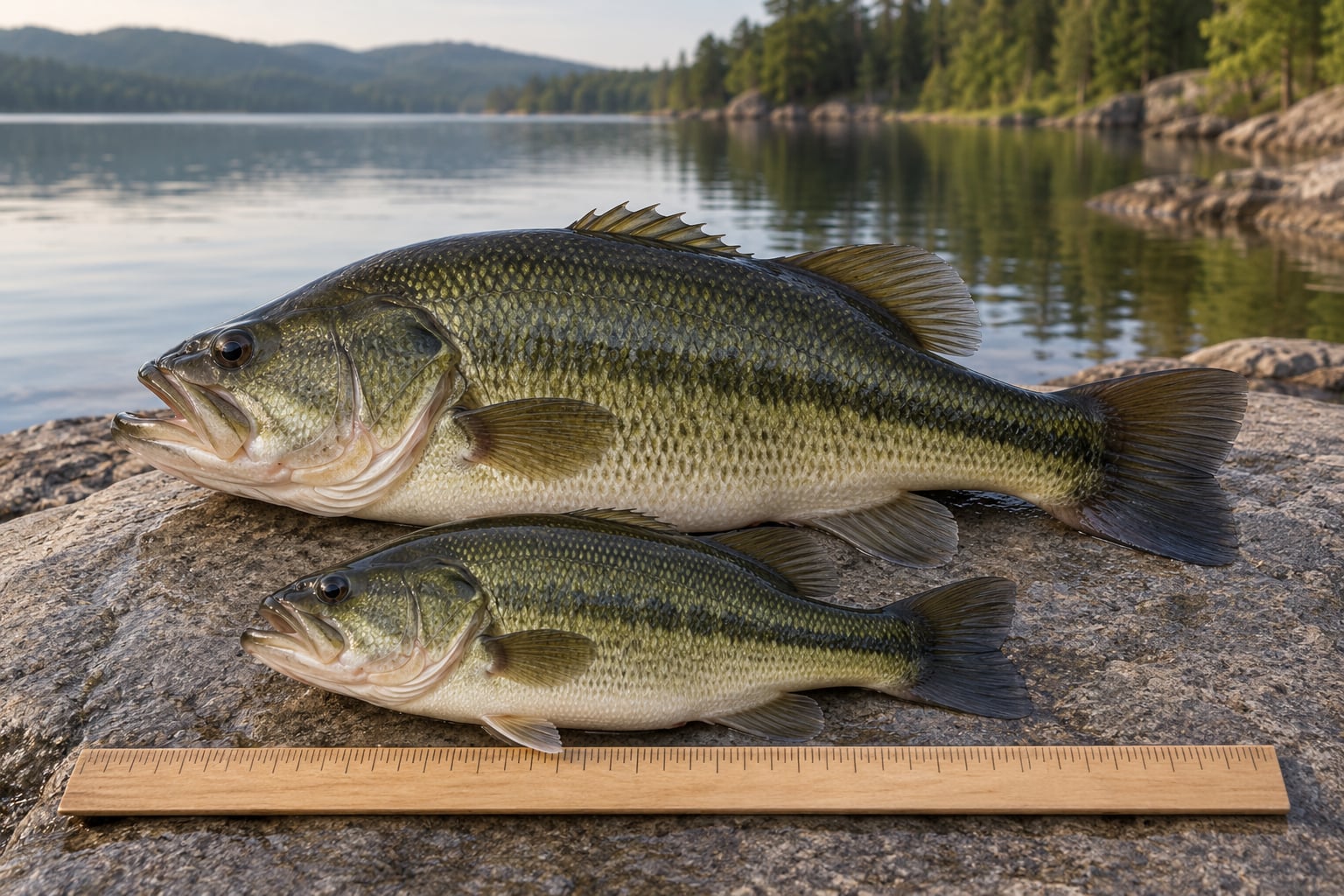
If you only have one field test for how to tell the difference between largemouth and smallmouth bass, use the jaw. On a largemouth bass (Micropterus salmoides), the upper jaw bone runs past the rear edge of the eye. On a smallmouth bass (Micropterus dolomieu), the jaw stops at the eye or short of it. Confirm that with the dorsal fin notch and the body markings, and you can call either fish correctly in about fifteen seconds.
Most misidentifications happen because anglers know the jaw rule but stop there, or because they trust color, which both species change depending on the water and the season. Color alone is the weakest of the four main cues, and it is the one most likely to start an argument on the boat ramp.
The two fish are close relatives and they share a silhouette, so nothing here is a giveaway on its own. Stack the cues: jaw first, then dorsal fin, then body pattern, then habitat. When three of them agree, you are right.
Table of Contents
- 1How to Tell the Difference Between Largemouth and Smallmouth Bass at a Glance
- 2Body Size and Shape
- 3Mouth Size and Jaw Position
- 4How to Tell the Difference Between Largemouth and Smallmouth Bass by Color and Markings
- 5Dorsal Fin, Habitat, and Behavior
- 6Habitat and Water Type
- 7Behavior and Feeding Differences
- 8Which Should You Choose?
- 9Frequently Asked Questions
- 10Is a 2 pound smallmouth bass big?
- 11What fights harder, smallmouth or largemouth bass?
- 12What does a smallmouth bass look like?
- 13Do largemouth bass taste the same as smallmouth bass?
- 14How do I know if a smallmouth’s jaw is past the eye because it’s really big?
How to Tell the Difference Between Largemouth and Smallmouth Bass at a Glance
| Feature | Largemouth bass | Smallmouth bass |
|---|---|---|
| Upper jaw (maxilla) | Extends past the rear margin of the eye | Stops at or before the rear margin of the eye |
| Dorsal fin | Deep notch between spiny and soft-rayed sections | Shallow notch, the two sections nearly joined |
| Body pattern | Broken, irregular horizontal stripe along the side | Faint or broken horizontal stripe, plus vertical bronze bars |
| Body color | Olive green to yellow-green, pale belly | Bronze brown to golden, sometimes with copper bars |
| Eye iris | Usually dark or amber | Often red to orange in adults |
| Body shape | Longer and heavier for its length | Compact and more cylindrical |
| Preferred cover | Weeds, wood, grass, lily pads, warm shallow water | Rock, gravel, riprap, deeper and cooler water |
| Typical feeding pattern | Ambushes from cover, especially in low light | Active in current and along drop-offs and rock edges |
| On the line | Heavier pull, fewer jumps | More jumps and more fight pound for pound |
Body Size and Shape
Largemouth bass run longer and heavier for a given length. A fish at 16 inches on a largemouth is generally bulkier through the shoulders than a 16-inch smallmouth, and it carries a noticeably bigger head relative to the body.
Smallmouth bass are stubbier and more cylindrical, almost tube-shaped through the middle. That compact build is one reason they fight so hard for their weight: less lateral flex, more pure muscle.
Size on its own is a weak clue, though. A big smallmouth overlaps with a small largemouth in weight, and plenty of trophy largemouth are shorter than the smallmouth in the same cooler. Use shape as supporting evidence, never as the deciding vote.
Mouth Size and Jaw Position
This is the test that matters. The maxilla is the upper jaw bone, and on a largemouth it extends back beyond the rear margin of the eye when the mouth is closed. On a smallmouth it ends at that same point or before it.
Here is how I do it in the boat. Grip the fish by the lower jaw, turn it belly-up or side-on so light hits the head, and trace an imaginary line from the back of the eye toward the corner of the mouth. If the upper jaw crosses that line, it is a largemouth. If it stops short of it, it is a smallmouth.
The reason people second-guess the jaw test is that big smallmouth have proportionally longer upper jaws than small ones, so a big fish’s jaw can appear to reach the eye. That is where the cue breaks down. When the jaw looks ambiguous, do not argue with it. Move to the dorsal fin.
How to Tell the Difference Between Largemouth and Smallmouth Bass by Color and Markings
Smallmouth bass wear bronze brown or golden tones, often with darker vertical bars along the side that fade toward the belly. Those bars are why the fish got its common name, and on a clear, well-lit fish they are usually obvious.
Largemouth bass are olive green to yellow-green with a pale belly, and they carry a dark horizontal stripe along the lateral line that breaks into a mottled, blotchy pattern toward the tail. The stripe is the giveaway, not the base color.
Here is where color misleads. In stained or weedy water, a largemouth can look as brown as any smallmouth, and both species darken dramatically on the spawn beds in spring. Red-eye adults are a useful secondary confirmation on smallmouth, but a dark iris does not rule a smallmouth out either.
If you want to try one more thing that almost nobody does, check the dorsal fin instead of squinting at the side of the fish.
Dorsal Fin, Habitat, and Behavior
The largemouth’s spiny dorsal fin and soft-rayed dorsal fin are separated by a deep notch, almost a break in the fin. On a smallmouth that notch is shallow, and the two sections run together with barely a dip between them. This one is easy to miss on a small fish, but on anything over a pound it usually ends the debate.
Next to the mouth, the dorsal notch is the most reliable confirmation on the fish in hand.
Habitat and Water Type
Largemouth bass are the weedy-lake fish. They hold in grass, wood, fallen timber, lily pads and docks, and they like warm water. In summer they sit in the shallows, sometimes in water too shallow to be comfortable for anything else. Rivers work too, especially around slow banks with cover.
Smallmouth bass prefer rock and current. Gravel bars, riprap, boulder fields, dam faces and deep rock ledges are home, and they tolerate cooler water than largemouth do, which is why northern anglers often catch smallmouth when the largemouth have gone dormant. In the southern range, smallmouth push into deep, cool reservoir bends through the summer heat.
Habitat is a genuine third clue even though it is softer than anatomy. If you are standing on a boulder field in 12 feet of cold water, you are holding a smallmouth. If you are knee-deep in grass behind a point in July, it is a largemouth.
Behavior and Feeding Differences
Largemouth are ambush predators. They sit still in cover and take prey that wanders past, which means the best fishing window is around dawn, dusk and nighttime, and it means a fish that barely moved before the hookup was probably a largemouth.
Smallmouth feed more actively and more often, working current seams, drop-offs and the edges of rock fields. Anglers report that largemouth are easier to find, while smallmouth are more willing biters once you locate them.
The fight is where the species split feels most obvious. Smallmouth pound for pound fight harder and jump more, and they tend to sound themselves when you are already close to the boat. Largemouth pull heavier and dive more, using their bulk rather than their jumping.
Knowing the species also tells you what to throw. Largemouth punish heavy cover with jigs, weedless soft plastics and topwater lures that rattle over grass. Smallmouth respond to anything moved along rock, crankbaits, tubes and craw imitations. If you know which fish lives where, you pick the lure before you make the first cast.
Which Should You Choose?
Pick by where you are fishing, not by which one bites harder.
- Fishing a weedy southern lake in summer: target largemouth. Grass and warm shallows are where the fish are, and a smaller, faster lure setup suits the cover.
- Fishing rock and current in a northern lake or river: target smallmouth. Cooler water and structure put them in front of you, and a firmer rod with heavier line keeps the jump manageable.
- New to bass fishing: largemouth are more forgiving. They tolerate heavier line and slower retrieves, and a missed fish is more likely to still be on.
- Chasing trophies: smallmouth. A four-pound fish is a genuine achievement on most waters, while a four-pound largemouth is an ordinary day.
One more reason to get the ID right: regulations are set by species. Slot limits, creel limits and minimum size rules often differ between largemouth and smallmouth on the same lake, and sometimes differ between lakes on the same river. Check the rules for the specific water body before you decide to keep the fish.
Handling matters too. Wet your hands, support the belly, keep the fish out of the air as briefly as possible, and let the boat ride on the water long enough for it to recover before you release it.
Frequently Asked Questions
Is a 2 pound smallmouth bass big?
Yes, a two-pound smallmouth is a solid catch on most water. Because smallmouth run small in many lakes and rivers, two pounds often represents a good day’s work for an experienced angler. A four-pound smallmouth is genuinely rare and worth photographing. Scale your expectations to the water body you are on, since some northern lakes and western rivers regularly produce fish far above two pounds.
What fights harder, smallmouth or largemouth bass?
Pound for pound, a smallmouth fights harder and jumps more often. Largemouth pull heavier and dive more, using their larger body to grind you down. Fish forum regulars describe big smallmouth as the ones that clear the water repeatedly, which is what makes landing one so memorable. A heavier rod and line setup keeps the jumping from costing you the fish.
What does a smallmouth bass look like?
A smallmouth bass is bronze brown or golden, often with darker vertical bars along the sides and a pale belly to yellowish-white lower fins. Adults frequently show a red to orange iris. The upper jaw stops at or before the rear margin of the eye, and the two sections of the dorsal fin are separated by a shallow notch rather than a deep break. That combination is close to conclusive.
Do largemouth bass taste the same as smallmouth bass?
They are close, and most anglers describe both as mild, firm white fish. Smallmouth are frequently described as slightly firmer and less flaky because of their compact build, while largemouth carry a bit more fat. Neither is fishy when kept cold and handled cleanly. Most anglers cook the two the same way and argue about which one is better rather than about flavor.
How do I know if a smallmouth’s jaw is past the eye because it’s really big?
That is exactly where the jaw test stops being reliable, because big smallmouth have proportionally longer upper jaws. Stop relying on the jaw at that point and check the dorsal fin instead. A deep notch separating the spiny and soft-rayed sections means largemouth, while a shallow notch running almost continuously means smallmouth. Bronze coloring with vertical bars and a red iris usually confirms a smallmouth before you even reach for the jaw.
Start with the jaw, confirm with the dorsal fin, and let color and habitat break any tie. Two pounds of smallmouth is a good fish anywhere, and check the species-specific limits for your water before you put one in the livewell.