How to paddleboard in wind comes down to three things: know what the wind is actually doing at board height, keep the wind at your back or your shoulder rather than in your face, and be willing to kneel or lie flat the moment it builds. Most beginners should stay on or under about 7 knots (8 mph / 13 km/h) of sustained wind. It takes about 20 minutes of setup to do it properly, and the skill itself is learnable in a single calm-water session.
Wind catches paddleboards harder than it catches kayaks because you are standing six feet tall on a flat platform with nothing above you to break the flow. A kayak paddler can duck and the hull slips under the gust; a stand-up paddler has a chest, shoulders and head taking the full push. That is why a forecast that reads 8 mph (13 km/h) can feel like 15 or 20 on the water, and why experienced paddlers plan their routes around wind direction rather than distance.
Table of Contents
- 1What You Need
- 2Step-by-Step: How to Paddleboard in Wind Safely
- 31. Check the wind, water, and weather
- 42. Choose the right board and paddle
- 53. Secure the leash and prepare to launch
- 64. Use a stable stance and keep your eyes up
- 75. Paddle on the windward side
- 86. Use short, controlled strokes when you paddleboard in wind
- 97. Turn early and land in sheltered water
- 10Common Mistakes
- 11Launching straight into an offshore wind
- 12Standing too far forward
- 13Overcorrecting a gust
- 14Ignoring gusts and the wind gradient
- 15Skipping the leash and traffic check
- 16Frequently Asked Questions
- 17How windy is too windy to paddleboard?
- 18Is 20 mph wind too strong for paddleboarding?
- 19Do you need a leash when paddleboarding in wind?
- 20How do you paddle upwind on a paddleboard?
- 21What should I wear when paddleboarding in wind and cold water?
- 22When should a beginner turn back on the water?
- 23Conclusion
What You Need
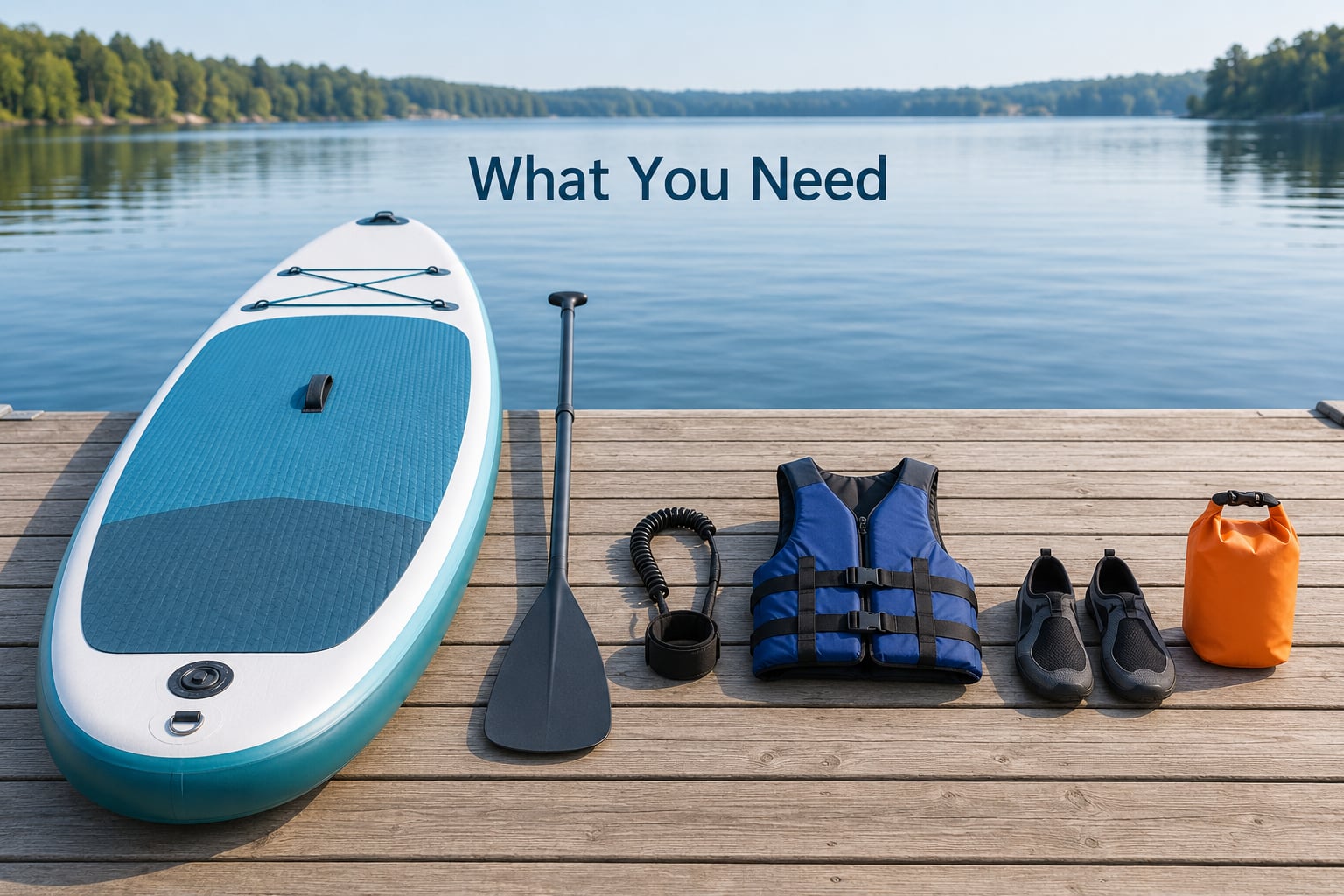
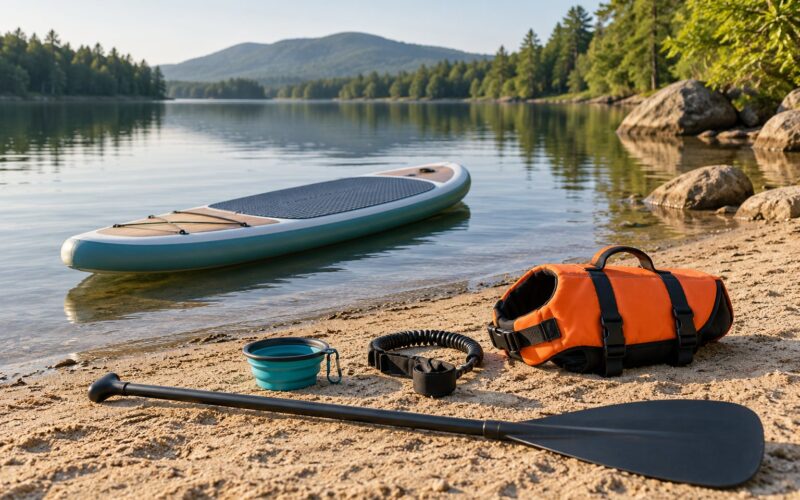
Start with the board. A wide all-around or beginner SUP, roughly 10 to 12 inches (25 to 30 cm) across, stays put in wind that would tip a narrow touring board. Volume matters more than length: a board with enough volume for your weight sits high in the water and has a thinner profile to push through the air.
Hard boards with some rocker in the nose cut through chop and are less likely to scoop when a wave catches underneath. Inflatables flex, which some beginners find harder to control in a headwind, though they are easier to store in a car and far easier to drag ashore in a crosswind.
- Paddle: Sized by board width and your height. On a wide board, hold the paddle and the blade should reach your forehead. A short paddle in wind gives you less blade area to push against the current.
- Leash: Use a coiled leash for flat water. The coil keeps the line off the water so it does not snag on rocks or weeds, and a quick-release type is worth having on moving water or in a current.
- Personal flotation device: A proper PFD, not a swim vest. On small lakes and tarns the water may be cold and shallow at the edges, and a vest is what buys you time.
- Clothing and water: A windproof outer layer, a dry top or spare dry clothes packed in a dry bag, a warm drink for cold days, and water shoes for launch surfaces you cannot see under the surface.
- Signalling gear: A whistle on your PFD strap and a phone in a dry bag. Both have saved people who were blown further out than they planned.
Colder water changes the gear list more than any wind forecast. Below about 50 to 60°F (10 to 15°C), falling in triggers an involuntary gasp and hyperventilation that makes swimming hard for the first minute, which is exactly when you want a PFD doing its job.
Step-by-Step: How to Paddleboard in Wind Safely
1. Check the wind, water, and weather
Read the forecast for your launch spot, not for the nearest town. Windfinder, Windy.com and the NOAA Marine Forecast all give you a direction and a sustained speed, and most also show gusts. Use the gust number for your decision and the sustained number for what the water will feel like.
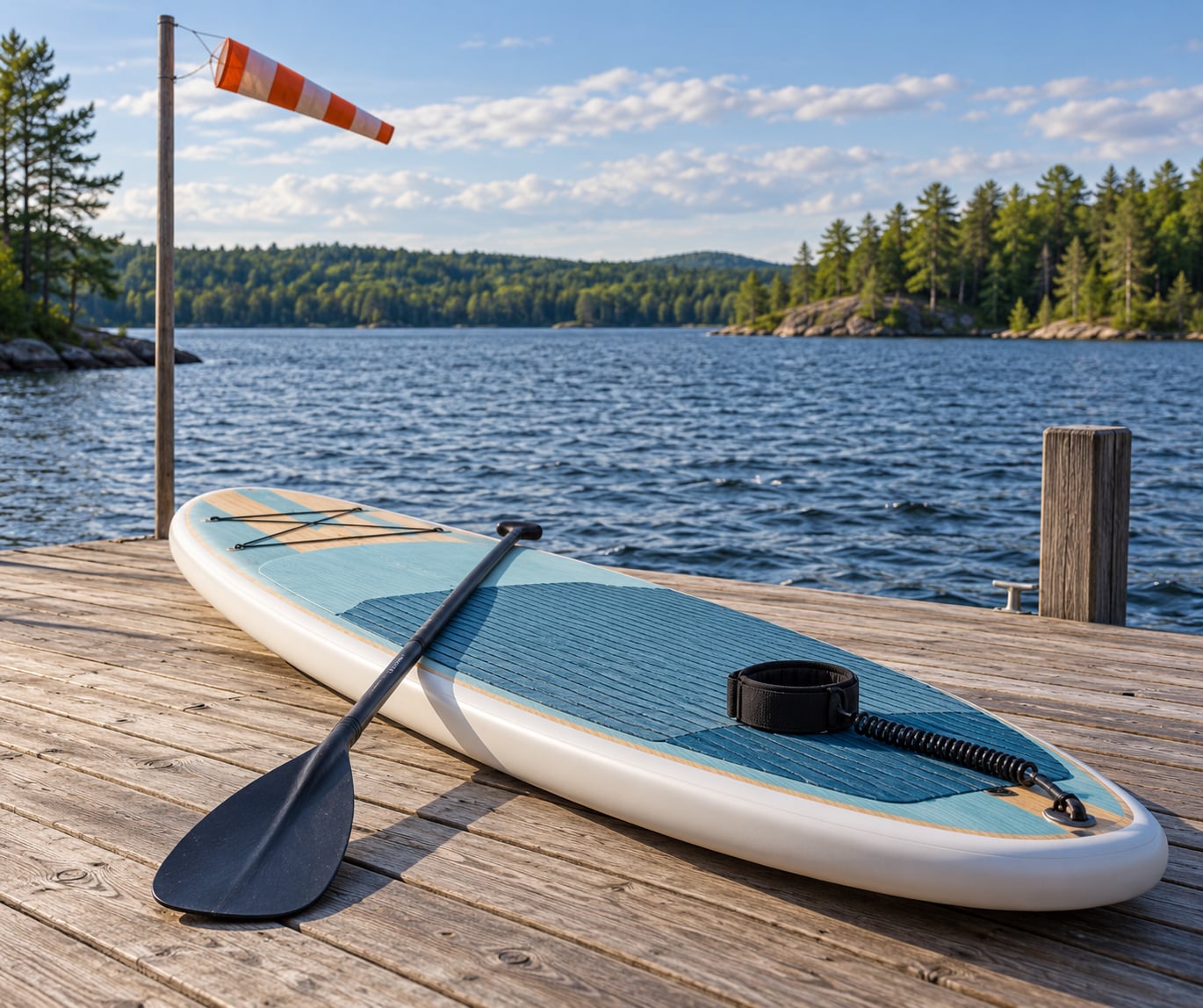
Direction matters more than speed. A wind blowing from land out toward open water (offshore) is the one to avoid, because it quietly pushes you away from the only safe place to land. Onshore wind, blowing from the water toward you, pushes you back toward land and is the safer of the two for a first outing.
On lakes, wind usually builds through the day as land warms, so a glassy 9 a.m. launch can turn into whitecaps by mid-afternoon. Check the forecast right before you inflate the board rather than relying on a plan made the night before, and postpone when the numbers sit above what you have already paddled in.
2. Choose the right board and paddle
A wider board is easier for beginners in wind because the extra width gives you a longer window between tipping and correcting. Length is the tradeoff: a longer board tracks straighter and is faster, but a narrow long board is twitchy in a crosswind.
Look at the fin setup too. A single long center fin holds direction well in a straight line but catches and skids sideways in a crosswind. Two smaller fins or a short center fin let the board pivot out of a gust rather than locking you into a spin.
As for paddle size, a wind board should be matched by width first. Too small and you will be taking a lot of strokes to move a heavy board into a headwind, which tires your shoulders before your legs.
3. Secure the leash and prepare to launch
Inspect the leash before you get in the water. Check the cuff for stretch, the Velcro for wear, and the swivel for spinning freely. Attach it to your rear ankle or calf, above the boot line, with the loop tight enough that it cannot slide over your foot.
Keep the coiled section on the board side and let it hang loose so it can extend without grabbing anything. A leash dragging over a rock or a submerged branch is the real argument people make against leashes, and a coiled line plus a quick release handles it.
Launch from a sheltered shoreline or a low dock rather than an exposed point. Carrying a fully inflated board across an open car park in 20 mph (32 km/h) is miserable and unmanageable, which is a good reason to leave the board in the bag until you are at the water.
4. Use a stable stance and keep your eyes up
Stand with your feet about hip width apart, one foot forward of the other, knees slightly bent and your core relaxed. Locked knees and a rigid grip are what make a board feel unstable, because a bent leg absorbs the small corrections that a stiff leg turns into big ones.
Hold the paddle with the lower hand on the shaft and the top hand on the T-grip, and keep the blade in the water near your feet on the power phase. Look ahead at the water surface rather than down at your feet. You need to see the dark ripple lines that mark a coming gust, and you need to see boats.
Aim the board slightly away from the wind when you start. In a headwind, a slight angle keeps you from walking straight into it and stops the bow dropping into waves.
5. Paddle on the windward side
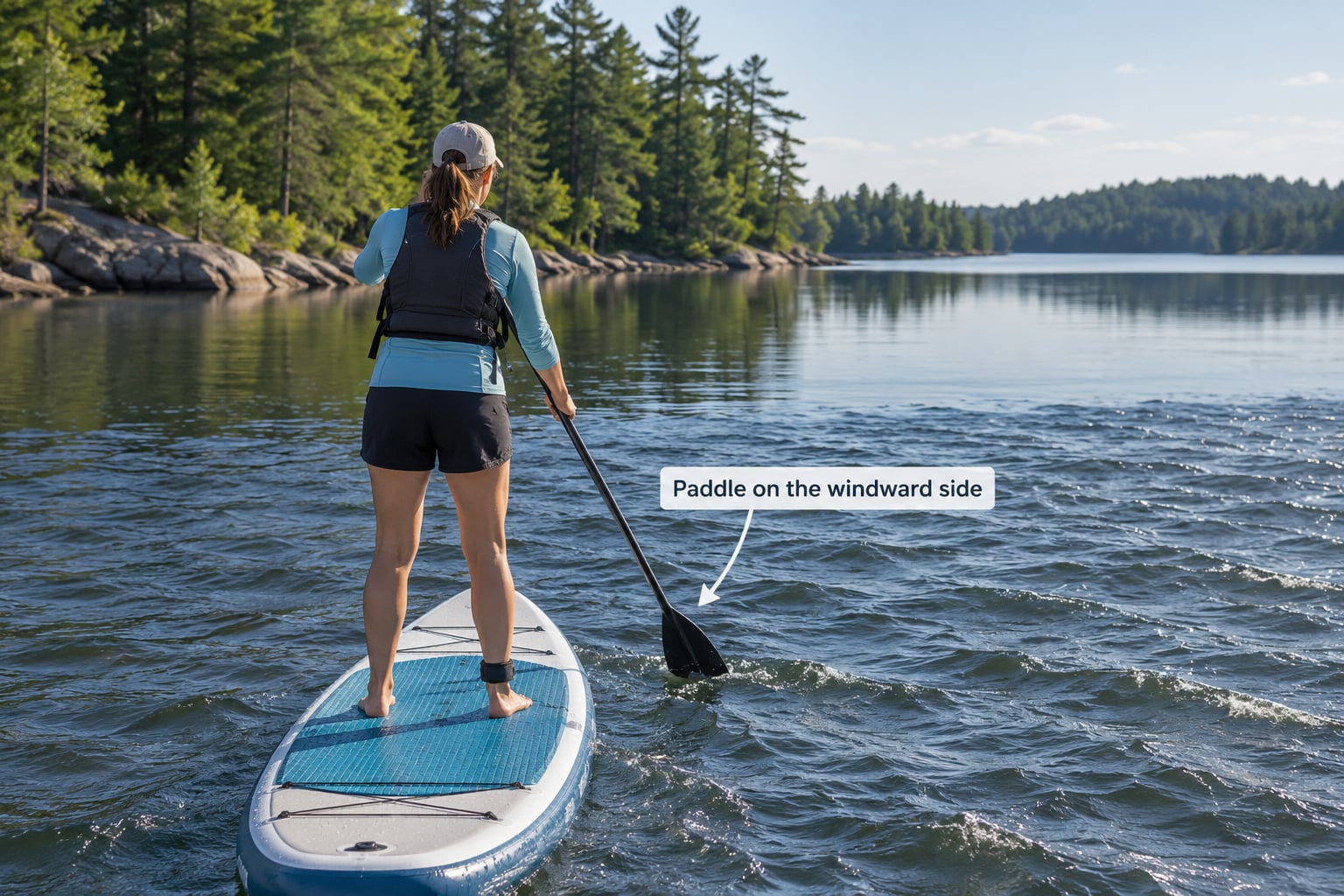
The most useful habit in wind is to keep the wind at your back or your shoulder. Paddling with the wind behind you feels effortless and gets you downwind fast; crossing the wind at an angle is manageable; paddling straight into it is the slowest and least stable of the three.
Experienced paddlers go further and turn the board partly into the wind to use it like a sail. Lean back slightly, angle the board across the wind, and let the pressure on the underside push you forward instead of fighting it with strokes. It feels wrong the first few times, then it becomes obvious.
To stay in the sweet spot, keep one shoulder pointing upwind and angle the board 20 to 30 degrees off the wind line. Small corrective strokes on the downwind side hold that angle without jerking the board.
6. Use short, controlled strokes when you paddleboard in wind
When the wind builds, cut the effort rather than increasing it. Short, quick strokes near the nose of the board keep you moving and stop the tail from being blown out. Long slow strokes with all your weight behind the blade give the wind time to spin you.
On the recovery, feather the paddle blade so its flat faces the wind instead of scooping air. That one adjustment removes a surprising amount of the wobble beginners blame on their own technique.
To brake or turn, plant the paddle on the windward side and sweep it behind you rather than shoving the board sideways. Shoving sideways in wind just converts forward speed into drift.
7. Turn early and land in sheltered water
The best time to turn back is while you are still comfortably making progress upwind, which is a decision you make early rather than when you are barely moving. Pick your landing point before you get tired, and aim for the spot where the wind is blocked by trees, a headland or a marina wall.
Approach the shore with the nose into the wind and steps short. When you get close enough, hop off on the windward side and hold the board’s rail so the wind cannot scoop the underside and flip it.
Common Mistakes
Launching straight into an offshore wind
Starting at an exposed shoreline with the wind pushing you off the beach means every stroke fights the current of air. Walk to the sheltered end of the launch, or accept a longer paddle to a protected corner of the lake.
Standing too far forward
The bow of a board is the most sensitive part to chop. Standing mid-deck or a little back, rather than on the nose, keeps the bow from pearling into a wave.
Overcorrecting a gust
Leaning hard away from the wind is how a gust becomes a capsize. Move your weight from the hips gradually and keep the paddle in the water as an anchor, and let the board’s own width do most of the work.
Ignoring gusts and the wind gradient
Wind speed increases with height, and forecasts measure it about 10 metres (33 feet) above the ground. Standing six feet on a board puts you in faster air than the app is reporting, so treat the forecast as a floor rather than a promise.
Skipping the leash and traffic check
A wind that would be a nuisance with a leash on becomes a 200-metre chase without one. And in stronger wind you can be moved fast enough to reach a boat lane you did not plan on crossing, so look for traffic before every launch.
Frequently Asked Questions
How windy is too windy to paddleboard?
Most beginners should stay on or under about 7 knots (8 mph / 13 km/h) of sustained wind. Intermediate paddlers handle 8 to 12 knots (9 to 14 mph), and experienced paddlers treat 15 knots (17 mph) as a hard ceiling rather than a target. The rule of 12 is a useful shortcut: past 12 mph of sustained wind, a beginner is likely having a hard time on the water.
Is 20 mph wind too strong for paddleboarding?
Twenty mph (32 km/h) is a serious wind on a paddleboard. You will drift downwind faster than you can paddle back in any direction except straight into it, and whitecaps make it hard to see the surface. That is a day for experienced paddlers in gear, not for a first outing or a trip with kids on board.
Do you need a leash when paddleboarding in wind?
Yes. The leash is what keeps the board from blowing away in the seconds after a fall, and a board drifting downwind is nearly impossible to catch from a swimming position. Use a coiled leash on flat water, keep it above the boot line on a rear ankle, and never paddle a fast-moving river or strong current with a leash that cannot release.
How do you paddle upwind on a paddleboard?
Kneel and paddle short, quick strokes near the nose, with the board angled 20 to 30 degrees off the wind rather than pointed straight into it. Feather the blade on the recovery so the wind does not scoop it, and shift your weight slowly. If you are barely making progress, paddle across the wind instead and let it carry you downwind toward your landing point.
What should I wear when paddleboarding in wind and cold water?
A windproof outer layer over layers you can keep moving in, plus water shoes and a spare dry layer packed in a dry bag. Below about 50 to 60°F (10 to 15°C) the water is cold enough to cause cold shock on immersion, so wear a wetsuit or neoprene top and make sure your PFD is fastened before you launch, not after you fall in.
When should a beginner turn back on the water?
Turn back while you are still making progress upwind, before you are tired or being pushed off course. Signs to head in: the wind has backed to onshore and gained a few knots, whitecaps have appeared where there were ripples, and you have drifted further from shore than you planned. Turning back early is a technique, not an admission that you failed.
Conclusion
Start with the forecast, not the board bag. Read the sustained wind and the gusts, check whether that wind is onshore or offshore, and pick a launch with trees or a headland breaking it up. Take the widest stable board you own, keep it on your windward shoulder, and stay close enough to shore that you can walk out if it goes wrong.
On the water, kneel before you need to. Nobody who has spent a season on a board has ever regretted dropping to their knees early, and every one of them has a story about the day they did not. This guide covers general conditions and skill thresholds, not local rules or certified instruction, so check what your lake or club requires before you head out.