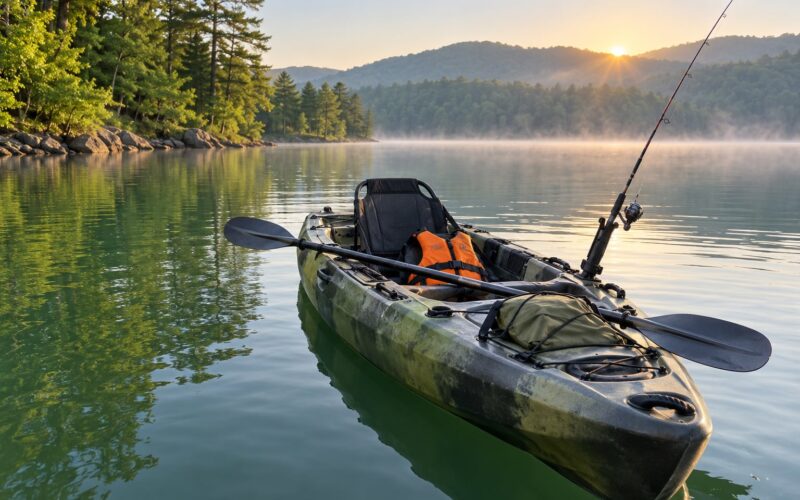
How to stay safe fishing alone comes down to one idea: you replace the buddy system with a plan, not with hope. Before you leave the house you file a float plan with a named person, you wear your flotation device instead of stowing it, and you decide now what conditions send you home. Most solo trips end without a single scare. The ones that go bad share a cause: nobody knew where the angler was, and nobody noticed they were overdue.
None of that takes more than about twenty minutes if you build it as a habit. What follows is the checklist I use, in the order I do it, from the night before through the ride home.
Table of Contents
- 1What You Need
- 2Planning documents
- 3Communication tools
- 4Flotation and weather gear
- 5Navigation equipment
- 6First aid and emergency information
- 7Know what you leave behind
- 8Step-by-Step
- 9How to Stay Safe Fishing Alone on the Water
- 10Check the Weather and Water Conditions Before Leaving
- 11Tell Someone Where You Are Going
- 12Carry Communication and Navigation Tools
- 13Inspect Your Boat, Flotation Gear, and Emergency Kit
- 14Use a Conservative Fishing Plan
- 15Know What to Do in an Emergency
- 16Common Mistakes
- 17Frequently Asked Questions
- 18Is it safe for an experienced angler to fish alone?
- 19What should I tell someone before fishing alone?
- 20How long can I safely fish alone on a lake?
- 21What should I do if I fall overboard while fishing alone?
- 22Is a charged cell phone enough for fishing alone?
- 23Should I postpone a fishing trip if the weather is uncertain?
What You Need
Solo fishing safety is mostly decided before you touch the truck. Think of this as five piles and pack them the night before.
Planning documents
A written float plan with the lake name, launch point, vehicle description and plate number, expected return time, and the person who will call if you miss it. Also your fishing license, any park or boat-launch permit, and the emergency number for the lake patrol or county dispatch, not just 911.
Communication tools
A fully charged phone in a waterproof case, a power bank or spare cable, and a whistle on a lanyard. For remote lakes where cell coverage dies, a marine radio or a satellite messenger, and for cold water, a personal locator beacon you have actually registered and tested.
Flotation and weather gear
A personal flotation device that fits, worn on your body from the moment you leave shore. Add a rain shell, one dry layer in a sealed bag, sun protection, a headlamp with spare batteries, and a small weather radio if the lake sits in a valley with spotty cell service.
Navigation equipment
A paper lake chart or downloaded offline maps, a compass you can actually use, a handheld GPS unit if the lake is big or wooded, and a marker buoy or brightly colored throw line for anchor work.
First aid and emergency information
A first aid kit with gauze and tape, a tourniquet, pain relief, blister care, antihistamine for insect bites, water purification tablets, and a small fire kit. Carry a whistle, a headlamp and a mirror or signal mirror too. Know the coordinates of your launch and the fastest route to shore.
Know what you leave behind
Freeze-dried meals instead of canned food, a plastic scoop instead of a heavy bucket of gear, and one rod instead of three. Anglers who fish solo say the same thing constantly: anything in a sled or a bucket is a thing you cannot reach while you are in the water. Ice picks, phone, whistle and PFD go on your body.
Step-by-Step
If you follow the sequence below, how to stay safe fishing alone stops being a pile of good intentions and turns into ten minutes of work plus a handful of habits. Do the same order every trip, whether it is a pond ten minutes from home or a lake two hours north.
How to Stay Safe Fishing Alone on the Water
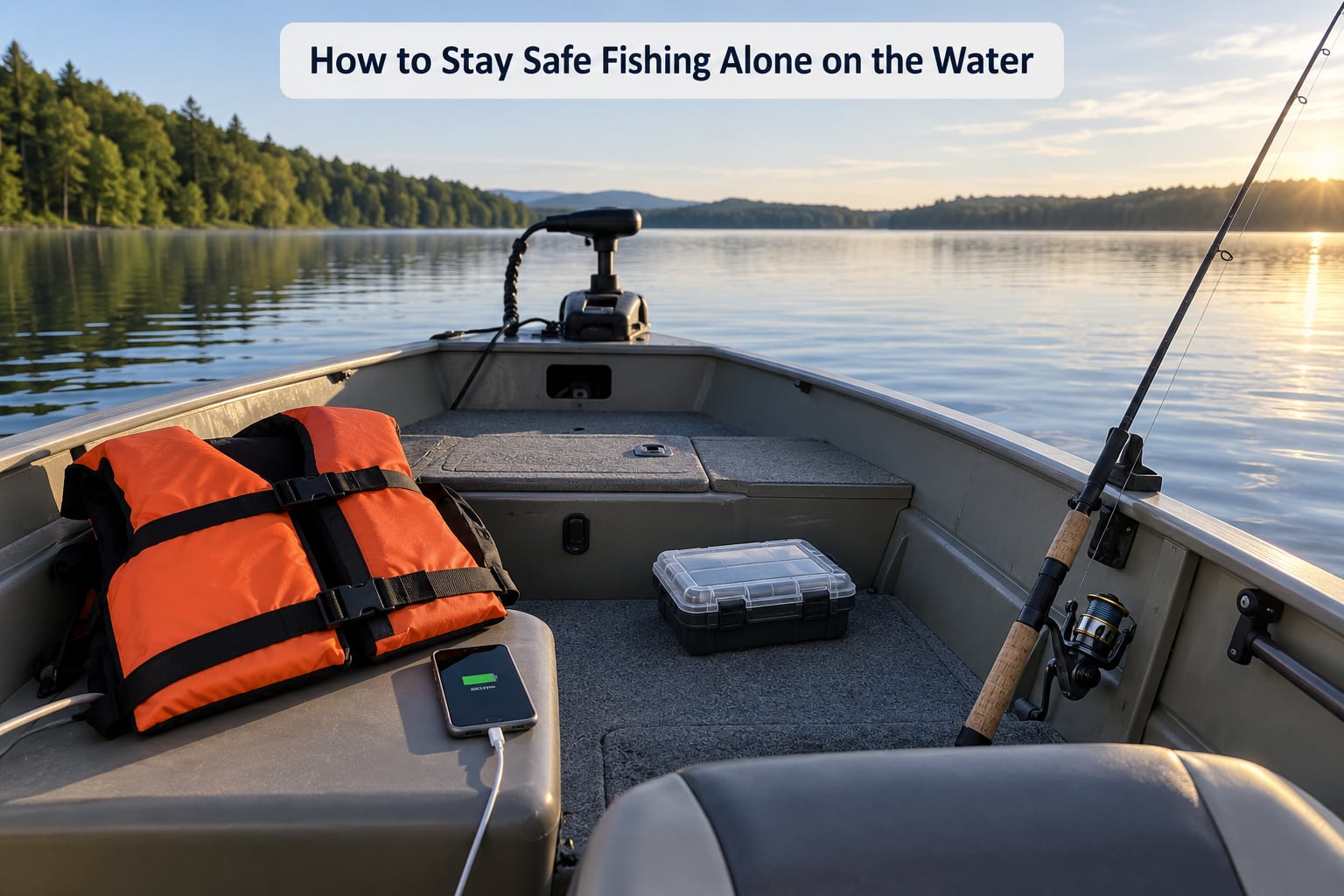
Stay inside cell or radio range whenever the lake allows it. A mile of signal and a mile of rescue are very different things, and remote coves are where people disappear for a week before anyone notices.
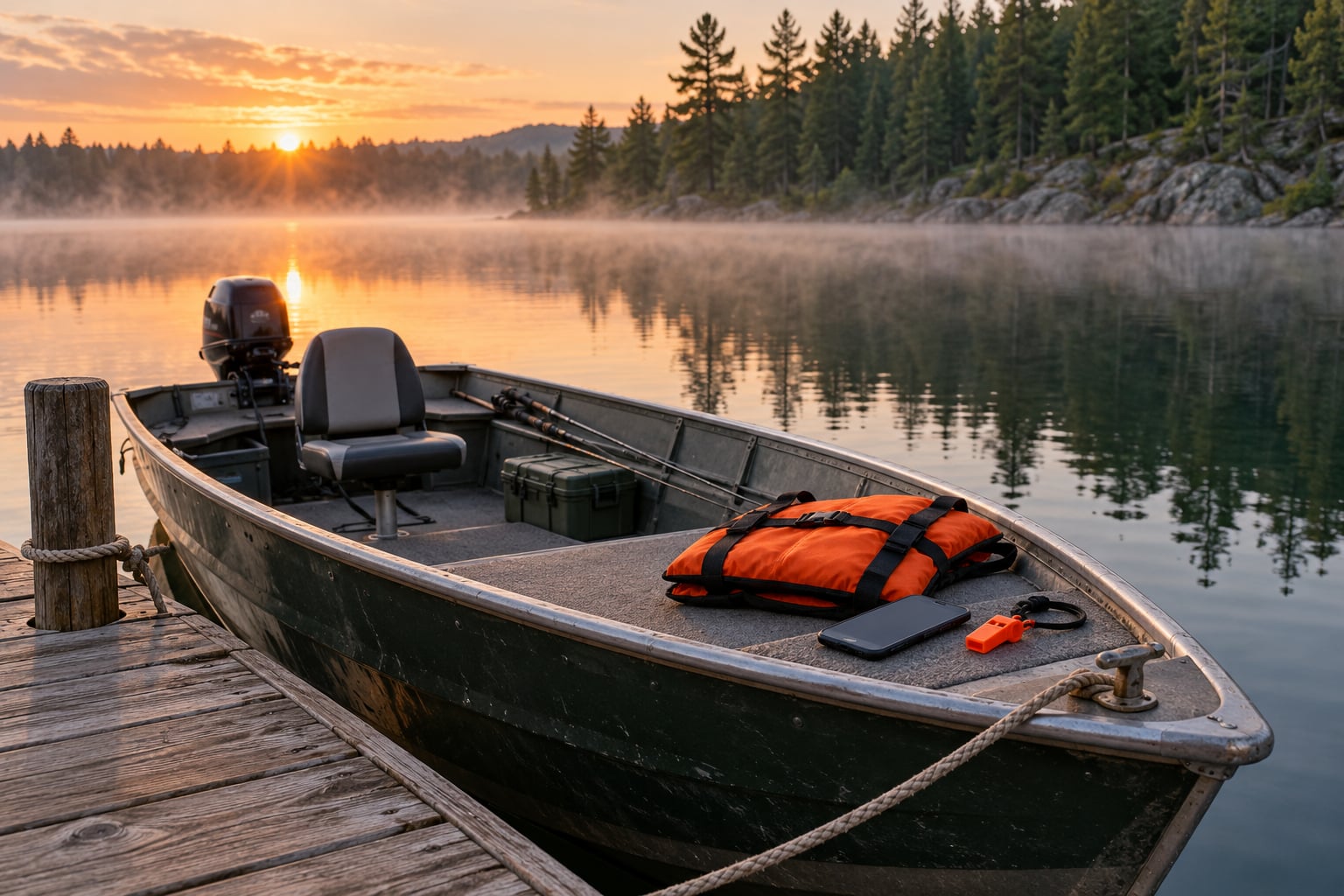
Keep your phone on you, charged, sound on, and out of a bag. Wear the PFD, not just carry it. Anglers who fish alone by choice all say the same habit matters most: the life jacket goes on before the rod comes out.
Do not let the fishing swallow your attention. Chasing a fish into a channel, climbing a steep bank to reach a pocket, or backing a trailer up a ramp in the dark all cause the same injuries that sober daylight anglers call unlucky.
Check the Weather and Water Conditions Before Leaving
Look at the forecast for the whole day, not the current radar cell. Wind is the variable that flips fastest on a lake, and an afternoon that starts flat can turn into a chop you cannot paddle home in.
Then check water temperature, visibility, current at the ramp and near structure, and whether the access point is open. Cold water below about 60°F kills more solo anglers than any other factor, because it removes your ability to swim before it removes your ability to breathe.
Check local restrictions too: closures, storm-season water levels, fire bans that affect boat launches. Then set your threshold out loud. If you wrote down “I stay off the lake when sustained wind is over 15 knots or thunderstorms are anywhere in the forecast,” you have already made the hardest call before the adrenaline starts.
Tell Someone Where You Are Going
A float plan is a short, specific message that one real person receives. Name the lake, the ramp or access point, your boat or vehicle color and plate, who is with you (nobody), and your expected return time.
The part people skip is the check-in window. Instead of a single return time, agree on when you will text “in” and “out.” Forum anglers point out the failure mode honestly: a float plan where the contact is asleep or does not have your phone gives false confidence, because nothing happens until somebody realizes you are late.
Pick someone awake and reachable for the whole trip. For a teenager or anyone worried about family worry, this conversation is the whole plan, so have it before you pack the truck.
Carry Communication and Navigation Tools
Start with the phone: charged, in a waterproof case, location sharing on, and downloaded offline maps because dead zones hit exactly when you need a map.
Add layers. A whistle costs nothing and travels farther than your voice, so wear it on a lanyard. A satellite messenger lets you send a message and your coordinates from lakes with no bars. A personal locator beacon only transmits a distress signal, which is useful for search and rescue but tells nobody where you are going tomorrow.
Know your compass before you need it, and practice reading a chart in daylight. Backup signalling matters: flare, mirror, and a bright light switched on at the right second can be the difference in a search.
Inspect Your Boat, Flotation Gear, and Emergency Kit
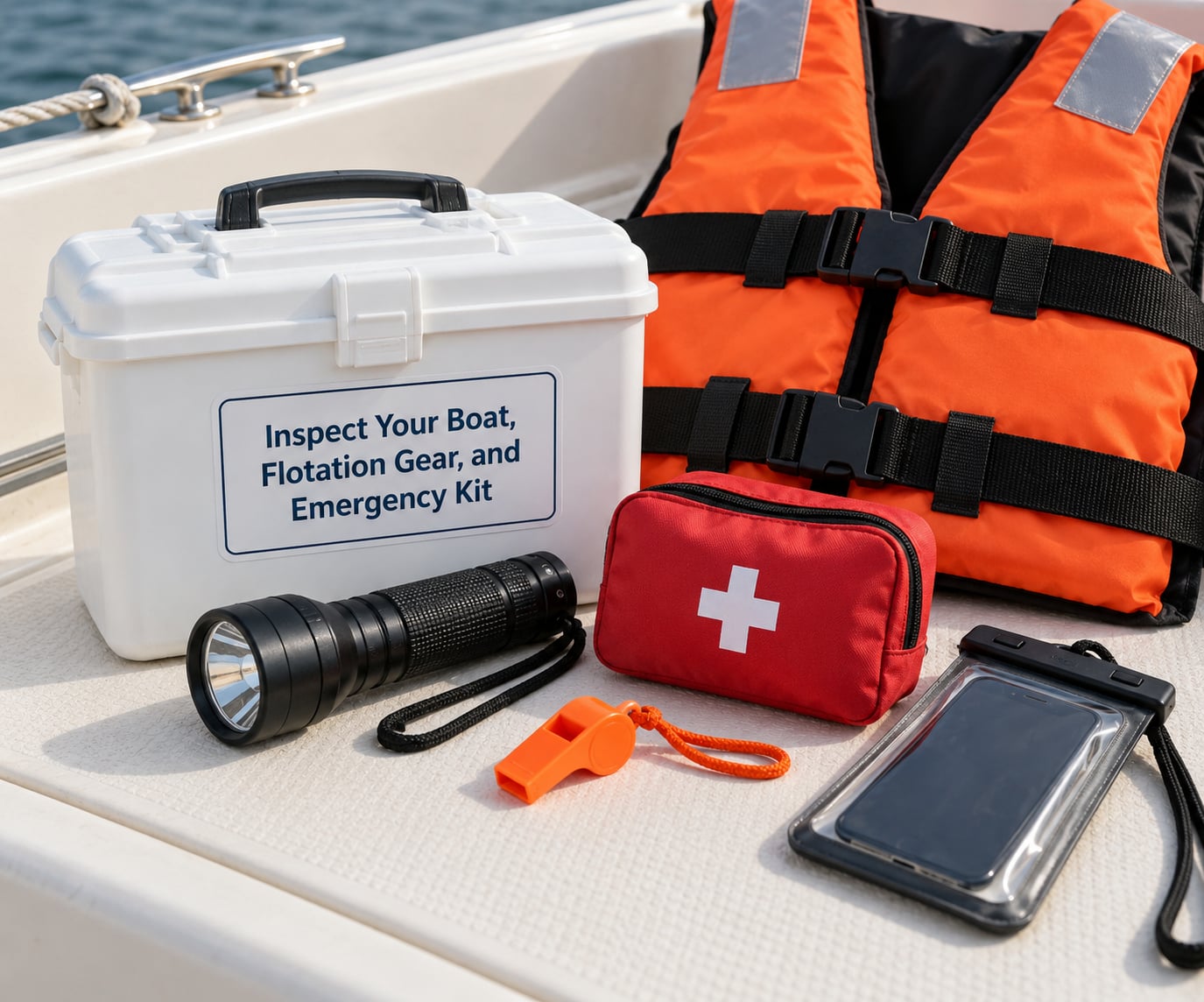
Walk the boat before you launch it. Drain the bilge, check the battery charge and the terminals, look at the prop and the steering, confirm the nav lights work, and check fuel against your return plus a margin.
Then the safety kit itself. Buckle the PFD zips, pull the whistle lanyard over your head, test the flashlight, open the first aid pouch and confirm the tourniquet and gauze are actually in it, and check that the waterproof phone case still seals.
Do the same walk when you get back. Gear that survives the trip is gear you can rely on next time.
Use a Conservative Fishing Plan
Start within sight of the launch and fish outward, not the reverse. Working away from shore early gives you options; working away from shore late does not.
Give yourself a hard turnaround time that has nothing to do with the light, and honor it. Fatigue and hunger make small mistakes bigger, and the last two hours of a solo trip are where most of them happen.
Avoid isolated water entirely when you are alone: far coves, behind dams, undercut banks, water below a spillway, and long stretches of shoreline with no houses or boats. If you are on ice solo, carry ice picks and a spud on your body and check the thickness report from your state DNR.
Know What to Do in an Emergency
If you fall overboard, do not swim for shore if the boat is floating and reachable. Most cold-water drownings happen to capable swimmers who tried to swim a short distance in water that stole their muscle function; researchers describe the pattern as roughly one minute to control your breathing, ten minutes of useful movement, then a long slow decline. Get back in the boat, get the PFD on, then head in.
If you are out of the boat, float on your back with your airway clear, conserve energy, swim only to the nearest safe landing, and get out of the water. Shivering stops being a sign you are fine and starts being an emergency.
After any immersion, treat for hypothermia even if you feel okay, and do not drink alcohol to warm up. Seek medical help if confusion, shivering that stops, slurred speech, or drowsiness appear.
Call for help as early as you can, and give the lake name first, then your coordinates or ramp, then what happened. Say what you are wearing so a boat can spot you. For lightning, leave the water immediately and move away from isolated trees and open shoreline. For a storm or flash flood on a river, get high or get out, and never cross moving water on foot.
If you are hurt and cannot move, control bleeding first with firm direct pressure and a tourniquet if the bleeding will not stop, then get to dry land before you treat anything else. Staying put on cold, wet ground while you bandage a cut is how a fixable injury becomes an emergency. Send a text or trigger your beacon with your location, then keep yourself warm and visible.
Common Mistakes
Every habit below shows up again and again in the fishing forums, and each one has a simple correction.
Relying on the phone alone. A phone has no bars at half the lakes people fish, and a wet phone is dead. Fix: carry a whistle always, and add a satellite messenger or beacon for remote water.
Telling a contact who is not really listening. “Yeah, be safe” is not a plan. Fix: get an actual check-in window and a reply, and send an “in” and an “out” text.
Ignoring the weather change. The forecast was fine at launch. Fix: set the postponement threshold in writing before you leave, so turning back is not a decision you make alone in the moment.
Fishing too far from shore. Distance turns a small problem into a rescue. Fix: start close, move out gradually, and keep the launch in sight or one quick trip away.
Carrying the life jacket instead of wearing it. Legal does not mean accessible, and it certainly does not mean on. Fix: buckle it on before the first cast.
Failing to turn back early. The trip was already a success two hours ago. Fix: set a turnaround time the night before, when nobody is disappointed.
Piling gear into a sled, bucket, or pack. Fix: phone, whistle, ice picks and PFD on your body, every time, including the twenty-minute pond run.
Treating waders and hip boots as harmless. They fill with water, and filled boots are hard to get out of in current. Fix: wear felt or cleated soles, avoid wading above the knee in moving water alone, and know where you can exit.
Frequently Asked Questions
Is it safe for an experienced angler to fish alone?
Yes, with a plan. Experience cuts down on technique errors but not on response time, which is what makes solo fishing risky. Anglers who fish alone safely all do the same things: wear the PFD, file a float plan with a real check-in time, keep a charged phone and whistle on their body, and stay inside cell range. The skill that matters is turning back early.
What should I tell someone before fishing alone?
Give them the lake name, the launch point or ramp, your vehicle color and plate number, who is with you (nobody), and your expected return time. Add an interim check-in: agree that you text in and out, and that if they do not hear from you by a set time they call the lake patrol or county dispatch with those details. Someone who is awake and has your details matters more than the message itself.
How long can I safely fish alone on a lake?
There is no safe number, but distance and darkness both raise the odds against you. On most lakes, staying within sight of the launch or a few minutes from it keeps your options open. Plan to finish before dark, and set a turnaround time the night before. Duration matters far less than staying close to shore and turning back while you still have daylight and energy.
What should I do if I fall overboard while fishing alone?
Do not swim for shore if the boat is still floating and close. Cold water takes useful muscle function in about ten minutes, and many capable swimmers drown in a hundred yards. Get a PFD on, get back into the boat if you can, or float on your back with your airway clear and swim only to the nearest safe landing. Once out, get dry, treat for hypothermia, and consider medical help.
Is a charged cell phone enough for fishing alone?
It is enough on a small lake with good coverage, and not enough anywhere else. Phones die when they get wet, run flat after a long day of photos, and lose signal at exactly the places anglers drift toward. Add a whistle on a lanyard for signaling, a waterproof case and a power bank, and for remote lakes a satellite messenger or a registered personal locator beacon.
Should I postpone a fishing trip if the weather is uncertain?
Yes, when the uncertainty involves wind, thunderstorms, or rising water. Afternoon thunderstorms over open water are the classic solo angler killer, and a forecast that says storms are possible nearby means storms will find a lake. Write your postponement rule before you leave the house, such as sustained wind over 15 knots or any thunderstorm within range, then follow it without negotiating with yourself on the ramp.
Do one thing first: tonight, before anything else, pick the person who will know where you are and set a check-in time with them. Then put the PFD on your body instead of in the boat, and check the forecast again in the morning.