To identify a northern pike vs muskie, work four checks in a fixed order: tail shape, body pattern, jaw pores, and cheek and gill-cover scales. Both fish are members of the pike family, genus Esox, so they share a torpedo body, a flattened duckbill snout, and a single dorsal fin set far back. Those shared traits tell you nothing. The four checks do.
Most anglers reach for size first, and size is the single least reliable clue here. Pike and muskies overlap heavily between about 20 and 35 inches, so a heavy fish in that window is not automatically a muskie. If you check the traits in the right sequence instead, a call takes about a minute, even on a small fish in the dark.
I have watched the same argument play out at launch ramps for years: a dock neighbour says pike, a passing motorist says musky, and the angler holding the net has no way to settle it. The forum consensus on Walleye Central and iBoats is the same as what state agency guides say, and it is not complicated. It just has to be applied in order. I checked the details below against current agency identification guidance in 2026, and the comparison table is the same one I keep coming back to.
Table of Contents
- 1How to Identify Northern Pike vs Muskie at a Glance
- 2How to Identify Northern Pike vs Muskie by Body Shape
- 3Pike are built for acceleration, muskies for endurance
- 4Why length-to-weight ratio beats a tape measure
- 5Snout and head profile: shared, with one exception
- 6Markings and Coloration: Which Fish Has Which Pattern?
- 7The one-sentence version to memorize
- 8What water, light and a wet tail do to the pattern
- 9Why small fish break the pattern rule
- 10Head, Bill, and Fins: Quick Clues at the Water
- 11Count the pores under one side of the jaw
- 12Cheek and gill-cover scales: the tiebreaker
- 13Fins, the eye, and the naming trap
- 14Size, Habitat, and Behavior: What Context Reveals
- 15Why size will not settle it
- 16Where they live and when they spawn
- 17Tiger musky: the answer when both sets of traits show
- 18Which Should You Choose?
- 19How to identify a northern pike vs muskie when the traits disagree
- 20Why getting the call right has consequences
- 21Which species to expect on your next outing
- 22Frequently Asked Questions
- 23What is the fastest way to tell a northern pike from a muskie?
- 24Are northern pike and muskies the same species?
- 25Which fish has light bean-shaped markings: northern pike or muskie?
- 26Can a small muskie look like a northern pike?
- 27Do northern pike and muskies have different tails or fins?
- 28How can I identify a northern pike or muskie from a photo?
How to Identify Northern Pike vs Muskie at a Glance
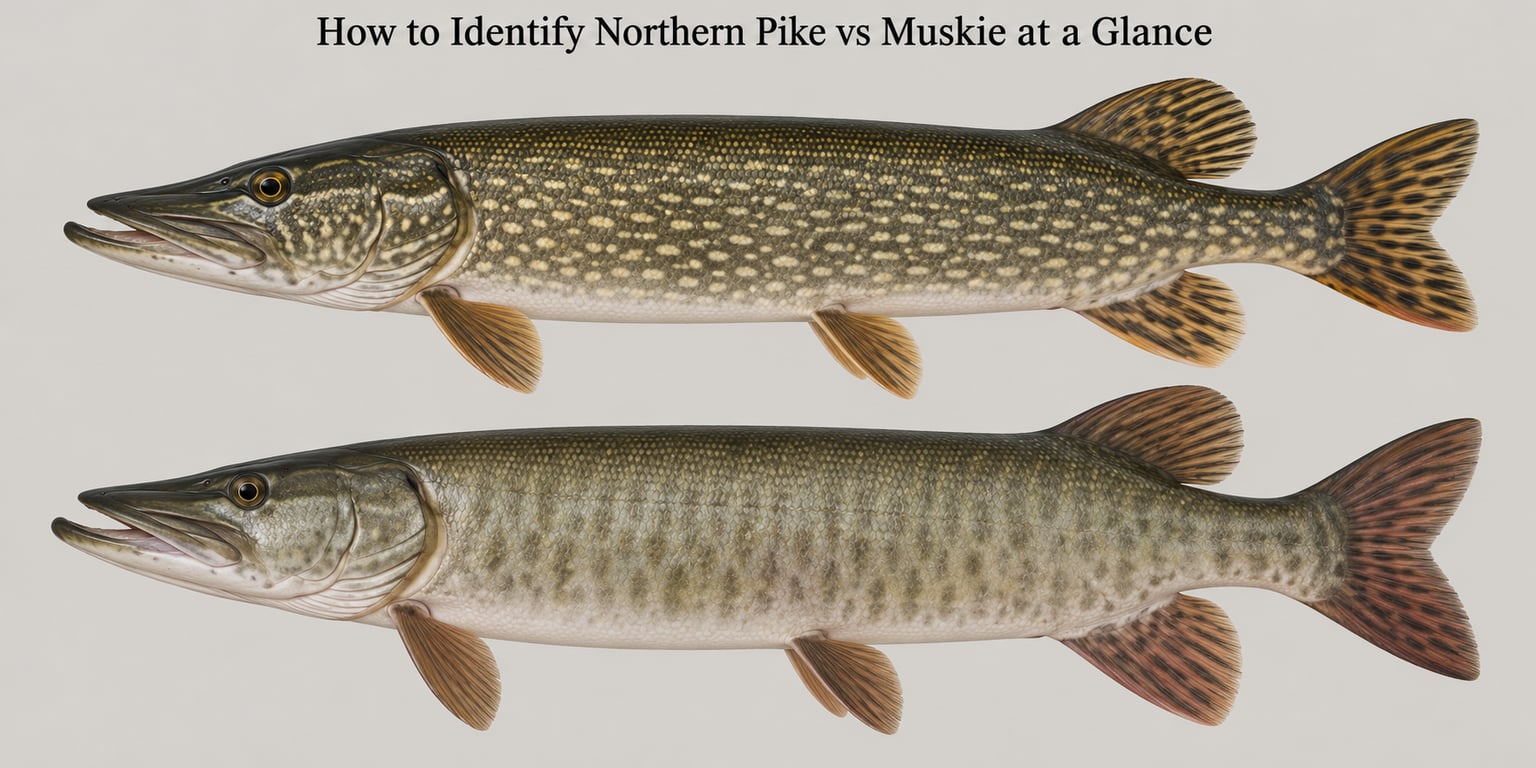
| Trait | Northern Pike (Esox lucius) | Muskie (Esox masquinongy) |
|---|---|---|
| Tail (caudal fin) | Deeply forked with rounded lobes | Deeply forked with pointed lobes |
| Body pattern | Light, bean-shaped spots on a dark olive or yellow-green body | Dark bars, blotches or spots on a light silver, brown or green body |
| Sensory pores, one side of the lower jaw | Five or fewer | Six to nine |
| Cheek and gill-cover scales | Fully scaled | Scaled on the upper half only, bare below |
| Body build | Long and comparatively slim | Deeper and heavier for its length |
| Typical length | Most fish are under 30 inches | Most fish fall between 28 and 50 inches or more |
| Trophy length | About 40 inches | About 50 inches |
| World record | About 55 pounds | About 67 pounds |
| Snout | Broad, flattened, duckbill shaped | Broad, flattened, duckbill shaped |
| Dorsal fin | Single, set far back | Single, set far back |
| Spawning timing | First, soon after ice-out | Later, often in rocky river current |
| Range | Broad across northern North America and Eurasia | Great Lakes, Mississippi and Ohio River basins, parts of the Northeast |
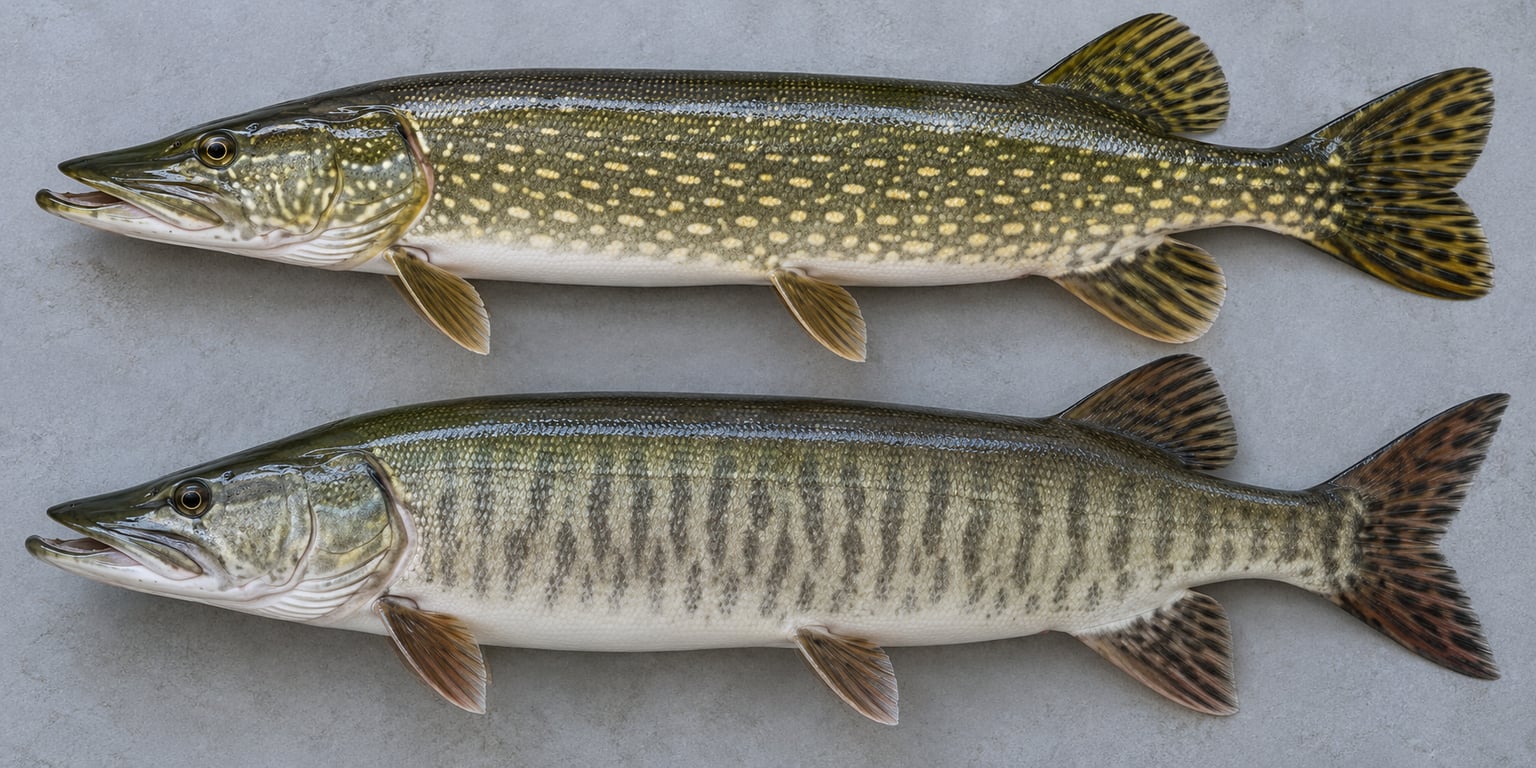
One sentence covers the pattern rule, which is the one most often stated backwards: a light background with dark marks is a muskie, and a dark background with light marks is a pike. Get that inversion right and most fish are settled in seconds.
How to Identify Northern Pike vs Muskie by Body Shape
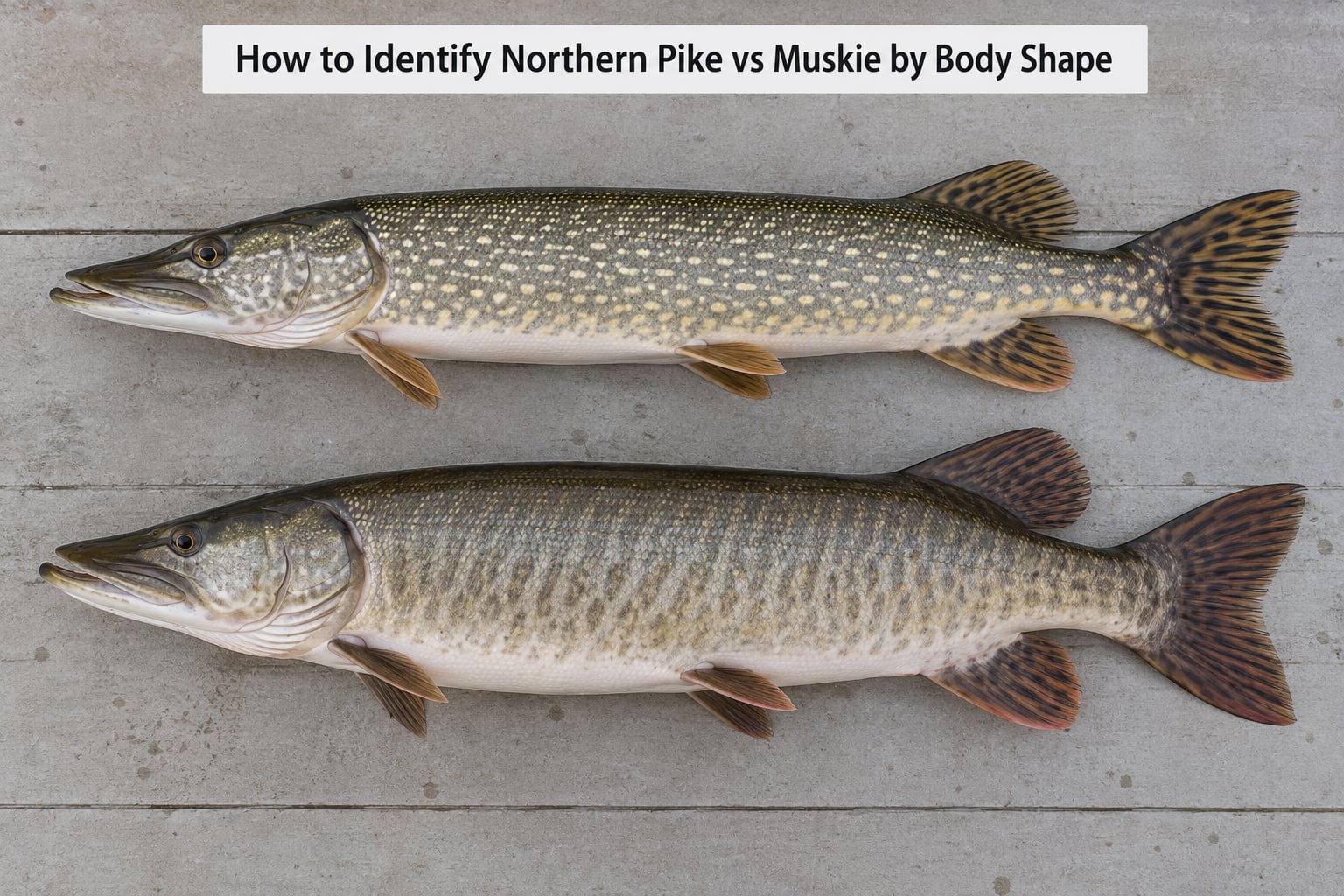
A northern pike is the slimmer of the two: long, relatively narrow through the shoulder, and built like a torpedo. A muskie carries noticeably more depth for its length, with a heavier head and a wider chest behind the gill cover. Hold one in each hand and the difference shows up in the weight, not just the outline.
Pike are built for acceleration, muskies for endurance
Both species are ambush predators that hang in weedlines and strike off the lay. A pike is the more dart-shaped of the two, and it is the fish you find in the thickest cabbage and over mudflats in cold water. A muskie carries its bulk a little further back and tends to run in slightly more open water along weed edges, timber and rock.
Because depth builds with length, a big muskie and a big pike at the same length still look different, but a juvenile muskie and a juvenile pike can overlap enough to fool you. Body shape is a supporting trait, never the one you close the call on.
Why length-to-weight ratio beats a tape measure
At equal length, the pike is the lighter fish, because its body is narrower. A 40-inch pike and a 40-inch muskie are not the same animal, and neither is a 45-inch version of either. That is why “too skinny to be a musky” fails, and it is also why a muskie that looks thin usually means you have an unusually small one.
Snout and head profile: shared, with one exception
Both fish have the broad, flattened, duckbill snout that gives the family its common names, and both have needlelike recurved teeth. Head shape alone is not a diagnostic. Where the head does help is the cheek: a pike’s cheek and gill cover are fully covered in scales, while a muskie’s lower cheek and gill plate are bare skin. That is the fourth check, and it is the one most often skipped.
Markings and Coloration: Which Fish Has Which Pattern?
A pike carries pale, bean-shaped or teardrop spots scattered over a dark olive, green or yellow-green body. A muskie carries dark markings laid over a lighter base, and that base can be silver, brown, gold or green. The pattern rule is really a background rule, and once you say it that way it is much harder to get wrong.
The one-sentence version to memorize
Light marks on a dark body means pike. Dark marks on a light body means muskie. Every forum answer that gets quoted in the comment section says the same thing, and the agencies that write the actual regulation guides say it in the same order.
What water, light and a wet tail do to the pattern
Turbid water, tannin staining and low light strip the pattern right off the fish, which is why the pattern check drops in value at the end of a long day. A muskie sitting in stained water can look olive, and a pike pulled into bright sun can wash out. If the pattern is not readable, stop leaning on it and move to the pores.
Why small fish break the pattern rule
This is the biggest source of mistakes. Small muskies frequently come through clear or golden with faint spotting, and small pike can look more strongly patterned than the fish you have seen on bigger specimens. On fish under roughly 20 inches, the pattern rule inverts more often than it holds, which is exactly the size range where the overlap already makes size useless.
Get in the habit of photographing small fish with something for scale, and measure them. Both details are what a biologist needs later, and both take five seconds in a livewell.
Head, Bill, and Fins: Quick Clues at the Water
Once tail and pattern have given you a lean, the head traits turn a lean into a call. They are the two checks that do not depend on colour, which makes them the most useful in stained water, at night, and on a fish that has already been in the net.
Count the pores under one side of the jaw
Esox have a row of sensory pores along the underside of the lower jaw, and they detect vibration. Count the pores on one side only. A northern pike has five or fewer per side. A muskie has six to nine per side, which is why so much of the old forum advice simply says pike have five dots and muskies have more. This is the definitive check, and it is the one most often botched in practice.
The practical problem is that the pores are small, the fish is wet and moving, and the light is bad. In the field, do it like this: photograph the fish first, then slide your fingers under the jaw and run a thumb along the row on one side, counting the raised dots against your fingertip. If the fish is small, put it in a shallow water-filled livewell or a bucket and do it there rather than in the water. If you truly cannot count, record the fish as unidentified and check it with a state wildlife agency creel line before you decide to keep it.
Cheek and gill-cover scales: the tiebreaker
Run your hand backward along the cheek, from the snout toward the gill plate. A pike feels fully scaled across the whole cheek and gill cover. A muskie is scaled on the upper half only, with bare skin on the lower cheek and lower gill plate. It feels like a smooth patch under your fingers once you know where to look, and it is the only check that catches a small or hybrid fish where tail and pattern have both gone ambiguous.
Fins, the eye, and the naming trap
Both species have one dorsal fin placed far back near the tail, so fin count and placement rule nothing out. The tail lobes are the fin feature that matters, and that is the check above. The mark behind and below the eye is useful as a supporting confirmation rather than a rule, because both species show it to some degree.
One piece of naming confusion trips people up constantly. “Pike” is used for the whole family, so pickerel are also technically pike. When someone at the dock says pike, they may mean the northern pike, or they may just mean an Esox. If the argument is about a small fish with a chain-like marking down the flank, you are probably looking at a chain pickerel, which tops out under about 24 inches.
Size, Habitat, and Behavior: What Context Reveals
Context narrows the field before you touch the fish. It never replaces the four checks, but on a lake where one species barely exists, the prior is worth a lot.
Why size will not settle it
Both species live comfortably in the 20 to 35 inch window, and that overlap is the root cause of nearly every misidentification. The size ceiling differs, and the records differ, with a world-record pike around 55 pounds against roughly 67 pounds for a muskie. Trophy thresholds are usually set much closer: about 40 inches for a pike and about 50 inches for a muskie. So a very large fish is a useful hint. A middling fish tells you almost nothing.
Where they live and when they spawn
Northern pike have the wider range, running through northern North America and across parts of Eurasia, and they tolerate cold water well enough to be caught through the ice. Muskies are more of a North American specialist, centered on the Great Lakes and connected waters, the Mississippi and Ohio River basins, and parts of the Northeast. They push into deeper, warmer water in the heat of summer.
Spawning timing is a useful second clue if you ever see fish guarding eggs. Pike typically spawn first, soon after ice-out, while muskies spawn later and often in rocky river current. A fish you find over eggs in cold water in early spring is far more likely a pike.
Tiger musky: the answer when both sets of traits show
The tiger musky, or tiger muskellunge, is a sterile hatchery hybrid produced from a female muskie and a male northern pike. It is why a fish can show a forked tail with intermediate lobes and a pattern that mixes both parents. The hybrids tend to grow faster than either parent, tolerate warmer water, and get into boats more readily, so they show up in places where anglers expect one species only.
When the tail is forked but the lobes sit somewhere between rounded and pointed, or when the pattern seems to be arguing with itself, treat it as a possible hybrid rather than forcing a pure call. A common middle color is a golden or bronze cast, which is normal for a tiger and not a muskie diagnostic on its own.
Which Should You Choose?
Neither fish is better than the other. The choice is about what you are holding and what the rules require, so the practical answer depends on the situation.
How to identify a northern pike vs muskie when the traits disagree
Work the checks in order and let the earliest strong signal carry the call, then confirm with the trait that does not depend on colour. Rounded lobes plus light spots on a dark body is a pike. Pointed lobes plus dark marks on a light body is a muskie. When tail and pattern conflict, the jaw pores decide, and the cheek scales confirm. If the pores are unclear on a small fish, take the photograph, measure the fish, note the exact location, and treat it as unidentified until you can check it with a state or provincial wildlife agency. A wrong confident call is worse than an honest maybe.
In a livewell or a dark boat, in a net at the dock, or from a photo taken across the water, the same order works. Take the picture before the fish goes back. A clear side-on shot that includes the tail, the jaw, and something for scale is enough for an identification you can stand behind, and it takes about ten seconds.
Why getting the call right has consequences
The two species carry different regulations in most jurisdictions: different size limits, different slot limits that allow only a limited number of fish over a minimum length, and season closures. Wisconsin, for one, closes the musky season from December through May. A muskie kept inside a pike limit, or a muskie taken during a closed season while the angler believed it was a pike, is an unintentional violation, and the conservation cost lands on the fish rather than on the guess.
On the eating question: both are good white-meat fish, and pike are worth keeping when you want them. The reason to get the identification right is the rules, not the flavor.
Which species to expect on your next outing
If you are after a pike, look in thick cabbage and over mudflats, fish cold water, and remember that they are aggressive and cannibalistic, which is why so many pike have pike tails inside them. If you are after a muskie, expect a fish of a thousand casts: bigger, later-spawning, more often found in slightly deeper and warmer water, and the reason most anglers settle for pike and still consider it a good day.
Frequently Asked Questions
What is the fastest way to tell a northern pike from a muskie?
Look at the tail first, then the pattern. A northern pike has a deeply forked tail with rounded lobes and light bean-shaped spots on a dark olive body. A muskie has pointed lobes and dark marks on a lighter silver or green body. If those two clues disagree, count the sensory pores on one side of the lower jaw: five or fewer is a pike, six to nine is a muskie.
Are northern pike and muskies the same species?
No. They are two separate species in the same genus, Esox. The northern pike is Esox lucius and the muskie, or muskellunge, is Esox masquinongy. The naming confusion comes from the word pike, which is used for the whole pike family, so pickerel are technically pike too. Sharing a genus explains the similar body plan, not the identity.
Which fish has light bean-shaped markings: northern pike or muskie?
The northern pike carries the light, bean-shaped or teardrop spots, and they sit on a dark olive, green or yellow-green background. A muskie has the darker markings, which appear as bars, blotches or spots over a lighter silver, brown, gold or green body. Small muskies are the exception, since young fish are often clear or golden with faint spotting.
Can a small muskie look like a northern pike?
Yes, and it happens constantly. Muskies under about 20 inches are frequently clear or golden rather than barred, which strips away the most obvious trait, and in that same size range a pike can look more strongly spotted. That is why the colour rules are unreliable on small fish. Tail shape, jaw pores and cheek scales still work at any size, so use those on juveniles.
Do northern pike and muskies have different tails or fins?
The tails differ clearly: both species have deeply forked caudal fins, but a pike’s lobes are rounded while a muskie’s come to a sharp point. The rest of the fin arrangement is nearly identical, since each species has a single dorsal fin set far back near the tail and paired pelvic fins. Fin placement and count will never separate the two, so judge them on the tail lobes alone.
How can I identify a northern pike or muskie from a photo?
Use a clear side-on shot that shows the whole fish including the tail, and put something next to it for scale. Read the tail lobes first, then the pattern, then zoom in on the underside of the jaw to count the pores on one side. A photo with the tail cropped out or the head out of frame will not settle the call, so take a second one first.
Start at the tail, then the pattern, then the pores, and save the cheek scales for the fish that argues back. Photograph what you catch before you decide anything about it, and if the traits still conflict, say so rather than guessing, because an unidentified fish is a phone call and a wrong call is a violation.