Invasive species spread between lakes mostly by hitching rides on people and equipment. Mussels and plant fragments stick to hulls, trailers and propellers; larvae and juveniles swim in livewell and bait bucket water; and connected waterways carry them without anyone involved. Almost every new infestation traces back to a boat or a bucket that moved from infested water to clean water.
The part most people miss is that prevention is dull and cheap while an established population is neither. This guide covers where the pathways are, what to look for on your next lake, and the routine that stops the ride.
Table of Contents
- 1What Is an Invasive Species?
- 2How Invasive Species Spread Between Lakes
- 3How Do Boats and Trailers Carry Species From Lake to Lake?
- 4Which Human Activities Are the Biggest Risk?
- 5Can Invasive Species Move Naturally Between Connected Lakes?
- 6What Signs Suggest a Lake Has an Invasive Species?
- 7How Can Boaters and Anglers Help Stop the Spread?
- 81. Inspect before you start the motor
- 92. Clean off everything attached
- 103. Drain every water source
- 114. Dry it for days, not hours
- 125. Check the notices for the lake you are entering
- 136. Never release what you did not intend to
- 14Frequently Asked Questions
- 15Can invasive species hitchhike on fishing gear?
- 16Is a boat still a risk if it looks clean?
- 17Why should I drain my livewell after fishing?
- 18Can I kill invasive species by boiling my equipment?
- 19What should I do if I find an invasive species in a lake?
- 20Does drying a boat really stop the spread?
- 21Conclusion
What Is an Invasive Species?
An invasive species is a non-native organism that establishes in a new area, spreads on its own, and causes harm to native species, the economy, or human health. Non-native simply means it arrived from somewhere else. Thousands of non-native species live in North American lakes without causing trouble.
The step that makes it invasive is the harm. A mussel filter-feeds until it strips the plankton that native fish larvae and water plants depend on. A plant like Eurasian watermilfoil crowds out native shoreline vegetation and changes the temperature and oxygen balance of shallow water.
Why does the same organism behave differently in a second lake? Predators are often the reason. Where a species evolved, something eats it or competes with it. In a new lake, that check is usually missing, and a population with few natural enemies grows quickly and spreads through a whole waterbody.
Two more terms show up in agency material. Ecosystem engineers are organisms that physically change their habitat, like mussels that build beds on the lake bottom. Veliger is the free-swimming larval stage of a mussel, small enough that people never notice it in a livewell.
How Invasive Species Spread Between Lakes
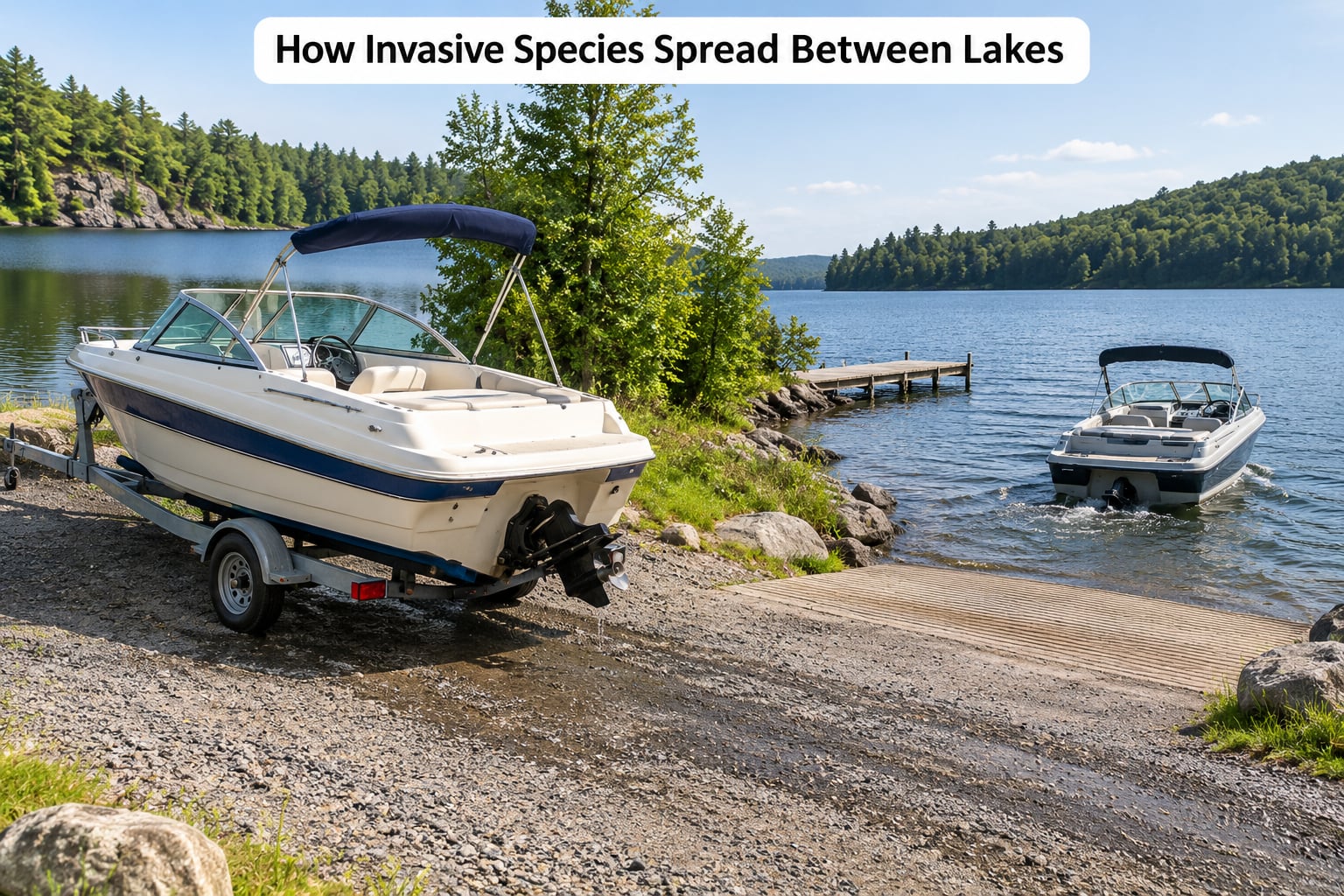
Six pathways account for nearly all introductions of aquatic invasive species into new waterbodies.
- Boats, trailers, and gear. Adults, larvae, eggs, and fragments of plants attach to hulls, propeller shafts, anchors, trailers, and tackle. This is the dominant pathway for the general public.
- Live bait and livewell water. Minnows, leeches, and the water in a bucket or livewell can hold eggs, larvae, and small organisms that survive the trip.
- Intentional transfer of water, plants, and animals. People dump aquarium plants, water garden plants, unused bait, or water taken from another lake.
- Connected waterways. Canals, rivers, and reservoir systems link lakes that people treat as separate, and ballast water moves organisms between distant ports.
- Natural dispersal. Waterbirds, fish predators, and flood or stormwater flows move organisms without human help.
- Amenity and aquaculture movement. Plants and stock moved for ponds, nurseries, and water gardens go where they are not wanted.
Each pathway carries different organisms and calls for a different prevention step.
| Pathway | What it carries | Prevention priority |
|---|---|---|
| Boats, trailers, gear | Mussels, plant fragments, snail eggs, crayfish | Inspect, clean, drain, dry before launching elsewhere |
| Live bait and livewells | Minnow eggs, larvae, small snails and plants in the water | Dispose of bait legally; never pour water between lakes |
| Intentional transfer | Aquarium and water-garden plants, released baitfish | Bag and trash plants; release nothing |
| Connected waterways | Free-swimming larvae and drifting fragments | Follow waterbody-specific rules and closures |
| Natural dispersal | Seeds, small crustaceans, juvenile fish | No user control; monitor and report |
| Pond and nursery trade | Non-native plants and stocked fish | Buy from sources that clean and certify stock |
That table is worth scanning before a trip rather than after. Most lakes fall into one of two situations: either they have an infestation and everything leaving them is a risk, or they do not and everything arriving is a risk. Your behavior changes with the answer.
How Do Boats and Trailers Carry Species From Lake to Lake?
Attachment is the mechanism. Zebra mussel veligers and plant fragments are microscopic or small enough to sit in mud, algae, and water films where nobody looks. A trailer that came up with mud, weeds, or damp vegetation carries a sample of that lake to the next one.
The usual hitchhiking spots are the ones with texture or shelter: the hull and hull seams, the propeller and shaft, the lower unit and cooling passages, the anchor and windlass, trailer bunks and rollers, fenders and dock lines, and the livewell. Mud under the trailer tongue is easy to forget and easy to spread.
What breaks the route is simple and mechanical. Inspect the boat and trailer while they are still on the trailer and before the motor is started, because running the pump can spread attached material across surfaces that looked clean. Look at the propeller, the hull near the waterline, the trailer frame, and anything trailing in the water.
Then remove it. Everything attached comes off before the boat touches the next lake. Water comes out of the hull, livewells, and bilge. And the boat sits dry for long enough to kill what cleaning missed, which is where most people cut corners.
Which Human Activities Are the Biggest Risk?
Risk depends on where you fish and how often you move, so any ranking is a rough guide rather than a rule. Boating and towing account for the largest share of introductions in most inland states, and the reason is volume rather than drama. One trailer moving between lakes weekly carries far more organisms than one barge making a single trip.
Entering a lake shortly after leaving another raises the risk because the boat is still wet and still carrying material. Long-haul towing, launching into a different ramp on the same day, and fishing a new waterbody before doing anything about the trailer all fit that pattern.
Moving live bait is a small amount of water carrying a lot of risk. Minnows are gathered from one waterbody, then carried alive to another, which is exactly the circumstance that moves eggs and larvae of unwanted species. Anglers who switch to dry-rigging and artificial lures take the whole category out of play.
Using connected waters, or fishing a lake that already has a documented infestation, changes the exposure rather than adding a new behavior. So does a new ramp opening or a rise in trailer traffic to a place: infestations often appear in a lake shortly after heavy new use.
Can Invasive Species Move Naturally Between Connected Lakes?
Yes, and no boater can stop it. Connected waterways are corridors by design. A canal or river system that links two basins gives drifting larvae, plant fragments, and free-swimming juveniles a continuous route with no trailer required.
Water movement carries them: flood events push organisms into new waterbodies, stormwater and stream flow move them downstream, and water level changes shift where populations live. Birds pick up mussels and snails and drop them in a different lake, sometimes on a nest material that has traveled surprisingly far.
Connection also changes the habitat itself. Reservoirs and channelized waters often have warmer, murkier conditions than natural lakes, with fewer native predators. That suits some invasive species unusually well, which is why manmade water systems have drawn attention in states such as Wisconsin.
The practical takeaway is simple: cleaning, draining, and drying stops what you carry, not what the water moves. Natural spread is one of the honest limits of prevention, and knowing it keeps expectations realistic.
What Signs Suggest a Lake Has an Invasive Species?
You will not always see one, but there are clues worth noting on and off the water.
- Water that looks unusually green, brown, or cloudy, or a shoreline with a mat of green growth that was not there last season
- Dense mats of stems near the surface, or a plant that resists pulling apart easily because of stiff branching
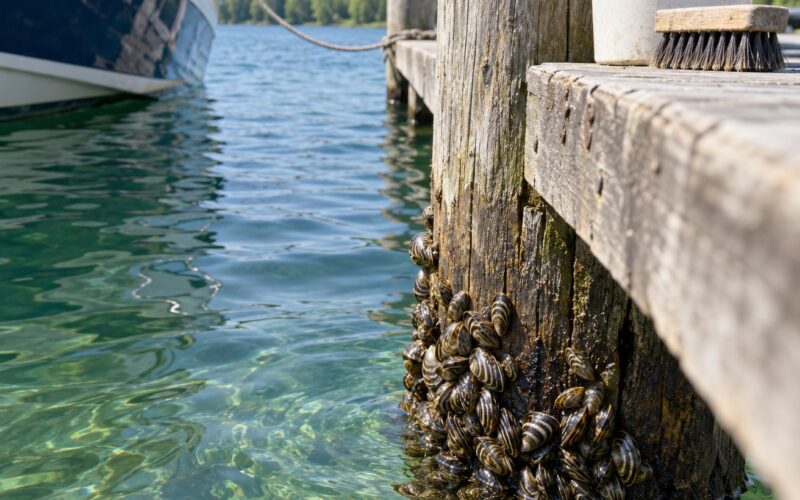
- Small striped or dark shells clustered on rocks, boat bottoms, docks, and anchors
- Dead fish along the shoreline, fish that look thin, or a baitfish population that collapsed without obvious cause
- Sudden declines in native ducks, amphibians, or shoreline birds
- Signs at the ramp asking you to inspect the boat, drain the livewell, or stay off an area
- A lower unit or prop covered in mussels, or a cooling intake clogged with plant matter that was not there before
None of these confirm an infestation on its own. Algae blooms happen, plants die back in winter, and a cold snap kills fish routinely. Treat a clue as a reason to look at the official list for that waterbody and to clean your gear more carefully, not as a diagnosis.
When something looks genuinely new, report it. State natural resources agencies and local watershed groups keep reporting forms, and a photo with a location and date is useful. Early detection is what gives an agency a chance to act before the population is established.
How Can Boaters and Anglers Help Stop the Spread?
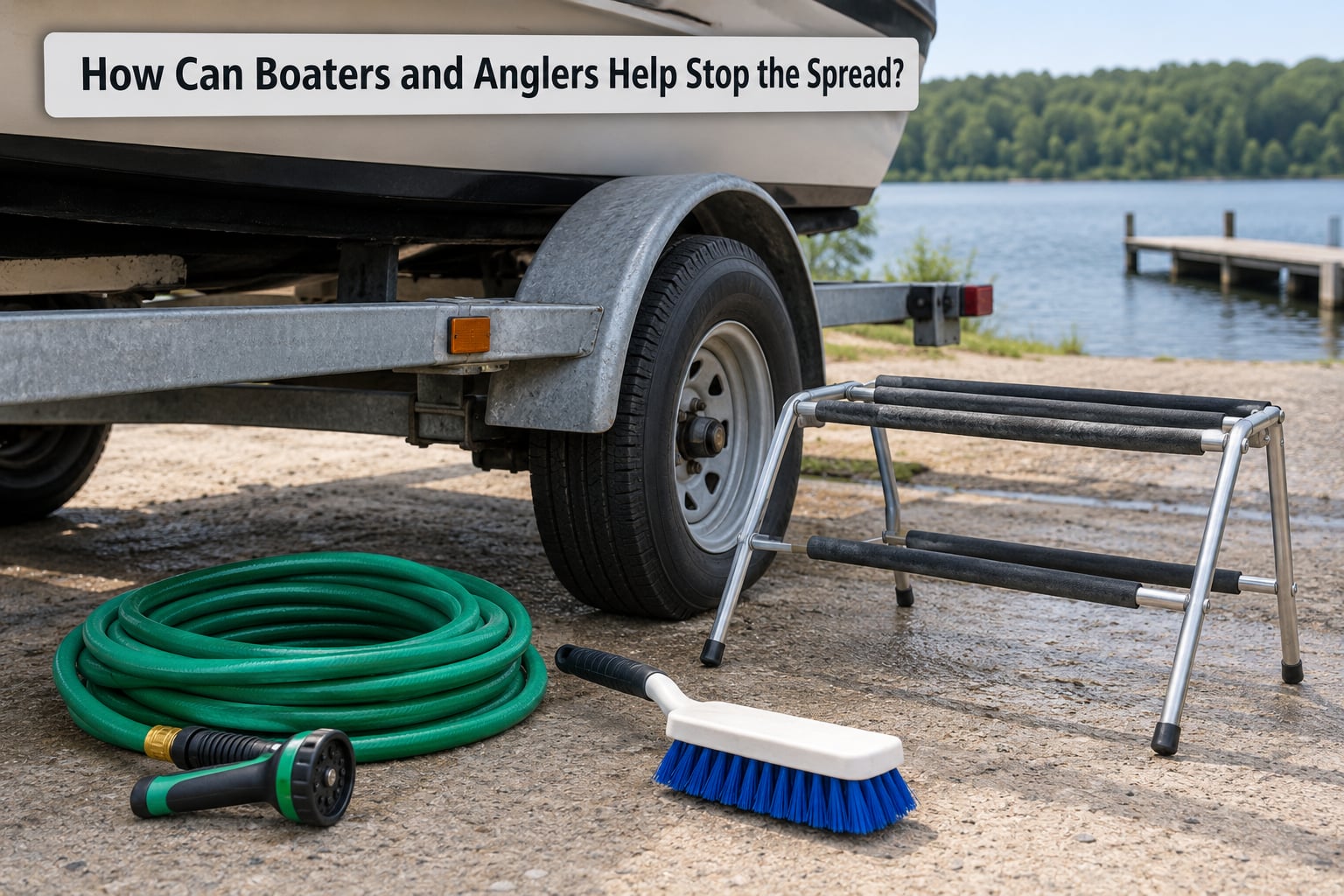
Here is the routine, in the order that matters.
1. Inspect before you start the motor
Walk the trailer with the boat still on it and check the propeller, shaft, hull near the waterline, trailer frame, bunk boards, and anything hanging in the water. The reason for looking first is simple: a short run of the engine can fling attached material onto surfaces you already cleared.
2. Clean off everything attached
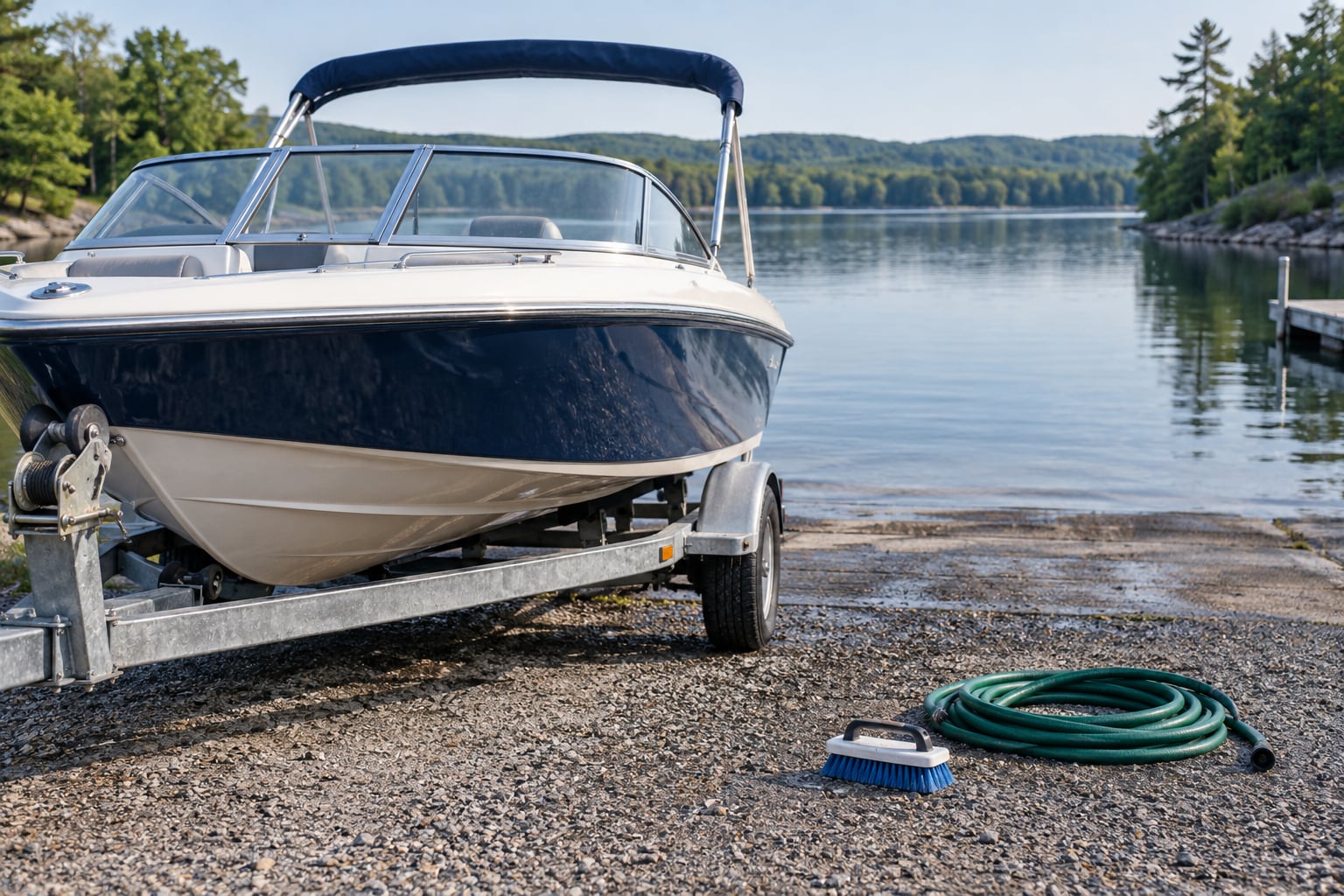
Pull off mud, algae, weeds, shells, and dead plant matter while the boat is out of the water. A hose and a stiff brush handle most of it. Waders, dive gear, paddle blades, nets, and downrigger lines get the same treatment, and they are the items most often skipped on a quiet lake trip.
3. Drain every water source
Pull the drain plug and empty the livewells, bilge, and any bucket holding lake water. Do this at the ramp rather than at home, because the point is to leave the water where it came from. Bait that must be released goes in the trash, not the lake, and never into a different lake.
4. Dry it for days, not hours
Drying is what kills what the brush missed, because attached mussels lose their ability to survive once they dry out. Guidance from state programs commonly calls for five or more days, and longer for fragmenting plants, which can regrow from small pieces. If you need the boat sooner, a hot water decontamination unit or a thorough wash-and-dry at a station is the alternative.
5. Check the notices for the lake you are entering
Rules differ between states, between waterbodies, and sometimes between ramps in the same county. Look for posted restrictions, check whether the target lake has a listed invasive species, and see whether an inspection or decontamination station sits near that launch. Searching your state natural resources department site by waterbody name is usually enough, and inspection station maps are often published statewide.
6. Never release what you did not intend to
Aquarium plants, water garden plants, leftover bait, and captured water all have to go somewhere other than the next lake. Bag plants and put them in the trash, and note that some states and local programs treat disposal of live bait differently, so check the specific rule before you drive home with a bucket.
Frequently Asked Questions
Can invasive species hitchhike on fishing gear?
Yes. Rods, nets, waders, boots, dive gear, and paddle blades all catch mud and plant fragments that dry slowly and travel well. A macrophyte fragment with a single viable node can root in new water. Give the same attention to paddlecraft gear that you give a hull, even on small lakes, because the waterbody next door may already have the species.
Is a boat still a risk if it looks clean?
Often, yes. Zebra mussel veligers are microscopic and plant fragments are small, so a boat can look spotless and still carry viable material. Visual inspection also misses damp mud in trailer bunk channels and debris under the tongue. Treat an apparently clean boat as unverified until it has been washed, drained, and dried.
Why should I drain my livewell after fishing?
Livewell water can hold eggs, larvae, and juvenile organisms, and it often travels warmer and better oxygenated than the lake it came from. Poured into another lake, it becomes live bait for whatever lives there. Drain at the ramp rather than at home so the water stays where it belongs.
Can I kill invasive species by boiling my equipment?
Boiling is not the standard recommendation. Agencies rely on hot water decontamination units that apply a controlled temperature for a set time with contained rinse water, rather than open boiling, which is unsafe around a fuel tank or engine. A kettle on a camping stove will not decontaminate a trailer frame. Wash with hot water at a station instead.
What should I do if I find an invasive species in a lake?
Note the location, date, depth, and a photo if you can take one safely, then report it to your state natural resources department or local watershed office. Do not try to remove it yourself and do not move the specimen to another water. Reports contribute to early detection programs, and agencies confirm identifications before treating a site.
Does drying a boat really stop the spread?
Drying is one of the three most effective steps, and it is the one most often rushed. Water must be drained first, since trapped moisture keeps organisms alive inside hulls and livewells. Program guidance commonly calls for five or more days before launching somewhere else, with longer for fragmenting plants that can regrow from tiny pieces.
Conclusion
Most lakes gain an invasive species because somebody moved water, gear, or a living thing from an infested waterbody to a clean one. Inspect, clean, drain, and dry before you launch somewhere else, and check your state’s guidance for the specific lake before the trip, not after the trailer is in the water.