How water quality is tested in lakes: technicians take a water sample, measure some properties in the field right away, send the rest to a lab, then compare every number against reference ranges for lakes. That is the whole process, whether it happens from a state agency boat or from a volunteer standing on a dock with a test tube.
The reason it matters to anyone who boats, paddles, swims, camps or fishes is simple. You can see a green scum line and you cannot see a toxin. Test data is the closest thing to an objective answer about the water you are putting a body in.
Here is the workflow in short form, because most people asking this question want the sequence before the details.
- Define the question. Recreational safety (bacteria, toxins, oxygen) is a different list than ecological health (nutrients, clarity, algae). Agencies usually already know which one they are answering.
- Pick sites and depths. A lake is not one body of water. Monitoring programs sample the main basin, coves, tributary mouths and the deepest hole, usually at several depths.
- Collect a grab sample. A sealed bottle is filled at a set depth, often without disturbing the sediment on the bottom.
- Measure field parameters on site. Temperature, dissolved oxygen, pH and conductivity change quickly once water sits in a warm bottle, so those readings happen at the shoreline or on the dock.
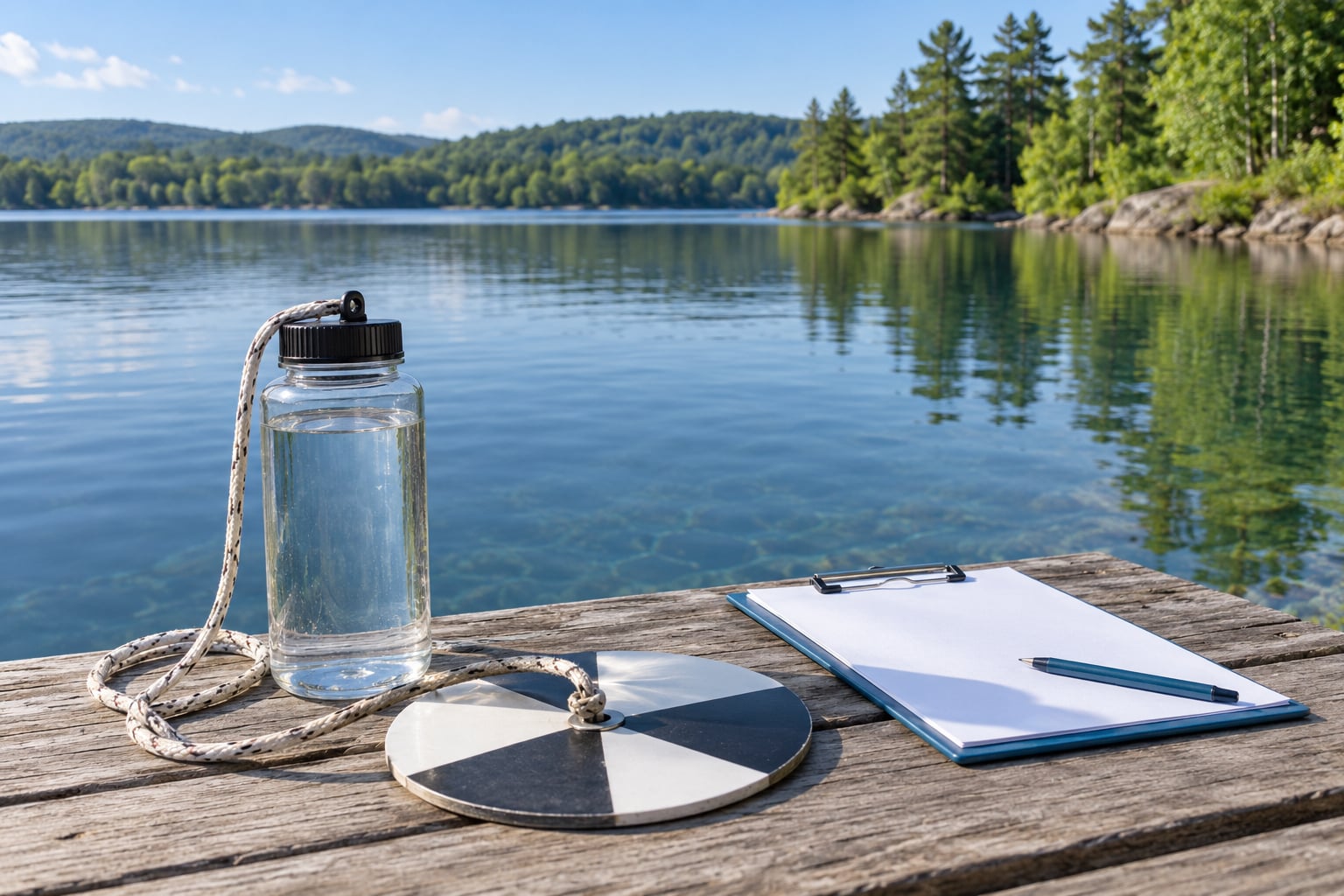
- Check clarity. A Secchi disk on a marked line is lowered until the disk disappears and raised until it reappears. Half the distance between the two is the recorded depth.
- Preserve and deliver lab samples. Nutrient and bacteria bottles get acid, preservative or refrigeration depending on the analyte, then a chain-of-custody form and a lab.
- Compare results to reference ranges and trends. A single number means little on its own. What matters is whether it sits above or below the lake’s own history and the state thresholds.
Table of Contents
- 1What Does Lake Water Quality Testing Measure?
- 2The two goals behind how water quality is tested in lakes
- 3Why Is Water Quality Testing Important for Visitors?
- 4How Is a Lake Water Sample Collected?
- 5Where the sample comes from
- 6Handling details that matter
- 7Which Tests Are Used for Lake Water?
- 8How Does Testing for Harmful Algal Blooms Work?
- 9How Are Test Results Interpreted?
- 10Who Tests Lakes and How Often Are They Monitored?
- 11How Can You Check Water Quality Before Swimming or Fishing?
- 12Frequently Asked Questions
- 13How can I tell if a lake is contaminated?
- 14Is it safe to swim in a lake with an algae bloom?
- 15Is there a test kit for blue-green algae?
- 16Can I do a DIY water quality test at home?
- 17What are the main water quality parameters for lakes?
- 18How do I know if my lake has an algae bloom?
- 19Conclusion
What Does Lake Water Quality Testing Measure?
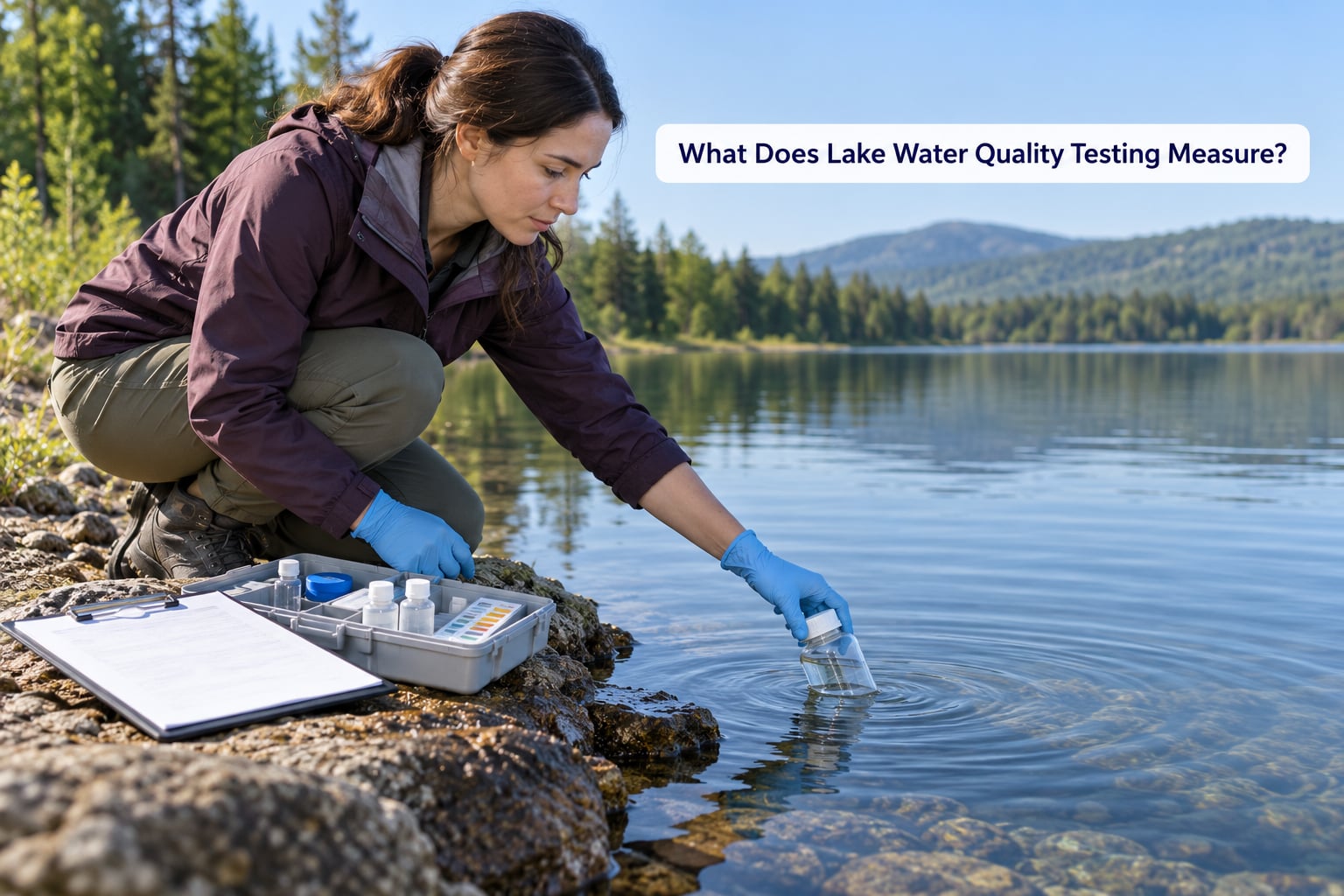
Lake water quality testing covers three families of measurement: physical, chemical and biological. Physical covers temperature, clarity and how much material is floating in the water. Chemical covers dissolved oxygen, pH, conductivity, nutrients and contaminants. Biological covers bacteria, algae and the organisms that live in the water column.
No single test describes a whole lake. A Secchi disk reading from one cove on a bright day says something real about that cove, and almost nothing about the shallow bay six miles away.
The two goals behind how water quality is tested in lakes
The first goal is public health. Can you swim, can you eat the fish you caught, should your dog go in after the stick? Those questions are answered with bacteria counts, cyanobacteria cell counts, toxin analysis and dissolved oxygen.
The second goal is lake condition. Is this lake getting clearer or greening year over year? Are nutrients rising? That question is answered with clarity, chlorophyll-a, total phosphorus and total nitrogen, often rolled into a single trophic state index score.
Confusing the two is the most common mistake people make with their own results. A crystal-clear lake can carry an elevated dissolved oxygen swing and low nutrient supply, and a green lake with a healthy Secchi reading can still be producing a toxin that closes a beach. Both readings are true at the same time.
Why Is Water Quality Testing Important for Visitors?
Because conditions change faster than most visitors expect. A lake can be fine on Tuesday and post an advisory on Thursday after three days of heat, or after a storm pushes farm runoff and street debris into the same bay where you planned to swim.
Health advisories usually come from a small number of measurements: E. coli or fecal coliform for sewage input, cyanobacteria cell density or microcystin for toxins, and sometimes dissolved oxygen for fish kills. Health departments and drinking water utilities run these, and they typically post results when something crosses an action level.
Ecological monitoring runs on a different clock. Agencies sample the same sites every month or every quarter so they can plot trends across years. A single bad summer does not make a lake unhealthy; five years of rising phosphorus does.
Event-based testing is the third kind. After a spill, a fish kill, a sewage plant upset or a suspected bloom, agencies collect targeted samples outside their routine schedule. Volunteer groups often cover the gap between scheduled visits, reporting high readings to the agency that runs the program.
How Is a Lake Water Sample Collected?
Sampling is the part that quietly ruins an otherwise good test result. Water quality testing is how water quality is tested in lakes, and a contaminated bottle or a stirred-up bottom turns hours of lab work into an unreadable number.
Where the sample comes from
A shoreline grab sample is taken by hand, usually from knee to waist deep, and it is the easiest option for a volunteer. It skews toward surface conditions and misses anything happening below.
A depth sample uses a bottle on a line, lowered quickly and opened at the intended depth without touching bottom. That is how programs sample stratification, and it is the only way to see a hypoxic layer under warm surface water.
Programs typically sample several sites and several depths, and they take duplicates at roughly one in ten sites to check their own consistency. The field technician records time, weather, water depth and site number on the sheet before the bottle goes on ice.
Handling details that matter
- Rinse with lake water. Test vessels get a rinse with the sample water before filling. Tap water leaves chlorine and trace metals behind.
- Fill without bubbles. Air contact changes dissolved oxygen and pH readings.
- Do not touch the inside. Gloves go on, and the cap stays on until the moment of filling.
- Preserve per analyte. Nutrient bottles get acid or preservative, bacteriological bottles get kept cold and delivered fast, and toxicology samples are frozen or chilled on a schedule set by the lab.
- Label everything. Site, depth, date, time and sampler name, plus the chain-of-custody form the lab requires.
- Deliver on schedule. Holding times are short, sometimes measured in hours for bacteria.
One small mistake travels a long way. A bottle that sits in a hot car for three hours before drop-off will read as lower dissolved oxygen and higher temperature than the lake actually is, and nobody downstream can tell.
Which Tests Are Used for Lake Water?
This is the reference table to come back to. It lists what each test measures, how it is measured, a reading that usually reads as healthy for a typical US lake, and why anyone cares about it.
| Test | What it measures | How it is measured | Typical reference reading | Why it matters |
|---|---|---|---|---|
| Temperature | Water temperature at depth | Thermistor or calibrated thermometer, on site | Follows seasonal air temperature | Drives stratification, dissolved oxygen and algal growth |
| Dissolved oxygen | Oxygen available to fish and bacteria | Winkler titration or dissolved oxygen meter, on site | Above 5 mg/L in open water; below 3 mg/L stresses warm-water fish | Low values drive fish kills and odor problems |
| pH | Acidity or alkalinity | Calibrated pH meter or colorimetric kit, on site | 6.5 to 8.5 | Shifts with acid rain, limestone and algal photosynthesis |
| Secchi depth | Water clarity | Black-and-white disk lowered on a marked line | Greater than 3 m in most temperate lakes | The simplest long-term trend in lake condition |
| Turbidity / total suspended solids | Cloudiness and material suspended in the water | Turbidimeter or filtered-weight analysis | Under 10 NTU in clear conditions | Shows erosion and sediment, and algae in water |
| Conductivity | Dissolved salts and ions | Meter reading, often paired with temperature | Highly site-specific | Traces runoff, septic input and road salt |
| Total phosphorus | All phosphorus in the sample | Persulfate digestion then spectrophotometric analysis in a lab | Under 10 to 20 micrograms per litre for most lakes | The nutrient that most often limits algae growth in freshwater |
| Total nitrogen | All nitrogen in the sample | Same digestion approach as phosphorus | Under 0.5 mg/L in many lakes | Often the limiting nutrient in brackish and coastal waters |
| Chlorophyll-a | Algal biomass | Extraction and spectrophotometric or fluorometric reading | Under 10 micrograms per litre for a clear-water lake | The biological half of the trophic state index |
| E. coli / fecal coliform | Fecal contamination | Membrane filtration culture in a lab | Recreational thresholds are commonly set in colonies per 100 mL | The basis for most swim advisories and closures |
| Cyanobacteria cell count | Blue-green algae density | Microscope counting or pigment analysis on a filtered sample | Action levels are set by state, often in cells per mL | Triggers a public health advisory |
| Microcystin | Cyanobacterial toxin | Enzyme-linked assay on surface water | Recreational action levels commonly sit in the low micrograms per litre range | Explains why a bloom with no obvious odor still closes a beach |
| Toxic contaminants | Metals, pesticides, solvents, PFAS | Gas or liquid chromatography after extraction | Site and use specific | Necessary near industrial sites, mines or treated land |
Two things about that table are worth remembering. Most of the routine parameters are cheap and fast enough to run on site; the expensive ones are the nutrients, the toxins and the contaminants. And no field kit covers the whole row set, which is why a lab drop-off is often the practical answer for a homeowner who wants real numbers.
How Does Testing for Harmful Algal Blooms Work?
Bloom testing is a three-part process, and all three parts matter.
The first part is visual. Staff log color, surface scum, streaks, odor and extent of coverage, usually with photographs. A blue-green paint-like scum, a musty odor, or a thick mat that gathers in bays and coves all trigger follow-up.
The second part is a field reading of chlorophyll-a and water temperature, plus a water sample for pigment analysis. Chlorophyll-a gives a rough biomass number, and pigment analysis on a filtered sample can tell you whether the dominant pigment is chlorophyll from true algae or phycocyanin from cyanobacteria.
The third part is the lab confirmation: a cell count under a microscope, and a toxin assay when the density is high enough to matter. Microcystin testing is what closes a beach, because the same green water can be mildly irritating one week and dangerously toxic the next as the bloom ages and cells break down.
Appearance alone cannot confirm toxicity. Local health reporting is consistent on this point, and so are the sample records from past bloom investigations. Some cyanobacteria species produce no toxin at all, and some blooms that produce toxin look thin and unremarkable.
Timing matters too. A bloom can double in a couple of warm days, which is why agencies re-test within days rather than waiting for the next routine round.
How Are Test Results Interpreted?
A number on its own is not a verdict. Interpretation depends on four things: the standard it is compared against, the lake’s own background conditions, the direction it is moving, and what you intend to do with the water.
Standards. Bacteria and dissolved oxygen have widely published numeric thresholds. Nutrients usually do not; most states instead compare them against a lake-specific criterion set for its type.
Background conditions. A shallow, naturally acidic lake in the Southeast does not have the same nutrient targets as a deep northern lake. Comparing two lakes on one number is how well-meaning reports go wrong.
Trends. Averages hide the interesting part. What a program actually plots is a time series: clarity falling year over year, phosphorus rising, chlorophyll-a following the phosphorus two years later. Averages versus ranges versus trends tell three different stories, and the trend is the one that predicts the future.
Intended use. The same clarity reading can be fine for fishing and unacceptable for swimming. Recreational thresholds and ecological targets were not written to be interchangeable.
The trophic state index, developed by Carlson, is the classic summary tool. It combines Secchi depth, total phosphorus and chlorophyll-a into an estimate of lake productivity, from oligotrophic at one end to hypereutrophic at the other. It is useful for describing a lake in one number and much less useful for deciding what to do this weekend.
Single samples also have hard limits. One bottle tells you about one place, at one moment, at one depth. Anyone who draws firm conclusions from a single reading without saying where and when it was taken is overstating what the data supports.
Who Tests Lakes and How Often Are They Monitored?
Nobody owns lake testing outright. It is split across several groups, and they overlap more than most people expect.
State environmental agencies run the long-term monitoring networks and the lake assessment reports, and they hold most of the historical data. Local health departments handle the bacteria sampling behind beach advisories and swim closures. Watershed organizations and lake associations fund extra sampling and sometimes pay for a laboratory contract. Municipal utilities monitor reservoirs that supply drinking water, under tighter rules than recreational lakes face. Universities and research groups add studies on stratification, nutrients and watershed modeling. Volunteer programs collect clarity, temperature and sometimes bacteria data on a fixed schedule using standardized kits.
Frequency depends on the lake’s use and its risk. A drinking water reservoir gets monitored far more often than a remote fishing lake. Baseline programs sample monthly in the warm season and a few times in winter. Event-based sampling adds visits after heavy rain, heat waves and reported fish kills.
Volunteer work is the easiest way in. State programs run through groups like the Izaak Walton League, and extension offices often process samples at a lower cost than a commercial lab. Forum conversations about DIY kits come back to this point again and again: people want to know who will actually look at the bottle, and the honest answer is usually the extension office or the state agency, not a home test.
How Can You Check Water Quality Before Swimming or Fishing?
Here is the order I would work in, and I would start at one and move down.
- Check the official notices first. Your state environmental agency and local health department post current advisories, closures and the most recent assessment report for your lake. That is faster and more reliable than any measurement you can take yourself.
- Read the recent report’s date. A report from two summers ago tells you about the lake, not about today.
- Look at the water. Surface scum in bays, unexpected odor, a film that gathers in coves and along the windward shore, or a sudden drop in clarity are all reasons to move to a different cove or come back later.
- Check the weather history. Several days of heat, or rain following a dry stretch, changes conditions fast. Recent heavy rain over farmland or developed land is a solid reason to wait.
- Use a field kit for what it can actually tell you. Consumer strips built for drinking water cover chlorine, hardness and pH, and they say nothing about dissolved oxygen, nutrients or cyanobacteria. A colorimetric field kit for those parameters gives you a real number, but it is a screening result, not a report.
- Follow the posted guidance. Public health advice on blooms is consistent: stay out of scummy water, keep pets away, rinse skin and pets after contact, and do not assume boiling fixes it, because boiling does not remove cyanobacterial toxins.
Know the limit of your own data. A kit reading tells you what you measured, in one place, at one moment. It cannot tell you whether a toxin is present three miles away, and it cannot tell you what the lake looked like last Tuesday. If the answer matters enough to act on, it comes from an agency or a lab.
Frequently Asked Questions
How can I tell if a lake is contaminated?
You cannot confirm contamination by looking, because the most common problems are invisible. The signs that testing is worthwhile are scum, odor, unusual clarity change, dead fish, or recent heavy rain over farmland or construction. The actual confirmation comes from measured parameters: E. coli or fecal coliform for sewage, total phosphorus and nitrogen for runoff, dissolved oxygen for low oxygen, and toxin analysis for cyanobacteria. Official agency reports are the fastest source.
Is it safe to swim in a lake with an algae bloom?
It depends on whether the bloom is producing toxins, and appearance cannot tell you that. Agencies post advisories based on cyanobacteria cell counts and microcystin measurements, and those are the numbers to follow. If a bloom advisory is posted for your lake, treat it as no swimming, keep pets out of the water entirely, and rinse skin and fur after any contact. Boiling water does not remove these toxins.
Is there a test kit for blue-green algae?
Partly. You can buy field kits and test strips that read cyanobacteria density indirectly through pigment response, and some measure chlorophyll-a or microcystin. They work as screening at the shoreline and give a rough yes or no on pigment. They cannot produce a certified cell count, they cannot map a bloom, and they cannot tell you the toxin level across a whole lake. For an official answer, use the state agency report.
Can I do a DIY water quality test at home?
You can, with limits worth knowing before you spend the money. Drinking-water test strips cover chlorine, hardness and pH and say nothing about dissolved oxygen, nutrients or algae. A colorimetric lake kit can measure dissolved oxygen, pH and some nutrients at the shoreline, but the numbers need reference ranges to mean anything and they change quickly. Volunteers submitting samples to an extension office usually get better data for less.
What are the main water quality parameters for lakes?
The short list is temperature, dissolved oxygen, pH, clarity, and nutrients. Add turbidity, conductivity, total suspended solids and chlorophyll-a for a fuller physical and chemical picture, plus fecal bacteria and cyanobacteria counts when the question is safety. Most state lake assessments lead with Secchi depth, total phosphorus, chlorophyll-a and dissolved oxygen, because those four cover condition, productivity and oxygen together.
How do I know if my lake has an algae bloom?
A bloom shows up as green, brown or blue-green discoloration, often with a surface scum, streaks, odor or a thick mat in coves and along shore. Warm, still, sunny weather drives them, and nutrient-rich runoff makes them worse. To confirm one, check the state agency advisory and report the sighting with location and date. Toxin risk comes only from lab analysis of cell counts and microcystin, never from the look of the water.
Conclusion
Start where a professional would: pull the current assessment and any open advisories for your lake from your state environmental agency, then check the report date before you treat any of it as current. If something looks off and no agency has sampled recently, a shoreline clarity reading and a temperature and dissolved oxygen reading from a field kit will tell you whether conditions are worth a closer look. Report what you saw, with the location and date, because that is what adds a sampling site to the next agency visit.