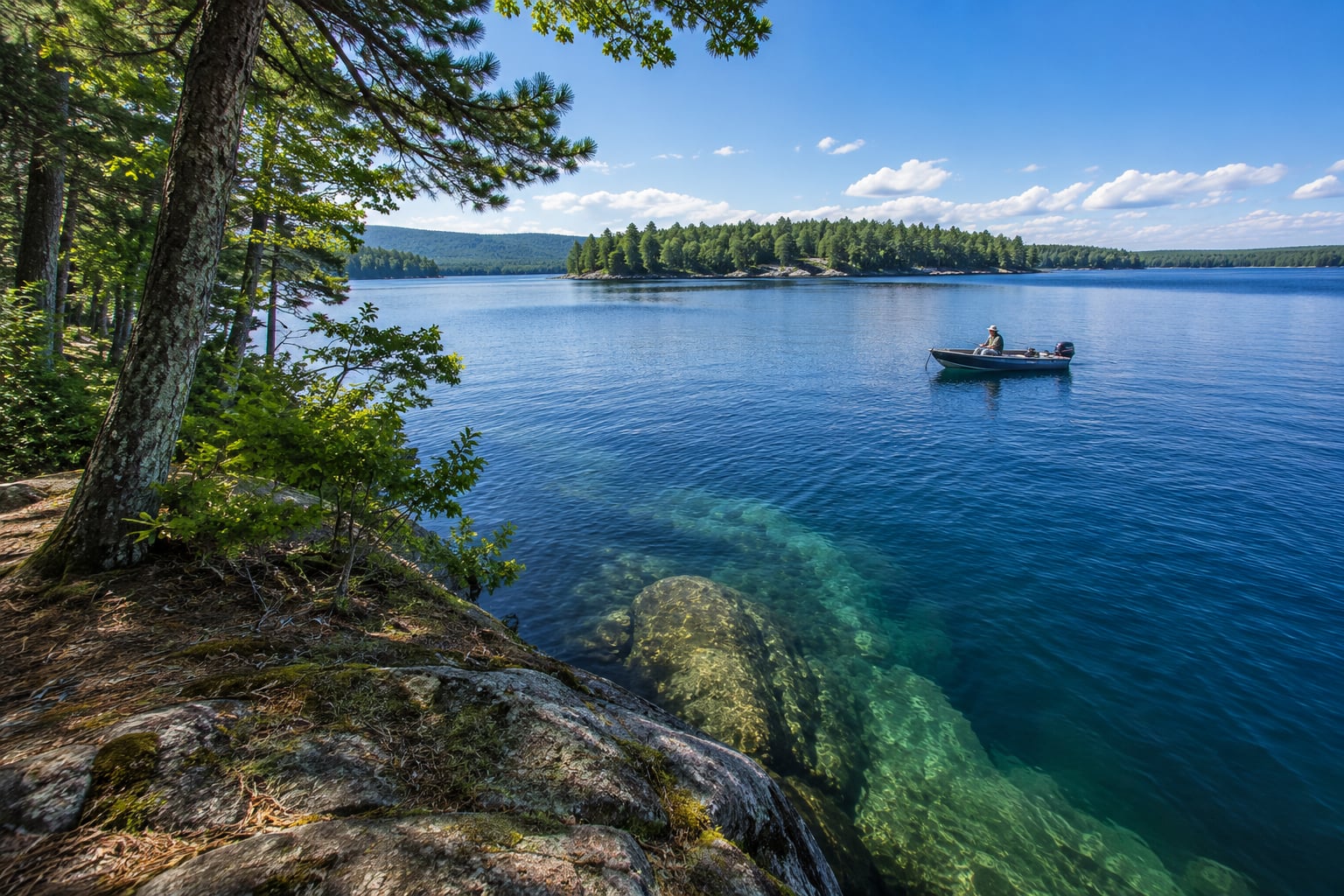
What depth to fish for bass in summer? On most U.S. lakes the answer is 10 to 20 feet, and on the deepest reservoirs it stretches to 25 to 35 feet. That range tracks the thermocline, the layer where warm surface water gives way to cold water below. Fish usually hold a foot or two above it. On lakes shallower than 15 feet, the whole rule flips and big bass stay in the shade at 3 to 8 feet all day.
That is the honest starting point, not a promise. Depth is a symptom. Temperature, dissolved oxygen, forage and barometric pressure decide where a bass is at any given hour, and they move.
Table of Contents
- What Depth to Fish for Bass in Summer?
- How Water Temperature Changes Bass Depth
- How to Find the Thermocline on Your Fish Finder
- Summer Bass Depths by Water Clarity and Weather
- Where Bass Are During the Summer Day
- How Lake Structure Changes the Best Fishing Depth
- What Depth to Fish for Bass in Summer: Lure and Presentation Choices
- How to Find the Right Depth Instead of Guessing
- Frequently Asked Questions
- Conclusion
What Depth to Fish for Bass in Summer?
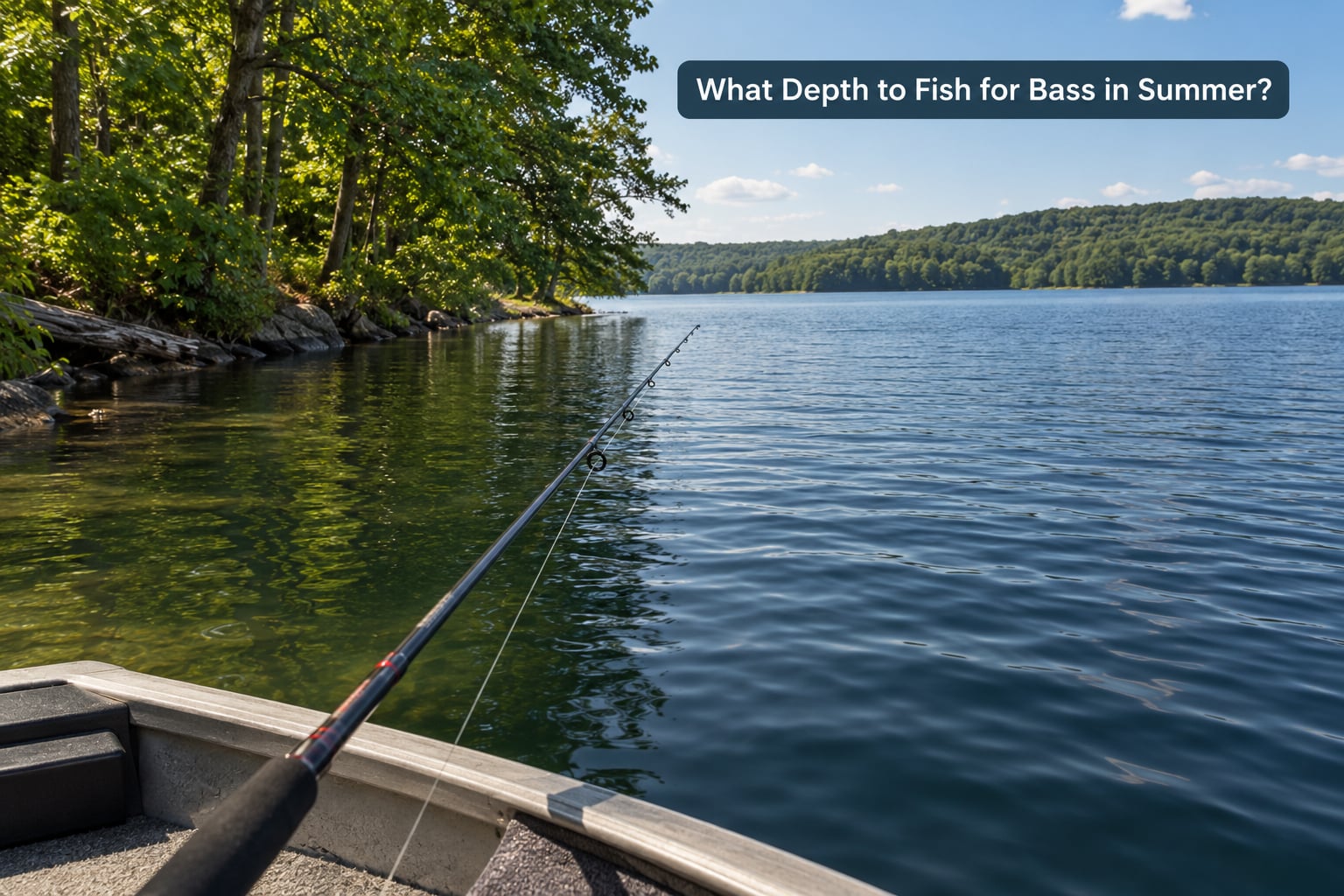
Start where the structure and the depth line up, and change one thing at a time. Here are the bands most anglers are working with through June, July, August and September.
- 0 to 5 feet. Best before sunrise through the first two hours of light, and again after sunset. Pitch a hollow frog or a popper over lily pads, moss, docks and grass edges in clear water.
- 5 to 10 feet. The most consistent band of the whole summer on shallow lakes. Grass edges, shallow points and the first step of a drop-off hold fish from early morning through late afternoon.
- 10 to 20 feet. The default summer band on reservoirs and most natural lakes. Ledges, channel bends and the upper third of a drop-off sit here, and this is where a big school usually sits in the heat of the day.
- 20 to 30 feet. Deep reservoir territory. Bump-and-run channels, deep bends and the lip of a deep ledge. Your electronics matter more at this depth than anywhere else.
- 30 feet and deeper. A summer visit, not a summer home. Deep lakes with healthy forage can hold a few early mornings and late evenings, but flat-out midday fishing at 35 feet is a tough way to spend a July afternoon.
The reason one number never holds all day is forage. Bass chase bluegill, crawfish and shad, and the bait is where the fish is. When bait moves shallow in the cool of the morning, bass follow it up. When the surface bakes and the bait drops into the shade of a ledge or into a cool seep, the fish go with it.
Water clarity changes the range more than most people expect. In stained water a fish sees six feet, so it does not have to be far from the structure it is hiding next to. In clear water it wants to be 20 feet away from the only thing worth hiding behind.
How Water Temperature Changes Bass Depth
The single word you need is stratification: as surface water heats through the summer, a lake splits into three distinct layers.
- The epilimnion, the warm top layer that mixes daily with wind and sun. In July and August it can sit in the low 80s or even the low 90s.
- The thermocline, a transition layer just below it where temperature falls off fast, sometimes several degrees in only a few feet. Fish find this layer and stop.
- The hypolimnion, the cold water at the bottom. Comfortable on temperature, poor on oxygen, because cool deep water holds little dissolved oxygen once the lake stops mixing.
Bass are cold-blooded, so water temperature sets their metabolism directly. Their comfort sits in the comfortable band near the thermocline, and they avoid the bottom layer because decomposing vegetation and algae keep drawing oxygen out of it. That combination of comfortable temperature and usable oxygen is the whole reason summer bass end up in a narrow ribbon of water rather than spread out across the lake.
Typical range: on most lakes deeper than 20 feet the summer thermocline sets up around 15 to 25 feet. Big deep reservoirs push it to 25 to 35 feet. It sits shallower in a shallow lake, and in a shallow lake there may barely be a thermocline at all because the whole column warms evenly.
Anglers argue about whether this is a real rule or a myth, and both camps have a point. One side puts the summer thermocline near 20 feet on most lakes deeper than 20 feet, making 15 to 25 feet the target. The other says there is no general depth where fish will be. Both are right, and the reconciliation is the whole point of this guide.
The thermocline sets a range, not an address. Where within that range the fish sit depends on oxygen, forage, clarity and the time of day. Treat the band as a starting zone, then hunt inside it.
How to Find the Thermocline on Your Fish Finder
On most units with a temperature sensor, the thermocline shows up as a thin band on the screen where the temperature line drops abruptly, often drawn as a firmer line running across the arch graph. Call it the hardline or the thermocline line. Once you spot it, note the depth and work a foot or two above it.
A classic tournament rule is worth memorizing: if the thermocline is sitting in 22 feet, start fishing 20 feet. It is the most useful single number on that screen. You are aiming for the warmest water that still holds enough oxygen, which is just above the layer where oxygen drops off.
Two caveats. A hardline that is one foot thick is not a real band, it is a sensor artifact from a rapidly changing layer, so look for a slower sloping transition. And on a windy morning after a front, the whole column may mix and the line disappears entirely.
Summer Bass Depths by Water Clarity and Weather
Read the water before you read the map. Clarity tells you how far a fish needs to be from cover, and weather tells you whether that fish is comfortable holding or pressing to feed.
| Water condition | Hot and stable | Overcast or rainy | After a cold front |
|---|---|---|---|
| Clear (you can see a fish 15 ft away) | 20 to 35 ft, tight to structure | 10 to 20 ft, more willing to move | Shallow to 12 ft, feeding hard |
| Lightly stained | 10 to 20 ft | 5 to 15 ft | Shallow to 10 ft |
| Heavily stained or murky | 3 to 8 ft, in the shade and in grass | 5 to 12 ft | 3 to 10 ft |
Heavy stain is the biggest adjustment most anglers miss. When you cannot see your own lure at arm’s length, a 15-foot cast to a grassy bank will beat a 25-foot cast to a bare ledge every time. Fish in murky water hug the shallow structure because the bait has no choice either.
Rain does two things at once. It darkens the water and cools the surface, and both push bass shallower and make them more aggressive on reaction baits. A falling barometer also tends to get fish feeding before the front arrives, which is the best window of the whole sequence.
Where Bass Are During the Summer Day
Watch one spot through a full summer day and the fish will move up and down it like an elevator. The depth change you make is often smaller than you think; the timing is what matters.
Before sunrise to 8 a.m.
Shallow and in cover. Fish the 2 to 6 foot range over lily pads, docks, grass and the tops of shallow points. Topwater and a light plastic on the first stop, then a spinnerbait or crankbait as the sun comes up.
8 a.m. to noon
The fish push to the coolest comfortable water they can find. On a clear lake that is often 15 to 25 feet on a ledge or the top third of a drop-off. On a stained lake it may be 5 feet, in the shade of a standing timber. Watch your temperature graph rather than the clock.
Noon to 4 p.m.
Hardest window of the summer. Most serious effort goes deep, to the upper channel bends and the deep ledge, where a deep-diving crankbait or a swimbait can reach a reaction bite. Grass edges at 8 to 12 feet still work on overcast days and whenever a front is close.
4 p.m. to dark
The shallow bite returns. Fish work back toward the 4 to 10 foot band as the water cools, and this is the best window for a bigger fish on a topwater frog or a spinnerbait with a Colorado blade worked slow.
After dark
Summer nights are productive precisely because the water never gets cold enough to shut the fish down. Target the same shallow spots you fished at dawn, with a frog, a popper or a slow creature bait. Many anglers call the night bite the morning bite with an extra two hours attached.
How Lake Structure Changes the Best Fishing Depth
Depth on its own does nothing. Depth plus a feature does everything. These are the structures worth running your numbers against.
- Points. The deeper end of a point usually lines up with the thermocline, so a point that runs from 4 feet to 24 feet gives you every band in one spot. Fish the mid-depth shoulder in the heat.
- Ledges. A ledge with 8 to 12 feet of drop is the classic summer bite. Bass sit just above the break, at the depth where they get shade without paying the full descent.
- Channel bends and channels. A river or creek channel often lines up with the thermocline by accident of geology. Fish the outside bend and the deepest point of the channel.
- Drop-offs. Work the top third, not the bottom. Bass rarely sit at the base in summer; they hover at the depth that matches the cool band.
- Creek channels in a reservoir. The cool water in the head of the creek is often several degrees below the main lake, and that temperature difference stacks fish in the mouth of the channel.
- Weed edges and submerged vegetation. In a shallow lake this is the entire summer map. The edge where the grass ends, at 5 to 10 feet, is where the forage gathers and where the fish hold.
- Boat docks. Shade, structure and access in one spot, and docks on shallow water run from 3 to 8 feet. Anglers who only fish main lake structure miss every big fish in town.
If your lake tops out under 15 feet, stop using reservoir rules. Anglers working 6 to 12 foot ponds report consistent catches on brush and docks with jigs and shallow crankbaits all summer long. Deep-water advice on water that shallow is useless.
What Depth to Fish for Bass in Summer: Lure and Presentation Choices
Match the lure to the band and the bite usually takes care of itself. A chart to keep in the boat:
| Depth band | Best presentations | How to work it |
|---|---|---|
| 0 to 5 ft | Hollow frog, popper, walking the bank | Crawl it over the pads, pause often, keep the rod tip high |
| 5 to 10 ft | Wobblehead, brush hog, shallow crankbait, spinnerbait | Drag it along the grass edge, then drop it just off the break |
| 10 to 20 ft | Jighead with a straight-tail worm, medium crankbait, dropshot | Sweep the ledge, then hold the bait in the strike zone for a reaction bite |
| 20 to 30 ft | Deep-diving crankbait, swimbait on a heavy jighead, leadhead | Bottom bounce or slow lift, stay tight and set the hook on the first swing |
| 30 ft and deeper | Deep crankbait, swimbait, heavy weight | Controlled drops, quiet boat, watch the screen for the school |
Deep water calls for a specific kind of patience. Bass hanging in a cold, oxygen-poor band are not hunting much, so the bite comes from a reaction lure that irritates or startles them. A deep crankbait worked into the school and then pulled free is a common summer trick precisely because the fish are not eating.
Shallow water rewards the opposite approach. A 9 inch plastic worked slowly into a grass edge in clear water gets eaten for structure reasons, not hunger, and the bite is usually soft.
How to Find the Right Depth Instead of Guessing
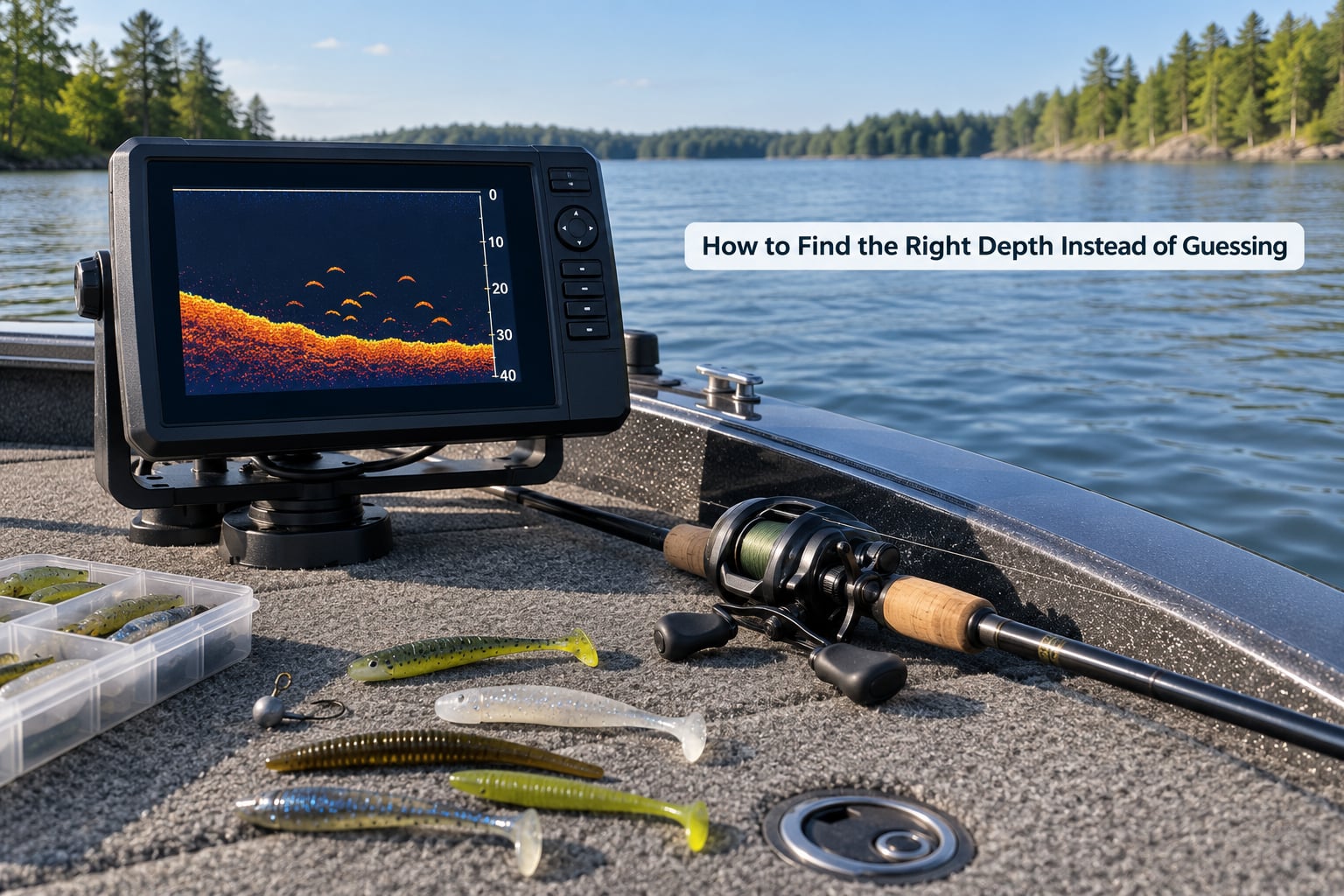
A repeatable process beats a lucky guess every time, and it is the fastest way to answer what depth to fish for bass in summer on water you have never fished before. Work through it in this order.
- Check the surface temperature first. Above 80 degrees and the fish are almost certainly looking for cooler water. Above 88 degrees and that becomes urgent.
- Read the map. Any bathymetric chart or app will show you the drop-offs, channels and creek mouths. Mark three spots with depth variety between them.
- Run the temperature graph. Cross your marked spots until the hardline shows up. Note the depth.
- Start two feet above it. If the thermocline is in 22 feet, start in 20. Work up and down from there in three-foot steps.
- Check dissolved oxygen if you own a meter. Water above roughly 5 mg/L is usable for bass. That reading tells you whether the deep band is alive or dead.
- Make controlled casts. Same bait, same retrieve, only the depth changes. You will know which band is holding fish within twenty minutes.
Without electronics, drop a weighted bait or a sinker and count the seconds until it reaches the lake bottom. Then subtract your known line and rod length. It is not fancy, and it is accurate enough to find a 5-foot ledge. Working the edge of a drop-off by feel alone also works, because the bite tells you where the break is.
Pay attention from the boat before you cast. A lake in the heat has visible seams: darker water, wind dimples, cooler seams, and birds working the surface. Seams between deep and shallow water are structure, and structure is where the depth changes fast.
Frequently Asked Questions
How deep will bass go in the summer?
Most summer bass hold between 10 and 20 feet on a typical lake, and between 25 and 35 feet on a deep reservoir. That range sits a foot or two above the thermocline, which usually sets up around 15 to 25 feet in midsummer. Fish will go deeper at times, but midday fishing at 35 feet is a tough way to spend a July afternoon.
How deep is the thermocline in summer?
On most U.S. lakes deeper than 20 feet, the summer thermocline settles somewhere between 15 and 25 feet. Deep southern reservoirs push it to 25 or 35 feet, while shallow lakes may warm evenly with no distinct thermocline at all. You can find it on a temperature graph as a thin line where the temperature drops fast.
Do you fish above or below the thermocline?
Above it, usually by about two feet. Water just below the thermocline holds the coldest water but the least dissolved oxygen, and bass will not sit in it for long. A commonly cited tournament rule is to start in 20 feet when the thermocline is at 22. Work upward from there as the fish and forage shift.
Should I fish deep or shallow in summer?
It depends on water clarity. In clear water, fish hold 15 to 25 feet from the nearest cover, so fish deeper structure. In heavily stained water they will lie in 3 to 8 feet of shade, grass and timber because the bait has nowhere else to go. Clear and cool conditions push fish shallow; hot, murky conditions do the opposite.
What depth do you fish for bass at midday in summer?
On a clear lake, 15 to 25 feet along a ledge or the upper third of a drop-off is the most common midday target. On a stained or shallow lake, drop to 5 to 10 feet and work grass edges and standing timber instead. Check your temperature graph rather than trusting the clock, since it moves faster than most anglers expect.
Will bass bite in 80 degree water?
Yes, but the window is narrow. Warm water slows a bass’s metabolism, so it feeds less often and less aggressively than in the spring. That is why summer anglers rely on reaction baits, deep crankbaits and swimbait at 15 to 25 feet rather than on a feeding bite. Go early, go late, and target structure rather than open water.
Conclusion
Start at the structure that matches the water you are looking at. On a clear lake, run the 10 to 20 foot band along a ledge or the top third of a drop-off and read the temperature graph to find the thermocline. On murky or shallow water, drop to 3 to 8 feet and work grass, timber and docks near the shade.
Make controlled casts, change only the depth between each one, and the lake will tell you which band is holding fish. When it does, mark it, because next month the answer will have moved a few feet.