To clean a boat to stop invasive species, remove every visible plant and animal, drain all standing water from the hull and compartments, then let the boat dry fully before it touches a different waterway. Most of the work takes 20 to 30 minutes at a ramp with a hose, and the hardest part is honestly the bits nobody thinks about: the trailer rollers, the transducer, the livewell drain, the motor’s cooling passages.
Zebra and quagga mussels hitchhike as microscopic veligers, roughly the size of a grain of salt, invisible to the naked eye. They attach to a wet hull, survive in damp gear for days, and colonize a new lake before anyone notices. Once established, they clog water intakes for towns, foul nets and boat bottoms, and cost agencies enormous sums to control.
Here is the sequence I walk anglers through, in the order that actually works at a launch ramp.
Table of Contents
- 1What You Need
- 2How to Clean a Boat to Stop Invasive Species, Step by Step
- 31. Find the Required Local Rules
- 42. Remove Aquatic Plants and Visible Debris
- 53. Drain Every Water Compartment
- 64. Wash the Boat, Trailer, and Fittings
- 75. Dry and Disinfect High-Risk Areas
- 86. Inspect and Document the Completed Cleaning
- 9Common Mistakes
- 10Prevention Tips for the Next Launch
- 11Frequently Asked Questions
- 12How long should a boat dry after cleaning?
- 13Can household soap be used to clean a boat for invasive species?
- 14How should livewells and bait tanks be cleaned?
- 15Can I clean my boat at home after returning from the lake?
- 16What should I do if I find attached aquatic plants or animals on my boat?
- 17Conclusion
What You Need
You do not need a decontamination trailer to do this properly. You need a few cheap items and about half an hour.
- A hose with a spray nozzle. Hot tap water where the local rules call for it, meaning at least 120°F and often 140°F for full heat treatment. A household water heater hose is the workhorse in cold states.
- A stiff brush or non-abrasive pad and a scraper. A plastic putty knife gets plant matter off the hull and trailer frame without scratching gelcoat.
- A boat hook or long pole. This is the tool that separates a decent cleaning from a good one. You cannot reach trailer bunks, rollers, and transducers by hand.
- Bucket, sponge, and rags. One bucket for clean water, one for dirty. Mixing them puts the contamination back.
- Gloves and eye protection. If you find an unknown attached organism, you do not want to handle it bare-handed.
- A dedicated drain plug key. Keeping it in the boat, not in the truck, is the difference between draining and intending to drain.
- Paper towels or a clipboard and pen. Or your phone. A written record of the cleaning date, waterbody, and inspector matters if the boat is towed through a state checkpoint.
Whatever soap or disinfectant you use, check your state agency first. Some require an approved product, some forbid anything that foams into the waterway.
How to Clean a Boat to Stop Invasive Species, Step by Step
Work through these in order. Skipping to the hose before you pull plants off the hull just spreads them around the ramp.
1. Find the Required Local Rules
Start at the state agency before you start spraying. Rules differ a lot between neighboring water bodies, and one lake inside an infested drainage will require certified decontamination that a friendly lake down the road does not.
Look up the waterbody you are leaving and the one you are entering, not just the state line. You want four answers: must the boat be inspected, must it be decontaminated, what is the required water temperature and dwell time, and how many days of drying are required or expected. Some watersheds with established zebra mussel populations run a staffed inspection station, and some states require a certificate that a technician issues after a hot water flush of the trailer and hull.
Boaters debate the exact numbers endlessly on forums, and the confusion is real. Some agencies call for 140°F for the boat, some accept 120°F, and the regulatory version is often written as 60°C. The safest read is the one written in your waterbody’s rule.
2. Remove Aquatic Plants and Visible Debris
Start dry and start with your hands off. Anything attached, peel it before you add water, because rinsing first just loosens the fragments and floats them down the ramp.
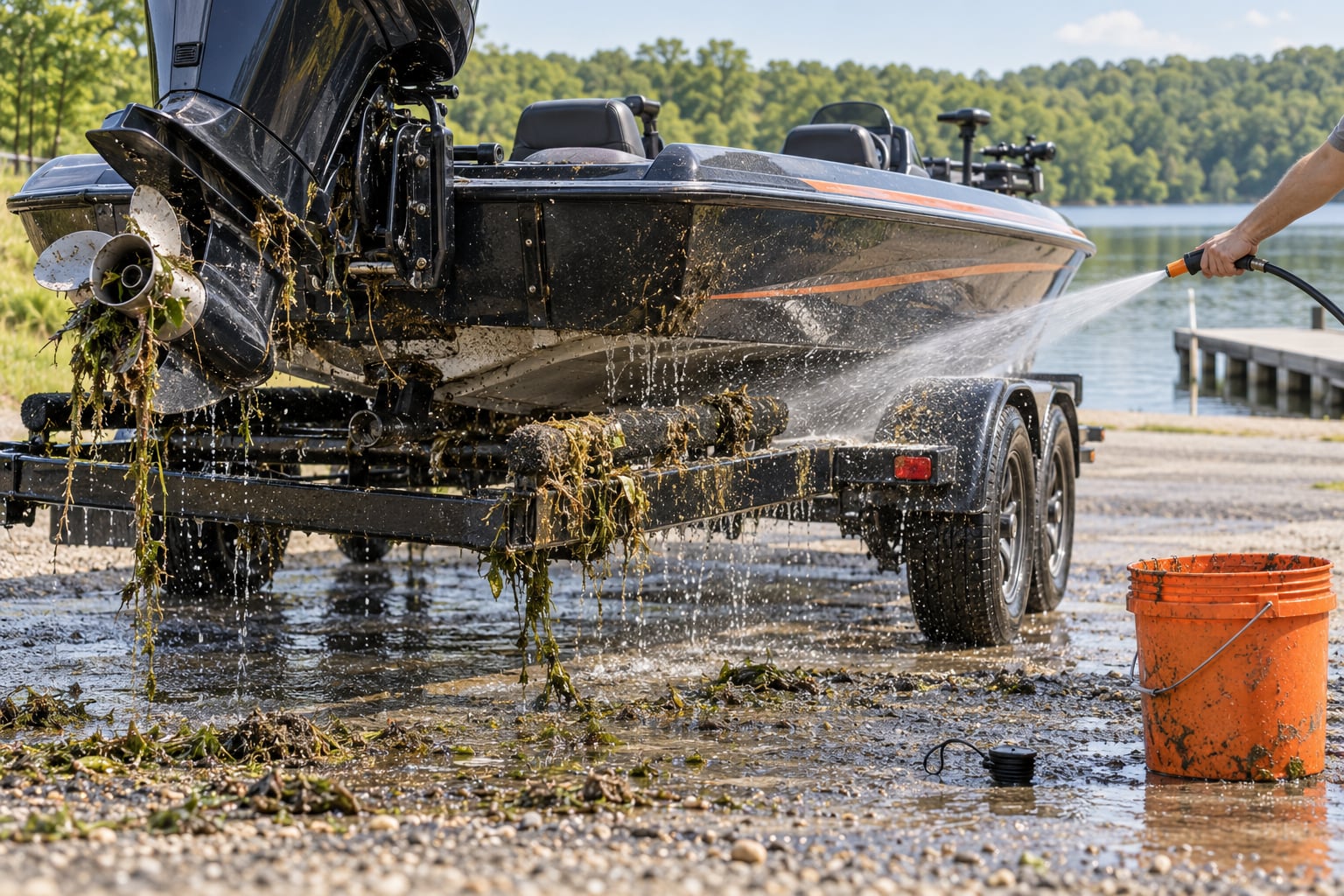
Work systematically across the hull, the transom, the trailer frame and tongue, the bunks and rollers, the fenders and boarding ladder, the trolling motor shaft and head, the outdrive or lower unit, the propeller, and the transducer. Pull anything green, brown, or slimy. Hydrilla grows in mats around bunks and can hold a dozen tiny animals inside it. Eurasian watermilfoil wraps in stringy streamers. Pulling the plant is what removes the animals sheltering in it.
After that, look at the boat hook list. Trailer bunk carpeting, roller shafts, the winch post, the spare tire, the dolly wheels, and the underside of the tongue bracket all hold water and debris. Fish hooks and scraps of tackle come off too, and leaving them behind invites the next car’s loose line tangles.
If you find mussel shells, egg masses that look like dark gelatinous dots, or an animal you cannot identify, note the location for a report rather than tossing it back.
3. Drain Every Water Compartment
Draining is the step that catches the invisible organisms. The veligers swim in water, so take the water away.
Remove every drain plug you can reach and put them in the boat, not back in the storage bag under the hull where they get reinstalled from habit. Then drain the livewell and its overflow, the bait tank, the bilge with the drain plate open, the sump, and any rod storage tube or locker that holds water. Lower the motor or outdrive fully so coolant and raw-water passages empty, which means many anglers pull the tilt and lower the drive as far as it will go.
There is a physical trick that works better than anything: park the trailer on a slight incline away from the water. Boaters on paddling and boating forums swear by it because pooled water in the lowest corner is exactly the puddle you forget.
How do you know it worked? Run a gloved hand along the bilge floor and the bottom of the livewell and feel for cold damp patches. Then look again. Water that has sat in a bilge behind a foam panel can hide for a week.
4. Wash the Boat, Trailer, and Fittings
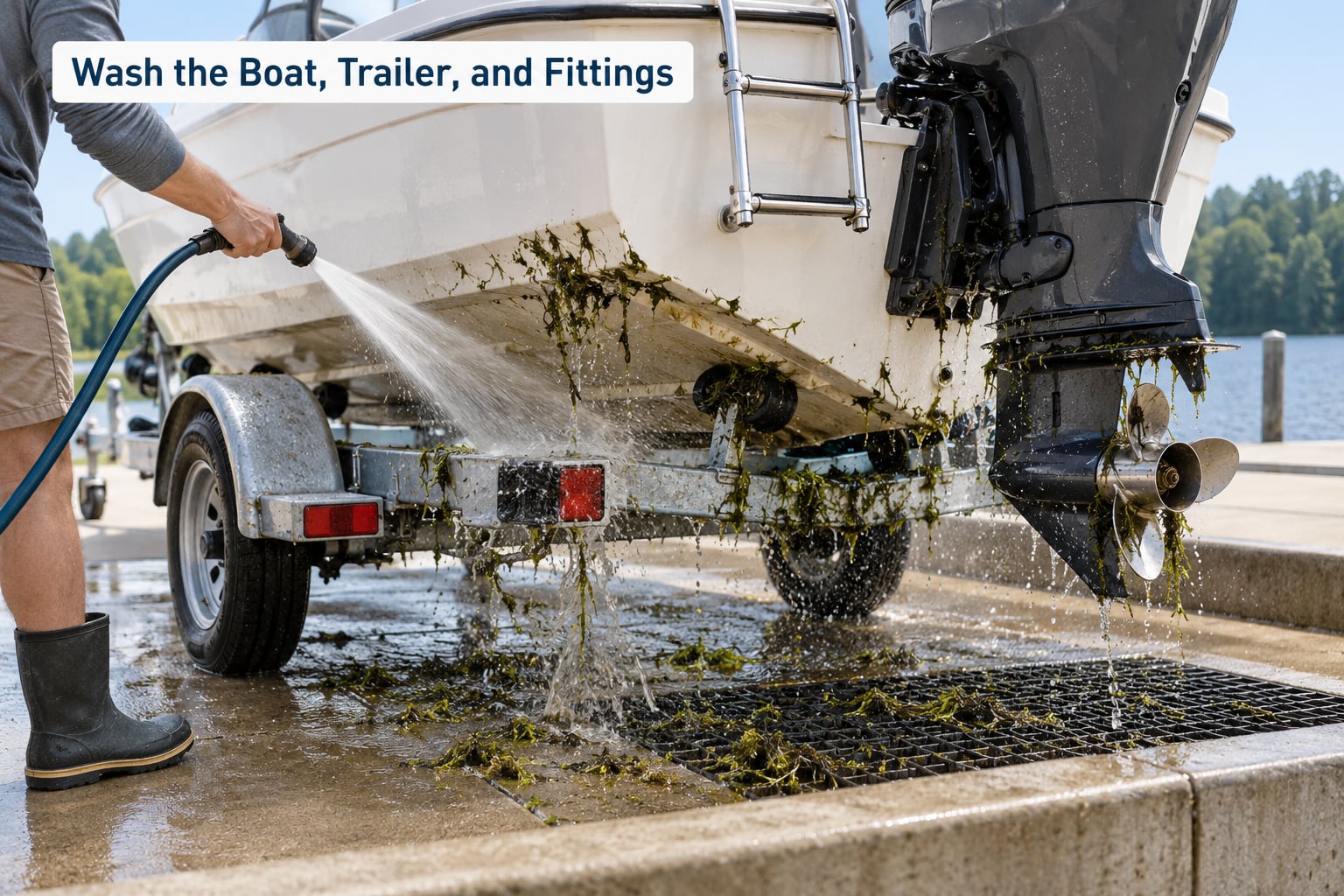
Rinse from the trailer and fittings toward the boat. The trailer sits lowest and touches the most water, and the motor hangs in the worst spot, so they go first, while the hull and deck go last.
Scrub as you spray, especially anywhere the surface is textured: the non-skid deck, the trailer carpeting, the roller shafts, the propeller and hub, and the raw-water intake screen. Hold the nozzle a few inches away rather than far back, so the water actually shears the material off. Hot water above the required temperature both loosens debris and kills attached organisms on contact.
Flush the motor’s cooling system with the lower unit tilted down, following the manufacturer’s procedure, and pull a plug from the raw water intake if the manual says to. Run the wash over the trolling motor, the anchor windlass, the boarding ladder, and every rope and fender that has been in the lake.
Rinse water carrying contamination goes into a contained runoff area, a bucket, or a drain away from the waterway. Never rinse a trailer full of lake water and plant matter straight into a boat ramp drain that empties into the lake you are trying to protect.
For soap, ordinary dish detergent and a hot rinse is fine for most routine cleaning, and household dish soap answers the question readers ask most. Bleach-based products are effective but corrosive to metals, hull coatings, and seals if left to dry, and some states restrict or prohibit them. If a waterbody requires an approved disinfectant, use that and follow the contact time exactly.
5. Dry and Disinfect High-Risk Areas
Drying kills what cleaning missed. Organisms that survive on a wet hull die once they stay dry, which is why a dry time, not a quick wipe, does the real work.
Five days of full air drying is the widely used guideline between separate water bodies, and hot, dry, breezy weather shortens it. The critical variable is the wettest spot staying dry for the whole period, not the boat in general. Those spots are the trailer tongue and roller ends, the carpeting on the bunks, the livewell corners, the hull below the waterline, the water intake, and any pocket that holds water under a seat or behind a panel.
Towel drying speeds the process up when you need to move the same day. Dry the surfaces thoroughly and park with the sun and wind on them, tilted if possible. Drying with a cover or tarp over a damp boat is the one thing worse than not drying, because you have sealed the moisture in.
Where disinfection is required, apply an approved product to the trailer tongue, rollers, livewell, propeller, hull, and intake areas, and keep it wet for the full contact time on the label. Then rinse as the label directs. Follow local directions rather than a generic internet recipe here.
6. Inspect and Document the Completed Cleaning
The final inspection is the step most people skip, and it is the step that catches the boat that is not actually ready.
Run your hand along the hull below the waterline. A gritty or rough patch means attached organisms, and it needs another wash rather than a pass. Check the trailer again with the boat hook, looking for plant fragments on the bunks and under the winch post. Confirm the bilge, livewell, and bait tank are dry inside, not just on top. Look at the propeller, the hull fittings, and anything with a seam or a bolt where a veliger can hide.
If an inspector came to you, keep the record. If you cleaned on your own, write down the date, the waterbody you came out of, the temperature you used, and who did the work. That is exactly what a checkpoint station asks for, and a phone photo of the timestamped note handles it.
Also check your drain plugs. Put them in the boat before you leave the ramp, not back in the storage bag, because leaving plugs in is the single most common thing an inspector flags.
Common Mistakes
Most spread happens through habits that feel responsible. Here are the ones I see most.
- Washing before draining. You rinse a bilge full of lake water, including veligers, down the ramp, and then drain what is left into a lake. Drain first, always.
- Rinsing into the waterway. Contaminated runoff at a ramp goes right back where it came from. Use a contained area or a drain that leads elsewhere.
- Using unapproved chemicals. Household bleach, ammonia, and degreaser can damage paint, electronics, and sealants, and some substances are restricted near water. Use what your waterbody specifies.
- Skipping the drain plugs and bilge. Plug in the bilge, never remove it, and assume nothing drains itself. If a boat sat overnight, water found a place you did not look.
- Launching before inspecting. A boat goes in wet, half-cleaned, or covered in a tarp that traps moisture. Inspect every time, not just the first trip of the season.
- Forgetting the gear. Waders, boots, nets, anchors, tackle boxes, and the boat hook all carry organisms. So do kayaks and paddleboards, even without a motor.
- Leaving bait and fish waste behind. Dispose of unused bait and dead fish in a trash can or as your state directs, not in the water and not in a different lake to use as bait.
Prevention Tips for the Next Launch
A routine beats a scramble. Pick a spot near your home where the trailer can drain, keep the hose and brush in the truck, and treat every return from the lake as a 30-minute job.
Clean, drain, dry, in that order, every single time, regardless of how clean the water looked. Keep your records. Give your local watershed group or state agency a call when you see something new, because early reports are what make containment possible, and a phone photo with a location is genuinely useful to them.
The same routine covers kayaks, paddleboards, and waders, which carry plants and veligers just as effectively as a trailer does. Rinse the hull and deck, drain any water held in the cockpit or deck pockets, wipe the paddle blades and leash, and let it dry before the next launch.
Frequently Asked Questions
How long should a boat dry after cleaning?
Five full days of air drying is the widely used guideline between separate water bodies, and several state programs accept it as sufficient on its own. What matters is that the wettest areas, the trailer tongue, roller ends, livewell corners, and hull below the waterline, stay dry the whole time. Hot, windy weather shortens it, and towel drying speeds up a same-day move, but a damp spot under a cover is worse than no drying at all.
Can household soap be used to clean a boat for invasive species?
For routine cleaning, ordinary dish detergent with a hot rinse works well on a boat hull and trailer frame, and many boaters use nothing else. Soap does not replace heat treatment, though. Water at the required temperature, often 120 to 140 degrees Fahrenheit, does the actual killing, and some states require an approved disinfectant with a set contact time. Bleach products corrode hardware and coatings, so check your waterbody rules first.
How should livewells and bait tanks be cleaned?
Drain the livewell completely, pull the plug and the overflow plug, and scrub the bottom and corners where debris settles. Rinse with hot water, then treat it with an approved disinfectant if your waterbody requires one and keep it wet for the label contact time. Do the same for the bait tank, and empty leftover bait in the trash rather than in the water. A damp livewell corner is a prime spot for veligers.
Can I clean my boat at home after returning from the lake?
Usually yes, as long as you do it before the boat gets wet again somewhere else, and as long as you keep rinse water away from any waterway. Park on a slope so the bilge and livewell drain onto gravel or a contained area, not into a neighbor’s lake or a storm drain that empties into one. If your state requires certified decontamination, home cleaning will not satisfy it and you need a station.
What should I do if I find attached aquatic plants or animals on my boat?
Do not throw it back and do not crush it where you stand. Pull the organism off, bag it if your state asks for a sample, and wash the whole area again with hot water until nothing comes off. Photograph it and note the exact waterbody and GPS coordinates, then report it to your state agency or the local invasive species coordinator. Leaving infested water with a visible organism attached is the worst case for a new lake, so wash before you do anything else.
Conclusion
Check the rules for both waterbodies first, then work the sequence without skipping: pull every plant and animal off while the boat is dry, drain the livewell, bait tank, bilge, sump, and raw water passages, wash from the trailer and motor up to the hull with water hot enough for your rules, and let it dry properly. Inspect with your hand and a boat hook before you launch, keep the drain plugs in the boat, and write down the date, the waterbody, and the water temperature you used.
That record and a rinsed-down trailer are how one trip stays one trip, instead of the reason a lake on the other side of the state has a new problem.