To know how to choose a lake house rental well, work through eight checks in order: define the trip, verify real water access, match size to your group, sort amenities by need, vet safety and reviews, then confirm total cost and house rules in writing before you pay. The whole process takes an evening of research and one message thread with the host.
The photos are the easy part. What trips people up is the gap between a listing’s word “lakefront” and the actual walk down to the dock. Second-guessing costs money, and a bad match costs a whole weekend.
Below is the process I use when a group asks me to help narrow lakefront listings. Eight steps, roughly in the order that saves the most wasted effort.
Table of Contents
- 1What You Need
- 2Step-by-Step: How to Choose a Lake House Rental
- 3How to Choose a Lake House Rental: Turn the Trip Into a Shortlist
- 4How to Compare Location and Lake Access
- 5How to Check Amenities for Your Group
- 6How to Review Safety, Cleanliness, and Reliability
- 7How to Confirm Costs, Policies, and Booking Details
- 8Common Mistakes
- 9Frequently Asked Questions
- 10What is the best time to rent a lake house?
- 11How far in advance should I book a lake house?
- 12What should I look for in reviews of a lake rental?
- 13Are pets usually allowed at lake house rentals?
- 14What if the lake house does not match the listing?
- 15Should I book on Airbnb, Vrbo, or with a local property manager?
What You Need
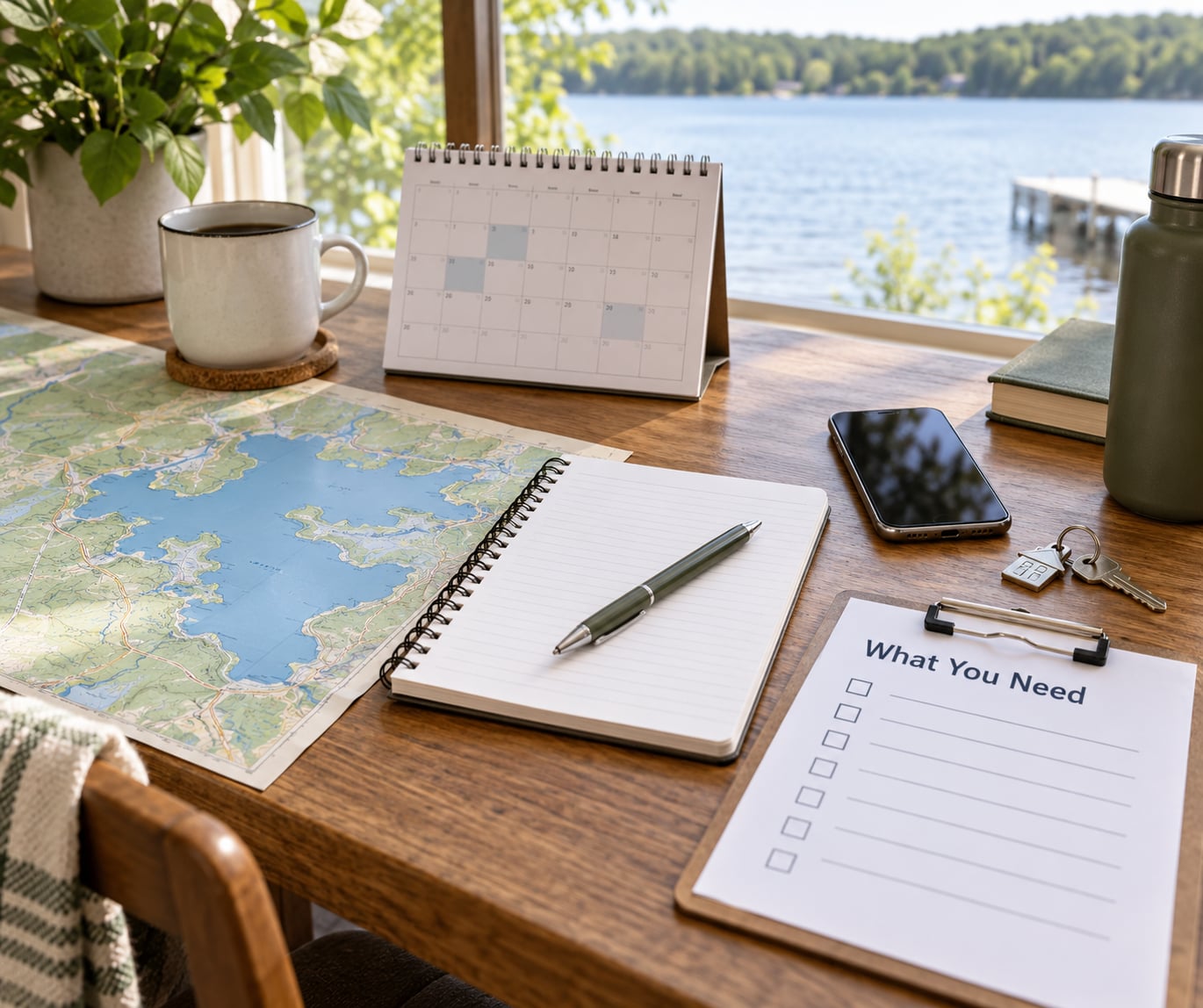
Gather these before you open a single listing. Without them, every property looks interesting.
- Trip brief — dates, nights, who is coming, and the one activity that has to work (swimming, fishing, a boat, quiet time with no kids).
- Group numbers — adults, kids by age, cots or pack-n-play needs, anyone with limited mobility, and pets.
- Budget ceiling per person — divide your all-in ceiling by group size before you look at nightly rates.
- Map access — Google Earth, Google Maps satellite view, and Street View for the shoreline and the road in.
- Question list — water access type, boat permissions, water level, road, check-in time, cancellation, fees.
- Three anchor activities — the lake, the trailhead, the town, each with drive time from the front door.
The budget-per-person step is the one people skip, and it is the one that keeps a $900-a-night dream house from feeling rational. Divide the ceiling by eight people and a nice place becomes a normal one.
Step-by-Step: How to Choose a Lake House Rental
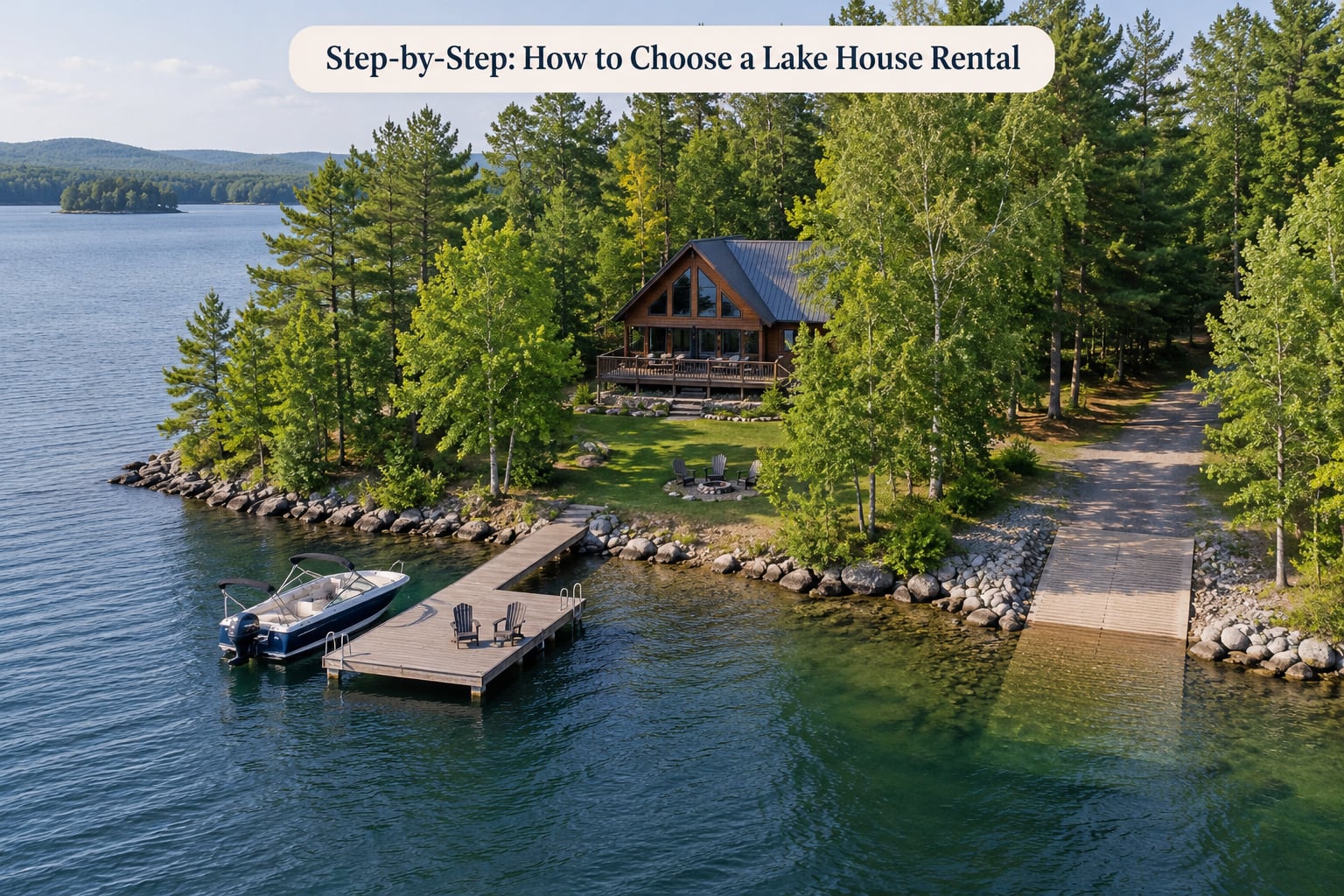
Here is the spine of the process. Each step has a checkpoint: if you cannot confirm the answer, that property probably does not survive the next step.
How to Choose a Lake House Rental: Turn the Trip Into a Shortlist
Start with constraints, not with browsing. Fix the date range, the group size, and the lake or region, then set three must-haves. A should-be on the water, a must-have kitchen for a week, no stairs for a grandparent. Everything else is negotiable.
With those fixed, build a shortlist of three to five listings instead of twenty tabs. Renters who check twenty homes end up booking the first one that looks good; renters who check five can actually compare. When a listing fails a must-have, delete it rather than saving it for later. You will not revisit it.
Season shapes the shortlist too. Peak summer inventory on good lakes is thin, so a flexible window of a few days widens your choices a lot. Shoulder months in fall are usually easier to book, cheaper, and quieter.
How to Compare Location and Lake Access
This is where most disappointment hides. “Waterfront” means a private dock or shoreline on the property. “Lake view” means windows facing water, which can be a quarter mile uphill through a neighbor’s yard. “Near lake” means you drive or walk.
Verify it yourself. Open satellite view and look for a dock, a shoreline path, or a shoreline boundary that touches the parcel. Look for a public boat ramp and how far the drive is. Check Street View along the access road to see whether it is paved, whether it floods, and whether there is a bridge that low water can close.
Then check the practicalities around the house: drive time to the nearest grocery store and gas station, how far the nearest hospital is, and whether cell coverage works at the house rather than only in the parking lot of the nearest town. Renters report cell service is the single thing most often assumed and least often verified.
Ask about water levels and the rules. Some lakes fluctuate a lot through a season, and a dock designed for full pool can be far from the water in a dry August. No-wake zones and posted speed limits affect noise, and a house on a busy channel is a different experience from one in a protected cove. Quiet hours and any association rules belong on this list, not as a surprise at check-in.
How to Check Amenities for Your Group
Do the bedroom and bathroom math out loud. Four bedrooms means four doors that close, and for a week with kids that matters more than square footage. Check the bathroom count against head count; two baths for six adults is a queue. Note where the beds are, since a loft bed reached by a pull-down ladder is a poor choice for a five-year-old or anyone with a bad knee.
Then match the rest to how you actually live there. A fully equipped kitchen saves money on meals and kills the trip mood otherwise. Heating matters more than air conditioning in shoulder season, and many older lake houses have one and not the other. Wi-Fi is worth confirming, especially if anyone is working remotely. A washer and dryer turns a seven-night stay into a one-load problem.
Outside, sort amenities by need: a private dock for a boating or fishing trip, a level lawn for a reunion, a hot tub for adults in shoulder months, kayaks and paddleboards if nobody wants to haul gear. Skip the game room if your group will not use it; it costs the same as a second bathroom and helps nobody. Check the pet policy in the rules rather than assuming.
How to Review Safety, Cleanliness, and Reliability
Read reviews as an inspector would, not as a mood board. Sort by most recent and most severe, then search the text for specific terms: cleanliness, dock condition, stairs, water depth, heat, hot tub, and how fast the host answered when something broke. A listing with two reviews from the same month tells you almost nothing. A listing with forty reviews across six years, including a few that mention a specific problem and how it was fixed, tells you plenty.
For water safety, ask what life-saving gear is on the property, whether a raft or swim platform exists, and what the water depth and drop-off are like near the dock. Children and strong swimmers are the ones to worry about on a lakefront property with an unguarded shoreline.
For reliability, message the host before booking with a real question. A fast, specific reply about lake levels or the road is worth more than a wall of praise. Note the check-in method and time, whether you will be driving in after dark, and whether the road is steep or unlit. Ask who handles emergencies after hours. Keep screenshots of the listing, the rules, and any written promises, because hosts and platforms edit their pages.
How to Confirm Costs, Policies, and Booking Details
The nightly rate is roughly half the story. Add the cleaning fee, any pet fee, taxes and platform fees, plus fuel, groceries, boat launch fees, and activity costs. Divide the result by group size to get a per-person number you can compare across listings. A higher nightly rate often wins once two families share a large house with a kitchen and a dock instead of booking two hotel blocks.
Ask for the full breakdown in writing before you pay anything, including the cleaning fee, the security deposit and whether it is refundable, the minimum stay, and the cancellation window. Flexible cancellation is worth real money on a lake booking, because weather and water levels change plans more often than people expect. Check for a turnover rule that blocks a one-night arrival right after a full week.
Finish with logistics. Confirm the check-in time and method, the number of keys or codes, parking limits, trash and firepit rules, what you must shut down, and the address you’ll actually navigate to. Then save the confirmation email with the final reservation details.
Common Mistakes
Choosing from photos alone. Listing photos are marketing shots, often with wide lenses. Scrutinize the exterior, the shoreline, and the road instead.
Accepting “near the lake.” A quarter mile with gear is a dealbreaker for most families. Ask for the distance in walking minutes and check it on satellite view.
Comparing nightly rates instead of per-person cost. Divide the all-in total by group size before you rank listings.
Skipping recent reviews. Old reviews describe a house and a host that may have changed. Weight the last twelve months most heavily.
Ignoring the rules until arrival. Quiet hours, hot tub curfews, no-cooking restrictions, pet limits and firepit restrictions are selection criteria. A rental that feels like a boarding school is not worth saving on.
Assuming cell service. Check coverage maps and read a review that mentions the phone signal before a remote trip.
Booking with a rigid cancellation policy for a weather-dependent trip. Lakes and weather change. Flexible terms cost more up front and less when plans shift.
Paying or moving off-platform before verifying. A host who asks for wire transfer, gift cards, or a message outside the platform is the strongest scam signal there is. Pay through the platform, which holds funds and gives you a dispute path.
Two smaller habits help. Ask the host directly whether they rent to large groups and whether the shoreline has any history of flooding, and get the answer in writing. And check whether a property manager manages the house; local managers usually know the lake’s rules, water levels, and ramp status better than any listing page does.
Frequently Asked Questions
What is the best time to rent a lake house?
Most families get the best combination of availability, weather and price in the shoulder months, roughly late September through October and again in May. Summer weekends in peak season sell out early and cost the most, but lakes are calmer then. Fall adds foliage and fishing, spring adds lower rates and mud. Pick based on the activity: boating needs open water and long days, fishing and hiking work well in fall.
How far in advance should I book a lake house?
For peak summer weeks, six to twelve months is a realistic window on a popular lake, and holiday weeks can go much earlier. Fall and winter trips usually need three to six months. Shoulder season can often be booked a few weeks out, though good properties still fill. If your dates are fixed, start looking at the shoulder of your window and be willing to shift a few days to land midweek.
What should I look for in reviews of a lake rental?
Search the reviews for specific complaints and specific fixes: cleanliness of the kitchen and bathrooms, the dock and stairs, hot tub and heating reliability, mosquitoes, road access, and cell signal. Recent reviews tell you more than old ones. A host who replies to a negative review calmly is a good sign. A listing with very few reviews, or only reviews from one month, tells you little.
Are pets usually allowed at lake house rentals?
It varies widely, and most properties charge a pet fee on top of the nightly rate. Filters help, but read the written house rules: some lakeside homes limit the number of pets, restrict them to the yard, or refuse them near the water entirely because of shoreline rules. Ask about cleanup expectations and whether the pet fee is per pet or per stay. Never assume a listing that shows a dog in a photo allows one.
What if the lake house does not match the listing?
Document the difference with photos and timestamps before you leave, and message the host and the platform the same day. Report it through the platform’s resolution process within the stated window, since evidence filed later is much weaker. Save your booking confirmation and the original listing screenshots, because pages get edited. A documented mismatch usually resolves into a partial refund or a relocation, but only if you file early.
Should I book on Airbnb, Vrbo, or with a local property manager?
Each has tradeoffs. Airbnb and Vrbo give you the widest selection and built-in payment protection, plus easy filters for water access, bedrooms and pets. A local property manager or a direct booking often means a better rate and local knowledge about ramps, rules and water levels, with less platform protection. Ask the manager about the total cost including any cleaning and service fee before deciding.
Start tonight: pick the dates and the group, then shortlist three lakes rather than three houses. Verify water access on satellite imagery, read the last twelve months of reviews, and get the full cost per person plus the cancellation terms in writing. If a property survives all eight checks, book it on a flexible window and save the confirmation.