To find a lake with a swimming beach, build a shortlist from a lake directory and map search, confirm a real beach or shallow shelf on satellite view, then check park agency pages, water-quality advisories, fees and access details before you drive. Six steps, about an hour of screen time.
Most people lose the search at step one. They type a lake name into a map, pick the closest blue shape, and arrive at a private pond ringed by houses, a boat-only access with a locked gate, or a drinking-water reservoir where swimming is posted as prohibited.
That failure is common enough that people notice it out loud. On an Ask MetaFilter thread about wild swimming, the person asking said he had not had a strong track record with just looking at a map and picking a spot. The map shows you where water sits. It rarely shows you whether you are allowed to touch it.
This guide gives you the screen work that comes after the map, so the drive is the last step rather than the first.
Table of Contents
- 1What You Need
- 2Step-by-Step: How to Find a Lake With a Swimming Beach
- 31. Start with a lake directory and map search to build a shortlist
- 42. Look for evidence of a real swimming beach, not just a shoreline
- 53. Check access, parking, and family-friendly amenities
- 64. Check water conditions, weather, and safety notices
- 75. Verify the swimming beach from recent local sources
- 86. Make a final check before swimming
- 9Common Mistakes
- 10Frequently Asked Questions
- 11How can I tell whether a lake has a swimming beach?
- 12What is a beach on a lake called?
- 13Should I rely on online reviews when choosing a lake for swimming?
- 14What information should I check before visiting a lake with a beach?
- 15How do I find a lake with parking, restrooms, and other family amenities?
- 16What should I do if a lake has a water-quality advisory?
- 17Conclusion
What You Need
Gather seven things before you start. Most are free, and all of them are public information that park and health agencies publish anyway.
- A map app with a satellite layer. Google Maps, Apple Maps or OpenStreetMap all let you switch from a road view to overhead imagery. The overhead layer is the one that shows a beach.
- A lake directory. A site that lists lakes by state and by swimming suitability beats a generic map search, because it filters out the private ponds and the boat-only water in the first pass.
- Your state park system website. State parks publish beach descriptions, sometimes counting them, and they name the operating authority for each one.
- Your county recreation or parks department site. County beaches are often the better family option because they are smaller and less crowded than the state park crowd.
- Your local or state health department water-quality page. This is where algae advisories and temporary swim restrictions are posted.
- The fee schedule for the agency that runs the beach. A free swim is not the same thing as a free admission, and parking is sometimes a vehicle entry fee even when swimming costs nothing.
- A backup list. Two good candidates instead of one, so a closed gate or a full parking lot does not end the day.
If you only do the first two, you will still find lakes. You just will not know which ones you can actually swim in.
Step-by-Step: How to Find a Lake With a Swimming Beach
Work through these six steps in order. Each one filters the list from step one, and by the end you should have two or three candidates worth the drive.
1. Start with a lake directory and map search to build a shortlist
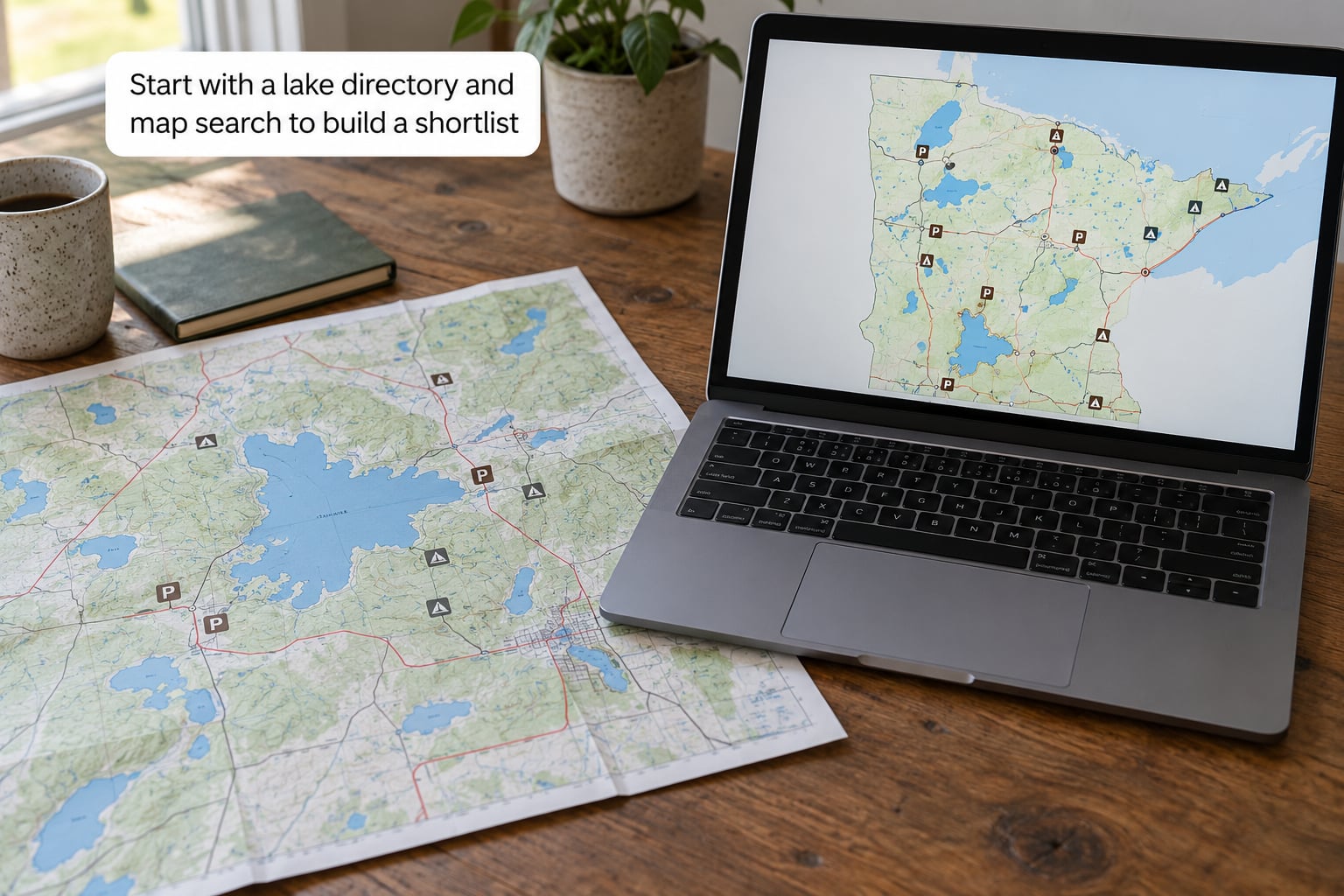
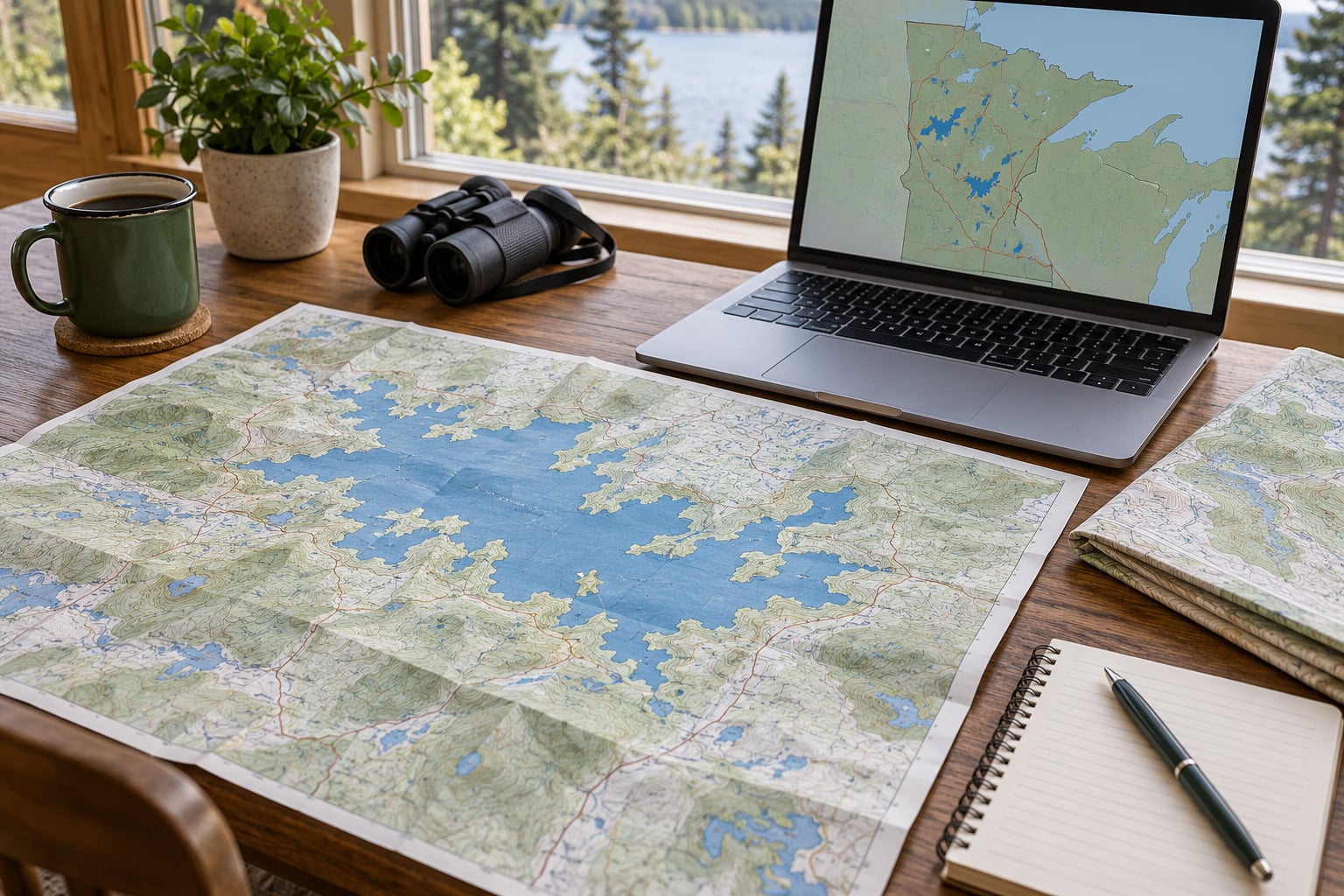
Open your directory and search by state, then filter to lakes and ponds with swimming access. Search by beach type as well: sandy beach, gravel beach, guarded beach, boat launch beach. A directory that lists swim beaches will hand you a shortlist in a minute; a plain map search gives you every puddle in a 40-mile radius.
Then put each candidate into the map app and pull back until you can see the whole lake and its road network. Drop anything that requires a long unpaved road, a private driveway, or a route through a gated community. People on swimming forums report driving an hour for a spot they could have reached in fifteen minutes.
You are looking for three things on this pass: a public road that ends at the water, somewhere to park a car, and at least one other sign of organised access such as a ramp, a picnic shelter or a restroom building.
| Search source | What it tells you | What it will not tell you |
|---|---|---|
| Lake directory | Which lakes have a swimming beach and how they are reached | Whether swimming is legal this week |
| Satellite layer | Whether a beach or shallow shelf physically exists | Fees, rules or water quality |
| State park site | Beach count, amenities, operating authority | Same-day algae advisories |
| County parks site | Family amenities, accessibility, meeting rules | Current conditions on the ground |
| Health department page | Advisories and temporary swim restrictions | Whether you can reach the beach |
| Community swim apps | Recent first-hand reports and photos | Fees, lifeguard schedules, anything older than a season |
No single source covers it. That is exactly why the method needs six steps instead of one search box.
2. Look for evidence of a real swimming beach, not just a shoreline
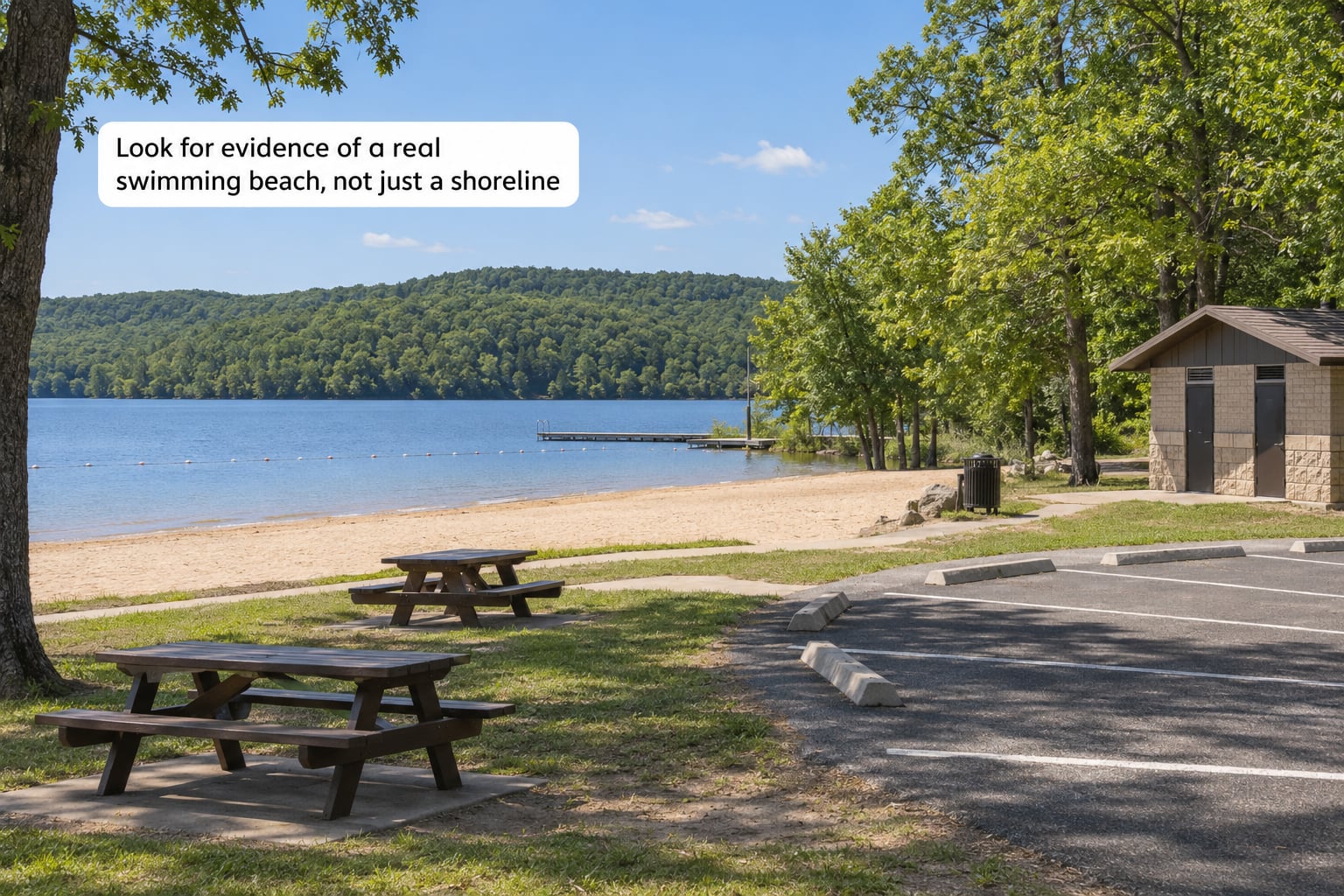
Most lakes have a shoreline. Very few have a beach. On satellite view, a real swimming beach shows as a pale tan or light grey patch that fans out into the water, with a soft edge and often a curve rather than a straight line. Shoreline that goes straight from tree line to dark water is usually a bank, a wall or riprap.
Zoom in and look for the entry shape. A wide, pale wedge that shallowly meets the water is a beach with a gradual entry. A hard edge or a dark line running parallel to shore often means a drop-off, which is the most common reason a good-looking lake gets ruled out for families with young kids.
Topographic and bathymetry layers help here. USGS and US Army Corps of Engineers lake sites publish depth contours for many reservoirs and larger lakes. If you can see a shelf that runs out gradually, you have found a swim beach even before anyone confirms it.
Also check what type of shoreline you are dealing with, because the entry changes what you bring and how careful you have to be.
| Shoreline type | Swim suitability | Entry | Crowd level |
|---|---|---|---|
| Sandy beach | Best for families | Gradual, wade-out entry | High on summer weekends |
| Gravel beach | Good | Gradual, firm underfoot | Medium |
| Rock ledge or shelf | Fair, deep quickly | Step in, then drop | Low |
| Boat-launch beach | Good but shared | Gradual, mixed with boats | Low after the ramp fills |
| Riprap or seawall | Poor | Sharp, immediate depth | None, rarely anyone swims |
| Quarry or gravel pit lake | Good water, serious drop-offs | Steep edge | Medium |
Someone who did this right usually leaves a shortlist of two or three lakes, not twelve. Narrowing early is what makes the rest of the steps possible.
3. Check access, parking, and family-friendly amenities
Now find out whether you can physically get to that beach. Open the agency page for the beach and look for the operating authority, because city, county and state beaches follow different rules. A county park beach might require an annual pass while the state park down the road is walk-in.
Read the access details closely. You are checking for parking, whether the lot is big enough that it fills by 11 a.m., whether there are restrooms, and whether the beach has an accessible route and accessible parking. Families planning a full day want a restroom more than they want a boat ramp.
Then confirm whether swimming is permitted at all. This is the step that catches drinking-water reservoirs, where swimming and body contact are prohibited because of the water supply, and private or community ponds where the shoreline belongs to residents. Both can look perfectly inviting from a satellite view.
Look for the words used in the agency rules. Designated swim area, bathing beach or swim beach all signal a place where swimming is expected. No swimming, body contact prohibited or no-wading sign a place where it is not. If you cannot find an explicit statement either way, call the ranger station or park office during business hours and ask.
Here is where the fee question gets settled. Swimming is usually free at a beach that is free to enter, but a vehicle entry fee may still apply at a state park, and some agencies charge separately for parking at a busy beach. The fee schedule on the agency site settles it in seconds, and guessing wastes a trip.
How it worked: you now know whether parking exists, whether there are restrooms, whether swimming is legal and whether anything is owed at the gate. If any answer is unclear, that lake moves to the backup list rather than the top of it.
4. Check water conditions, weather, and safety notices
Water quality is the thing you most want to know before leaving home and the thing people most often skip. State and county health departments post advisories when harmful algal blooms show up, which is common in warm, still, nutrient-rich lakes from midsummer into early fall.
Search for the lake name plus the state health department or water quality report. Check the current advisory and the date on it. A report from two summers ago tells you nothing about this weekend.
Weather matters for more than comfort. Afternoon thunderstorms over open water are a genuine hazard, and a forecast that turns stormy in the afternoon changes your plan. Wind picks up too, and on a lake with boat traffic a strong north wind pushes chop straight into a shallow swim beach.
Check the lake level as well. Drought years drop water levels and expose shoreline that used to be submerged, and rising levels can turn a gradual entry into a short drop. Both change what a beach looks like from the year a review or photo was taken.
Also read the posted rules for the specific beach. Some limit swimming to marked areas, some close the beach after heavy rain because of runoff, and some set hours around a marina or a boat channel. A rule you learned after you are already in the water is not much use.
How it worked: you have a current advisory status, a forecast you are comfortable with and a list of the rules that apply on the day you plan to go.
5. Verify the swimming beach from recent local sources
Now check whether the beach matches its description right now. Search the lake name with the word beach or swimming, then sort reviews by newest. Look for reviews and posts from the current season, not the top result, which may be four years old.
Recent user photos are worth more than recent words here. A photo shows the actual beach structure: sand, gravel, muck, or rock. In a local swimming forum thread about public access near Lakeland, someone pointed to Frostproof Lake Clinch as a sandy swimming spot with regular swimmers, which is exactly the kind of detail a county page leaves out.
Ranger and park updates are the other half. Seasonal updates usually cover water quality, shoreline erosion after a storm, beach renovations, and whether the lifeguard schedule changed for the season.
Now think about crowding, because a good beach at its worst hour is a bad afternoon. Locals consistently point at the same tactics: arrive before 10 a.m., go on a weekday, and look past the main park beach to the boat launch beach or a secondary access point once the lot fills. Smaller lakes also warm faster, which matters in the shoulder season when a large lake is still cold and a small one is already swimmable.
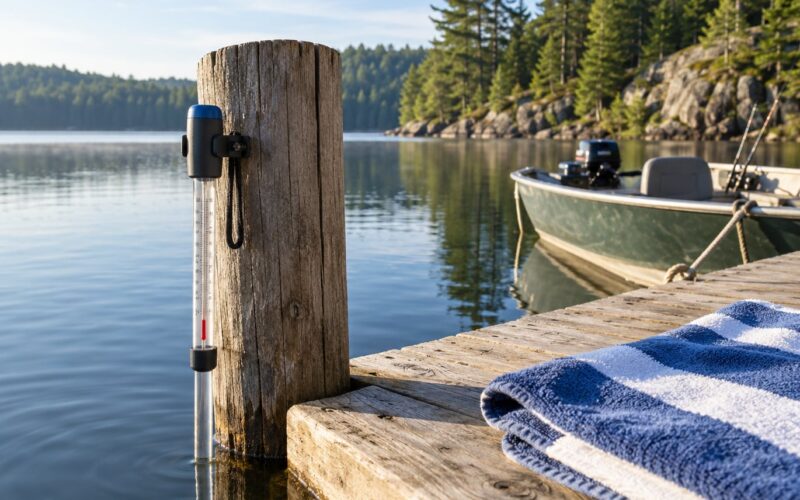
Before you commit, it is worth checking the water temperature. Surface temperatures in midsummer generally land in the following bands, and lake size and local climate move them around.
| Region | Typical July surface temperature | Swimming notes |
|---|---|---|
| Gulf and South Central states | Mid to upper 80s Fahrenheit and above | Warm most of the summer |
| Mid-Atlantic and lower Midwest | Upper 70s to mid 80s Fahrenheit | Comfortable in July, cool in May and June |
| Upper Midwest and northern New England | Upper 60s to mid 70s Fahrenheit | Warmest small lakes in July |
| Pacific Northwest and mountain West | 60s to low 70s Fahrenheit | High elevation lakes stay cold |
| Northeast and New England | Upper 60s to mid 70s Fahrenheit | Coastal water is colder than inland |
Elevation is the sleeper variable. A lake at 8,000 feet in the Rockies can read ten to fifteen degrees colder than a lake at sea level in the same week, which is why mountain swimmers talk about wetsuits rather than towels.
How it worked: you have two candidates confirmed by current sources, with the crowding plan, the temperature expectation and any recent change to the beach written down.
6. Make a final check before swimming
On arrival, park and look before you get out of the car. Walk to the water first and find the designated swimming area, because on a busy beach it can be a marked section well away from where you parked.
Watch the water and the shoreline for a minute. Look for anything unusual in colour or smell, an oily sheen, a green cast in shallow water, or foam collecting in a corner. Green water in a warm lake usually means an algal bloom, and that is your cue to get out and check the advisory rather than wade in.
Read the sign at the access point. It will usually state whether swimming is permitted, whether the beach is unguarded, and whether there are boat-launch hours or motorised water restrictions during swimming hours. Posted signage overrides anything you read online that season.
Then judge your group against the entry. A wide sandy entry that walks out gradually works for small children. A rocky ledge or a steep quarry bank does not, no matter how clear the water looks from the shore.
Unguarded water means the decision is yours. There is no lifeguard, so bring a personal flotation device for anyone who is not a confident swimmer, and stay close to shore if there is boat traffic in the channel nearby.
What to pack depends on the shoreline you identified. Water shoes for a mucky bottom, a towel for gravel that is rough on bare feet, a layer for the drive home, and a shade setup if the beach has no trees. Skip the expectation that a beach has a lifeguard unless the agency page says it does.
How it worked: you are standing at the water, you have read the sign, and the entry matches what your group needs.
Common Mistakes
These are the six failures that send people to the wrong water. Each one has a simple correction.
- Assuming every lakeshore is swimmable. A shoreline is a boundary. A swim beach is a designated place with public access. Correct: look for a beach on satellite view and confirm the designation in the agency rules before you load the car.
- Trusting a review from three summers ago. Beaches close, shorelines erode, parking lots get rebuilt and lifeguard schedules change. Correct: sort by newest and treat anything older than last season as background only.
- Overlooking access. A beautiful beach at the end of a private road is not a beach you can use. Correct: check the road class, the parking situation and who owns the shoreline before you leave.
- Ignoring posted warnings and advisories. A blue-green algae advisory is a health notice, not a suggestion. Correct: check the health department page and the sign at the access point on the day you go.
- Coming with only one plan. A locked gate at 9 a.m. ruins the day. Correct: keep a second lake within a 20-minute drive of the first.
- Going at peak hour on a weekend. The same beach that was excellent on a Tuesday can be unusable on a July Saturday. Correct: arrive before 10 a.m., or pick the second access point or boat launch beach instead of the main one.
One more habit worth keeping: write down the lake name, the access point and the date as soon as you confirm it. People who swim regularly at more than one lake stop losing track of which boat ramp went with which lake, and the next trip starts from scratch.
Conditions and rules change with the season and with the water level, so a spot that worked last August deserves a fresh check before the next trip.
Frequently Asked Questions
How can I tell whether a lake has a swimming beach?
Switch the map to satellite view and look for a pale tan or grey patch that fans out into the water with a soft, curved edge. That is sand or gravel. A shoreline that runs straight from tree line to dark water is usually a bank or riprap. Then confirm on the county or state park page that the beach is named as a swim beach, because the visual alone does not tell you whether swimming is permitted.
What is a beach on a lake called?
The usual terms are swim beach, swimming beach and bathing beach. A designated swim area is the marked section inside a larger beach, often separated from the boat channel. Some agencies call them swimming areas or beaches rather than swim beaches, so searching both terms surfaces more park pages. Regional tourism sites often just say beach under the park name.
Should I rely on online reviews when choosing a lake for swimming?
Use them for beach structure and current conditions, not for the final call. Recent photos tell you whether you are looking at sand, gravel or rock, and recent posts reveal algae, erosion or crowding. They will not tell you whether a vehicle entry fee applies or whether the lifeguard schedule changed, so confirm those on the agency site the same day.
What information should I check before visiting a lake with a beach?
Check four things: whether swimming is permitted, whether a vehicle entry fee or parking fee applies, whether a health department advisory is active, and whether the beach is guarded or unguarded. Add the forecast and the lake level, since both change what the entry feels like. All of it is published on the operating agency’s site or the state health department page.
How do I find a lake with parking, restrooms, and other family amenities?
Start with county recreation departments rather than state parks, because county beaches are usually smaller, closer and less crowded, and their pages list restrooms, accessible parking and play areas in detail. Then confirm the parking lot size in satellite view. A lot that looks full in summer imagery will be full by 11 a.m. on a Saturday.
What should I do if a lake has a water-quality advisory?
Follow the advisory rather than judging the water yourself. Blue-green algal bloom advisories usually mean avoiding contact with scummy water and keeping pets out of it, and they apply to shoreline areas as well as open water. Pick a different lake from your backup list, and recheck the advisory a few days before you plan to swim in case it has been lifted.
Conclusion
To find a lake with a swimming beach, work the screen before you work the road. Start with a lake directory and a map search to build a shortlist, check satellite view for a real beach and a shallow entry, then confirm access, parking, restrooms, swimming rules, fees and any active water-quality advisory. Pick the quieter candidate, arrive early, and read the sign when you get there. Start your search with your state park and county recreation pages, since those three checks kill more bad candidates than everything else combined.
Sources and verification: information in this guide points to public agency sources rather than opinion, including state park system pages, county recreation department sites, local health department water-quality reports, and USGS and US Army Corps of Engineers lake data. Conditions change with weather, water level and season, so recheck before every trip.