What to check before renting a pontoon comes down to three things: confirm you are legally allowed and financially covered to run the boat, document its condition and safety gear at the dock, and match the lake and weather to the people on board. Most rental disputes trace back to a scuff or a missing life jacket nobody wrote down.
The whole process takes about 15 minutes on the dock and 10 minutes at the booking desk. It fits neatly into three stages: before you book, at pickup, and before you cast off.
If you have never driven a boat, pontoons are the forgiving place to start. Two wide pontoons under the deck make them stable at low speed, slow to respond, and hard to roll over. That is exactly why first-timers land on them, and why a proper handover matters more here than on a deep-V runabout.
Table of Contents
- 1What You Need to Check Before Renting a Pontoon
- 2Step-by-Step
- 31. Confirm the Reservation and Rental Requirements
- 42. What to Check Before Renting a Pontoon: Hull, Deck, and Seating
- 53. Check the Motor, Steering, and Battery
- 64. Verify Life Jackets and Emergency Equipment
- 75. Understand the Lake and Weather Conditions
- 86. Review the Price, Fuel, and Damage Policy
- 97. Complete a Pre-Launch Test and Return Plan
- 10Common Mistakes
- 11Frequently Asked Questions
- 12Do I need a boating license or safety card to rent a pontoon?
- 13How many life jackets come with a rented pontoon?
- 14What is the 1/3 rule in boating?
- 15Can I take my 2 year old on a rented pontoon?
- 16Do you tip boat rentals?
- 17What happens if I damage a rented pontoon?
- 18Conclusion
What You Need to Check Before Renting a Pontoon
Bring these to the dock and the inspection takes minutes instead of an hour. Most of it is proof of who you are, plus a short gear list.
- Photo ID and the physical payment card the deposit will be held on. A virtual card that shows a different name than your ID is a common reason for a hold being declined at the ramp.
- Your state boating safety card, if your state requires one for operators born after a certain year. Florida issues a Boating Safety Identification card and allows a 90-day temporary certificate. Other states use different names and different birth-year cutoffs, so check your own state agency before you drive to the lake.
- The reservation confirmation with the boat length, pickup slip, dock address and after-hours number.
- A charged phone plus the rental company’s number saved in case something goes wrong on the water.
- A person on shore who knows your route and your return time. This is the float plan, and it is the single most useful thing you will do all day.
- Soft-soled shoes, sun protection, water and a waterproof phone case. Deck shoes with hard soles are the leading cause of slips on a wet pontoon deck.
- A saved copy of a dock-side checklist so you are not relying on memory while a staff member waits.
Skip the food and cooler debate until after the walkaround. Unloading gear early is how people step on a wet deck in socks and end up going in the water before the motor has even started.
Step-by-Step
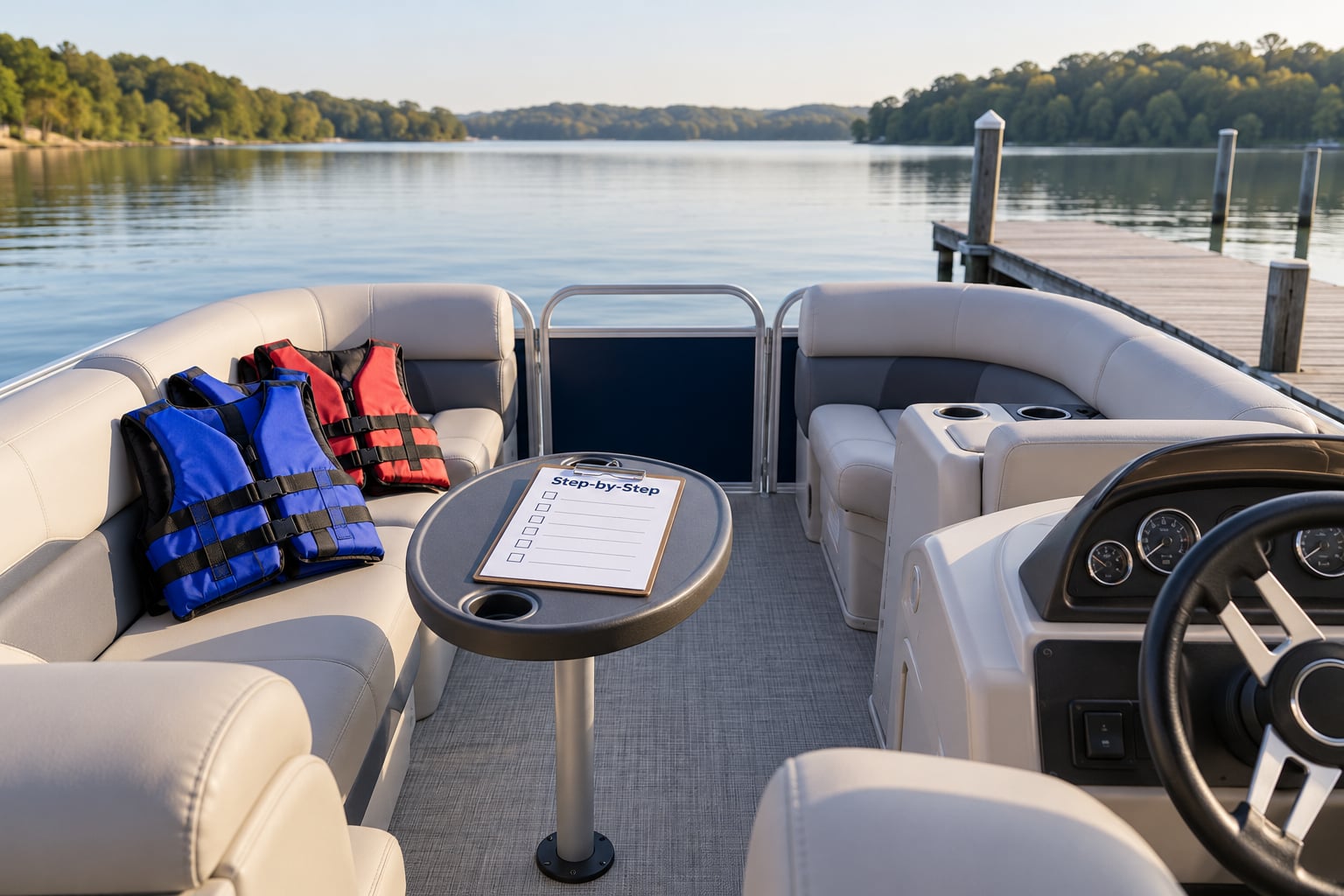
Renters catch most problems in seven steps, in this order. Do not start the engine until steps 2 through 4 are done, because the boat may move while you are walking it.
1. Confirm the Reservation and Rental Requirements
Check that the boat you booked matches the people you actually have. A 16 to 19 foot pontoon with a capacity plate for 8 to 10 people will not safely carry a 12-person group, no matter how much deck space it appears to have.
Confirm five things before you hand over a card: boat length and rated capacity, rental duration and any hourly minimum, pickup and drop-off location, minimum age, and who counts as a captain if you have more than one adult.
Read the cancellation and weather clauses at this stage, not at the counter. If the trip gets rained out, some operators offer a make-up day and some treat it as a forfeiture. Knowing which one applies to you decides whether a forecast change is worth calling them about.
2. What to Check Before Renting a Pontoon: Hull, Deck, and Seating
Start at the dock ladder and work clockwise, running your hands along everything. What you are hunting for is punctures, lifting seams and looseness, not cosmetic scuffs.
On the pontoon tubes and logs, look for cuts, chafe marks, bulges, seam tape lifting at the corners and any section sitting lower than the others. A soft spot under your palm means a leak that grows the longer you run.
On the deck, check carpet and vinyl for tears, bubbles, delaminating edges, exposed or raised fasteners, and standing water that has not drained. Bridge rash and rust at the carpet seams show up on older decks and tell you the boat has been outside a long time.
Now squeeze the railing, test each gate latch and pull every handhold. Then check the swim ladder mount, the bimini frame struts and the canvas for tears, and the table mounts, seats, fishin seat and rod holders. A seat bracket that moves under weight is a loose fitting coming off later.
Photograph all of it before the motor runs. Wide shots of each side, close shots of anything already marked or dented.
3. Check the Motor, Steering, and Battery
Confirm the engine starts clean, shifts smoothly and steers with no pull before you leave the slip. Run it only with the staff’s permission and with the boat clear of the dock and other boats.
Check that the kill switch lanyard is attached and clips on properly. This is the engine cut-off switch, and it is the item that saves lives when someone falls overboard and cannot be found quickly. If a boat operator loops it around a wrist or a fixed rail instead of wearing it, the kill switch does nothing.
Look at the gauges, the trim position, the depth finder or chartplotter, and confirm the bilge pump switch works. Note the fuel level and the engine hours; engine hours tell you how hard the motor has been worked, and the fuel gauge is your first clue about the fuel policy in practice.
Look under the engine cover for fresh oil, coolant or a weeping fuel line. If there is a puddle in the bilge when the boat is cold, ask for a different hull.
4. Verify Life Jackets and Emergency Equipment
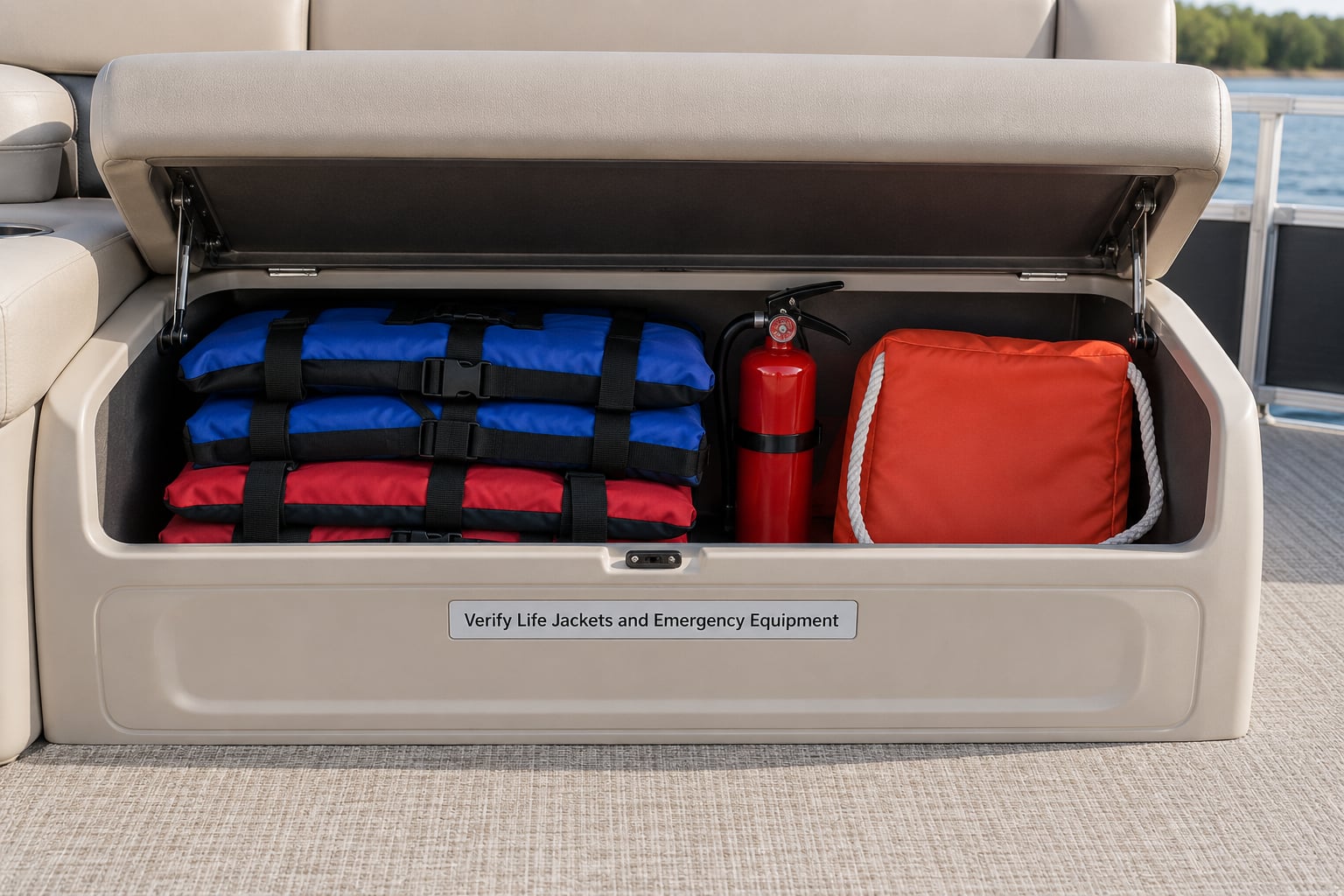
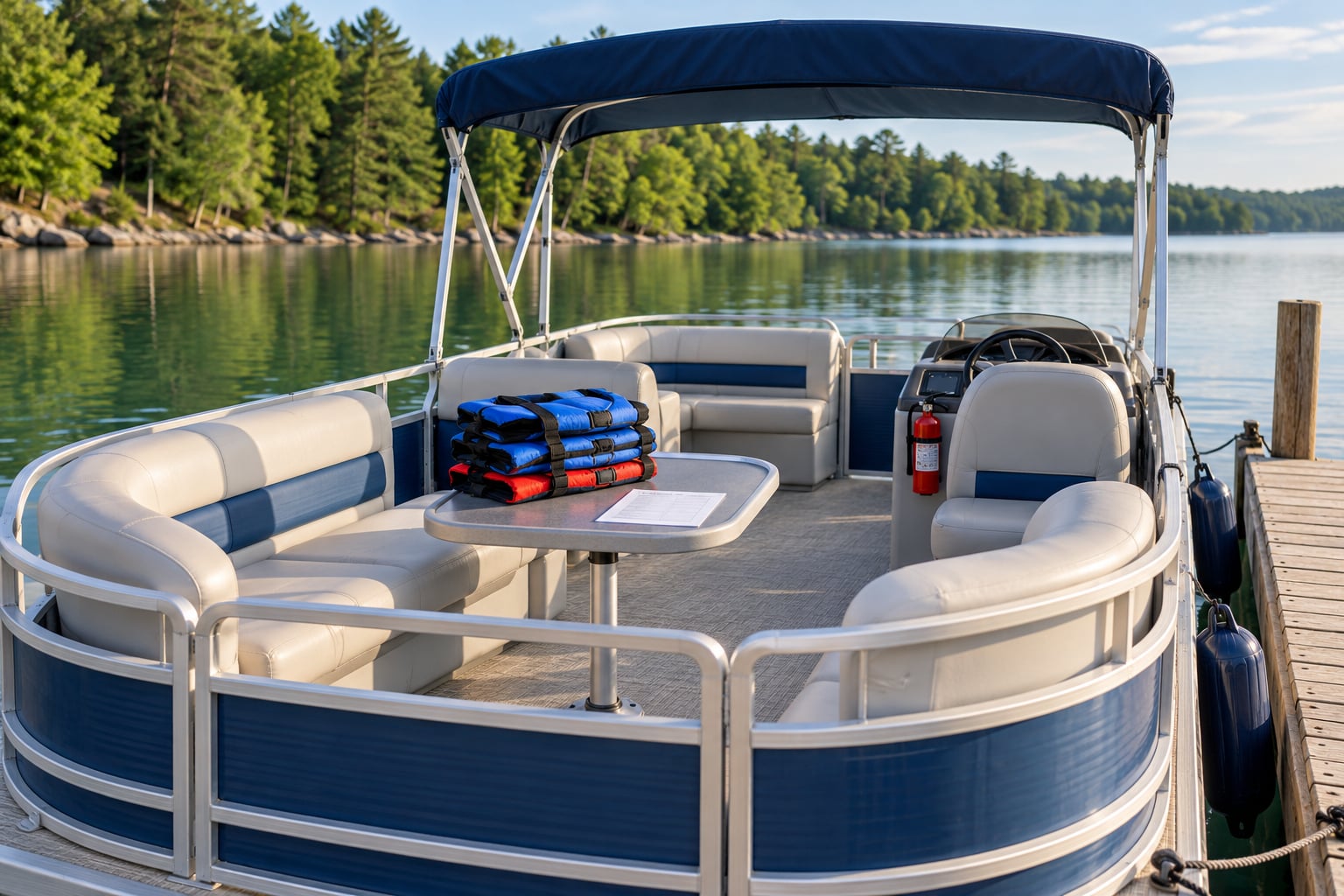
Count the life jackets against the capacity plate, then check the sizes. A correct count of one USCG-approved PFD per person, in adult and child sizes, with working buckles and crotch straps, is the minimum acceptable handover.
Try one on before leaving the dock. Adults should be able to pull the shoulder straps tight enough that the jacket does not ride above the chin, and child jackets need the crotch strap or grab loop fitted so the child cannot slip out of it.
Then verify the rest of the required kit: a throwable flotation device, a fire extinguisher with a readable gauge in the green, a horn or whistle, an anchor with enough line to hold in the lake you are on, a first aid kit, and navigation lights that the staff confirms have been checked.
Ask where emergency contacts are written down and where the throwable lives onboard. Gear on a rental boat is often well labelled, and knowing the layout before you need it is the whole point.
5. Understand the Lake and Weather Conditions
Match the lake to the boat, the group and the driver’s experience. A pontoon is stable but wide, slow to turn and impossible to stop quickly, and that combination rules out some water entirely.
Check the forecast before you leave the dock and again before you leave the cove. On most lakes, morning is calmer and afternoon wind is the norm, with thunderstorm risk peaking later in the day. Look up local marine warnings, not just a phone weather app.
Confirm water level and current, and find the no-wake zones, launch rules and any local restrictions on where you can be. Shallow areas and dam spillways change shape with water level, and a rental boat rarely carries a detailed chart.
Decide your route out loud to your shore contact, include landmarks, and set a turn-around time that is earlier than you think you need.
6. Review the Price, Fuel, and Damage Policy
Get the total in writing before you sign, not a verbal assurance. The three things renters most often conflate are the deposit hold, the renter liability gap and the damage waiver, and each one works differently.
The deposit hold is a temporary freeze on your own card. It is not a charge, but it can trigger an overdraft fee and it stays held after the boat comes back, sometimes for several business days.
The renter liability gap is what you personally owe if you cause damage. Most rental company liability policies cover the boat, not the renter, which means you are exposed unless you buy the damage waiver, a daily fee that reduces your share of the cost to a stated deductible.
Read the fuel clause carefully. Full-to-full with a nearby dock you can refuel at is the cheapest arrangement; pre-paid or refill-fee policies cost more and sometimes leave the vessel short for the next renter.
Ask about the extras too: tow bar and tube rope, water toys, a second captain, cleaning fees, late-return increments and hourly minimums. Then divide the total by the hours you will actually use the boat. That real hourly figure is what tells you whether a full day or a half day makes more sense.
7. Complete a Pre-Launch Test and Return Plan
Do the final check with everyone in their seat, not before. The capacity plate gives a maximum passenger count and a total weight limit, and you need both numbers in front of you as people climb aboard.
Hand each person a life jacket and fit the children yourself. Clip the kill switch lanyard to the operator and leave it clipped for the entire outing.
Run the boat slowly out of the slip, away from the dock and other boats, and practice three things before anyone is nervous: forward and reverse with a pause between, a slow turn in each direction, and stopping from planing speed. Throttle and steering on a pontoon respond gradually, and that feels like lag until you know it is just a big boat.
Agree on the return plan before you leave. Note the fuel gauge reading, take a timestamped photo of the hull and deck again, confirm the return time and dock, and put trash in a bag rather than leaving it aboard. When you hand it back, walk it with a staff member and photograph the same angles.
Common Mistakes
Almost every complaint from a first-time renter traces to one of these. Each has a fix you can apply at the dock in a few minutes.
Rushing or skipping the walkaround. The most common thread in renter advice is that people who rush the inspection regret it later. Book the rental with a little buffer in the morning, and ask for the walkaround even if the line is long.
Assuming everything is included. Life jackets, an anchor, the tow bar, the tube rope and the paddle are not always onboard, and cooler space is limited. Ask which of those items are on the boat before you load the car.
Ignoring the capacity plate. People are measured by weight on a capacity plate, not just by seat count, and a pontoon loaded with adults and coolers can sit deep and handle badly. Leave a cushion of capacity below the plate number.
Failing to photograph existing damage. Take the pictures, then have staff mark every scuff and dent on the agreement before you sign. Verbal assurances do not survive a dispute.
Signing without reading the fuel and damage clauses. Read them at the desk with your own glasses on. If the deductible and the fuel policy are unclear, ask until the answer is specific.
Ignoring the child PFD rules. Several states require a wearable life jacket for young children at all times, on shore or in the water. Know the rule for your state before the kids are aboard.
There are also conditions worth declining outright. Walk away or switch boats if the handover is skipped, the safety gear is incomplete or wrongly sized, the existing damage will not be written down, the fuel policy stays vague, or no one will explain who is liable for damage. A five-minute delay at the dock is a good trade for a boat you cannot verify.
Frequently Asked Questions
Do I need a boating license or safety card to rent a pontoon?
It depends on your state and your birth year. Many states require a boating safety card for operators born after a set date, and some issue a temporary certificate valid for a limited period so first-time renters can go out immediately. The rental company usually checks the card at the counter, so confirm the exact card name and age rule with your state agency before you travel.
How many life jackets come with a rented pontoon?
A well-run rental carries one USCG-approved PFD per person on the capacity plate, in adult and child sizes. Verify the count and the sizes at the dock rather than assuming, and fit children before the boat leaves. Buckles, crotch straps and inflation tabs all get tested by renting families at some point in the summer.
What is the 1/3 rule in boating?
The 1/3 rule means you start with a full tank, use about a third going out, keep a third in reserve for the return, and still arrive with a third remaining. On a rental, confirm the refuel policy first, because some boats leave the dock half full regardless of the gauge. Running the reserve down on a lake full of coves is how days end badly.
Can I take my 2 year old on a rented pontoon?
Usually yes, with a properly fitted child PFD and close supervision. Several states have always-wear rules that require a wearable life jacket for children under 6 whether they are on the boat, at the dock or in the water. Test the jacket fit onshore, keep the child off the swim ladder unsupervised, and decide early whether a boat is the right day for a toddler.
Do you tip boat rentals?
Tipping is customary but not universal. Some operators run deckhand-operated rentals and expect a tip, while counter or app-based companies often do not. If nobody mentions it at handover, a modest tip for a genuinely good walkthrough is reasonable. The deckhand briefing is the service that determines whether your day runs smoothly.
What happens if I damage a rented pontoon?
You are normally liable unless you bought the damage waiver, and the amount depends on the deductible written into your agreement. Photograph the damage immediately, note where and how it happened, and call the rental company before you do anything else. Documenting it yourself and reporting it promptly is what separates a fair charge from a disputed one.
Conclusion
The first action is the least glamorous one: read the rental agreement before you pay, and confirm your state’s boating card requirement while you have a phone in your hand. Then walk the pontoon at the dock with a staff member, photograph every existing mark, and have those marks written on the agreement.
Count the life jackets against the capacity plate, test the fit on the children, check the kill switch lanyard and the fuel gauge, and confirm the lake rules and the real total cost in writing. If the handover is rushed, the safety gear is short, or the weather and water do not suit the group, decline the boat.
A rental you cannot verify is not a bargain. The pontoon you walk away from is always cheaper than the damage charge, the lost deposit and the day that ends early.