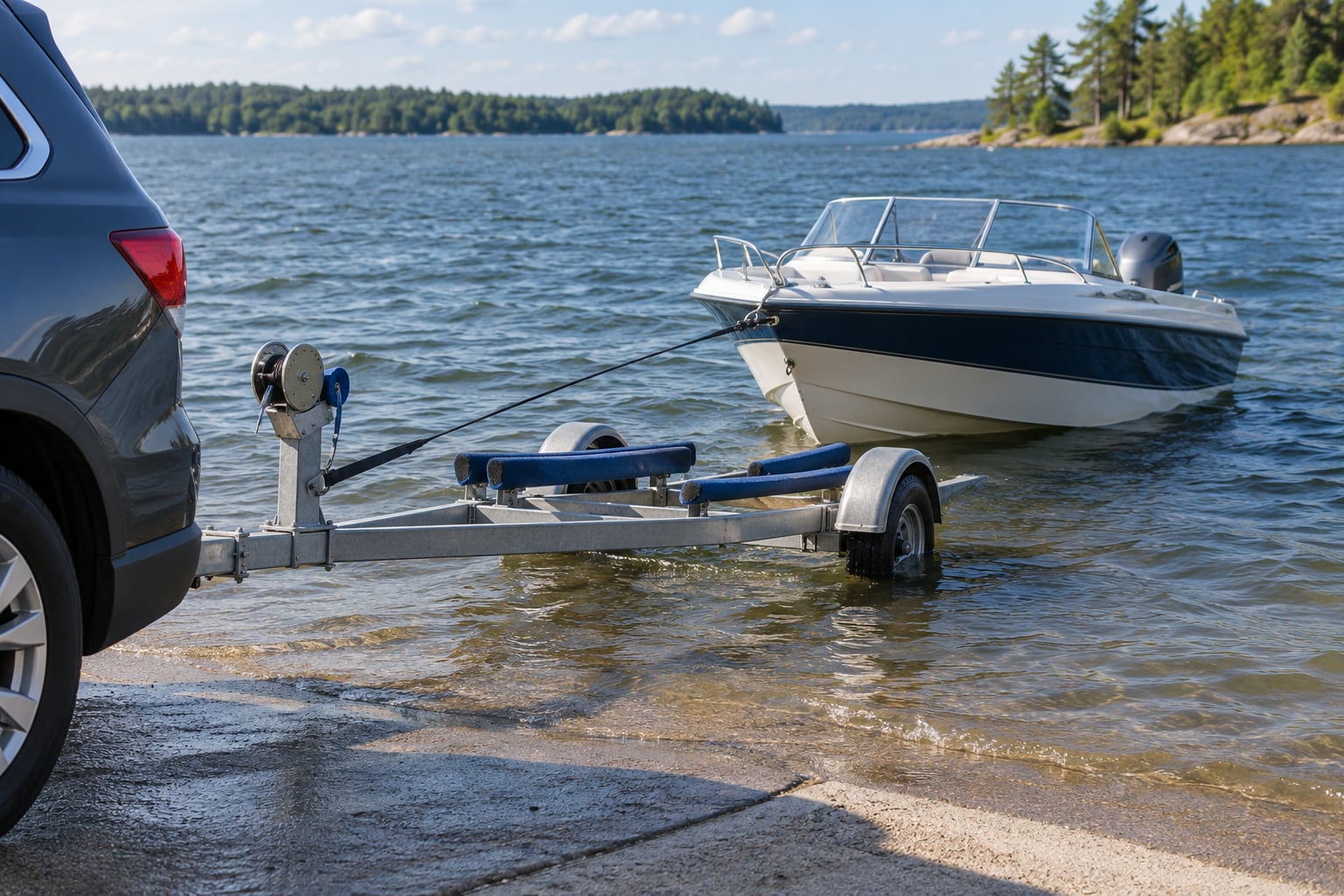
Learning how to load a boat onto a trailer in wind comes down to three things: point the hull into the wind, tie the boat to the trailer before it reaches the rollers, and never crank the winch without a person or a fixed cleat absorbing the sideways push. On a calm day the whole job takes ten minutes. In a gusty crosswind, give yourself double that and a plan for stopping.
Wind is the one part of trailer loading you cannot turn off. Once the bow is on the bunks, the wind is pushing on the hull’s freeboard like a sail, and that sideways force can swing the bow wide of the guide-on posts, hold the boat off the rollers entirely, or shove it back into the water mid-load.
That last scenario is how most ramp injuries happen. A gust arrives while somebody is holding the bow line, pins an arm against the hull, or shifts a hull with a few thousand pounds of momentum in it. The rest of this guide is built around never being in that spot.
Table of Contents
- 1What You Need
- 2Step-by-Step: How to Load a Boat Onto a Trailer in Wind Safely
- 3Check the Wind and Launch Conditions
- 4Position the Trailer and Vehicle
- 5Attach the Winch Line with the Boat Facing the Wind
- 6How to Winch a Boat Onto the Trailer in a Sidewind
- 7Center the Boat and Attach Safety Supports
- 8Common Mistakes to Avoid
- 9Frequently Asked Questions
- 10Should I point the boat into the wind when loading it onto a trailer?
- 11What wind speed is too strong to safely launch a boat?
- 12Should I use the trailer winch while the wind is pushing the boat sideways?
- 13Where should my spotter stand during a windy launch?
- 14What should I do if the boat keeps drifting away from the trailer?
- 15Can I load a boat onto a trailer by driving beside it instead of using a winch?
- 16Conclusion
What You Need
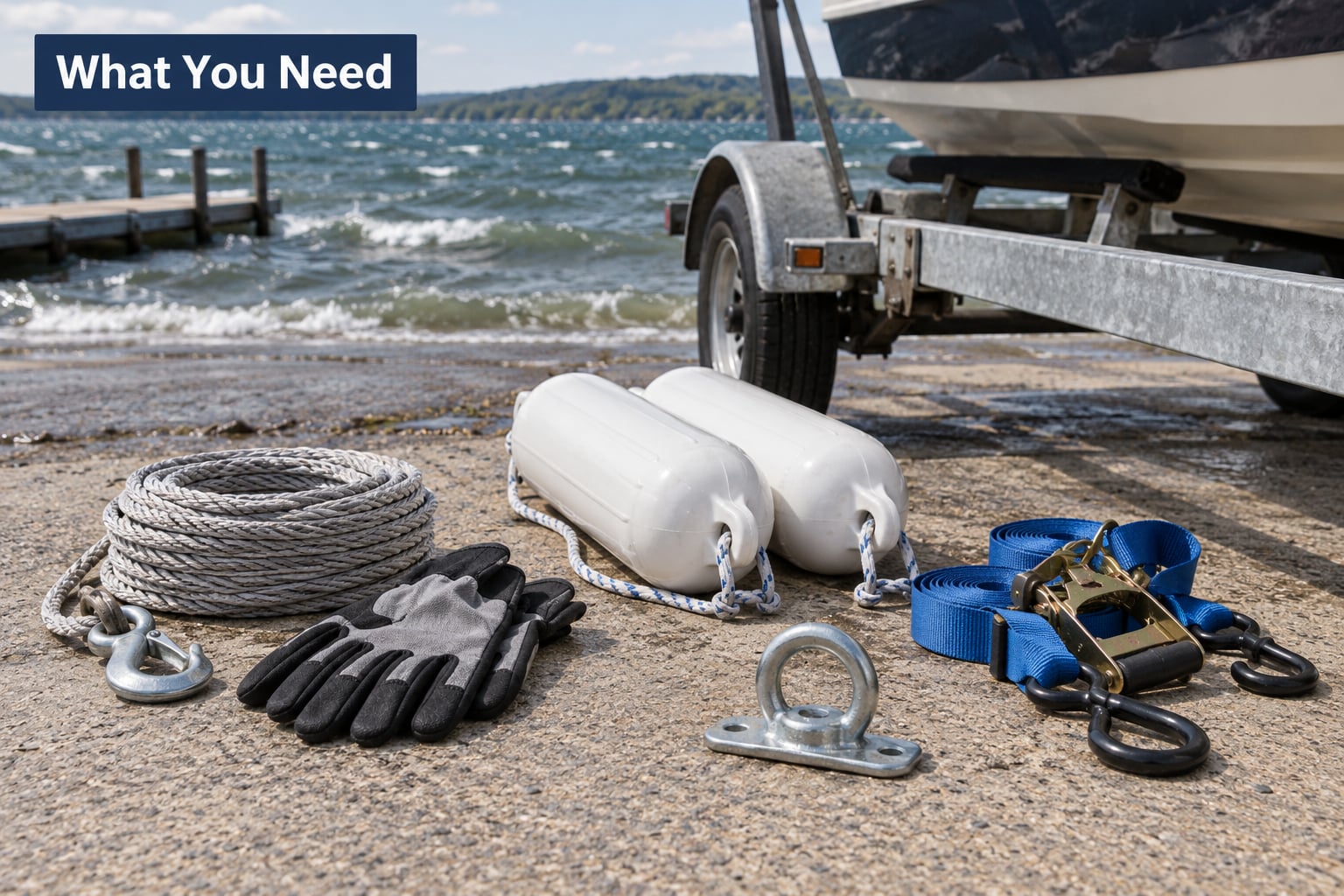
Most of this list you already own. The point is knowing where each piece is before you are standing in the water with a gust coming across the ramp.
- A winch line with a bow eye loop rated for the boat’s weight. Check the splice and the strap for chafe before you attach it, not after.
- A second line of roughly 30 feet for the bow-to-trailer pre-tie. This is the single most useful wind tool a solo loader can carry.
- Fenders for any dock or piling within reach. A hull that drifts two feet sideways in a gust finds those pilings fast.
- Ratchet straps, bow safety chain, and transom tie-downs, inspected for cuts and stretched webbing.
- Gloves. Winch handles and cleats get wet and sharp-edged, and wet hands lose a line exactly when you cannot chase it down.
- A spotter, for a two-person load. If you are alone, the pre-tied line does part of that job.
- A vehicle and trailer combo with working brakes and a trailer that tracks straight. A bent strut or a worn roller turns a crosswind load into a fight.
Before you back down the ramp, walk the trailer once. Check the winch strap, the clutch, the bow stop height, the guide-on posts, and the keel rollers. On a forum thread that still ranks for this exact query, experienced owners fix stuck-on-the-bunks loads with a floor jack under the keel aft of the front bunks, lifting just enough to clear the bunks and continuing the winch. That trick only works on a trailer you have already inspected.
Step-by-Step: How to Load a Boat Onto a Trailer in Wind Safely
Check the Wind and Launch Conditions
The honest answer on wind speed is that no rule book sets a number, because a 20 mph breeze across a wide flat lake and the same breeze funnelled between two hillsides are not the same problem. What changes it is your boat’s freeboard, which is the vertical side of the hull above the waterline. A pontoon or cuddy-cabin cruiser with tall topsides catches far more wind than a low-slung bass boat, so the same gust is routine for one hull and a stop-work for another.
These thresholds are practical working points, not a Coast Guard standard. Read your own boat against them.
| Wind at the ramp | What it feels like | What to do |
|---|---|---|
| Under 10 mph | Ripples, no foam, bow drifts a few inches | Load normally with normal care. |
| 10 to 15 mph | Persistent push, boat holds an angle off the trailer | Use fenders and the pre-tied bow line. One person is fine on a low hull. |
| 15 to 20 mph | Gusts swing the bow between winch pulls | Two people, or a deep-V hull that cuts through it. Bow into the wind is not optional. |
| 20 to 25 mph | Hull yawing broadside, winch load pulsing | Only with two people, a sheltered ramp, and a pre-set abort plan. |
| Above 25 mph, gusting | Boat blows off the trailer during a pull | Do not load. Tie the boat up, come back later, or get help. |
Also read the ramp itself. A steep grade plus a crosswind roughly doubles the load on the winch, because the hull is hanging at an angle and the wind is now pushing along the ramp instead of across it. Chop and current add their own push. If the ramp surface is slick, launching with a trailer already sitting in the water is easier than trying to push a boat back down the lane.
Position the Trailer and Vehicle
Back the trailer straight down the lane and into the water until the trailer bunks and rollers sit deep enough that the hull floats onto them. On most trailers that is roughly a foot of water over the bunks, more if the ramp is shallow. The vehicle stays where it is, in park with the parking brake set. Put it in neutral only if you are working the winch and need the trailer to stay put without the brake biting.
Wind matters more than people expect here. Once the trailer is in the water with the tongue supported by the vehicle, the wind loads the trailer itself, and a trailer with a light boat on it has very little mass resisting a push. Turn the wheels so that a trailer rolling sideways would lean toward the bank rather than into your tow vehicle or another boat in the lane.
Face the bow of the boat into the wind whenever you can. A hull presented bow-first to a steady wind has far less side area exposed than the same hull presented broadside, and it tends to track rather than yaw. If the ramp layout will not let you do that, at least set the trailer so the wind pushes the boat parallel to the ramp instead of sideways across it.
Attach the Winch Line with the Boat Facing the Wind
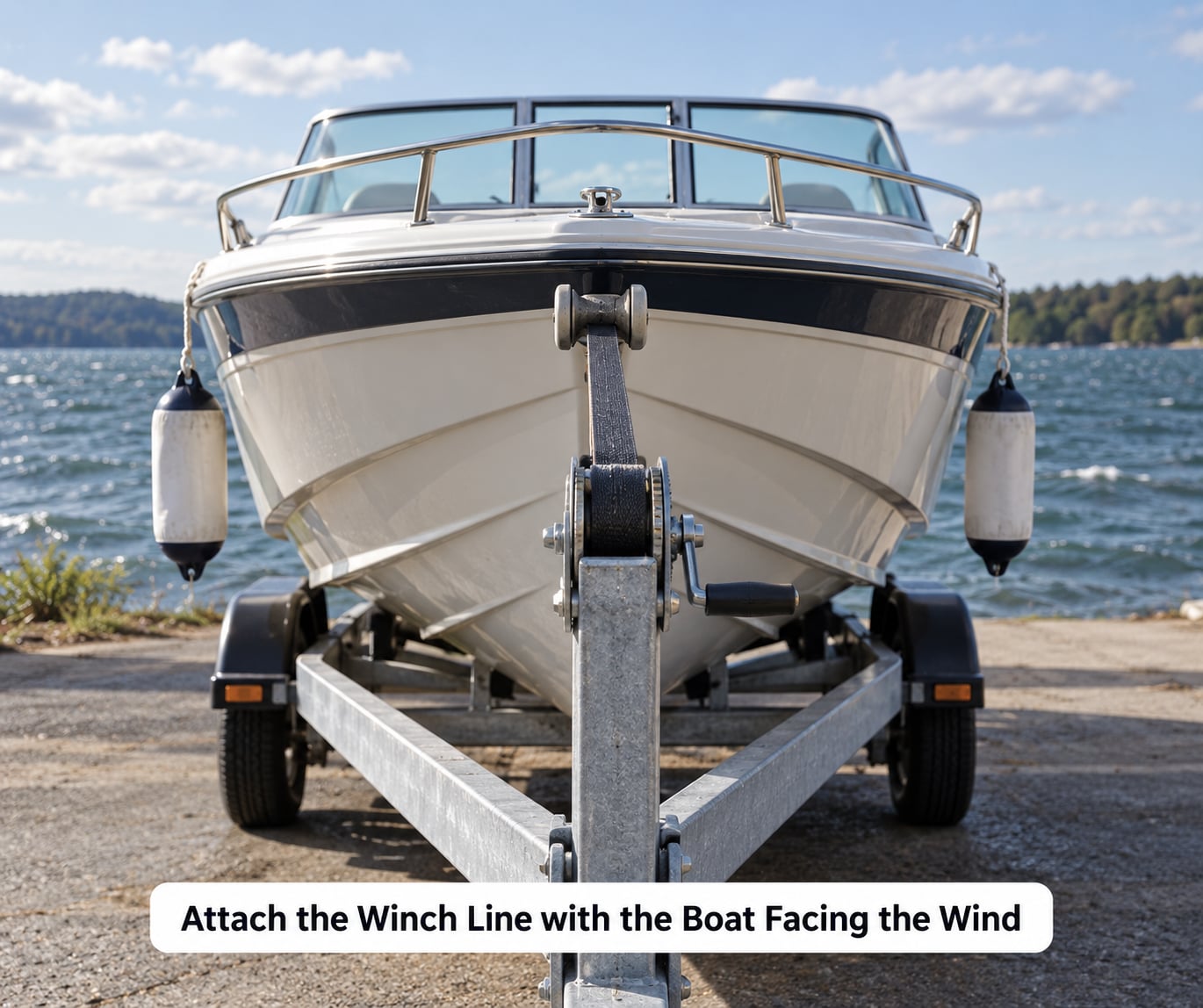
This is the moment the standard procedure changes. Rather than cranking the bow in and correcting the angle afterward, tie the boat to the trailer first. Take your pre-tied line, loop it through the trailer tongue eye or a rail eye, and bring it up to the boat’s bow eye or a dock cleat inside the bow. This short line gives you a handhold that holds the hull against the trailer the entire time you are cranking.
Attach the winch strap afterward, and take one handle of the crank at a time. Never reach across the strap, never wrap the line around your hand, and never stand in line with the bow while it is moving. If you have to reach past the bow eye to clip the strap, switch the clutch to free, back the winch off slightly, and move to the other side.
For a solo load, the winch strap alone is a poor choice in wind because it does the one job a hand should do. Pre-tied line is the wind mitigation that changes the outcome.
How to Winch a Boat Onto the Trailer in a Sidewind
Winch in short stages rather than one long pull. Crank until the bow comes off the water and the line tightens, then stop and look. Check where the bow sits relative to the guide-on posts, where the keel sits relative to the keel rollers, and whether the hull is tracking straight or angled.
When the bow swings, do not crank through it. Wind plus a swinging bow is how the hull ends up sideways on the bunks or back in the water with the bow riding up onto the winch post. Correct the angle first, either by pulling the pre-tied line from the trailer side or by having the spotter walk the hull back toward center, then resume cranking.
Pause points are the safety mechanism. Every time you stop, everyone gets a chance to see where their hands and feet are. On a two-person load, agree on one word for stop and one for keep going before you attach the line, so nobody has to shout over a winch handle.
Stop the whole operation if any of these appear: the winch load pulses and drops repeatedly, meaning the bow is riding up rather than settling onto the bunks; the hull starts taking on a list; or the pre-tied line goes slack, which means the boat is moving away from the trailer faster than the winch can pull it back.
Center the Boat and Attach Safety Supports
Once the hull is fully on the bunks and the transom sits against the stern rollers, let the wind do one thing for you. Release tension on the winch strap by about half an inch and watch. If the hull shifts on its own, it is not centered and the wind is still calling the shots.
Center it before you secure anything. The guide-on posts should sit snug against both sides of the hull without forcing it. If they are too short, angled outward, or set too far back for your particular hull, they will let the bow swing wide, and no amount of winching fixes that. Bennington Marine forum owners point to guide-on height and side position as the most common fix for hulls that will not guide on cleanly, which matches what the load itself will show you.
Then secure in this order:
- Attach the bow safety chain, and take up its slack so the bow cannot lift off the bow stop.
- Set the bow stop against the hull, snug rather than forced.
- Winch the bow strap down until the strap is straight and the bow is fully seated.
- Attach the transom tie-downs at the transom eyes, keeping them straight across rather than angled to one side.
Attach the bow safety chain before you relax the winch strap. It holds the boat if the wind lifts the bow after you walk away, and it is the support you would want if the winch line parted mid-pull.
Finally, pull forward a few inches to set the tongue weight and let the trailer’s rollers self-center the hull, then re-check everything. Confirm the boat sits with roughly 60 percent of its length ahead of the axle, which is the usual rule of thumb for a stable tow, and that the winch strap and tie-downs are snug after that movement.
Common Mistakes to Avoid
Every one of these shows up on ramp threads and in marine service write-ups, and every one of them is fixable before you ever touch the winch.
Standing downhill of the boat. The gap between a floating hull and a trailer’s bow stop is a closing space, and a gust can close it fast. Stay out of that gap and out of the bow’s path at all times. Work from the trailer side of the centerline whenever the ramp allows.
Leaving the parking brake off. A trailer sitting in the water with the tongue on a slope wants to roll. Set the brake before you leave the cab, and keep the vehicle in park.
Chasing a swinging bow. Cranking harder into a swing puts more force on the winch strap and less control on the hull. Stop, correct the angle with the line or the spotter, then pull again.
Grabbing a line that is not in your hand. The classic solo mistake. The boat swings downwind with the cleat now out of reach, and now you are swimming after it. Tie the bow line before you back down the ramp, not after the boat has already drifted.
Using a strap with cuts, or bailing out a worn strap mid-load. Inspect the webbing and the winch line splice in daylight before the trip. A strap that fails under load near a hull edge does real damage.
Securing before the hull is centered. Ratcheting the transom tie-downs while the boat is still angled drives the hull against one guide-on and loads that side of the bunks unevenly. Center first, secure second, then re-check after the pull-forward.
Two more habits worth building. Power loading with the boat’s own engine is convenient in flat water, but you cannot stop instantly from it and the wind is still free to push the hull broadside during the approach, so in any real wind the winch wins. And once you are home, drain the bilge, flush the bunks and rollers with fresh water, and stow loose gear, because salt left on a trailer roller is what makes the next load bind.
Frequently Asked Questions
Should I point the boat into the wind when loading it onto a trailer?
Yes, whenever the ramp layout allows it. A bow presented into a steady wind presents far less side area than the same hull shown broadside, so it tracks instead of yawing and you spend less time correcting the angle between winch pulls. If the ramp forces a broadside presentation, position the trailer so the wind pushes the boat parallel to the ramp rather than across it, and pre-tie the bow line before you crank.
What wind speed is too strong to safely launch a boat?
There is no official cutoff, because hull freeboard and ramp shelter matter as much as the number. In practice, loads get uncomfortable above 15 mph, risky between 20 and 25 mph, and unworkable for most people in gusts above 25 mph. A high-freeboard pontoon feels a breeze far harder than a low bass boat, so use those figures as a starting point and delay the load if you cannot keep a bow line on the hull.
Should I use the trailer winch while the wind is pushing the boat sideways?
Winching is safer than power loading in wind, but only if something other than your body is holding the hull sideways. Pre-tie a short line from the trailer’s tongue or rail eye to the boat’s bow eye before you crank. That line absorbs the crosswind load the whole time the strap is pulling. Cranking with the hull already sliding is how the bow ends up on the winch post.
Where should my spotter stand during a windy launch?
On the trailer side of the boat, holding the bow line or working the hull back toward the guide-on posts, never in the gap between the hull and the bow stop and never in the bow’s path. Agree on a stop word and a go word before you attach the winch line. The spotter’s job is hands on the boat, eyes on the wind, and the ability to stop the whole operation on one word.
What should I do if the boat keeps drifting away from the trailer?
Stop cranking and stop the boat first. Do not try to winch faster. Have the spotter take the pre-tied line and haul on it, or hold a dock line already made fast to a cleat or piling. If the boat is riding up on the winch strap rather than settling onto the bunks, back the winch off and reset the alignment. If you cannot hold the hull against the wind with two people and a line, secure the boat where it floats and come back when it drops.
Can I load a boat onto a trailer by driving beside it instead of using a winch?
Only in flat water, and it is the riskier choice in wind. Power loading means you cannot stop instantly, and a crosswind can push the hull broadside while the engine is still driving it forward, which is how boats end up alongside the trailer rather than on it. If the boat is small enough to hand-walk onto the bunks with a bow line, that beats both. Otherwise winch it, slowly, with the bow line already tied.
Conclusion
Do these five things in order and most windy loads become boring. Read the wind and delay the launch if you cannot hold a bow line on the hull. Position the trailer with the bow into the wind and the parking brake set. Have a spotter or a pre-tied line holding the bow. Winch in short pulls with pause points. Secure the safety chain before you relax the strap, then check the hull again after the pull-forward.
And if the bow will not stop swinging, stop the job. A boat that drifts away costs you an afternoon. A person pinned between a hull and a bow stop costs much more.