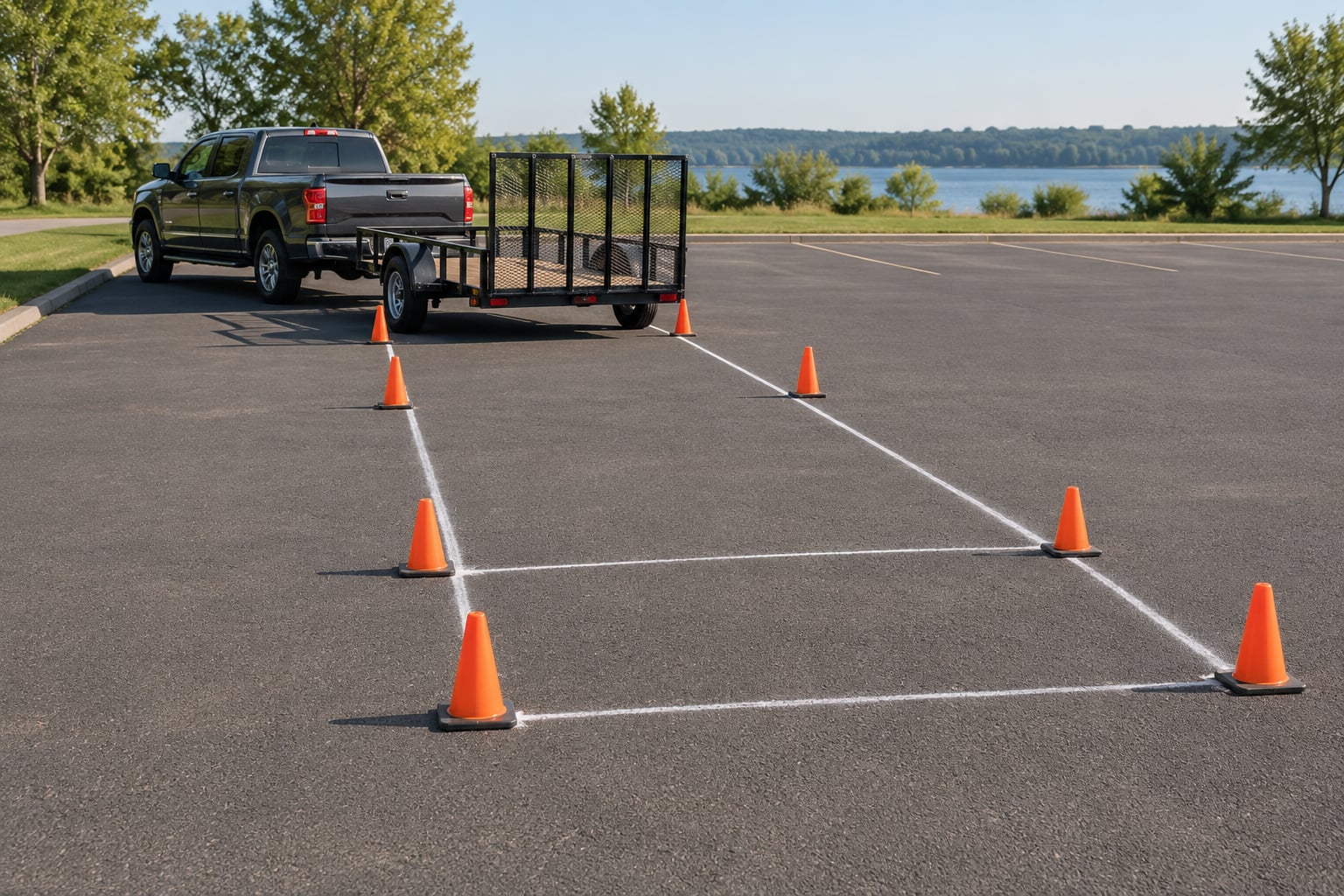
Backing up a trailer comes down to one habit: put your hand at the bottom of the steering wheel, at 6 o’clock, then move that hand in the direction you want the trailer to go. Because the trailer pivots at the hitch ball and swings opposite to your truck’s rear, the wheel turns the right way on its own. Learning how to practice backing up a trailer takes a few focused sessions in an empty lot, not a special talent.
Most new drivers lose the first ten minutes fighting their own instincts. They see the trailer drifting left and crank the wheel left, which swings the back end further left and makes it worse. Once that reversal clicks, the rest is repetition at walking pace.
Table of Contents
- 1What You Need
- 2Step-by-Step
- 3Inspect the Hitch and Set Up the Practice Area
- 4Set Your Mirrors and Reference Points
- 5Back Straight Very Slowly
- 6Make Small Steering Corrections
- 7Practice Turning Into and Out of a Space
- 8Repeat Until the Movement Feels Predictable
- 9Common Mistakes
- 10Frequently Asked Questions
- 11What is the easiest way to practice backing up a trailer?
- 12How do beginners know which way to turn when backing a trailer?
- 13Should I use a helper while practicing trailer backing?
- 14How much space do I need to practice backing a trailer?
- 15How can I stop the trailer from drifting to one side?
- 16Is it safe to practice backing a trailer alone?
- 17Conclusion
What You Need
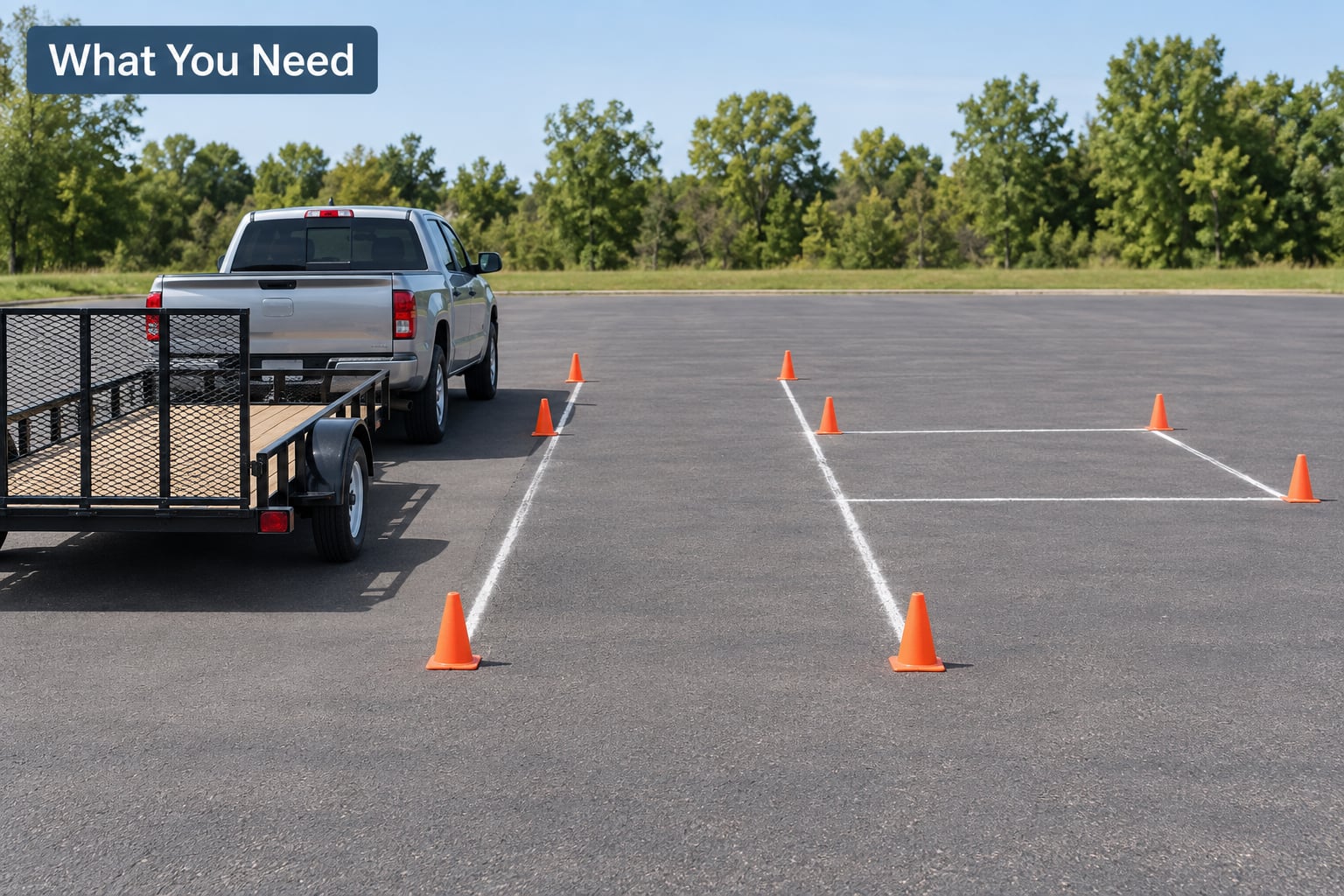
A flat, empty parking lot is the single most useful piece of equipment. Look for asphalt or packed gravel with no curbs, posts, light poles, storm drains or parked cars within about 100 feet of where you will swing.
Before the first session, confirm these with the tow vehicle and trailer paperwork rather than assumption:
- A properly rated hitch on the vehicle frame and a hitch ball the exact diameter the trailer coupler expects.
- The hitch pin fully seated with its retaining clip or latch closed, plus the locking pin or bolt if your ball is a locking type.
- Two crossed safety chains, each hooked to a rated anchor point on the trailer frame, with enough slack for a straight pull but no slack to drag.
- Breakaway cable attached to the trailer’s brake system if the trailer has brakes, plus the electrical connector plugged in and the safety chains not crossing under the coupler.
- Working brake and tail lights, checked with somebody standing behind the trailer while you press the pedal.
- Tires at the pressures printed on the trailer’s own placard, including the spare.
- Extended tow mirrors or at least the truck’s standard mirrors cleaned and adjusted for the loaded position.
Owner’s manuals for both the vehicle and the trailer tell you the tow rating, the required ball size, fuse and connector pinouts, and any limits on hitch accessories. Read the hitch section rather than the whole book; it is usually two pages and it settles most arguments before they start.
If the trailer is equipped with a sway control bar or an equivalent weight-distribution hitch, note which ones must be disconnected before reversing. Sway hardware is designed for straight-line travel and its bars can block the tight turns you are trying to learn.
Step-by-Step
Learning how to practice backing up a trailer works best as a ladder. Each step below adds one new demand, and you move up only when the step below feels automatic. Start at the bottom and stay there longer than feels necessary; boredom is fine, panic is not.
Inspect the Hitch and Set Up the Practice Area
Do the walk-around before the engine starts, every single session. Sit in the cab, put the key in the on position without starting, and confirm the hitch pin is seated and locked, the safety chains are crossed and clipped, the breakaway cable is pulled free of its pin and secured to the tow vehicle, and the lights work.
Then walk to the back of the trailer. Crouch and look along both sides to the ground. Look for the thing that ruins new awnings and fenders: low branches, a rock wall, a sprinkler head, a post the height of a wheel, or a slope the trailer will settle into. Clear anything you cannot see past from the driver’s seat.
Choose a spot with a firm, level surface. A slight downhill grade gives you a poor reference line, and on a real slope the trailer’s weight changes how the vehicle follows it, so save grades for when you already have control.
Set Your Mirrors and Reference Points
Adjust the side mirrors from the normal driving position, then lean forward slightly, which is roughly where your head sits while reversing. You should see the trailer’s near edge in the lower outer third of each mirror without craning.
Extended tow mirrors are worth the adjustment effort because they show the side of the trailer instead of the truck bed. If your vehicle has a backup camera, treat it as a supplement. The camera shows the middle of the trailer; the corner you will actually hit is usually outside the frame.
Now pick one reference point and use it every time. Two work well for beginners: the edge of the trailer’s rear corner against a fixed object like a pole, and the coupler itself as it approaches a marked point on the ground. Whichever you choose, park the trailer in the correct spot once at the start of the session and look at what the mirrors and the ground show you. That is your target image.
Back Straight Very Slowly
Straight-line backing is drill one, and it deserves more time than beginners give it. Sit square to a row of cones about 10 feet wide, or set two cones roughly 12 feet apart to form a simple lane. The 12-foot span is narrow enough to demand real attention and wide enough that a normal trailer fits.
Check over your shoulder and both mirrors, confirm the lane behind you is clear, and shift into reverse. Keep the throttle at idle or just above it. An automatic transmission in most tow vehicles will not let you select reverse until the vehicle is nearly stopped, which is one less thing to worry about.
Feather the wheel rather than turning it. Slide your hand along the rim between the 6 and 9 o’clock positions for small left inputs, and between 6 and 3 for small right inputs. Hold each position, look, make the next small adjustment, hold again.
If the trailer starts to drift, stop the vehicle completely rather than correcting while moving. Idling forward a foot resets the geometry without adding angle. Aim for 60 to 100 feet of straight travel without a correction before you call the drill passed.
Make Small Steering Corrections
The correction is directional and it feels wrong at first. When the trailer’s rear starts to travel to the left, you move your hand at the bottom of the wheel to the left, which puts the truck’s rear to the right and pulls the trailer back toward center. You are chasing the trailer, following its movement rather than fighting it.
Two habits keep this in control. First, make the input small; a quarter turn of the wheel is often enough at idle speed, and a full turn at that pace moves the trailer several feet. Second, alternate; move left, straighten, check the mirrors, move right, straighten, check again.
When the drift is mild and steady, the Z method is the tidy fix. Steer briefly toward the direction you want the trailer to end up, then counter-steer to straighten the coupling, then steer again toward the target. It straightens the alignment without the big swing that a single hard correction produces.
Watch the coupling angle between truck and trailer as you work. When it opens past roughly 90 degrees you have a jackknife: the trailer is folded against the vehicle, steering barely influences it, and pulling forward is the only clean recovery. Slow inputs keep the angle small, and full lock held while reversing closes it fast.
Practice Turning Into and Out of a Space
Once straight lines feel boring, mark a lane at a right angle to your starting position and back into it. This is drill two and the one that most resembles a real driveway or campsite pad.
Back the trailer to a shallow angle first, roughly 30 degrees off the lane, then curve the combination into it and straighten up inside the space. Backing straight in at 90 degrees immediately is how beginners jackknife their first attempt; the angled approach gives you room to correct without folding the trailer.
For the 90-degree backing exercise itself, position the truck so the trailer is about 45 degrees to the lane, then reverse with steady small inputs until the trailer squares up, then continue straight until the reference point reaches the target. Stop the moment the trailer reaches the marker. Hitting the marker is a scoring event, not a near miss.
Give yourself at least three trailer lengths of room behind the truck to pull forward and start over. If you do not have that room, you will learn to panic, and panic is a much harder habit to unlearn than geometry.
Repeat Until the Movement Feels Predictable
Short sessions beat long ones. Most people reach basic competence after three to five hours of deliberate practice spread over several days, and real comfort arrives after they have parked in actual driveways and ramps a handful of times. Forum regulars consistently report that number, and they also report that the first hour feels terrible and the fourth feels ordinary.
Give every session a goal instead of just driving around. Straight-line: 100 feet with fewer than three corrections. Lane: back into the box in one attempt without touching the cones. Turn: come out of the lane and pivot left, then pivot right. Tracking one measurable goal per session is what turns practice into progress.
Drop back a level whenever you start making the same mistake twice. If you are folding the trailer in the lane drill, spend a session back on straight lines with a spotter instead of pushing through.
Use a spotter for anything you cannot see clearly, and agree on the vocabulary before you move. Words like left and right are where backing accidents start, because a spotter may mean the wheel, the truck, or the trailer. The driver owns the decision: spotter calls direction, driver makes the input.
A qualified instructor is worth it when your rig has an unusual combination, when the only space available is a real driveway or narrow lane, or when a previous mistake damaged something. This guide is a practice routine, not a substitute for hands-on instruction.
Common Mistakes
Almost every avoidable trailer backing incident traces back to one of these:
- Staring at the trailer’s center instead of its edge. Fix: pick the corner you care about most and watch it in the mirror until it reaches your target.
- Big steering inputs. Fix: quarter turns at idle, then hold and look. Small adjustments keep the coupling angle shallow and give you time to react.
- Backing faster than you can think. Fix: set an artificial ceiling of walking pace. Nobody ever needed to undo a jackknife created at three miles per hour.
- Failing to check around the corner before moving. Fix: full walk-around every session, and check the trailer’s blind side again after each stop and each new position.
- Not stopping between corrections. Fix: treat a stop as free. Idling forward to reset is cheap insurance.
- Using the brake as a steering tool. Fix: brakes manage speed and hold position. If you find yourself stabbing them mid-turn, you are moving too fast.
- Leaving the sway bar connected while practicing. Fix: disconnect hardware that limits turning radius before the session, reconnect it before the drive home.
One troubleshooting note worth knowing: a trailer that drifts to the same side every single attempt is usually not a skill problem. Uneven tire pressure, mismatched tires across the axle, a bent axle or bunk height, and dragging wheel bearings all push the trailer consistently one way. Check pressures cold and confirm the trailer is level with the truck before blaming yourself.
Solvers also report that short trailers are harder than long ones, because a short trailer reacts faster to the same steering input and gives less time to correct. Practicing with a small trailer first does not make you worse at a big one; it teaches faster corrections.
Frequently Asked Questions
What is the easiest way to practice backing up a trailer?
Find a wide, level, empty parking lot and start with straight-line backing between two cones set about 12 feet apart. Set your hand at the 6 o’clock position on the steering wheel, back at idle speed, and make quarter-turn corrections only. Add a marked lane at a right angle once you can hold 100 feet straight without drifting.
How do beginners know which way to turn when backing a trailer?
Put your hand at the bottom of the steering wheel and move it in the direction you want the trailer’s rear to go. Moving your hand left puts the truck’s rear to the right, which pulls the trailer back toward center. The reason it feels reversed is that the trailer pivots at the hitch ball and swings opposite to your vehicle’s rear.
Should I use a helper while practicing trailer backing?
Yes for anything tight or anything where you cannot see the trailer’s blind side. Agree on vocabulary first: the spotter calls left or right for the trailer’s movement, and you, the driver, decide whether to move the wheel. Agree that you stop whenever either of you feels unsure, and never move until the spotter is out of the path.
How much space do I need to practice backing a trailer?
Aim for a flat area roughly 100 feet long and 50 feet wide with no curbs, posts or parked cars, which a large empty parking lot usually provides. Give yourself at least three trailer lengths behind the truck so you can pull forward and restart. Mark a 12-foot lane for straight backing and a right-angle box for turn practice.
How can I stop the trailer from drifting to one side?
First chase the drift: when the trailer’s rear starts traveling left, move your hand at the bottom of the wheel to the left and then straighten. If it drifts the same direction every single attempt, check tire pressures cold, mismatched tires, bunk height, axle alignment and wheel bearing drag, since those push a trailer consistently one way regardless of technique.
Is it safe to practice backing a trailer alone?
It is safe on a wide, empty, level lot at idle speed with no obstacles in the trailer’s path, and solo travelers do it regularly after focused empty-lot practice. It is not safe where you cannot see behind the trailer, where pedestrians or traffic could appear, or where a mistake reaches something expensive. Use a spotter or an instructor in those spots.
Conclusion
Start with the safety walk-around and a wide, level, obstacle-free space. Set your mirrors, pick one reference point, put your hand at the bottom of the steering wheel, and back straight at walking pace before attempting any turn. Make small corrections, chase the trailer rather than fighting it, stop between inputs, and repeat with one clear goal per session until the movement stops surprising you.
Once straight lines and a marked lane feel ordinary in an empty lot, take the same routine into a real driveway or campsite pad with a spotter standing clear. That is the whole method. Most beginners need three to five hours of deliberate practice, and almost everyone reports that the first hour is the hardest.