For most US lakes, the best months to visit a lake for warm water are mid-July through early September, with the peak landing in July for shallow ponds and small lakes and in August for deep basins and the Great Lakes. Southern lakes from Florida to the Gulf Coast run warm from May through October. The calendar matters less than the lake itself: depth, size, latitude and how the water is fed decide which of those months actually delivers swimmable water.
Air temperature is the trap here. You can arrive on a day when the thermometer reads 85F and find a lake sitting at 62F, because water heats far more slowly than land does. A lot of the frustration people report on lake forums comes down to trusting the weather app instead of the lake.
Table of Contents
- 1When Is Lake Water Warm Enough to Enjoy?
- 2Why lake water lags behind the air by weeks
- 3The Best Months by Activity
- 4Best Months for Swimming and Warm-Water Fun
- 5Is it July or August?
- 6The August tradeoff nobody warns you about
- 7Best Months for Boating and Paddling
- 8Best Months for Fishing
- 9Best Months for Camping and Lake Vacations
- 10How Regional Climate Changes the Answer
- 11How to Choose the Best Month for Your Lake
- 121. Find the current water temperature, not the forecast
- 132. Check for an active swim advisory
- 143. Match the month to the activity you actually care about
- 154. Find out the lake’s depth and size
- 165. Book a backup month
- 176. Set your tolerance before you book
- 18Frequently Asked Questions
- 19What month is lake water the warmest?
- 20How warm should a lake be to swim in?
- 21Is 70 degrees warm enough to swim in a lake?
- 22Is 75 too cold to swim in a lake?
- 23Which lake has the warmest water?
- 24Do I need a wetsuit for 70 degree water?
- 25Start With Your Lake’s Typical Water Temperature
When Is Lake Water Warm Enough to Enjoy?
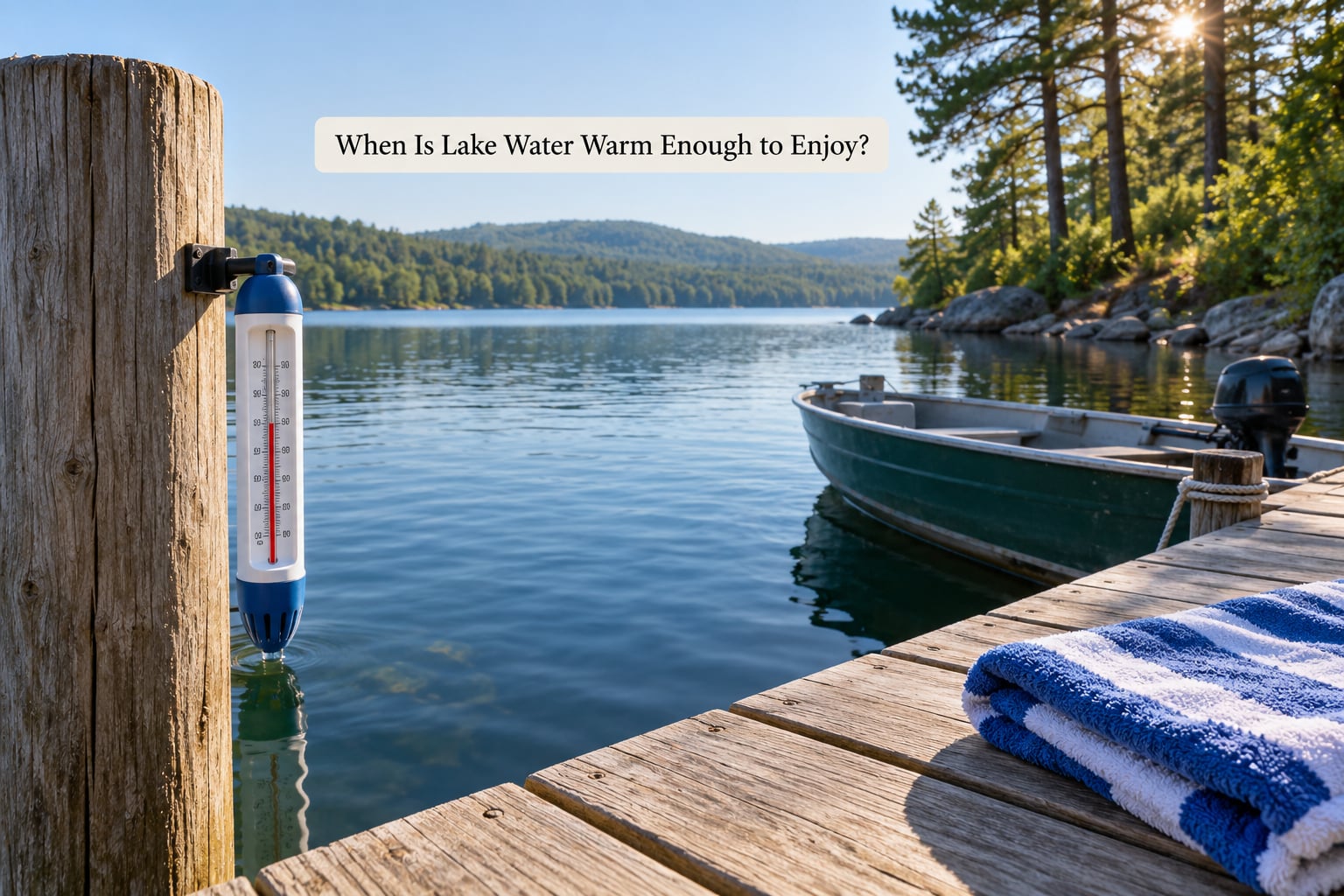
About 70F (21C) is the point where most adults stop bracing and start swimming. Comfortable open-water swimming sits between 75F and 80F (24C to 27C), and 77F (25C) is the temperature Olympic swimming competition is held at. Below 60F (15.5C), most people should not be in open water without a flotation vest and a reason.
Here is how the common numbers actually feel:
| Water temperature | What it feels like | Verdict |
|---|---|---|
| Below 60F (15.5C) | Entry gasp within seconds, arms feel numb fast | Cold-water territory. Wetsuit territory. |
| 60F to 64F (15.5C to 18C) | Hard entry, then tolerable for a few minutes | For cold-water swimmers only |
| 65F to 68F (18C to 20C) | Shallow gasp, then fine once you are moving | Short dip, wetsuit helps |
| 70F to 72F (21C to 22C) | Very manageable, no wetsuit needed | The practical warm-enough floor |
| 75F (24C) | Comfortable for a long swim | Not cold at all |
| 78F to 82F (26C to 28C) | Warm, sometimes unpleasantly so | Peak, and often the algae window too |
Two caveats on that table. First, these are surface readings in a nearshore swim area, not readings from the middle of the lake. Second, they are comfort thresholds, not safety guarantees. Water clarity, wind, and your own cold tolerance change everything.
Why lake water lags behind the air by weeks
Water has a far higher heat capacity than land, so a lake absorbs spring heat slowly and releases it slowly in fall. The result is a lag of several weeks in both directions. A lake often hits its warmest point in mid-August, after the hottest air temperatures of the year have already passed.
Depth makes it stranger. In a shallow pond, the whole water column warms together and reaches its high point in July, then can swing several degrees in a week of hot weather. In a deep basin, only the top few feet respond to the season while the mass below stays cold all summer. That deeper lake rises more slowly, peaks in August, and holds heat into September.
By August most lakes go thermally stratified: warm surface water floating over a colder layer, with a boundary between them called the thermocline. The shallower and windier the lake, the weaker that layer becomes. Spring turnover, when cold and warm water mix back together, is usually over by the time most people think about swimming.
None of this is a forecast. A monthly average tells you what a lake typically does, not what it will read on the day you arrive.
The Best Months by Activity
The best months to visit a lake for warm water depend on what you plan to do there. The table below matches the ordinary month to the ordinary activity for a mid-latitude inland lake; the regional section after that shifts the dates for you.
| Activity | Best months (northern inland lakes) | Why |
|---|---|---|
| Open-water swimming | Mid-July to early September | Surface crosses 70F and stays there |
| Beach and shoreline trips | Late May to September | Air is comfortable before the water is |
| Kayaking and canoeing | Late May to September | Most paddlers wear a spring suit or nothing at all |
| Paddleboarding | June to September | Longer daylight, less wind than late summer |
| Motorboating | May to October | Comfort is set by air, not water |
| Warm-water fishing | April to June and September to October | Species feed in shallower, cooler water in spring and fall |
| Trout and salmon fishing | Spring and late fall | These species want cool, oxygen-rich water |
| Camping | Late May to September | Heat, mosquitoes and storms trade off against crowds |
| Family beach vacation | Mid-July to late August | Warmest water, longest afternoon play |
A useful rule for the table above: paddling and boating comfort track air temperature more closely than water temperature, while swimming tracks water temperature exactly. A windsurfing trip can be great in mid-May while the lake is still 55F, because you are not getting wet in the cold.
Best Months for Swimming and Warm-Water Fun
For most mid-latitude lakes, the swimming window opens in late June, becomes genuinely warm in the second half of July, and stays pleasant into the first half of September. In the Upper Midwest and northern New England, the reliable warm stretch is narrower, often running from the second week of July to the first week of August.
Is it July or August?
Use the lake, not the calendar. Shallow ponds, small lakes and reservoirs under about 40 feet deep tend to peak in late July. Deep basins and the Great Lakes keep gaining heat and usually peak in early to mid-August. Lake Michigan is a good example of the deep-lake pattern: July water runs from the mid-60s to the low 70s, and the warmest point usually lands on or near August 10 in the low to mid 70s.
That is also the decision most people get wrong in both directions. Someone who books the first week of July for a deep northern lake may find it merely brisk. Someone who books late August at a small shallow lake may find the water has already started to turn, along with the algae.
The August tradeoff nobody warns you about
Peak warmth and peak algae risk land in the same weeks. Warm, still, nutrient-rich water is exactly what cyanobacteria, the blue-green algae behind most swim advisories, need to bloom. Many state agencies see the lowest advisory counts in late spring and early summer, then the highest counts in late August and September.
So the warmest water is not automatically the best swimming water. For most lakes, mid-July through early August is the sweet spot: warm enough to be pleasant, early enough that the bloom has not fully peaked. Check your state or county advisory page before you drive out, every time, because bloom conditions change weekly.
It is also the crowded part of the season. A lake that feels quiet on a Tuesday in mid-July is shoulder-to-shoulder on a Saturday in late August. If your plan is swimming rather than boating, favor the earlier window.
Best Months for Boating and Paddling
For motorboating, the best months are wider than the swimming window. May and early June give you long daylight, cool air, empty docks and calm mornings. Late May through June is often the best boating stretch of the entire year, precisely because the water has not yet heated up.
For kayaks and canoes, comfort depends on your tolerance more than the thermometer. Most paddlers are comfortable from late May through September. In early spring and late fall, a neoprene spring suit or dry top extends the season by a month or more in either direction, and a wetsuit is common for June and September trips on northern lakes.
Three things change the boating calendar more than the calendar month does:
- Wind and onshore flow. A sustained wind pushing water toward one shoreline makes that shoreline warmer, and the opposite one cooler. On a big lake this can mean several degrees between the two ends of the same beach on the same afternoon.
- Thunderstorms. Afternoon storms are the defining weather of July in much of the country, and they peak in frequency as the summer goes on. Mornings and weekends get calmer; the middle of a summer afternoon is where small craft get caught out.
- Water levels. Rainy months raise a lake and drown the low shoreline, which changes launch availability. Drought months drop it, exposing launch ramps and mud flats. Check the local river basin or water district page for current level before packing the trailer.
Paddleboarding leans the same way. It works from June through September, and late June and early July give you the best combination of long evenings, no crowds and water you can stand in without a wetsuit.
Best Months for Fishing
Fishing is the one activity where the best month is usually not the warmest one. Anglers split into two camps, and they want opposite things from the calendar.
Warm-water species such as bass, crappie, bluegill, pike and channel catfish are most active in spring and early fall. In April, May and June they feed in shallow water and in the shallower arms of a lake as the water crosses the 50F to 60F range. Late summer changes that: heavy stratification pushes the surface hot, the deeper water holds less oxygen, and the fish are less concentrated. The fishing picks back up in September and October as the water cools and turns over.
Cool-water species want the opposite. Trout and salmon do their best in spring and late fall, in water in the 40F to 60F range, when dissolved oxygen is high and the water is moving. The same stratification that frustrates a bass angler in July is what makes a deep, cold lake worth fishing in August.
Two other timing factors worth knowing. Rain and heavy cloud cover suppress surface feeding, so the day after a front can be better than the day of one. And the weeks right after a summer cold front are often the most productive stretch of the season, because falling water temperature and rising oxygen move everything shallow at once.
Best Months for Camping and Lake Vacations
Late spring, mid-summer and early fall each suit a different set of priorities, and the difference is more about comfort than about water temperature.
Late May and June give you cool nights, low mosquito pressure, empty campsites and the best boat and kayak conditions of the year. The trade-off is that the lake is often not warm enough for a long swim, and afternoon temperatures can still spike.
Mid-summer, roughly the second week of July through the first week of August, is the warmest water and the most reliable swimming of the year. It is also peak heat, peak mosquitoes at dusk, and the thunderstorm season. Campsites along good access points book months ahead. If you want this window, you are making reservations in the winter, not in May.
Late August and September trade warmth for comfort. Daytime heat eases, the mosquitoes thin out, and the water is still often warm in deep basins. You give up peak swimming warmth, gain better sleeping conditions, and land in the window when algae advisories are most likely to be posted.
For weekend trips, the middle of the week matters more than the month. A Tuesday in late July is a different trip from a Saturday in late July.
How Regional Climate Changes the Answer
Everything above assumes a mid-latitude inland lake. Shift the map and the calendar moves by weeks in either direction.
| Region | Warm-water window | Peak month | Watch out for |
|---|---|---|---|
| Florida and the Gulf Coast | May to October | July and August | Afternoon storms, afternoon heat, afternoon rain |
| Southeast inland | Late May to September | July | Reservoir drawdown late summer |
| Great Lakes | Mid-July to early September | August | Cool nights, wind, a wide nearshore temperature spread |
| Upper Midwest | Mid-July to mid-August | Late July | Short season, big weekend crowds, algae in late August |
| Northeast | Late July to early September | August | Lake effect changes the calendar year to year |
| Mountain West | July to early September | August | High-elevation lakes often never get truly warm |
| Pacific Northwest | July and August | August | Mountain lakes stay cold; glacier-fed lakes are cold all year |
The Mountain West and Pacific Northwest rows deserve a note. People in Pacific Northwest lake forums talk about high-elevation lakes the same way year after year: they never get warm, and mid-July through August is described as bearable rather than swimmable. A glacier-fed lake can hold temperatures in the 40s and 50s even at the height of summer. If that is the kind of lake you are booking, plan the trip for scenery and paddling, and pack a wetsuit for swimming.
Florida and the Gulf Coast behave like a different season entirely. Water crosses 70F early and stays there, so the practical question there is not when the lake is warm but when you want to be outside. Early morning and late evening in July and August are far more pleasant than the middle of the day.
How to Choose the Best Month for Your Lake
Once you have a lake in mind, work through this in order.
1. Find the current water temperature, not the forecast
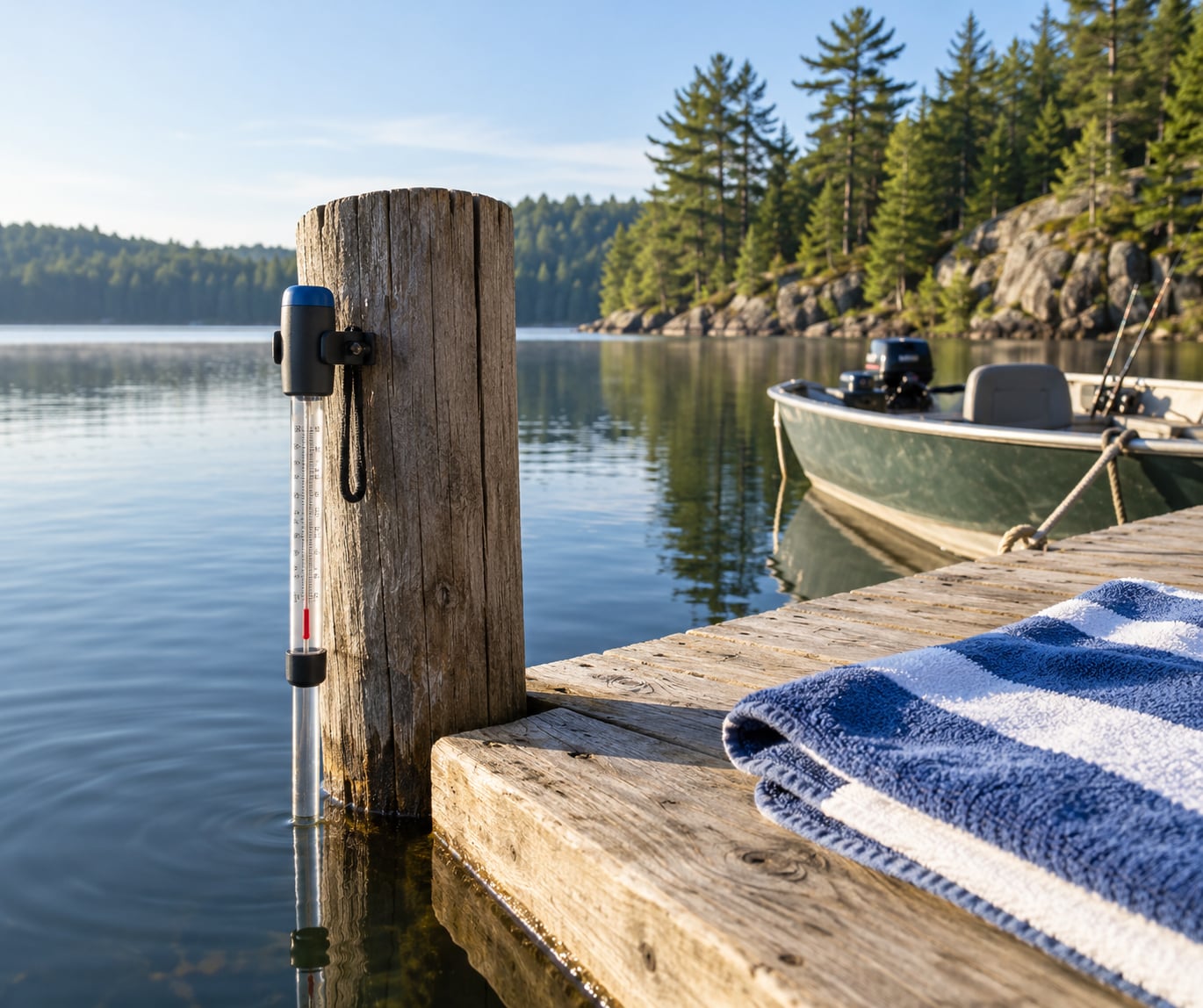
State environmental agencies, the USGS, NOAA’s Great Lakes Environmental Research Laboratory and the EPA Water Quality Portal all publish readings for monitored lakes. Many smaller lakes have a county or township gauge, and some have a live buoy reporting surface temperature continuously. Search the lake name plus water temperature or gauge, and look for a date on the reading. A number with no date is useless.
2. Check for an active swim advisory
Do this the same week you check the temperature. Search your state or county name with cyanobacteria or blue-green algae advisory. An advisory on a warm lake overrides any temperature-based plan you made.
3. Match the month to the activity you actually care about
Swimming points to mid-July through early August. Boating and paddling point to late May through June. Trout fishing points to spring and late fall. Bass and panfish point to spring and early fall. Pick the month for the main thing, and accept that the secondary thing will be a compromise.
4. Find out the lake’s depth and size
This is what separates July from August. Shallow and small means July. Deep and large means August, and often a warm September. Look for the lake’s maximum depth in a state lake finder or a bathymetry map; it is usually a single number and it does more work than any other piece of information you can find.
5. Book a backup month
Weather runs ahead of the calendar some years and behind it in others. If your trip can move, pick a primary week and a secondary week three weeks apart. The middle of the week beats the weekend if you have any flexibility at all.
6. Set your tolerance before you book
If cold-water swimming is not part of why you go to a lake, pick a lake that reliably passes 70F in your target month. That single filter removes most of the disappointment people describe in forums, and it removes far more lakes than latitude does.
Frequently Asked Questions
What month is lake water the warmest?
For most US lakes, late July to early August. Shallow ponds and small lakes usually peak in the last week of July, while deep basins and the Great Lakes tend to peak in early to mid-August. Lake Michigan is a typical example, with July water in the mid-60s to low 70s and the warmest point landing near August 10. Remember these are climatological averages, not a reading for your trip date.
How warm should a lake be to swim in?
About 70F (21C) is the practical floor for most adults, and 75F to 80F (24C to 27C) is genuinely comfortable for a long swim. Olympic competition water is set at 77F (25C). Below 60F (15.5C), cold water shock on entry is a real risk for almost everyone, and a wetsuit is not optional.
Is 70 degrees warm enough to swim in a lake?
Yes. At 70F (21C) most people can get in without a wetsuit and stay in for a reasonable length of time, though the first minute can still bring a sharp intake of breath. It is the number most cold-tolerant open-water swimmers use as their lower limit, and it is a practical one for a short or casual swim.
Is 75 too cold to swim in a lake?
No. Seventy-five degrees Fahrenheit (24C) is not cold, it is comfortably warm, and plenty of people swim it for an hour without thinking about the temperature. If 75F feels startlingly low to you, you have probably been swimming in a pool or a tropical lake rather than a freshwater one.
Which lake has the warmest water?
Shallow, southern, slow-moving lakes warm first and hold their heat longest, so Florida and the Gulf Coast generally win for absolute water temperature. The warmest large lakes tend to be deep, low-latitude reservoirs rather than shallow ponds, because a big mass of water stores heat well. Mountain and glacier-fed lakes are the opposite case and may never exceed the 50s and low 60s.
Do I need a wetsuit for 70 degree water?
Usually not. At 70F (21C) a wetsuit is optional for a casual swim and a bad idea for a long one, since you will overheat. Open-water swimmers describe 59F to 64F (15C to 18C) as the range where a wetsuit turns an unpleasant dip into a usable one. For children, a flotation vest matters more than a wetsuit at any temperature.
Start With Your Lake’s Typical Water Temperature
Before you book anything, find one number: what your lake’s surface typically reads in the month you want to travel, and the lake’s maximum depth. Depth tells you whether to aim for July or August. The regional table above tells you roughly when the season runs. Then check a live reading and any cyanobacteria advisory in the week you leave, because averages are not a forecast.
Pick the month that matches the activity you actually care about, not the month with the nicest weather. If swimming is the reason, mid-July through early August is the answer almost everywhere north of the Deep South. If it is boating, quiet mornings, or trout, you have a much wider window and better odds of an uncrowded trip.
And keep a shoulder-season week in reserve. A week either side of your target month costs you a few degrees of water temperature and buys you space, lower rates, and weather that is easier to enjoy at 6pm.