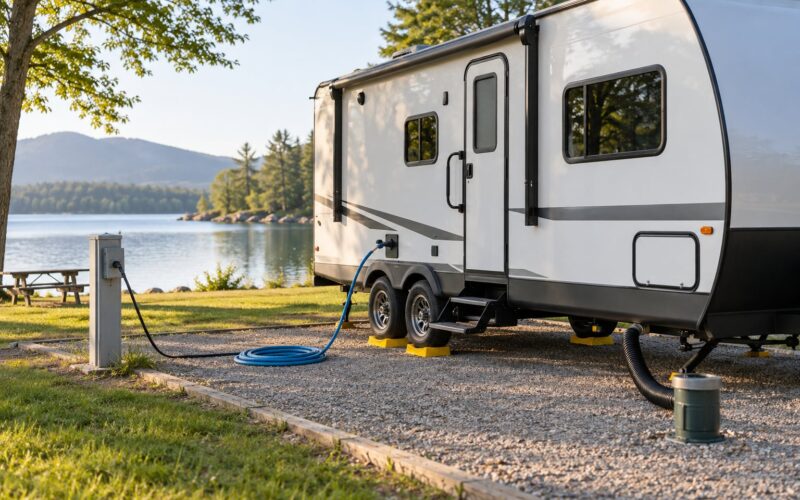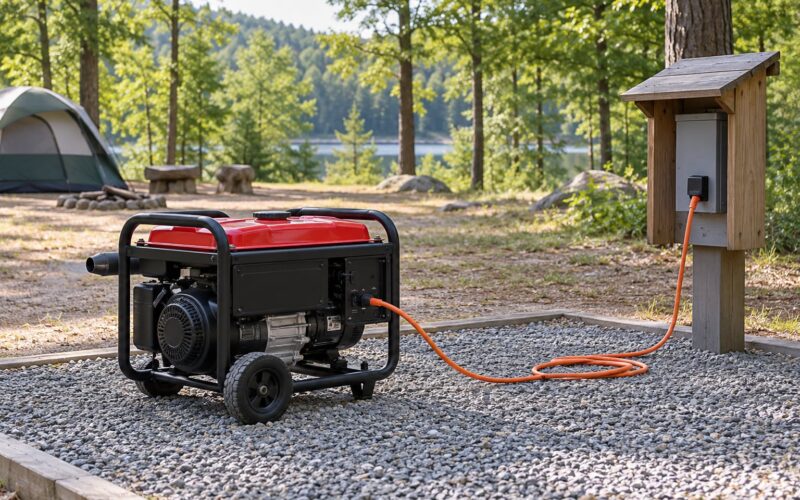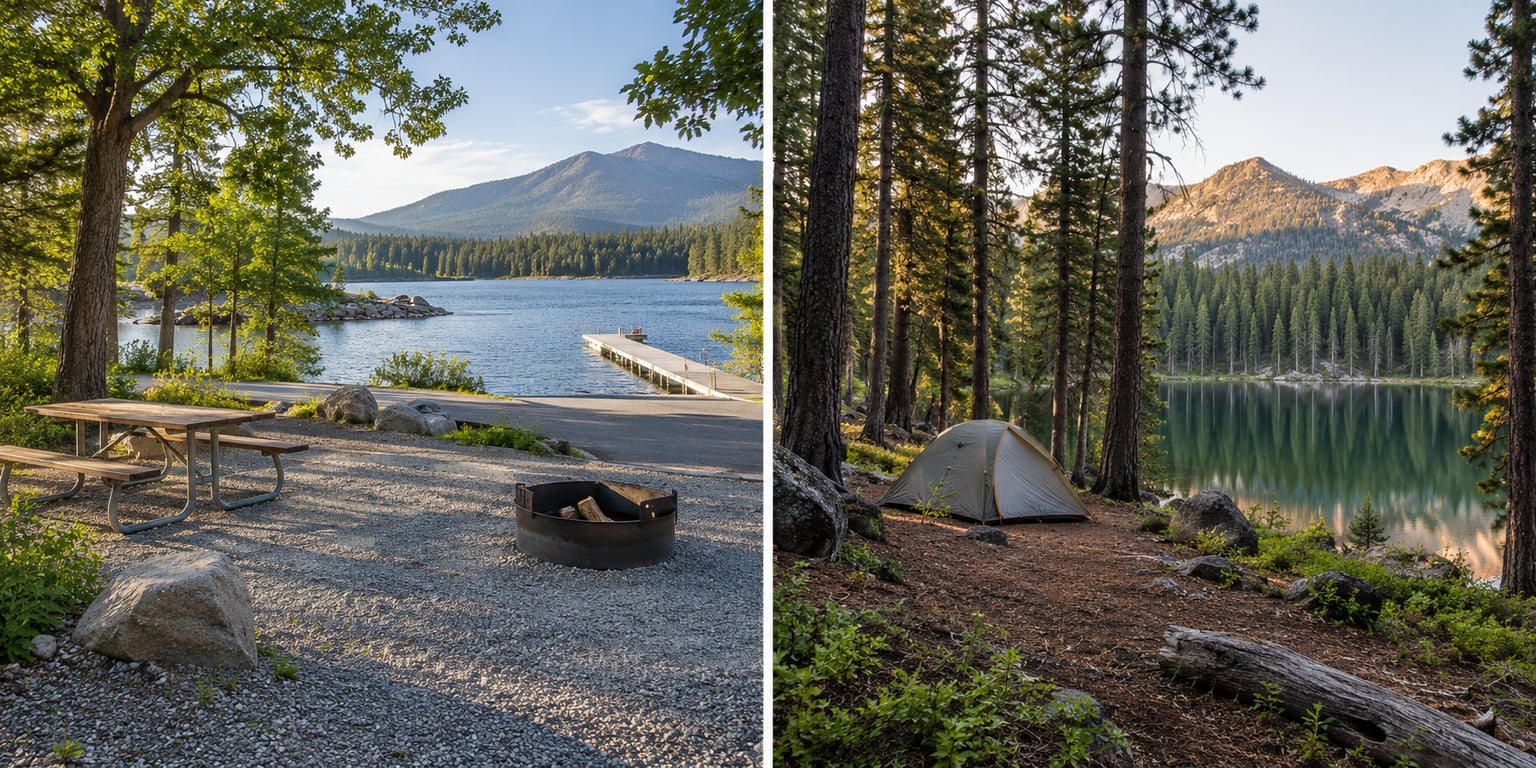
The difference between a state park and a national forest campground comes down to who runs the land and what they built for you. A state park campground is a developed, reservable site run by a state recreation agency, usually with restrooms and paved access. A national forest campground is a USDA Forest Service site on multiple-use public land, usually simpler, cheaper and far more often walk-up.
Pick the state park if you want showers, hookups and a guaranteed site. Pick the national forest campground if you want quiet, space, and don’t mind bringing your own water.
Both charge a site fee, both have rules about fires and pets, and both can put you on a beautiful lake shoreline. The practical details differ enough that booking the wrong one is the most common trip mistake I hear about, so here is how each system actually works in 2026.
Table of Contents
- 1Difference Between a State Park and National Forest Campground at a Glance
- 2Who Manages the Land?
- 3Terms that get mixed up
- 4What Kind of Camping Experience Do They Offer?
- 5Which Has Better Amenities and Facilities?
- 6What You Can Count On at a State Park Campground
- 7How Do Reservations, Fees, and Booking Work?
- 8What to do when a forest campground is full
- 9Which Is Better for Families, Anglers, and Boaters?
- 10State Park or National Forest Campground: Which Should You Choose?
- 11Frequently Asked Questions
- 12Can you camp in both a state park and a national forest?
- 13Are national forest campgrounds usually less developed?
- 14Do state parks allow fishing and boating more often?
- 15Can I reserve a national forest campground online?
- 16Are pets allowed at state parks and national forests?
- 17Is a national forest campground the same as a national park?
- 18Conclusion
Difference Between a State Park and National Forest Campground at a Glance
| Factor | State park campground | National forest campground |
|---|---|---|
| Who manages it | A state agency, such as a state parks department or state recreation department | The USDA Forest Service, part of the Department of Agriculture |
| Core mission | Recreation and preservation, with visitors as the priority | Multiple use: timber, wildlife, grazing and recreation together |
| Typical setting | Named park with a lake, beach or scenic feature at its center | A large tract of forest and mountain land, often 100,000 acres or more |
| Campground style | Developed sites on paved loops, often numbered | Everything from developed loops to one-lane gravel spurs and dispersed sites |
| Restrooms and water | Flush or vault toilets, and water hookups at many sites | Vault toilets at some loops, nothing at most primitive sites |
| Electric hookups | Common at developed sites, including 30 and 50 amp service | Rare. Only a small number of forest campgrounds have any electricity |
| How you book | Reserve online through the state portal or a booking vendor, often months ahead | Mostly first-come, first served; a minority reservable through Recreation.gov |
| Stay limit | Varies by state and park, commonly a night cap of two to three weeks | 14 days at one site, though individual campgrounds shorten it |
| Fee structure | Site fee plus a separate day-use or entrance fee for the park | Often a single site fee, and many dispersed camping areas charge nothing |
| Pets | Usually allowed on leash, sometimes an extra pet fee, often restricted at beaches or pavilions | Generally allowed, commonly leashed in developed areas and campgrounds |
| Fires | Fire ring rules, seasonal bans, and strict quiet hours | Fire ring rules and seasonal bans too, with more discretion in dispersed areas |
| Hunting and fishing | Hunting usually prohibited; fishing governed by the state wildlife agency | Hunting usually allowed under state rules; fishing governed by state wildlife agency |
| Road access | Paved or graded access, easy trailer sites | Gravel, dirt and high-clearance roads, with some routes closed seasonally |
| Best trip fit | Families, first-timers, RV travelers, anyone who needs hookups | Boondockers, anglers, dog owners, solitude-seekers, off-road campers |
Who Manages the Land?
A state park belongs to a state government and is run by that state’s parks or recreation department. The agency’s job is to get you there safely and give you a good weekend, so it spends its budget on roads, restrooms, playgrounds, dump stations and reservation systems.
A national forest campground sits on land managed by the USDA Forest Service under a multiple-use mandate. That mandate means the land is managed for timber production, wildlife habitat, grazing, watershed protection and recreation all at once, which is why you sometimes drive through a clearcut with a thin strip of new trees and a campground at the edge of it.
That open, managed look confuses people. A flat meadow with a gravel bar and widely spaced ponderosa pines is often the result of prescribed fire and thinning, not neglect. State parks tend to look more curated for a single afternoon of visitor comfort.
A short history explains most of it. The Forest Reserve Act of 1891 set aside national forest land, the Forest Service was created in 1905, the National Park System followed in 1916, and the multiple-use principle was written into law through the Wilderness Act of 1964 and the National Forest Management Act of 1976.
Terms that get mixed up
- State park — state-owned land built around recreation and preservation.
- State forest — state-owned land managed much like a national forest, with timber as a major product.
- National forest — federal land under USDA Forest Service multiple-use management.
- National park — federal land under National Park Service protection, where hunting and extractive uses are largely barred.
- National grassland — federal land managed under the same multiple-use rules, mostly in the Great Plains.
- National recreation area — federal land managed for recreation, but with far looser protection than a national park.
- Wilderness area — the most protected designation, where motorized camping and fires are both prohibited.
What Kind of Camping Experience Do They Offer?
A state park campground is built. You pull into a numbered site beside a neighbor, park on pavement or a packed gravel pad, and walk thirty yards to a restroom. The experience is predictable, which is exactly why families like it.
A national forest campground is less uniform. Some forest campgrounds look much like a small state park, complete with a loop road and flush toilets. Others are a dozen pull-outs on a dirt road with a vault toilet at the trailhead and nothing else. Still others are simply a meadow you can pull into, where you choose your own spot.
That last option is dispersed camping, and it is the defining feature of forest land. You camp outside a developed site for free, usually for up to 14 days, as long as you stay on durable surfaces and off the Motor Vehicle Use Map routes that prohibit driving. Most states have their own rules on this, and a few are stricter than the federal baseline.
On r/LifeProTips, the summary that shows up most often is that state and national parks are developed recreation sites while national forests are much more rugged. That is a fair shorthand, but it describes the average better than it describes any single campground.
Which Has Better Amenities and Facilities?
State parks win on amenities, and it isn’t close. Electrical service, water hookups, flush toilets, showers, picnic shelters, playgrounds and paved walking paths are normal rather than exceptional. Many also have a boat ramp, a fish-cleaning station, a marina store and a dump station on site.
National forest campgrounds are not always bare ground. A handful of larger developed campgrounds across the Forest Service system have electrical hookups and even individual water hookups at each site. Treat those as the exception worth planning a whole trip around, not as the standard to expect.
What You Can Count On at a State Park Campground
On the state park side, check for four things before you book: a restroom type you can live with, water at the site or an access point, electricity if your rig needs it, and a site length that fits your rig with a slide-out deployed. Those four answers are all on the individual campground page, and they matter more than the scenery.
On the forest side, assume you bring your own water, pack out what you pack in unless bins are provided, and download the map before you lose signal. Cell service is inconsistent in forest campgrounds in a way it rarely is in a state park, and that is a real safety consideration on remote roads.
Firewood is the other quiet difference. State parks in some states restrict or ban outside firewood to slow the spread of invasive insects, and they may sell certified local wood on site. National forest land is a different story: many forest campgrounds encourage you to gather dead wood nearby and pack out what you do not burn.
How Do Reservations, Fees, and Booking Work?
State parks run on reservations. Most states use their own booking portal or a contracted vendor, and popular campgrounds open their books a fixed window ahead, usually six months or so. Fill the window for a Friday-in-summer arrival and you are competing with reservation systems that stagger release times by site type.
National forest campgrounds mostly run on first-come, first served. That is the phrase campers see as FF on signs and reservation pages, and it means no booking exists at all. A related thread on r/GoRVing covers the habit of holding a booking or two open as a spontaneity buffer between planned destinations, which is a reasonable approach when you cannot rely on walk-up inventory.
Some forest campgrounds are reservable, and those use Recreation.gov. A few also take reservations through the local ranger district office. The honest answer, and the one most forum readers say they could never find stated plainly, is this: you have to check the individual campground page, because the booking model is set site by site rather than system wide.
Stay limits differ in a way that can break an itinerary. Federal campgrounds follow a 14-day standard at one site, and many individual campgrounds cut that to seven nights in the busy season. State parks set their own limits, commonly around 14 to 21 days, and some require a second reservation or a permit extension once you hit the cap.
Fees are structured differently too. A state park typically separates the camping fee from the park’s day-use or entrance fee, so you can pay one for a three-night stay and another for every person you bring. National forests often charge a single flat site fee, and dispersed camping is frequently free.
Passes work the same way. A state park annual pass pays off if you camp at the same heavily visited park several times a year. The federal America the Beautiful annual pass covers entrance fees at national parks and federal recreation areas, but most national forest campground site fees, and it does not cover state parks at all. Check which side of that line your actual trip falls on.
What to do when a forest campground is full
- Walk the whole loop before you give up, including sites marked for a different type of camping.
- Ask the host or ranger station whether a walk-up campsite exists anywhere in the same recreation area.
- Check the map for a nearby forest campground on a different forest highway rather than the main scenic route.
- If dispersed camping is legal in that drainage and you have a self-contained rig, move to a dispersed site and set up properly.
- Check for a nearby state park as a fallback, and reserve it before you drive out rather than gambling on another walk-up.
Which Is Better for Families, Anglers, and Boaters?
Families with young kids usually belong in the state park campground. Shorter walks to the restroom, playgrounds, a beach that is a sidewalk away from the site, and a booked spot are the whole point. The tradeoff is noise and neighbors, plus quiet hours that are genuinely enforced at many state parks.
Anglers get a mixed picture. Water quality is usually excellent on both, since state park lakes and forest lakes are frequently the same lake with a different shoreline. The difference is convenience. State parks are more likely to have a paved ramp, a dock, a fish-cleaning station and a place to park the truck, and they are more likely to stock trout or keep a tighter creel limit under the state wildlife agency.
Boaters face the same tradeoff. State parks usually put the ramp close to the campground loop. Forest campgrounds near a reservoir can put you on great water with no ramp at all, which means a trailered boat and a long carry.
One more thing anglers should know: a forest campground near a river can be closed entirely or have the fishing access limited during spawning seasons, because the multiple-use mandate that allows hunting also brings wildlife closures. State park lakes are more predictable year round.
Pet owners get an easier time at national forests, where leash rules are common but breed restrictions and pet fees are rarer. Facebook RVer groups turn into a long thread on this exact question, and the pattern holds: forest campgrounds welcome dogs more freely, state parks charge more and restrict them more at pavilions and swim beaches.
State Park or National Forest Campground: Which Should You Choose?
Match the campground type to what your rig actually needs.
- Full-time RV or motorhome — state park. You want a site long enough to deploy slides, a 50 amp pedestal and a dump station you can reach without moving the rig.
- Family with young children — state park. Bathrooms, playgrounds and short walking distances are not a nicety at that age.
- First-time camper — state park. A booked site with a marked pad and a working restroom removes almost every way a first trip goes wrong.
- Dog owner — national forest campground, unless you need hookups.
- Angler or boater — state park for convenience, forest campground for a quieter shoreline and a longer weekend.
- Solitude-seeker — national forest, ideally midweek or in the shoulder season.
- Off-road or high-clearance camper — national forest. Some forest roads are unmaintained, and that is the point.
- Budget camper with a self-contained rig — national forest. Site fees are lower and dispersed camping is often free.
Five quick checks settle it. Do you need electricity? Go state park. Do you have a reservation? If not, go state park, because walk-up inventory is not a plan. Do you have a trailer under about 25 feet? Go national forest. Are you bringing kids or a mobility device? Go state park. Do you want to drive until you find an empty site? Go national forest.
Frequently Asked Questions
Can you camp in both a state park and a national forest?
Yes, and plenty of trips use both in one weekend. State parks and national forests are different agencies managing different land, so they run separate reservation systems, rules and fees. A common route is a developed state park site for the amenities night one and a forest campground or dispersed site for solitude on nights two and three.
Are national forest campgrounds usually less developed?
Yes. The average Forest Service campground is a gravel loop with vault toilets, a fire ring and a picnic table, if even that much. A minority of larger forest campgrounds have electrical service, flush toilets and running water. Some Forest Service land has no designated campground at all, which is where dispersed camping comes in.
Do state parks allow fishing and boating more often?
Fishing is widely allowed at both, under the same state wildlife agency rules for licenses, species and creel limits. Boating access is where state parks usually win, because paved ramps, docks and trailer parking are more common in a developed park. A forest campground on a reservoir can put you on excellent water with no ramp at all.
Can I reserve a national forest campground online?
Some of them, yes. Reservable forest campgrounds book through Recreation.gov, and a few also take reservations through the local ranger district office. Most are first-come, first served with no booking available, so check the individual campground page before you drive out. The booking model is set site by site, not system wide.
Are pets allowed at state parks and national forests?
Dogs are generally welcome at both, usually on leash. National forests lean more permissive, with fewer breed restrictions and fewer pet fees. State parks more often add a per-pet charge and restrict dogs at beaches, pools and group pavilions. Leashed dogs are standard at both, and it is common to see pets excluded from a single loop entirely.
Is a national forest campground the same as a national park?
No. A national park is National Park Service land managed mainly for protection, where hunting and commercial timber are largely excluded. A national forest campground is USDA Forest Service land managed for multiple use, which is why timber harvest, grazing and hunting are allowed alongside camping. That mandate is the core of the difference between a state park and a national forest campground too.
Conclusion
The difference between a state park and a national forest campground is the mandate behind the land. State parks are built for a comfortable visit and sold by reservation. National forests are managed for many uses at once, which means simpler sites, walk-up camping, cheaper nights and more freedom, with less certainty.
Start with the individual campground’s official page, not the agency overview. Check the restroom type, whether electricity and water reach the site, how it books, the stay limit and the seasonal fire restrictions. Those five answers settle the choice faster than any amount of scenery description.