Most first-timers stand up on a paddleboard the same way: you start on your knees, take a stroke or two for momentum, lay the paddle across the board, bring your feet up one at a time into a squat, and raise your chest before your legs. Done in calm, shallow water, that whole sequence takes about ten minutes. Nobody pops straight up from kneeling, and the ones who look effortless just spent an hour on their knees first.
If you have been stuck kneeling and quietly wondering what you are doing wrong, the fix is almost always one of four things: locked knees, feet too close together, eyes on your feet instead of the horizon, or standing without any forward momentum. Each one is easy to correct once you know to look for it.
Before you get in the water, check the gear and the conditions below. It is a five-minute checklist that saves you from the two beginner errors nobody warns you about, a board pumped up too soft and a lake with more boat traffic than you expected.
Table of Contents
- 1What You Need
- 2Step-by-Step: How to Stand Up on a Paddleboard for the First Time
- 3Start in a Safe Position
- 4Find Your Stance
- 5Stand Up Slowly
- 6Take Your First Strokes
- 7What to Do If You Fall In
- 8Standing Up with Bad Knees or Limited Mobility
- 9Common Mistakes
- 10Tips for Your First Paddleboard Session
- 11Frequently Asked Questions
- 12Can I learn to stand up on a paddleboard by starting on my knees?
- 13How long does it take most beginners to stand up on a paddleboard?
- 14Which foot should go forward when learning to stand up on a paddleboard?
- 15Is a paddleboard stable enough for a complete beginner?
- 16What should I do if I fall off while learning to stand up on a paddleboard?
- 17Conclusion
What You Need
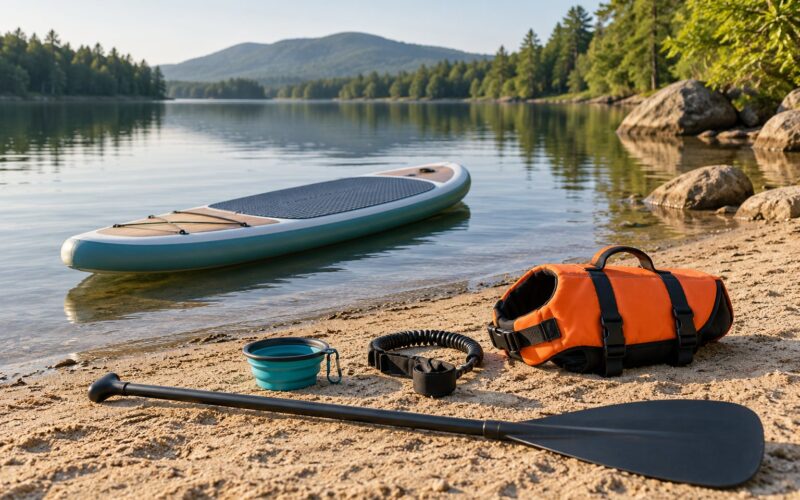
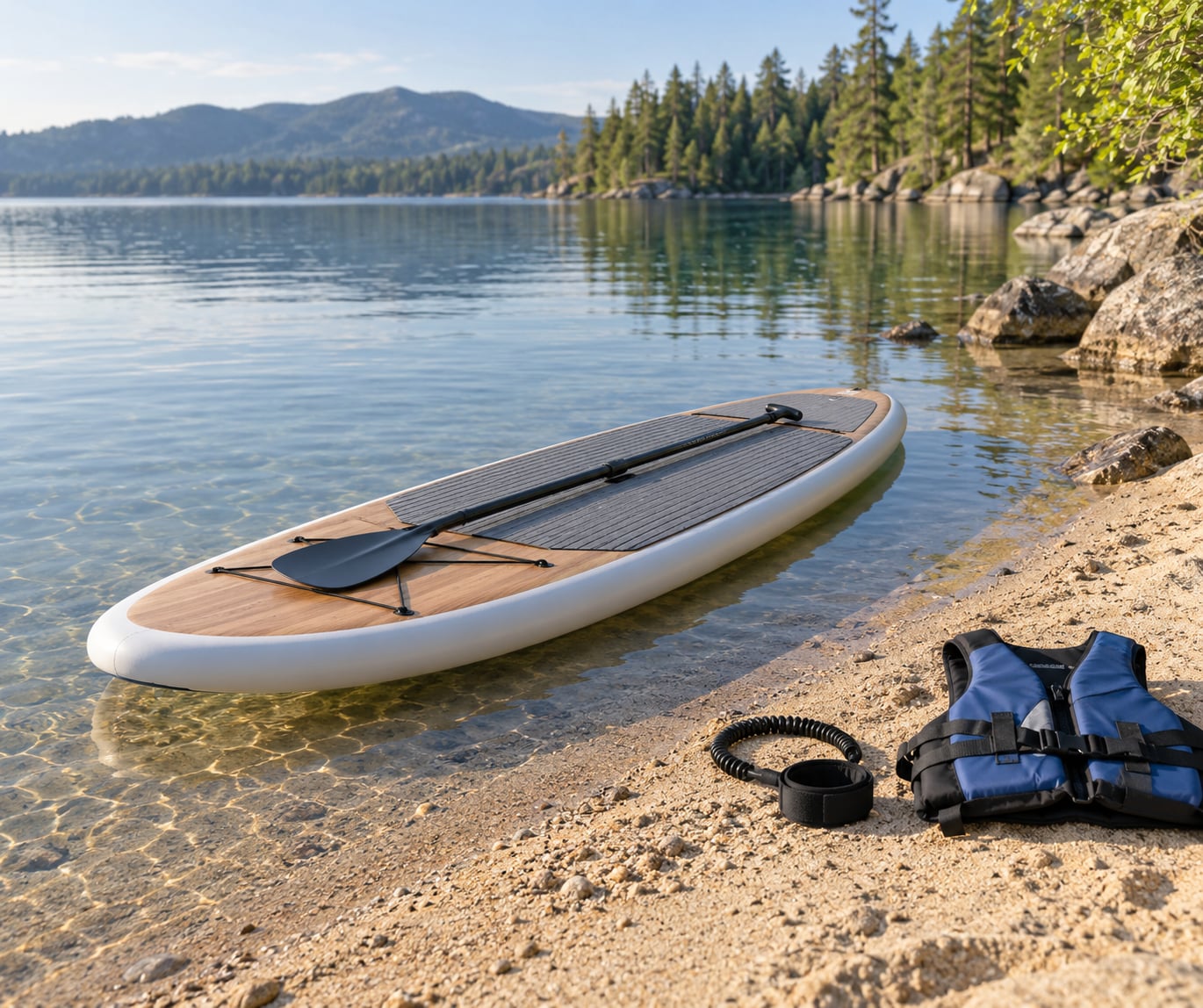
A stable board matters more than anything else you will own. For a first session, a wide, thick all-around inflatable gives you more forgiveness than a narrow surf shape, and it takes up about the same space in a car.
As a rough guide, riders under about 120 pounds get along with a 10-foot board, most adults sit comfortably on an 11-foot board, and anyone over roughly 170 pounds should look at 11 feet or longer with extra thickness. Those are starting points, not rules, and a rental shop will happily put you on something wider than you need. Wider is better for a first attempt.
Check the pressure before you launch. Inflatable boards carry a maximum PSI printed on the valve or the rail, and a soft board rocks under you in a way that feels like a balance failure but is not one. One recurring beginner diagnosis on r/Sup is a board rated for 15 psi pumped to 8, which explains a lot of wobbling that technique alone will not fix.
A few more items worth sorting:
- An adjustable paddle set roughly 6 to 10 inches taller than you are, measured from the water to the top of the T-grip.
- An ankle leash attached to the D-ring at the rear of the board and worn on the ankle closest to the water. Clipped to your wrist it is useless.
- A personal flotation device. A waist-pack style vest keeps you low and does not restrict your paddle stroke, which matters more than it sounds.
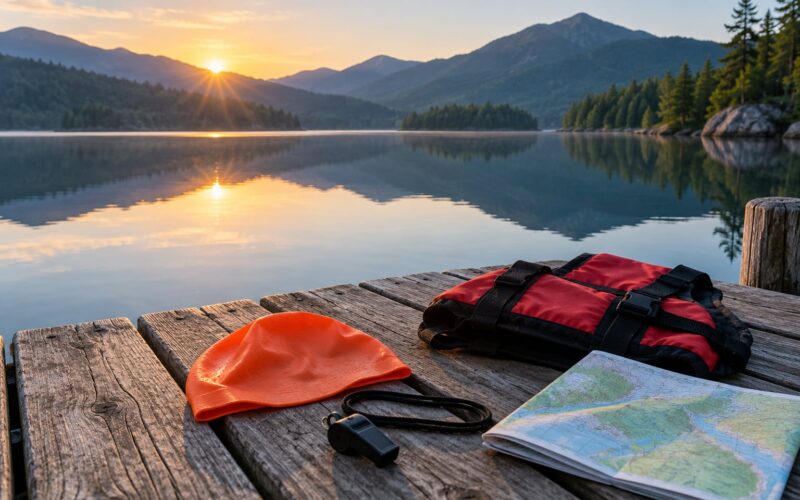
- A whistle on the PFD. On a lake, this is what gets help when nobody can hear you call.
- A non-slip deck pad and something to grip if your hands sweat, since a bare handle in wet hands is a fast way into the water.
- Quick-dry clothing, a rash guard or top, and sunscreen you will not mind soaking. You are going in the water, so plan on wet feet and wet legs for the first half hour.
For conditions, aim for flat, calm water in the morning or early evening when the wind is lightest, and pick a sandy or shallow launch where you can walk the board out instead of swimming it. Check the forecast the day before and the wind at the launch on the morning of, because lake wind builds through the afternoon faster than most people expect.
One habit is worth building from the start: paddle into the wind on the way out so the return is with your back to it. Wind on your face is much harder to manage than wind pushing you along.
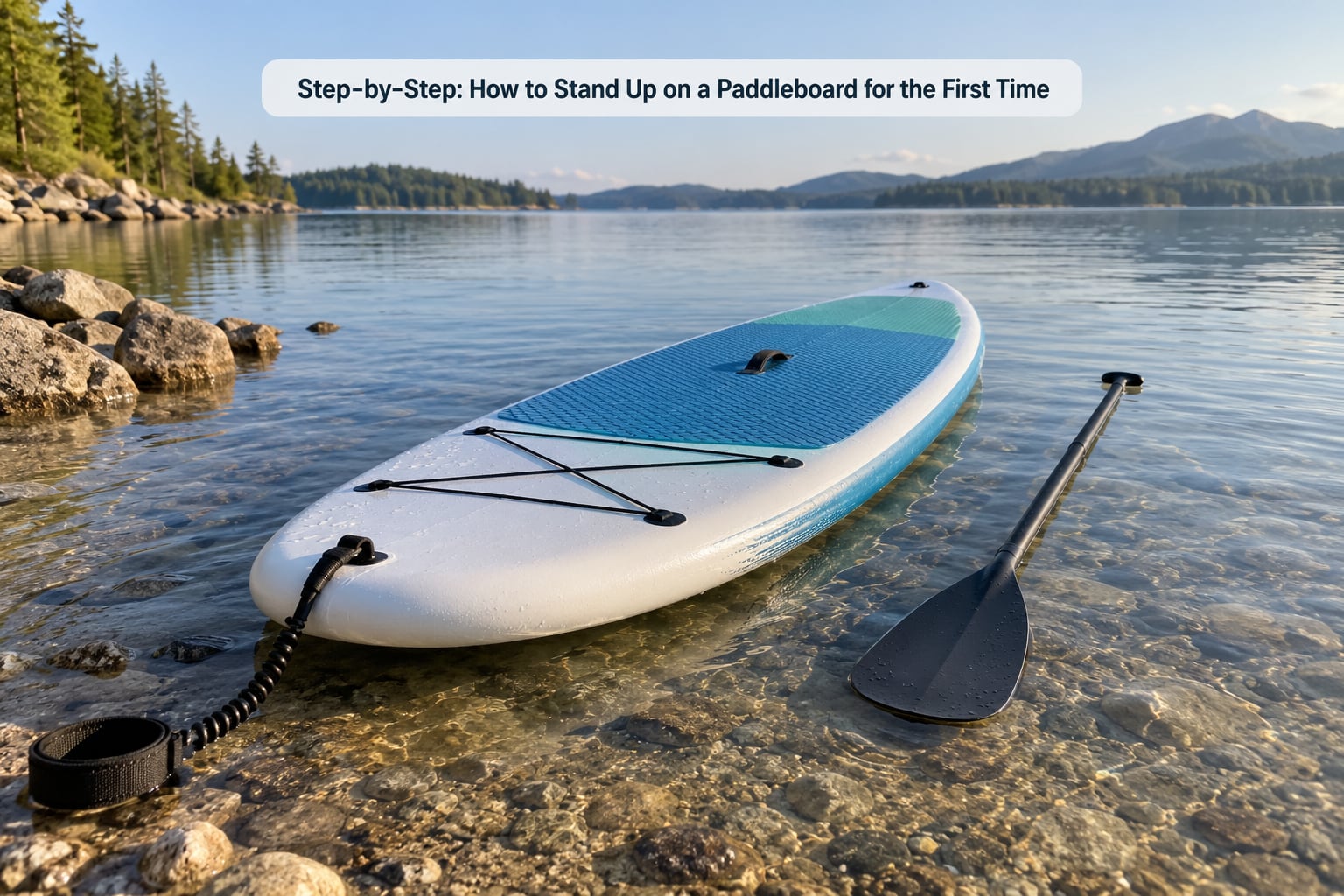
Step-by-Step: How to Stand Up on a Paddleboard for the First Time
Start in a Safe Position
Carry the board out with the leash in your hand, not clipped to your ankle until the board is floating and you are ready to launch. Then set it down parallel to the shore and walk it out into water deep enough that the fin will not touch the bottom, roughly knee to thigh deep.
Stand beside the board, hold the rail, and climb on with your hands and knees. That means one knee on the deck pad, then the other, then you sit back on your heels. Sitting back matters more than it looks. It puts your weight low and centered, and it puts the board in its most stable trim before you ask it to hold an adult at full height.
Take a few strokes from your knees. This is not the beginner’s consolation prize, it is the step where you learn how the board answers the paddle. It also settles the board and stops it drifting sideways while you think about your feet.
Before anything else, look at the water. Notice where the wind is coming from, where the current is moving you, and where the boat lane is. A calm lake with a steady breeze usually means the breeze is your friend on one side and your problem on the other.
You are done with this stage when the board glides without a lurch under your weight and you can put both hands somewhere other than the board. Stay kneeling until that is true.
Find Your Stance
There is no single right stance for everyone, and a lot of beginners get stuck because they copy a surfer’s sideways stance that does nothing for them on flat water. Use the regular stance instead: both feet pointing forward or slightly turned out, positioned about hip to shoulder width apart.
Find the carrying handle, usually a webbing loop at the center of the board, and place your feet so they straddle it. Centered on that point is centered on the board’s width, which is where the buoyancy is strongest. Feet forward of it and the nose dips. Feet back and the board stalls and bows away from you.
Stay on the deck pad, mid-board rather than near the nose or tail, and keep your weight over the stringer running down the middle. One foot a few inches ahead of the other feels more natural to some people, and there is nothing wrong with that. What you are avoiding is a narrow stance or feet set at diagonal angles, because both take away your lateral stability.
The easiest self-check is the board itself. If it noses in when you put weight on it, move your feet back. If it stops dead or tries to push you off, move them forward. Shift a few inches at a time.
Stand Up Slowly
Take one or two strong strokes on one side to get the board gliding. Momentum is doing real work here. A board with forward speed is far more stable than one sitting still, which is why the fastest paddlers on a lake are usually the steadiest.
Then lay the paddle across the board with the shaft perpendicular to the deck, resting on the rails, and hold it with both hands. It becomes a stabilizer bar, a third point of contact, and a place to put your weight when a gust hits.
Bring your feet up one at a time, flat on the deck, and stop in a squat with your knees at roughly 90 degrees. Do not straighten up yet. This squat position with the paddle across the board is the most stable place you will ever be, and rushing past it is the single most common reason first attempts end in the water.
When your hips are level and the board has stopped wobbling, raise your chest first while keeping your knees bent, then extend your legs. Chest first is the key instruction and the one people skip. It keeps your center of gravity low and forward while the board is still moving.
Imagine sliding the board underneath you rather than pulling your body up off it. A bent-knee stance gives you a little bounce that absorbs the board’s motion, and a locked-knee stance transmits every wobble straight up into your legs. Loose knees are the single best habit a beginner can build.
Then put your hand back on the T-grip and paddle. If you made it that far, you are standing up on a paddleboard. The timing varies more than people expect: many beginners manage it within 5 to 15 minutes on flat water, and a few need a second session, which is completely normal.
Take Your First Strokes
Hold the paddle with your top hand on the T-grip and your lower hand about a third of the way down the shaft. That one-handed top grip is fine and much less tiring than two hands clamped halfway down.
Plant the whole blade in the water near the rail of the board, roughly where you would reach with your arm low, and pull back to your hip while rotating your torso. The power comes from turning your chest, not from your arm. Reach forward, plant, turn, finish at your hip, recover, repeat on the other side.
Start with short, alternating strokes on whichever side you are already leaning toward. As you settle, move to one side then the other on a straight line, which is how you travel in a straight line at all.
Three strokes cover almost everything you need on day one:
- Forward stroke for going straight, pulling to your hip with a rotated torso.
- Reverse stroke for backing up or stopping, a short push with the blade angled back near the tail.
- Sweep stroke for turning, a wide arc starting at the nose and finishing at the tail.
The blade angle is what beginners get wrong. Too flat and the stroke does nothing; too vertical and you just push water straight down. If your strokes feel powerless, angle the working edge of the blade slightly away from you so it pushes water backward rather than slipping sideways.
And look ahead. The number one thing the beginner paddling communities repeat, in lesson after lesson, is that balance comes from your eyes. Look at the horizon or at the shoreline, not at the water right next to your feet.
What to Do If You Fall In
Falling is a skill you can practise, and treating it as one takes the fear out faster than anything else on this list. Most beginners freeze in a wobble because they try to ride it out. Dropping to your knees first takes a fraction of a second and is the correct response, not a failure.
Fall away from the board, not across it. Going off to the side with your legs clear of the deck avoids landing on the fin or the rail edge, and hold on to your paddle as you go down so it does not drift.
Stay with the board, because it is the largest floating object around you and the leash is your backup. Grab the rail or the carrying handle, kick your legs up behind you one at a time, and climb back on on your hands and knees. Then sit back on your heels and paddle away.
Swimming back to the board is what beginners fear most, and avoiding it entirely is a strong reason to keep the leash on. If the board is drifting away from you, it is usually because the leash is loose or clipped to the wrong place, not because the water is pulling it away.
Standing Up with Bad Knees or Limited Mobility
If your knees hurt, have had an injury, or you are returning after years off, the explosive single-leg swing is going to fight you. Use a three-point transition instead, and it works on any body.
- Both hands on the center carrying handle, arms straight, taking some of your weight off your knees.
- Place one foot flat on the deck beside the handle, knee bent, and stop there. Shift your weight onto it while the hands keep you supported.
- Move the other foot into position at the same width, still in the squat, still holding the handle.
- Push gently through your arms and straighten your legs, keeping your chest up as you go.
- Drop back to the handle anytime you need a rest, then try the transition again.
Treat the handle as a handrail rather than a place to hang. You are guiding the rise, not hoisting yourself with it, and if you push too hard you will tip the board.
Common Mistakes
Almost every “I can’t stand up” moment has a specific, fixable cause. These are the ones that come up again and again.
Standing too fast, in one motion. The fix is to split the move in two. Chest up with knees bent, pause, then legs. A single pop-up puts your weight high before the board has settled.
Standing near the nose or the tail. Both ends have far less buoyancy under them than the middle. Move your feet until you are straddling the center handle, mid-board on the deck pad.
Locking your knees. Locked legs act like a rigid post and every wobble travels straight into your upper body. Keep a soft bend in them the entire time you are standing.
Looking down at your feet. This is the mistake that ruins the most first attempts. Your inner ear balances you using the horizon, and looking down removes the reference. Eyes forward, always.
Feet too close together. A narrow stance gives you almost no side-to-side stability. Open to hip or shoulder width and let your toes angle out slightly.
Standing without any momentum. A stationary board tips with the smallest lean. One or two strokes before you rise makes the transition far easier.
Surf stance on flat water. A sideways, knees-forward stance works for riding waves. On flat water, stand regular with feet pointing forward and hands on the T-grip.
Holding the paddle like a broomstick. Two hands wrapped halfway down the shaft gives you no leverage. Top hand on the T-grip, lower hand a third down.
An under-inflated board. A soft board flexes and rolls under your weight and feels like a balance problem. Inflate to the maximum PSI printed on the board.
Using the leash wrong. It goes on the ankle closest to the water and clips to the rear D-ring. Clipped to your wrist it does nothing for a drifting board.
Ignoring wind or current. Check both before you launch, and if either is picking up, kneel and paddle or come back in. Flat calm water is not a rule of thumb, it is the whole point of the first session.
Paddling with far too much force. Beginners often throw everything into the first strokes, which throws the board around more than a gentle glide. Short strokes, softer grip, calmer rhythm.
A few symptoms are worth mapping to their cause directly:
- Wobbling constantly even while kneeling: the board is likely under-inflated, or the water is choppier than you thought. Check pressure, then conditions.
- Board noses in when you step up: your weight is too far forward. Move both feet back toward the tail by a few inches.
- Board stalls or bows away from you: your weight is too far back. Move forward toward the center handle.
- Falling backward the instant you stand: your weight is behind your feet. Lean slightly forward over your toes, like a ski jumper’s position.
- Strokes feel powerless: your blade angle is too flat, or you are pulling with your arm instead of rotating your torso.
- Everything feels shaky after standing: your knees are locked, or you are still looking down. Soften the knees and lift your gaze.
Tips for Your First Paddleboard Session
Pick a pond, a small lake, or a sheltered cove rather than open water. A sandy wade-in beach is worth driving past a dock launch to find, because you want to be standing in knee-deep water with nothing slippery under your feet.
Go early. Calm morning water means glassy surface, no boat traffic, and cooler air if you do fall in, which matters more in a lake than most beginners expect.
Take breaks before you are tired. Twenty minutes on your knees and a few minutes standing is better than an hour of wobbly paddling that ends with a fall you did not see coming.
Keep the paddle within reach at all times, laid across the board between strokes. Beginners who drift a few feet from their paddle are the ones who freeze.
Practise kneeling down and standing back up a few times before you paddle out into deeper water. Getting up is a movement, and movements get easier through repetition, not through thinking about them.
Take a lesson or go with an experienced friend if you can. The physical skills are learnable on your own, but a lake has boat lanes, drop-offs, and sudden wind that take a few hours of local knowledge to read properly.
Do not progress until standing feels boring. Once you can stand, paddle a straight line, and stop without thinking about it, then try longer paddles and a little wind. That is the order of difficulty that works.
And expect to be sore the next day. A short first session works your core, back, and shoulders hard, because those are the muscles holding you up on the board rather than driving it.
Frequently Asked Questions
Can I learn to stand up on a paddleboard by starting on my knees?
Yes. Starting on your knees is the normal first position, not a shortcut or a failure. Kneeling is far more stable, it lets you learn how the board answers your paddle, and it keeps your weight low while the board settles. Learning how to stand up on a paddleboard for the first time starts with a few kneeling strokes, then the rise from there.
How long does it take most beginners to stand up on a paddleboard?
On flat, calm water most first-timers manage it in 5 to 15 minutes, and many are standing and paddling a straight line inside half an hour. A few people need two sessions, usually because they practised in wind or chop. If you have been kneeling for 30 minutes, step off, check your board pressure, and try again on a calmer day.
Which foot should go forward when learning to stand up on a paddleboard?
Either one, and it barely matters. What matters is that your feet straddle the center carrying handle, sit hip to shoulder width apart, and land mid-board on the deck pad with your weight over the centerline. If your board noses in, move both feet back a few inches. If it stalls, move them forward.
Is a paddleboard stable enough for a complete beginner?
A wide, thick, properly inflated all-around board is stable enough for almost anyone, which is why board width matters more than length. The wobble you feel when you first stand is normal and fades as your knees soften and your eyes stay on the horizon. A soft board feels unstable no matter who rides it, so check the PSI first.
What should I do if I fall off while learning to stand up on a paddleboard?
Fall away from the board rather than across it, hold onto your paddle, and stay with the board, which is the biggest floating object around you. Grab the rail or the carrying handle, kick your legs up behind you one at a time, and climb back on. Practising falling and climbing back on is what removes the fear for most beginners.
Conclusion
Your first job is not to stand, it is to pick calm water, a properly inflated wide board, a leash, and a PFD. Then run the sequence slowly in that order: kneel, paddle for momentum, lay the paddle across the board, bring your feet up one at a time into a squat, raise your chest, and only then straighten your legs.
Keep your knees soft and your eyes on the horizon. When you can hold that stance without thinking about it, add distance and a little wind, and only after that.