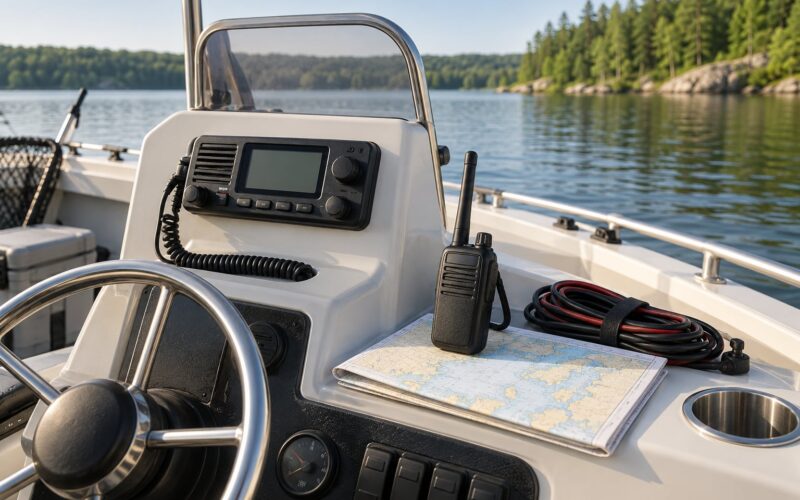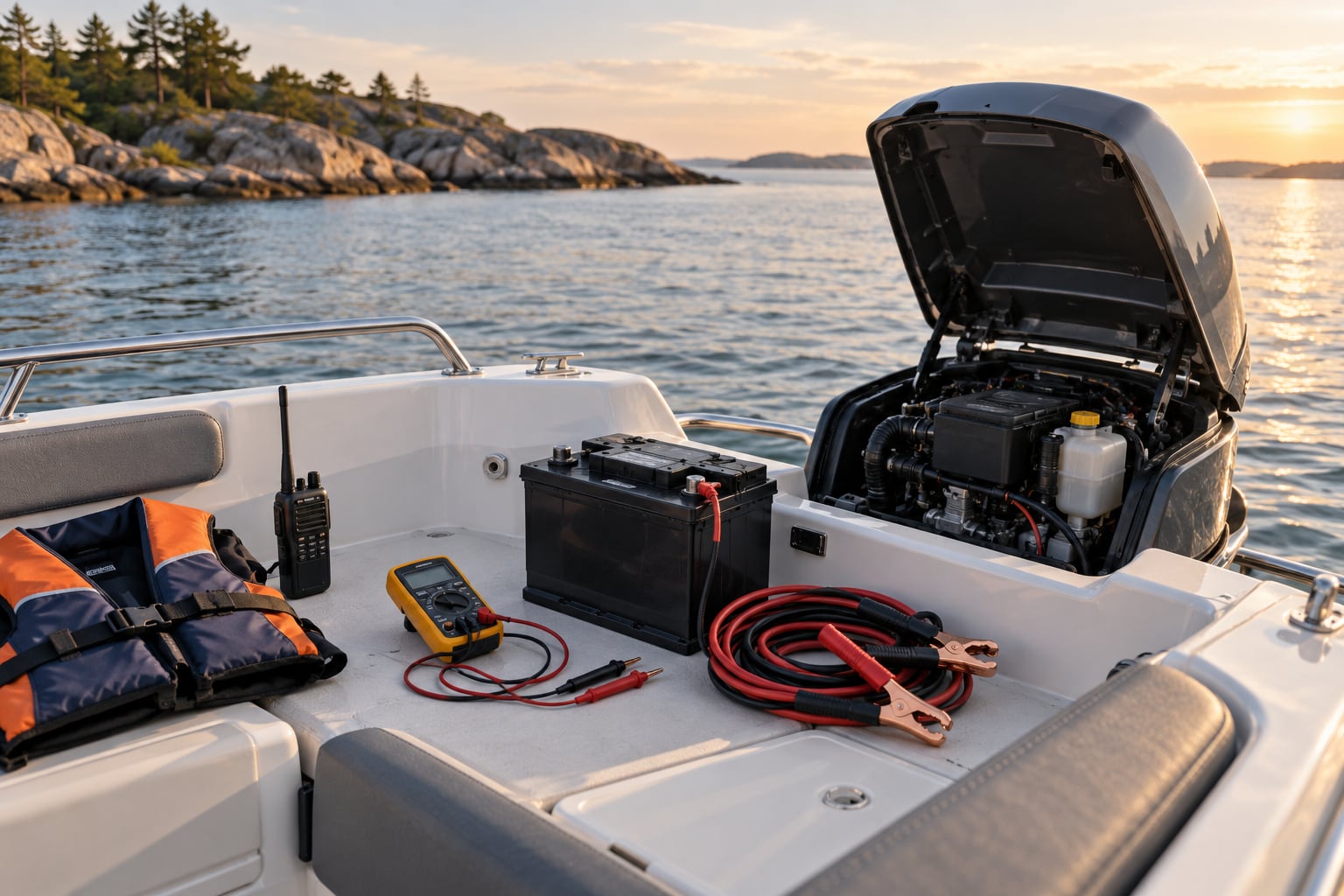
If your engine will not start away from the dock, the first thing to do is anchor, get a life jacket on everyone aboard, and stop drifting toward rocks, shoals or a busy channel. Then work the problem in order: connections, battery switch, voltage test, backup power. Knowing how to deal with a dead battery on the water is mostly about staying put safely while you diagnose, because the fix itself is usually simple.
A flat battery offshore is one of the most common reasons boaters end up calling for a tow, and most of those calls were preventable. In forum threads on r/boating and thehulltruth.com, the same pattern repeats: both batteries died because of a wiring fault, an accessory wired around the battery switch, or corrosion on a terminal that looked fine from the deck.
Here is the sequence I would follow, roughly in the order the Coast Guard would want it done. It assumes you are anchored or otherwise holding position, because nothing else on this list matters if the boat is moving toward something solid.
Table of Contents
- 1What You Need
- 2Step-by-Step
- 3Step 1: Signal for help and make the boat safe
- 4Step 2: Check the battery and connections
- 5Step 3: Test the battery safely
- 6Step 4: Reconnect, jump-start, or use a backup source
- 7Step 5: Restart the engine and monitor charging
- 8Step 6: Return to shore or arrange a tow
- 9How to deal with a dead battery on the water
- 10Common Mistakes
- 11Frequently Asked Questions
- 12Is it possible to jump start a dead boat battery?
- 13Can a completely dead marine battery be recharged or is it ruined?
- 14How can I test for parasitic draw on my boat?
- 15Does idling a boat charge the battery?
- 16How long does it take to charge a dead boat battery?
- 17How do I disconnect a boat battery safely?
- 18Conclusion
What You Need
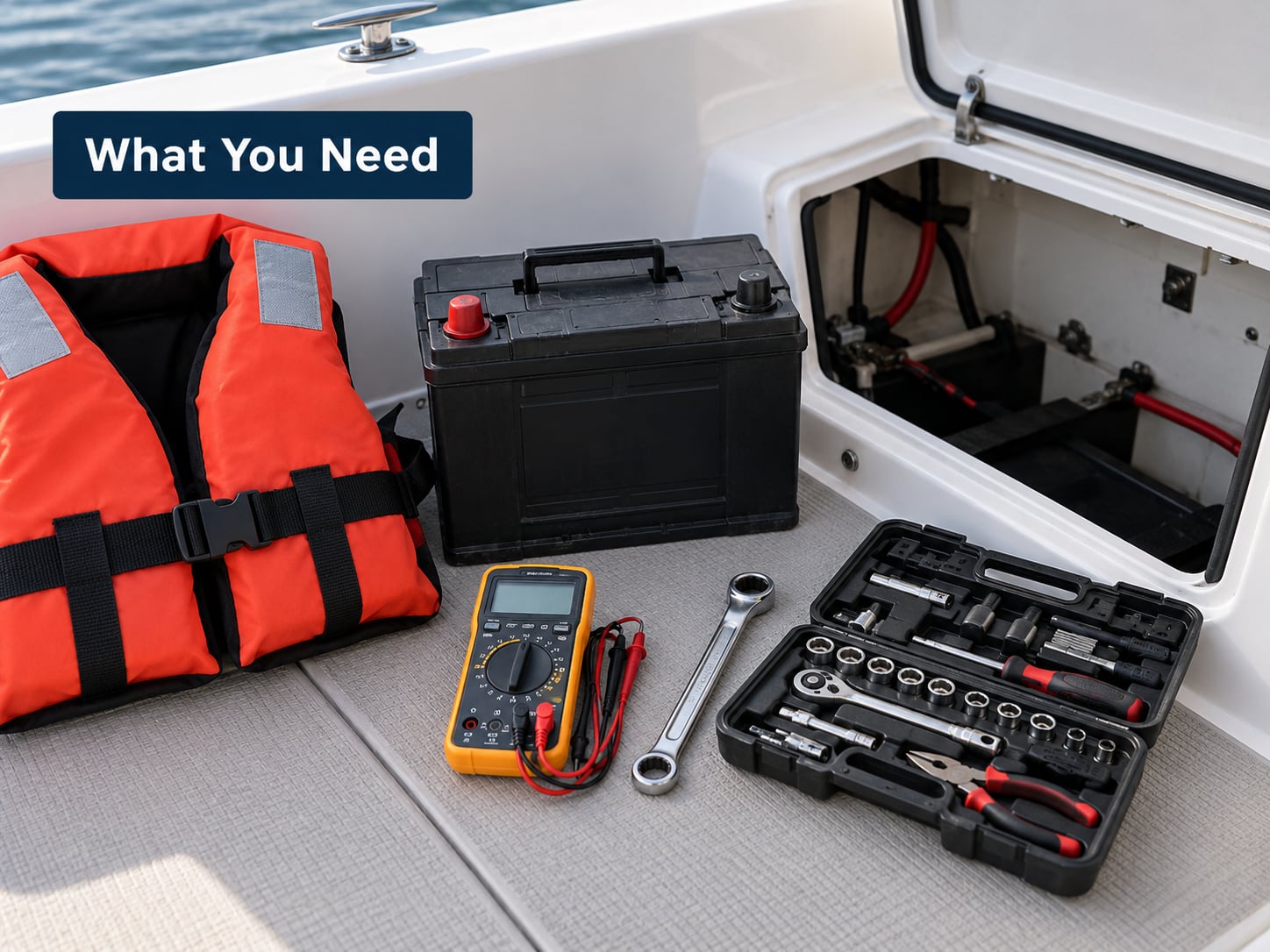
Most of this list costs nothing beyond what you already own, and half of it belongs in the boat permanently. Grab what is within reach, then work down the list as the situation demands.
- A properly worn life jacket for every person aboard. A dead battery can turn a slow drift into a fast one if you are standing on a bow fiddling with cables.
- A working VHF radio, either fixed mount or handheld. A handheld with its own battery is the fallback when the boat’s electrical system is the thing that failed.
- Anchor, chain and enough rode to hold bottom. Without it you are diagnosing while drifting, which is how a dead battery turns into a hull repair.
- A basic multimeter. A ten-dollar meter reading DC volts tells you more than any amount of guessing.
- Terminal wrench, wire brush or terminal cleaner, and dielectric grease. Corrosion is the single most common cause of a battery that reads fine and refuses to crank.
- Spare fuses in the sizes your fuse panel uses. A blown breaker or fuse is quicker to fix than a flat battery and gets mistaken for one constantly.
- A portable jump starter or spare battery, sized for your engine. For most outboards under 150 hp, a lithium pack rated 1000 amps or more gives comfortable headroom.
- Your battery’s spec sheet, or at least the amp-hour and cold cranking amp numbers. Knowing what you should be measuring keeps you from replacing a healthy battery.
- A fresh replacement battery of the same group size. Not for today unless you are close to shore, but knowing it exists saves an hour of searching.
- Boat keys and a phone in a waterproof pouch. Both are useless if they are in the bilge where the water is going.
Know where your boat’s battery switch and fuse panel are before you leave the dock, not while you are drifting toward a sandbar. On a dual battery setup the switch usually has positions marked 1, 2, 1+2 and OFF, and forum posters report that misunderstanding those labels causes more confusion than the actual fault. If you have never operated yours in open water, spend ten minutes with the owner’s manual before your next trip.
Step-by-Step
Step 1: Signal for help and make the boat safe
Put the anchor down first. If you are in less than a few feet of water or drifting toward traffic, a Channel 16 call comes before the anchor comes down. Once you are holding position, get life jackets on everyone, then post a lookout.
Kill anything that draws power without being needed: cabin lights, the fridge, the stereo, fish finders and screens you are not actively using. Save the bilge pump and any navigation equipment you need to stay safe. On a typical boat those electronics and accessories can pull more current than the radio you are relying on, and cutting them buys you hours instead of minutes.
If you have a handheld VHF, keep it on and monitoring rather than transmitting continuously. Save the battery for the call you may need to make.
Step 2: Check the battery and connections
Look before you touch. Greenish-blue or white crust around a terminal means corrosion, and corrosion adds resistance that can stop a healthy battery from cranking. A battery that looks puffy, is weeping acid, or has a bulging case is finished, and cranking it risks acid spray and hydrogen gas in an enclosed compartment.
Check that every battery cable is actually connected. Boats get started with the start battery switched off at the battery switch or left isolated at the selector, and that is the whole fault more than once. Watch for frayed strands inside a cable near the terminal, a cable that is warm to the touch, or a terminal clamp that moves on the post when you wiggle it gently.
On a dual battery system, confirm which bank the switch is selecting. Both batteries dying at the same moment is a strong hint that something bypasses the switch entirely, and previous owners wiring an accessory directly to a battery is a repeat offender in owner reports. The bilge pump is the usual suspect because it needs to work even when the selector is OFF.
Step 3: Test the battery safely
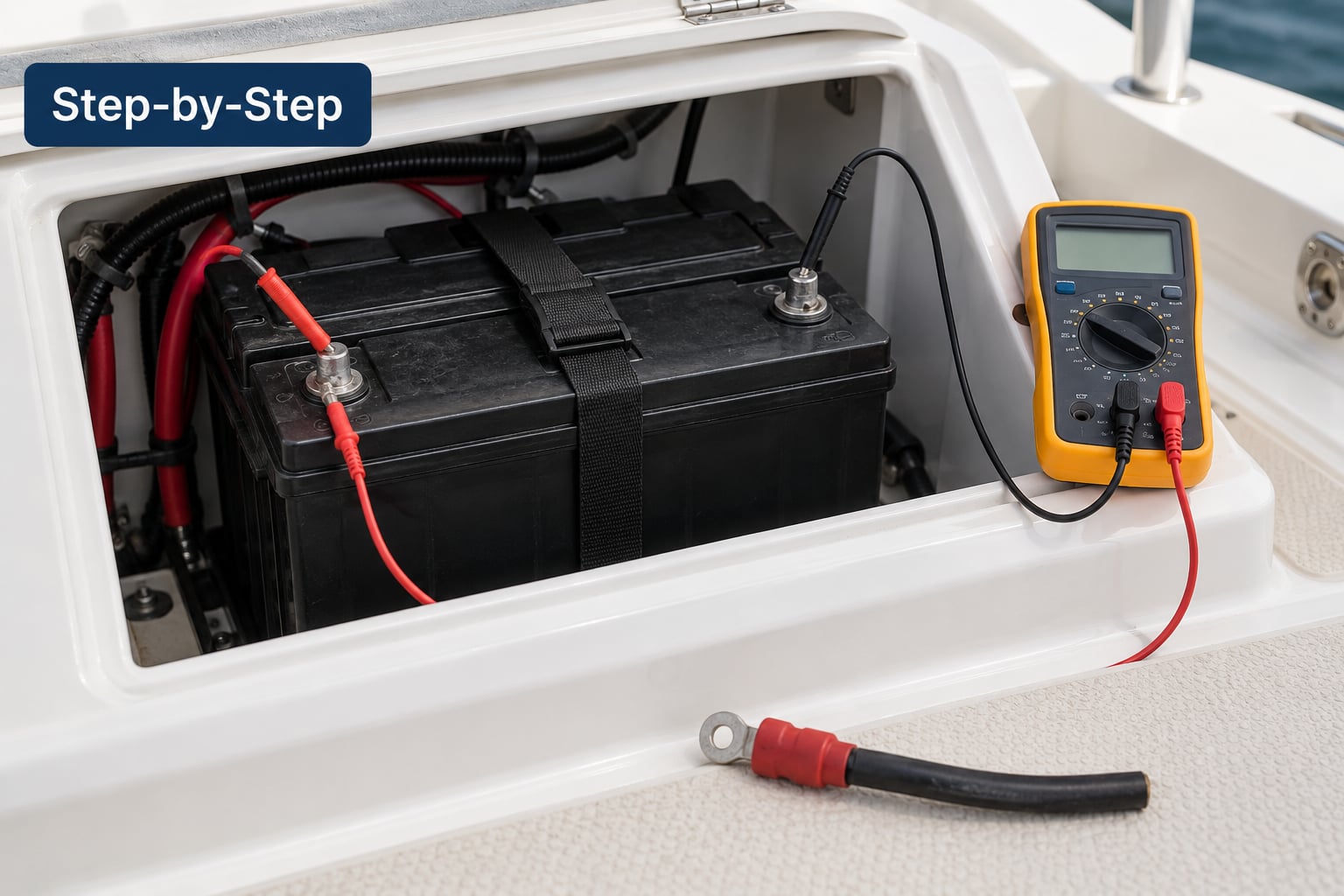
Set your multimeter to DC volts and touch the probes across the battery posts, negative to negative and positive to positive. A fully charged 12-volt lead-acid battery reads about 12.6 to 12.8 volts at rest. Above roughly 12.4 volts you are in decent shape, somewhere around 12.0 to 12.2 volts means partially discharged, and below about 11.8 volts while the boat sat unused means it is deeply discharged or sulfated.
Open the throttle or injector so the engine does not fire if it does catch, turn the key and watch what the meter does while the engine cranks. A battery that reads 12.4 volts and drops below 9.6 volts under cranking load has lost its capacity. That is the case forum readers describe as a battery that shows 12 volts but dies the moment you turn the key, and it will not recover with a charger.
Test at the terminals first, then test again at the battery switch or at the starter. A difference of more than about half a volt between the battery and the switch means the cable, the connection or the switch itself has voltage drop, and that is your actual fault rather than the battery.
Remember that a deeply discharged battery cannot tell you whether it is sulfated or simply flat. Recharge and load test it later; on the water, the number only tells you whether a jump start is worth trying.
Step 4: Reconnect, jump-start, or use a backup source
Start with the cheap fix. If corrosion is the problem, disconnect the negative cable first, then the positive. Clean the posts and the clamps with a wire brush, reconnect, and smear dielectric grease on the outside of the joints. Do not get grease on the terminal face, and never work on a battery with a flame nearby.
If you are using a jump pack, follow your boat manufacturer’s procedure first, since the sequence varies between outboards, stern drives and inboards. The common method for a portable pack is: engine off, negative pack clamp to the battery negative post, positive pack clamp to the battery positive post or the starter terminal, pack off, turn the key and crank briefly, then remove positive then negative. Connecting to the starter terminal gets a stronger crank because less current has to travel through a tired cable.
If you are jumping from a second battery, keep the batteries of the same chemistry, connect positive to positive and negative to negative, and never let the clamps touch. If the second battery is also deeply discharged, expect a weak result and go looking for a charger or a pack with real capacity.
For a trolling motor battery that has gone flat, the procedure is different because there is no alternator. Once you are back at the dock, charge it with a charger matched to the chemistry, and check the prop and shaft for debris from the trip. Fishing forum advice is consistent on this: do not check the prop on the water, run the motor forward only in shallow clear water with the tilt raised.
Step 5: Restart the engine and monitor charging
Once the engine catches, get it off the anchor and clear of any hazard before doing anything else. Disconnect the jump source before the engine dies again, because an alternator-driven alternator arrangement through a dead battery can fry both.
Then measure. With the engine running, the charging voltage at the battery should read roughly 13.8 to 14.4 volts on a typical charging system. Anything at or below the battery’s resting voltage means the alternator, the voltage regulator or the drive belt is not putting out current. If the engine ran for twenty minutes or more after the jump and the voltage never rose above about 13 volts, the charging system is the reason your battery died and it will do it again.
Watch your gauges for the rest of the trip. Overheating, low oil pressure or a voltage that sags when you throttle up are all reasons to head straight for the nearest ramp rather than trying to make the marina you planned.
Step 6: Return to shore or arrange a tow
Decide with the engine running, not before. A jump start that holds a steady charging voltage and a steady coolant temperature is a reasonable case for a slow, careful run to the nearest launch ramp. Make sure your life jackets are on, tell someone your route, and keep the handheld VHF in your hand.
Call for a tow if the distance to shore is greater than your fuel, the charging voltage is erratic, the engine is running rough, the weather is closing in, or you simply do not trust the restart. A tow is expensive and slow. Grounding into rocks at night is both, and worse.
If you are calling the Coast Guard or a tow operator, give your position, the number of people aboard, fuel status and the nature of the problem. They have heard every version of “battery is dead” and will ask for the same details anyway.
How to deal with a dead battery on the water
Anchor first, then get a life jacket on everyone and call for help early if you are near hazards. Check the simple causes in order: a disconnected cable, a battery switch in the wrong position, a blown fuse, corrosion on a terminal. Test the battery with a multimeter, clean and reconnect the terminals or attach a properly sized jump pack, restart the engine, and confirm the charging voltage is holding above about 13.8 volts. Head home or call for a tow when the numbers or the weather say the restart cannot be trusted.
Common Mistakes
Jumping the batteries in the wrong order. Negative to negative and positive to positive, clamp to clamp, engine off. Reversing polarity on modern electronics is expensive and in lithium installations it can start a fire. If you are unsure about any step, the manufacturer’s procedure in the owner’s manual wins.
Cranking a depleted battery over and over. Each attempt pulls a huge amount of current from a battery that has little left, and deep discharges sulfate the plates faster than anything else you can do to it. Two or three attempts spaced a minute apart is the practical limit; beyond that you are flattening a battery that might still have survived.
Assuming the restart means the electrical system works. A jump start gives you an engine. It says nothing about the alternator, the regulator or a parasitic draw that emptied the battery in the first place. Check the charging voltage before you plan a second trip on the same battery.
Bypassing safety equipment to save power. Cutting the bilge pump or navigation lights to preserve the radio is the wrong trade in any condition. Anchor, hold position, and keep the bilge pump running.
Troubleshooting while drifting. Every second spent bent over a battery compartment is a second of uncontrolled movement. If you cannot anchor where you are, motor toward a safe stretch of open water, find a heading and hold it while you work.
Cleaning corrosion without a plan. Baking soda and water works, but the terminals will grow crust again within a season unless you dry them, tighten the clamps properly and protect them with dielectric grease or a felt washers and protective spray.
Trying to make a dead lithium battery charge. A lithium pack or battery that has been deeply discharged, damaged or wet may never recover, and recharging it can be hazardous. Replace it.
Two habits prevent most repeat incidents. Put a battery maintainer on the house bank any time the boat sits for more than a week, and run a load test and a parasitic draw check each season start rather than waiting for the failure.
Frequently Asked Questions
Is it possible to jump start a dead boat battery?
Usually, yes. If the battery still holds some charge and the cables are sound, a portable jump pack rated for your engine will crank it. A battery that reads under 11.8 volts at rest may crank weakly or not at all, and one that drops below 9.6 volts under cranking load has lost its capacity. Clean the terminals, confirm your battery switch is set to include the start bank, and follow the connection order in the manufacturer’s instructions.
Can a completely dead marine battery be recharged or is it ruined?
It depends on how long it sat discharged. A battery drained overnight or for a few days usually comes back with a proper charger once you clean the terminals. One that has sat flat for months will have sulfated, and if a load test still fails after a full charge it is finished. Deep cycling also shortens life, so treat any battery that goes fully flat as close to end of life.
How can I test for parasitic draw on my boat?
With the engine off and everything switched off, set a multimeter to DC current and connect it in series between the negative battery terminal and the negative battery cable. Read the draw, then start pulling fuses or turning off circuits one at a time. The circuit where the reading drops sharply is your drain. Anything above roughly 50 milliamps with everything off will flatten a house bank over a day or two of sitting.
Does idling a boat charge the battery?
Barely, and less than people expect. Most outboards and stern drives produce only a modest share of their rated charging output at idle, so an hour of idling recovers far less than you would think. You want the engine above idle and under load. The alternator also needs to be healthy, which is why the charging voltage at the battery matters more than the run time.
How long does it take to charge a dead boat battery?
It is a long process, typically ten hours or more with a charger rated around 10 amps for a single deep cycle battery, and considerably longer if the battery is deeply discharged or cold. A lithium jump pack gives you a fast partial top-up, not a full charge. Charge it slowly, keep it ventilated, and follow the chemistry instructions, especially for lithium packs that have been discharged.
How do I disconnect a boat battery safely?
Turn the battery switch to OFF, then remove the negative cable first and the positive second. Always work on that order when disconnecting and the reverse when reconnecting. Take a photo of the cable layout before you touch anything, keep metal tools and jewelry away from both posts at once, and remember that some circuits, including the bilge pump on many boats, stay live even with the switch off.
Conclusion
Anchor, put on life jackets, call for help early if you are close to hazards, and then check the cheap causes in order: a loose or disconnected cable, a battery switch in the wrong position, a blown fuse, corrosion on a terminal. Test with a multimeter before you replace anything, jump-start only with the right equipment, and confirm the charging voltage is holding once the engine runs. If any of that is uncertain, get a tow.