How to handle no wake zones is mostly repetition: find the boundary, get down to idle speed well before it, hold a straight steady line until you are clear, then accelerate. It takes about ten seconds of planning and is the easiest boating habit to get right.
A no wake zone is a posted section of waterway where vessels must operate at idle speed, slow enough that the boat creates no wake behind it. Those zones protect docks, seawalls, shorelines, nesting birds and the people living on the bank, and they are enforced by state law, county ordinance, and sometimes by the lake association that manages the water.
Table of Contents
- 1What You Need
- 2Step-by-Step: How to Handle No Wake Zones
- 31. Identify the No Wake Zone Before You Enter It
- 42. Reduce Speed Early and Smoothly When Handling No Wake Zones
- 53. Maintain a Safe Course and Watch for Other Boats
- 64. Keep Your Boat’s Wake Under Control
- 7Where no wake rules come from
- 85. Exit the Zone Only When It Is Safe
- 9Common Mistakes
- 10Entering Too Fast
- 11Relying on Buoys Alone
- 12Making a Wake While Turning
- 13Stopping or Anchoring in the Zone
- 14Confusing Slow With No Wake
- 15Not Checking Local Rules
- 16Judging Your Own Speed Wrong
- 17Frequently Asked Questions
- 18How fast are you supposed to go in a no wake zone?
- 19Do you have to be in neutral in a no wake zone?
- 20What is the difference between no wake and minimum wake?
- 21Can you get a ticket for making wake in a no wake zone?
- 22Why does my boat make a wake at what I think is idle?
- 23Do no wake rules change from one lake to the next?
- 24Conclusion
What You Need
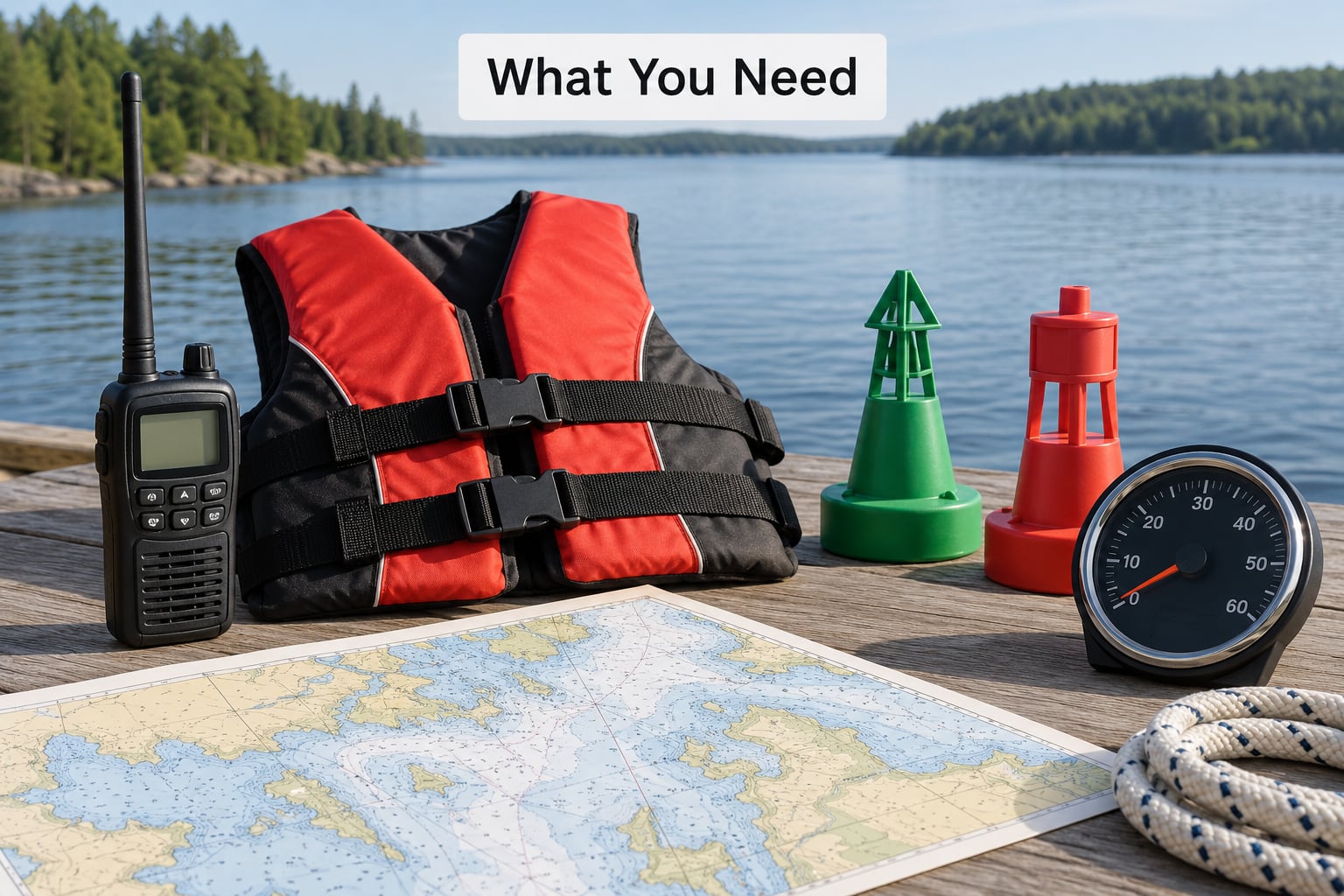
You do not need special equipment to handle a no wake zone correctly. You do need to know where the zone starts, and you need the control skills to hold a slow speed without surging.
- Sign and buoy recognition. Know the difference between a no wake sign, a slow or minimum wake sign, and a posted speed limit sign. They look similar from a distance and mean very different things.
- A source that flags zones before you get there. A paper lake chart, a chartplotter with the no wake overlay switched on, or a boating app with zone maps. Boaters repeatedly complain that zone warnings only show up after they are already committed to the approach.
- Throttle, trim and gear control. Including knowing how to drop the drive into neutral and hold it there, because that is often the only way to kill a residual surge.
- A real lookout, plus a spotter. At idle speed you are barely moving, so you need eyes on the water ahead and behind. I have put a passenger on the bow more than once to watch the water behind us, and it is the only check that has ever settled an argument about whether we were actually making a wake.
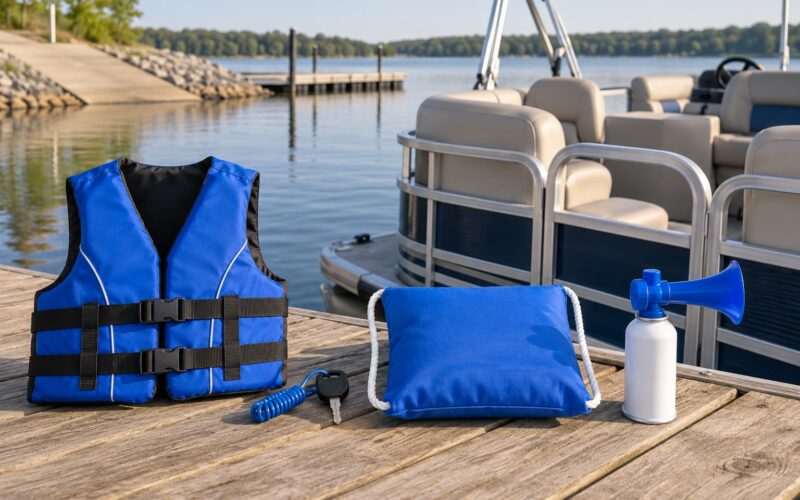
- A sound signal. One short blast tells another vessel you intend to pass on your port side. At canal speeds, a horn is often the only way to communicate an intention a wake-free boat cannot otherwise show.
- A wearable PFD for everyone aboard. Idle speed does not mean no risk. Most canal incidents happen at exactly these speeds, with distracted drivers and inattentive passengers.
- A working phone and a marine radio. Useful for checking local restrictions, and for reporting the boat that ignored the zone behind you.
Step-by-Step: How to Handle No Wake Zones
Boaters who get citations usually did not miss a rule. They simply never saw the boundary in time to act on it. This sequence puts you ahead of that problem every time.
1. Identify the No Wake Zone Before You Enter It
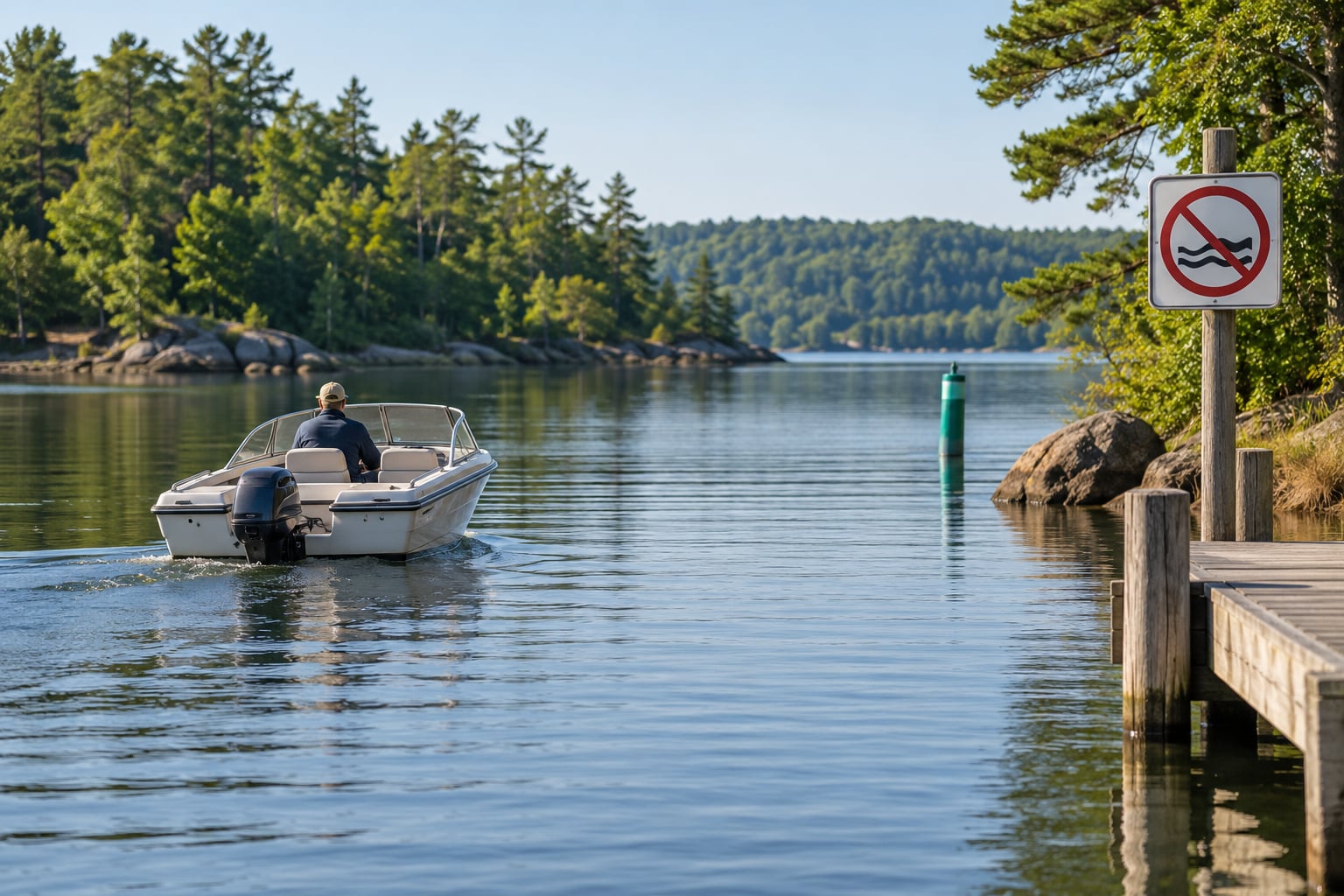
Look for the zone before it becomes urgent: the white rectangular sign with a boat and a crossed-out wake, the channel markers that bracket the restricted stretch, and any shoreline that sits close to your route. My habit is to spot the sign or the marker pair while I am still at cruise, which leaves me plenty of room to come down gently rather than braking.
Regulatory no wake signs are fixed to posts, pilings or structures, so read them as you pass. Buoys are a different system. A red triangular buoy is a channel marker, not a no wake symbol, and it tells you where the navigable channel runs rather than what your throttle should be doing.
Know the boundary before you slow down, because the two most common complaints from boaters are the same: a zone that starts at the dock and runs to the shoreline, or a zone that starts at the dock and runs only to the outer buoy. When those are ambiguous, assume the shorter and safer interpretation until the signs make it clear.
Harbor entrances, narrow residential canals, dredged channels, launch ramp approaches, and the stretches around low-clearance bridges are the most common places a zone appears without much warning. Treat any of those as a zone until you confirm otherwise.
Temporary restrictions are the other surprise. Event organizers, marine patrol and lake associations post seasonal or dated no wake areas for regattas, construction, drawdowns and nesting season, and those often sit right alongside permanent ones. A permanent sign does not expire when the temporary buoys come up, and a temporary sign does not disappear at the end of the weekend.
If you are approaching an unfamiliar water, make the identification step happen before the throttle step. Take fifteen seconds to look, and the rest of the transit is calm.
2. Reduce Speed Early and Smoothly When Handling No Wake Zones
Start coming down well before the boundary, not at it. A boat that drops from cruising speed right at the sign is still carrying planing trim and will throw a wake through the first third of the zone.
Bring the throttle back to idle, keep the drive engaged, and let the boat settle flat. On most hulls that takes a few seconds of deceleration after the throttle is closed. The bow should come down until it is level or slightly nose-up, and the hull should stop throwing a rooster tail off the transom.
Avoid hard braking inside the zone. Sudden throttle movements in neutral are the classic cause of a surge, and a surge at low speed is how people accidentally punch a hole in a dock. Make small, deliberate corrections instead of chasing the tiller.
If the boat will not hold a clean idle and surges when you release the throttle, get it serviced before you need it in a canal. Boaters on forum threads describe this exact problem repeatedly, and the fix is mechanical rather than a technique change.
3. Maintain a Safe Course and Watch for Other Boats
Hold a steady, straight line through the zone. Wake grows with instability, so every correction you avoid is wake you do not make. Hold a constant speed rather than constantly adjusting it.
Rules of the road apply in a no wake zone exactly as they apply anywhere else. A vessel you are about to cross is the give-way vessel and you hold back; a vessel on your port side has the right of way. Never assume that because everyone is at idle speed, nobody has priority.
For passing, crossing and following in a queue, these are the habits that work:
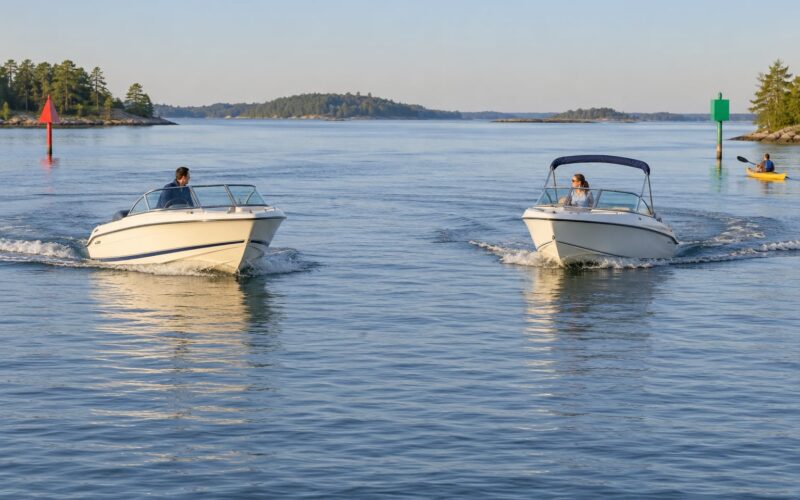
- Pass to port. Meeting head-on or overtaking, keep the other boat on your starboard side, and signal with one short blast.
- Fall in behind, never alongside. A line of boats moving at idle speed is a convoy. Match the speed of the boat ahead rather than overtaking on one side.
- Give paddlers and anglers a wide berth. Kayakers, paddleboarders and people fishing from a boat have almost no steering authority. Slow further and give them room.
- Sound your horn early. At canal speeds the sound carries further than you think, and a surprise meeting in a narrow channel is the collision people remember.
- Use your spotter. Have a passenger watch for small boats, and let them call your speed and your wake, not just traffic.
If a wake boat follows you through a canal at planing speed, do not try to outrun it or match its speed. Stay in the throttle pocket you can hold, hold your line, and keep clear of the docks. You do not control the wake coming from behind you, and slowing down to argue with a bad driver changes nothing except your exposure.
Who has priority in a canal queue where every boat is at idle speed is the question people argue about most. The answer is that nothing changes: the give-way vessel still gives way, and in a single-width canal the boat ahead has the room, so you follow. Where a passing lane is marked, use your side and signal first. Where it is not marked, do not assume the other boat will yield because you are in a hurry to get past them.
4. Keep Your Boat’s Wake Under Control
Legal operation depends on your vessel and on the rule posted for that water, but the boat itself decides how much wake you produce at a given throttle setting.
A wake boat with full ballast is the hardest case. Loaded ballast sits low in the hull, so the boat pushes a wave even at low speed, and the driver who feels like they are at idle can still be throwing water. Empty the ballast, set the surf tabs flat, and drop the tow point before the boundary instead of after.
Passenger weight changes the result in both directions. Weight forward raises the bow and increases planing tendency at low speed. Weight aft pushes the stern down and deepens the wake.
Keep the propeller and hull in good shape. A fouled or bent prop, weed growth, or a hull sitting too deep in the water all reduce control at exactly the speeds where you have the least of it.
Different hull types behave differently at the same throttle position. A deep-V planing hull settles quickly. A pontoon is a flat surface pushing a wave. A personal watercraft makes a narrow but sharp jet wake at very low speed. A displacement sailboat barely wakes at all. Which means the throttle setting that is correct on one boat is wrong on the next, which is why the rule has always been about the wake you see, not a number on the gauge.
Where no wake rules come from
The hierarchy trips people up. Your state statute sets the baseline, a county ordinance can add zones inside that framework, and a lake association or marina can post its own restriction on private or association water. A signed channel marker in a state waterway has legal force; a neighbour’s sign on a private cove usually does not.
The other layer is the Navigation Rules of the Road, published by the U.S. Coast Guard. Those cover conduct and right of way rather than wake specifically, but they are what you fall back on when a zone boundary is disputed and nobody can agree where it starts.
5. Exit the Zone Only When It Is Safe
Stay at idle until the entire boundary is behind you and you have room to build speed without throwing a wake back into the zone or toward the boat behind you.
Coming back up to speed is where a lot of accidents happen. Do it in stages: ease the throttle forward while still in displacement, let the hull settle as it comes up, then add power once you are on plane and well clear.
Some boaters drop into neutral coming out of idle to break the prop’s suction, then re-engage. It works, and forum regulars describe it as the reliable way to kill a surge. If you do it, do it once, gently, and away from docks and swimmers.
Look behind you before you accelerate. The most common wreck in a canal is not the boat in front, it is the one behind that was waiting for you to speed up.
Why the zones exist in the first place is worth understanding, because it tells you who you are actually protecting. A wake passing a dock pulls water out from under the pilings as it goes and pushes it back as it returns, which works the joint loose over a season. Shorelines lose soil the same way. Nesting birds on the shallows get flooded out of a nest if the water moves too much. And the person fishing quietly off a point in a cove has no way at all to move out of your way.
Common Mistakes
Entering Too Fast
The mistake: Trimming speed down at the sign instead of before it.
The correction: Pick up the zone on your chart or in sight, and start easing off throttle before the marker rather than at it. Two minutes of slow cruising costs nothing; a citation costs a few hundred dollars and a wake costs a dock.
Relying on Buoys Alone
The mistake: Treating buoys as the boundary and ignoring the posted signs.
The correction: Channel markers describe the navigable waterway. Signs describe your speed. Read both, and assume the sign governs where the two disagree.
Making a Wake While Turning
The mistake: Slowing down but still carrying planing trim into a turn.
The correction: Get the boat flat and fully settled before you turn at all. A hard turn at residual planing speed throws more water than a straight pass at the same speed.
Tip: A spotter on the bow watching your wake is worth more than any gauge reading.
Stopping or Anchoring in the Zone
The mistake: Killing the engine or dropping an anchor to fish in restricted water.
The correction: A no wake zone is a speed rule, not a parking lot. Anchoring there often breaks a separate navigation rule as well, and it always risks a prop strike on someone else’s line.
Confusing Slow With No Wake
The mistake: Reading a slow or minimum wake sign as permission to cruise.
The correction: Idle equals no wake, slow equals minimum wake. On a minimum wake sign, your boat may carry a small, non-propagating wake and nothing more. Think of it as the slowest speed that leaves a ripple behind the transom.
Not Checking Local Rules
The mistake: Assuming last year’s map is current, or that a lake association notice is the same as state law.
The correction: Zones get added, moved and re-worded. Temporary restrictions for events, spawning seasons and construction appear with little notice, so check the state DNR and the lake association before the trip, not on the water.
Judging Your Own Speed Wrong
The mistake: Assuming what feels like idle from the helm equals idle from the transom.
The correction: Three checks. Can you see a wake behind you? Is the bow raised? Are you still on plane with the prop pushing hard rather than just turning? If any answer is yes, you are going too fast.
Tip: Comparing your transom to a fixed object, like a piling or a seawall edge, at idle and again at the speed you think is idle tells you more than any onboard reading.
Frequently Asked Questions
How fast are you supposed to go in a no wake zone?
At idle speed, which is the lowest speed that keeps the boat moving and steering. There is usually no single posted number, because the rule is about the wake, not the gauge. Your boat should sit flat with no bow-up trim and leave a small, non-propagating ripple behind the transom. If you can see a wave travelling away from you, you are going too fast.
Do you have to be in neutral in a no wake zone?
No. Most operators stay in gear at idle and simply close the throttle. Putting the drive into neutral briefly can help kill a residual surge when you are changing speed, but running in neutral for the whole transit means you have no steering control in a busy canal. If your boat surges when you release the throttle, have it serviced before your next trip.
What is the difference between no wake and minimum wake?
A no wake zone asks for no wake at all, meaning idle speed only. A slow or minimum wake zone allows a small wake that travels briefly and does not build on itself. The shorthand that agency notices and marina posts repeat is simple: idle equals no wake, slow equals minimum wake. When the wording is confusing on the sign, slow down more than you think you need to.
Can you get a ticket for making wake in a no wake zone?
Yes. Zones are established through state law, county ordinance or local restriction, and enforcement usually comes as a civil citation with a fine defined by the authority that posted the zone. Repeat violations can affect your operator record, and some insurers ask about boating citations during a claim review. Exact amounts and consequences vary by state, so check with your state DNR.
Why does my boat make a wake at what I think is idle?
Ballast, passenger position and hull type all change the answer. A wake boat running full ballast pushes a wave even at low throttle. Weight forward raises the bow and makes the boat want to plane sooner. Pontoons and personal watercraft make a flatter but sharper wake than a deep-V hull. Put a spotter on the bow and look at the water behind you instead of trusting the throttle position.
Do no wake rules change from one lake to the next?
They change constantly, and sometimes within the same lake. The law comes from your state, the zone can be set by county ordinance, and a lake association or marina can add its own restriction on top. Some waters apply year-round, others only during spawning season or posted events. Check the state DNR, the local marine patrol and your lake association before you head out.
Conclusion
Everything you need to know how to handle no wake zones comes down to four things you can do on every single trip: find the boundary before you reach it, drop to idle early enough that the boat has settled flat, hold a straight line with a spotter watching your wake, and accelerate only once the whole zone is behind you. Follow the posted signs and the local navigation rules where you are, and the rest takes care of itself.