Short answer: on a U.S. lake, a powerboat must carry a U.S. Coast Guard-approved life jacket for every person aboard, plus a fire extinguisher, a sound-signaling device, visual distress signals when appropriate, navigation lights for night operation, and current registration papers. Boats over 16 feet also need a throwable flotation device, and your state’s boating agency can add requirements on top of that federal baseline.
That list is the floor, not the finish line. The gear that saves your life in a real emergency is rarely the gear an officer ticks off on a ramp, and the rules shift with boat length, horsepower, where you are on the water, and who is riding with you. This guide separates what boating safety gear is required on a lake under the federal baseline from what is merely sensible, and shows you how to confirm the parts that depend on your state.
Everything below was checked in October 2026 against U.S. Coast Guard guidance and the recurring themes on boating forums. Treat it as a map, not as the final authority.
Table of Contents
- 1What Boating Safety Gear Is Required on a Lake?
- 2Boating Safety Requirements at a Glance
- 3Life Jackets and Flotation Devices
- 4Emergency and Sound-Producing Equipment
- 5Fire Extinguishers and Engine-Safety Equipment
- 6Navigation, Weather, and Communication Equipment
- 7Equipment for Children, Beginners, and Special Circumstances
- 8A Pre-Launch Boating Safety Checklist
- 9How State Laws Change What You Must Carry
- 10Frequently Asked Questions
- 11What boating safety gear is required on a lake in every state?
- 12Do I need to wear a life jacket while operating a boat?
- 13What safety equipment is required for children on a boat?
- 14Is a fire extinguisher legally required on a recreational boat?
- 15What should I carry in case my boat engine stops?
- 16Are waterproof phones or marine radios required on a boat?
- 17Conclusion
What Boating Safety Gear Is Required on a Lake?
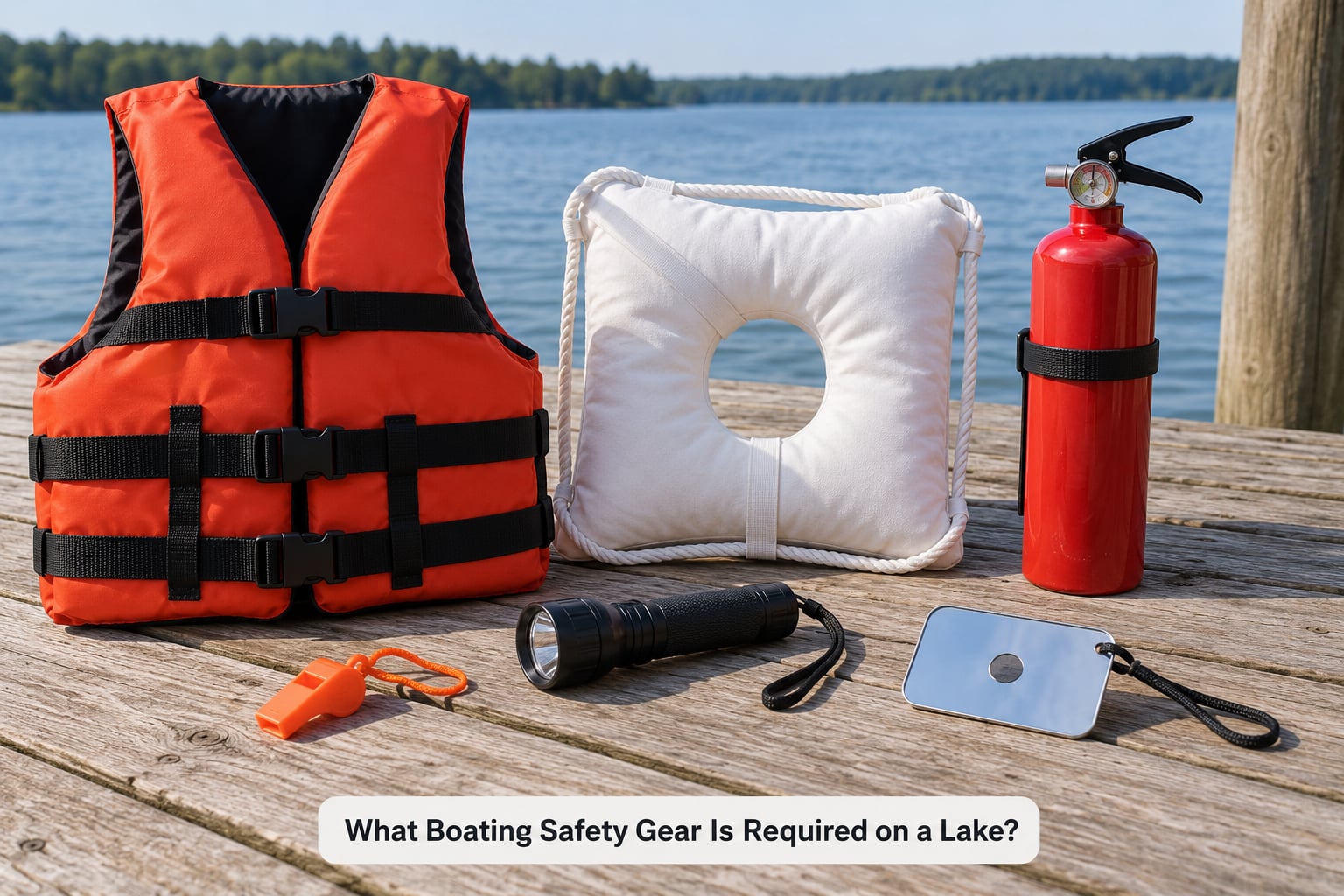
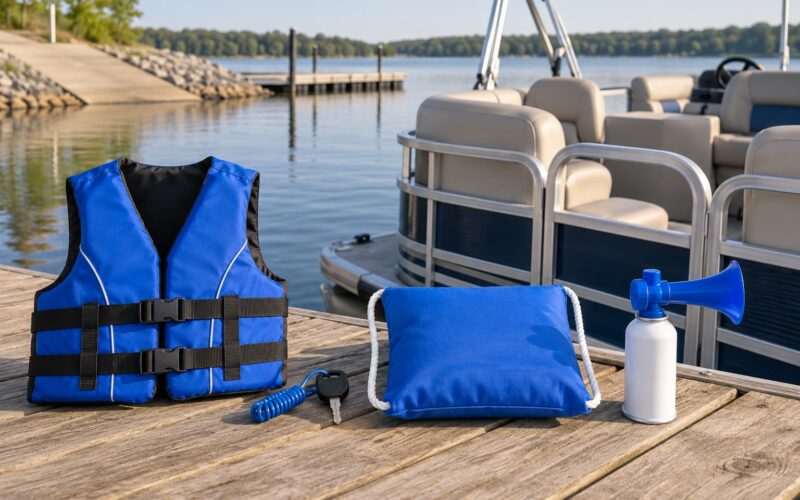
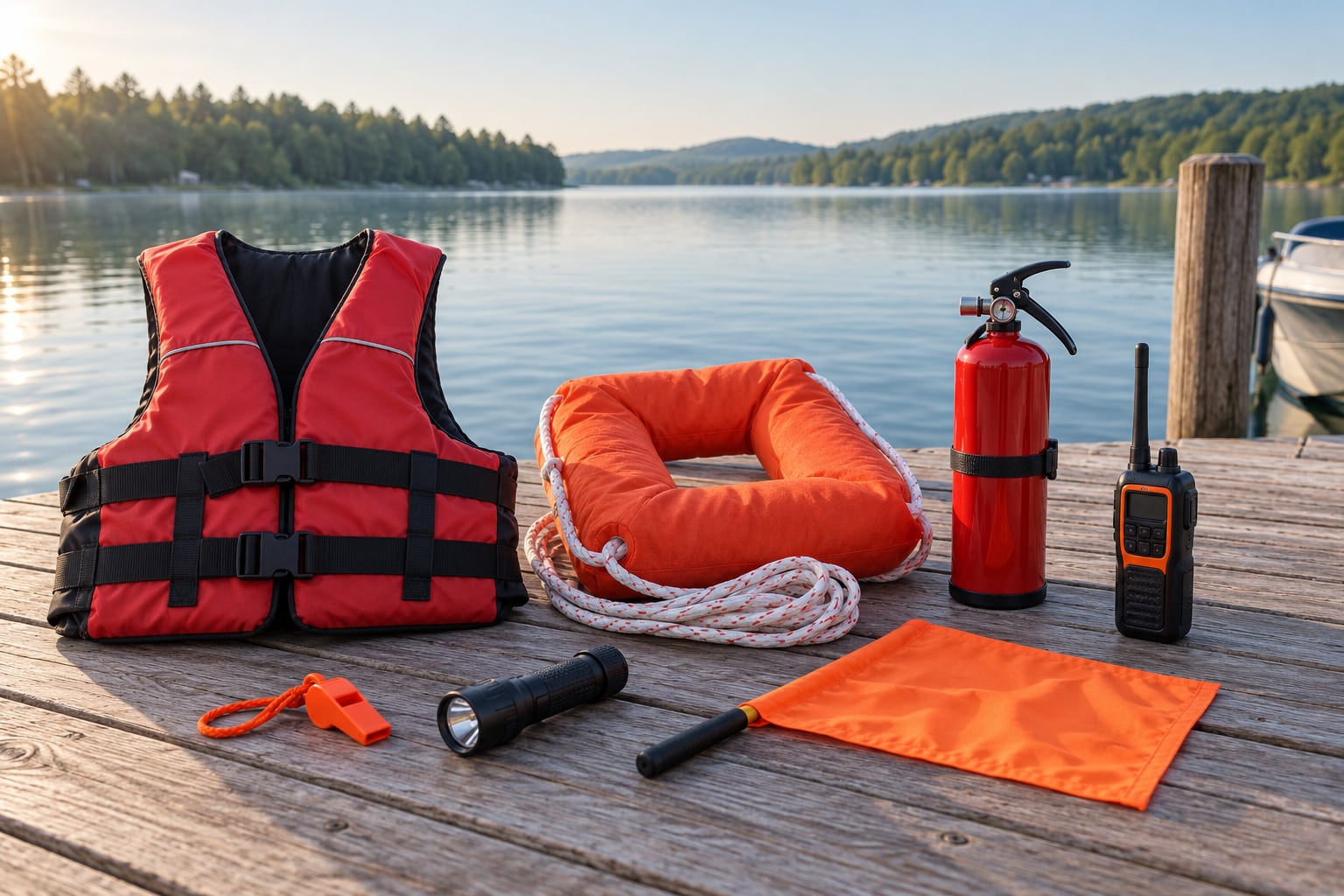
The federal baseline for recreational boats is short enough to memorize. Every person on board gets an approved personal flotation device. The boat itself carries a fire extinguisher, a way to make sound, a way to be seen, navigation lights for after dark, and proof that the boat is registered. A throwable cushion comes aboard when the boat is longer than 16 feet.
Here is that baseline, item by item:
- One USCG-approved PFD per person, sized for that person and immediately reachable, not buried under a seat or in a hull locker.
- A throwable flotation device on boats over 16 feet, with a line of at least 25 feet attached.
- A fire extinguisher where required, usually a B-1 rated marine unit, mounted where you can reach it from the helm.
- A sound-producing device such as a horn, bell, or whistle that carries over engine noise.
- Visual distress signals, such as flares or an orange flag, where the boat operates outside a limited area or at night.
- Working navigation lights for operation from sunset to sunrise.
- Registration papers and the capacity plate aboard, with the plate legible and matched to the number of people you actually brought.
The most common failure is not owning too little. It is having life jackets that live in a storage bag, an extinguisher whose pressure gauge crept into the red over winter, and flares that expired two seasons ago. Gear that is present but unusable is functionally missing.
Boating Safety Requirements at a Glance
The table below separates the pieces most boaters conflate. Legal status changes with state law, so read the status column as the federal floor and verify the rest locally.
| Item | Typical legal status | Who requires it | Best use |
|---|---|---|---|
| Wearable PFD per person | Required, federal baseline | U.S. Coast Guard, adopted by states | Every second on the water |
| Throwable cushion with 25 ft line | Required over 16 ft | U.S. Coast Guard | Reaching a person in the water from the helm |
| Marine fire extinguisher | Required in many states and on many boats | State agencies, boat manufacturer guidance | Engine bay or fuel fire before it spreads |
| Horn, bell, or whistle | Required | U.S. Coast Guard | Warning other vessels, signaling in fog or a crowd |
| Visual distress signals | Required when operating outside a limited area or at night | U.S. Coast Guard | Being located from shore or from the air |
| Navigation lights | Required sunset to sunrise | U.S. Coast Guard | Showing your side and heading to other traffic |
| Registration and capacity plate | Required in every state | State agency | Proving legality and staying inside weight limits |
| Anchor and line, bail bucket, spare drain plug | Recommended, not mandated | Common sense and forum consensus | Keeping the boat where you put it, or afloat after a swamping |
| VHF radio or charged waterproof phone | Recommended; some states mandate a comms device for larger boats | State agencies | Reaching help where cell service dies |
Two states add categories most readers never expect, such as carbon monoxide alarms on enclosed-cockpit boats or mandatory operator education cards. Before you launch anywhere new, check the official page of the state agency that manages registration where you plan to boat. Two minutes there saves a citation at the ramp.
Life Jackets and Flotation Devices
The Coast Guard prefers the term personal flotation device, or PFD, because a life jacket is a broader category of gear and a PFD is the legal standard. Look for the USCG approval label inside the garment. It carries a certification date, and inflatable models add hydrostatic or automatic inflators with status indicators that tell you at a glance whether the bladder will fire.
The four types come up constantly, so here is what each one is in plain terms:
- Type I is the bulky offshore vest with flotation built into the front and back, mainly for vessels that could capsize or carry passengers.
- Type II is the near-immersion version, worn front or back, common on smaller recreational boats.
- Type III is the familiar boating jacket with thin foam and a collar, typically zipped or buckled closed and worn at all times on a moving boat.
- Type IV is the throwable cushion or horseshoe buoy. It supports rather than wears, and it is required aboard boats over 16 feet.
Fit matters more than brand. A jacket that buckles but leaves loose straps riding up over your ears is not protecting you. Pull the shoulder straps snug, cinch the side straps until the body of the vest cannot shift upward, and confirm the chin support does not ride above the chin. Kids should be in a USCG-approved vest, not water wings, which are built for pool play and do nothing in moving water.
Wearing versus carrying is where most citations happen. Carrying an approved PFD satisfies the equipment rule. Wearing one is what saves the person. Many states, and every rental company, require a worn PFD for anyone under a certain age, for personal watercraft, and for anyone being towed. Treat wearing one as the default, especially with children aboard.
One more thing people ask about constantly: the throwable’s line. It must be at least 25 feet long and attached. A cushion tossed to a swimmer with no line is decoration. Store it where the person at the helm can grab and throw it without turning around.
Emergency and Sound-Producing Equipment
A whistle costs little and does two jobs. It signals other boats in fog or heavy traffic, and it is the cheapest way for someone in the water near your boat to attract attention. Horns and bells work better at distance, but a whistle stays on your keychain and works when the electrical system does not. Carry both if your boat is large or operates in a busy channel.
Visual distress signals fill the other half. Daytime calls for an orange distress flag. Night and low light call for pyrotechnic flares, and those have printed expiration dates on the body. Check those dates every spring. Expired flares do not count, and officers do look. A hand-held signal mirror or a flashlight with fresh batteries costs almost nothing and works indefinitely, which is exactly why it belongs on the list even though it is not mandated.
Stabilizing gear keeps a disabled boat from becoming a drifting one. An anchor with enough rode to hold bottom, a couple of spare lines, and a bail bucket for taking on water all fall in the recommended column, and every one of them shows up repeatedly on the forums when owners describe what they wish they had packed. A spare drain plug and a spare propeller belong in the same bucket of quiet insurance: neither is required, both decide how long a bad afternoon lasts.
Fire Extinguishers and Engine-Safety Equipment
A fuel fire on a small boat moves fast. The extinguisher is your only chance to put it out before the hull or the fuel tank goes. Federal guidance points to a B-1 rated marine extinguisher for boats with enclosed gasoline engines, and most states carry a version of that requirement into law, sometimes with extra triggers such as length, fuel type, or enclosed compartments. Treat the B-1 unit as the safe choice regardless of your state’s exact wording.
Inspection takes ten seconds and happens at the dock. Check that the pressure gauge needle sits in the green. Confirm the safety pin is intact and the tamper seal is unbroken. Look for corrosion around the nozzle and the cylinder base, and check the in-date inspection tag, which is usually zip-tied to the handle. If the needle has crept past the green, the unit gets serviced before your next trip, not after.
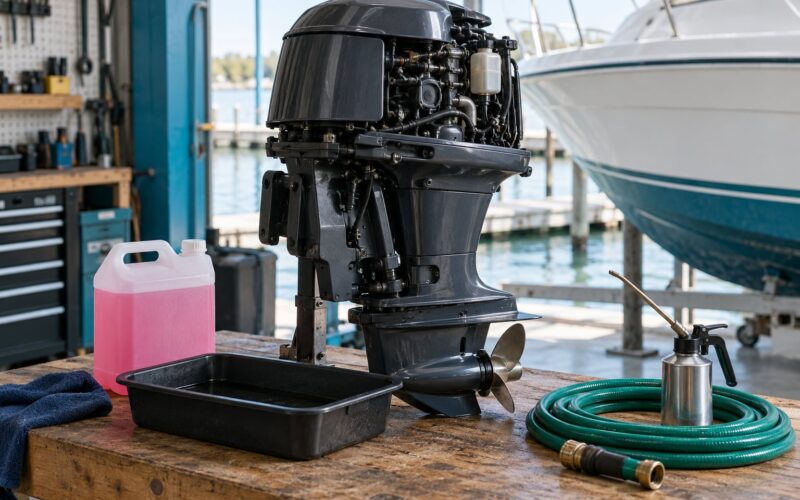
Mount the extinguisher where it can be reached from the helm, and where a passenger can reach it too. Relying on one strapped to the transom means somebody has to run aft into the smoke to get it. Spend a minute on the fuel system instead: run the blower before starting, after fueling, and after a smoke-filled start. Keep the drain plug in the boat while it runs so an overheating engine vents instead of filling the hull. And if the engine stalls in gear, the emergency cut-off switch lanyard is what stops a boat from circling back into the people who were in the water.
Follow the owner’s manual for anything beyond that. Engine layouts differ enough that a general rule beats a specific guess.
Navigation, Weather, and Communication Equipment
Navigation lights are a legal requirement and a practical one. Red to port, green to starboard, white astern, and all of them visible when someone looks your way after dark. Check them the first evening you own the boat rather than the first time you need them, because a dead bulb discovered at a ramp at dusk ruins a trip and can earn a fix-it ticket.
A paper chart or a phone map tells you where the shoals and channel markers are. A compass tells you where you are when the phone dies. Cheap insurance is carrying both, with the compass stowed somewhere you can reach from the helm instead of buried under the seat cushion.
Weather on a lake can turn in under an hour, especially in spring when warm air rides over cold water. A radio you can hear, or a weather app you checked before the ramp, is the difference between a bad afternoon and a bad night on the water. In the far reaches of a big lake, a forecast you loaded at the parking lot may not update. Know when you are about to lose signal and turn back before that point, not after.
For communication, most lake boaters carry a charged phone in a waterproof case. That is enough for calling 911 when you have service, and for nothing at all when you do not. A handheld VHF radio listening on Channel 16 costs more than a phone and works far offshore, on lakes with no coverage at all, and to other boaters who can hear you. It is not universally required on recreational boats, but it is the single most recommended upgrade among people who boat alone.
Whatever you carry, keep the electrical load sane. A VHF, a depth finder, a bilge pump, a phone, and a set of nav lights all at once on a tired starting battery is how a boat becomes a drift. Carry a portable power pack, know your battery’s age, and test it rather than assuming it turns over in March.
Equipment for Children, Beginners, and Special Circumstances
Children need a properly fitted, approved PFD, worn, and supervised by an adult who is also wearing one. The adult matters as much as the child, because most drownings on small boats involve an adult who could not reach the bottom or got separated from the boat. If your crew includes anyone who cannot swim well, treat the vest as non-negotiable even on a calm afternoon in shallow water.
Novice operators usually need fewer gadgets and better habits. Take a free boating safety course from your state agency, which covers the rules that will be cited against you and the handful of maneuvers that prevent most on-water mishaps. Learn the boat’s controls before you leave the dock, know where the anchor and line are stowed, and run the pre-launch routine below until it stops requiring thought.
Cold water deserves respect even on a lake in mild weather. Spring and fall water can drop a person into hypothermia territory fast, and heat loss can be severe before it feels like an emergency. Dress for the water temperature rather than the air temperature, carry dry layers in a sealed bag, and treat a soaked passenger as a medical problem, not an inconvenience.
Night boating, remote coves, and solo trips each add a requirement of their own that the law does not write down. Night means working nav lights plus a working flashlight. Remote means a comms plan that does not depend on bars. Solo means a lanyard worn, not clipped and forgotten. Parents of new boaters on the forums tend to land on the same two fears, whether required gear is missing and what happens when the motor quits, and both are answered by the checklist that follows.
A Pre-Launch Boating Safety Checklist
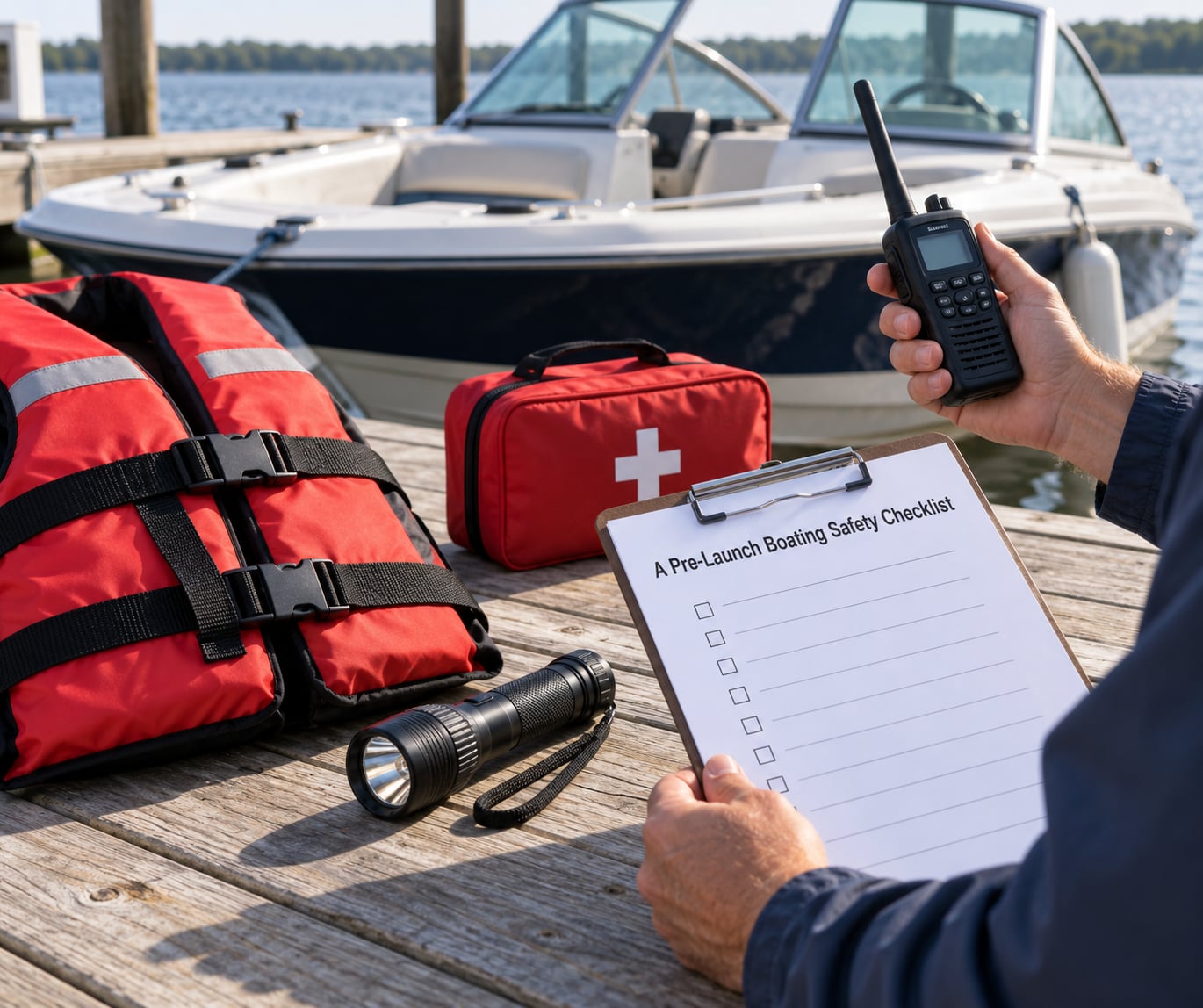
Run this before the trailer goes in the water, every time. It takes about ten minutes once you have done it a few times, and it catches the failures that turn a good day into a bad one.
- Registration and papers. Current registration in the boat, insurance card if your state or lender requires it, and your operator card or boating license on hand.
- Capacity plate. Find it in the hull or console and read it aloud against your real passenger count. Check the maximum horsepower on the plate matches what is bolted to the transom.
- Weather. Forecast, wind, and the radar loop before you turn the key. Note when signal will drop out.
- Float plan. Someone ashore knows the boat description, the ramp you launched from, your route, and your expected return time.
- Fuel, oil, battery, drain plug. Enough fuel for the trip plus a margin, oil at level, battery terminals clean, drain plug seated and its spare stowed with the tools.
- PFDs for everyone. Correct size, buckles tested, straps snug, no moth holes, and stored where they are reachable from the seating area.
- Throwable cushion if the boat is over 16 feet, with its line attached and coiled so it can be thrown without tangling.
- Fire extinguisher. Gauge in the green, pin intact, inspection tag in date, mounted within reach of the helm.
- Signaling. Horn, bell or whistle; flares and flag with unexpired dates; flashlight with fresh batteries.
- Communications. Phone charged and protected, VHF charged if you carry one, and the local emergency channel noted.
- Emergency kit. First aid kit, bail bucket, anchor with adequate line, spare prop and tools, basic tool set, a jug of spare fuel if the motor takes it.
- People. Float plan sent, emergency cut-off lanyard attached, sober operator.
How State Laws Change What You Must Carry
The Coast Guard sets the floor for federally regulated waters. States enforce it and extend it, and that is where the differences come from. A state can require life jackets for adults on a specific waterway, mandate a carbon monoxide alarm on an enclosed-cockpit boat, demand an education certificate before you operate, set its own age at which children must wear a vest, or add requirements that apply only to vessels above a certain length or horsepower.
Requirements can also split by water. A federally regulated lake, a state lake, a county lake, a reservoir under federal control, and a private pond are not always governed by the same list. Waterways managed by the Bureau of Reclamation or the Army Corps of Engineers can apply the federal rules plus local overlays.
Checking your own state takes two minutes. Search your state’s name plus boating regulations or boat registration, open the official agency site rather than a forum thread or a retailer page, and look for the equipment requirements page. Read it once at home, then photograph the gear section on your phone so you have it at the ramp. If your state has a boating safety course or a vessel safety check program offered through the Coast Guard Auxiliary, both are free or nearly free and both pay you back at inspection time.
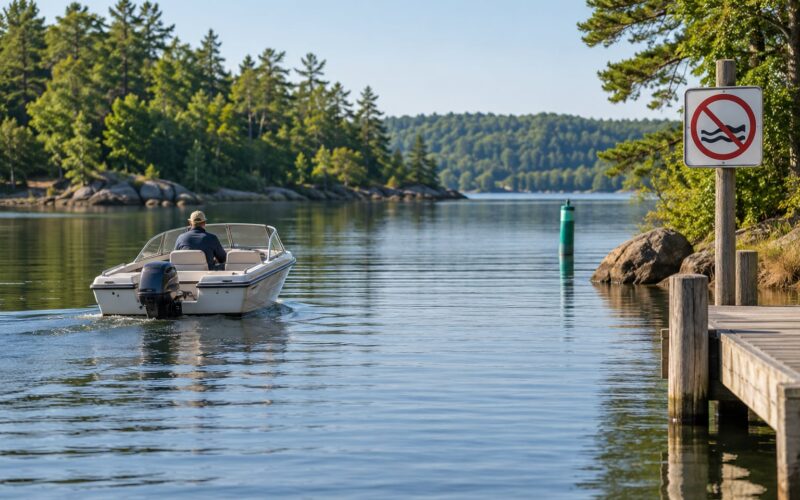
One more wrinkle worth knowing: if you boat across state lines on a multi-state lake, the rules you must satisfy are the ones for the water you are physically on, which is why a shared lake can produce two different legal answers within a mile.
Frequently Asked Questions
What boating safety gear is required on a lake in every state?
The federal baseline is the same everywhere: a USCG-approved life jacket for each person aboard, a sound-producing device, visual distress signals where required, navigation lights for night operation, a fire extinguisher where applicable, and current registration. Boats over 16 feet also need a throwable flotation device with at least 25 feet of line. Your state can add rules on top, so check the state agency site before you launch.
Do I need to wear a life jacket while operating a boat?
Wearing one is not universally mandated for adult operators on small recreational boats, though many states require it for children, personal watercraft riders, and anyone being towed. Carrying an approved PFD satisfies the equipment rule. Wearing it is what saves the person in the water. Most first-time owners decide early to make it the default.
What safety equipment is required for children on a boat?
Children need a properly fitted, USCG-approved PFD, worn rather than carried. Weight and chest size both matter, and a snug fit with tightened side straps is what confirms the size is right. Water wings are pool toys, not flotation devices. Most states set an age under which wearing a vest is mandatory, and many require anyone towing a child on a tube to wear one too.
Is a fire extinguisher legally required on a recreational boat?
Federal guidance points to a B-1 rated marine extinguisher for boats with enclosed gasoline engines, and many states carry that into law with their own triggers based on length, fuel type, or enclosed compartments. Whether or not your state requires one, a fuel fire grows in seconds. Check the pressure gauge is in the green, the pin is intact, and the inspection tag is in date.
What should I carry in case my boat engine stops?
Carry a basic tool set, spare spark plugs and fuses, a spare propeller and hardware, a spare drain plug, channel-lock pliers, wire, duct tape, a bail bucket, and enough spare fuel for the trip home. An anchor with adequate rode lets you secure the boat while you work. On a lake with weak phone coverage, a handheld VHF radio on Channel 16 is the item owners most often wish they had bought.
Are waterproof phones or marine radios required on a boat?
Usually recommended rather than required for small recreational boats, though some states require a communications device on larger vessels. A charged phone in a waterproof case handles emergencies where bars exist. A handheld VHF works where bars do not, reaches other boaters in the area, and is the standard choice for solo operators and remote water. Neither substitutes for a float plan.
Conclusion
Start at your state’s official boating law page and read the equipment section once, at home, with a coffee. Then fit a life jacket on the person who wears it smallest, confirm the throwable line and the extinguisher gauge, check flare dates, and charge the device you would actually use to call for help. Do those four things before the trailer goes in the water and the rest of the checklist takes care of itself.