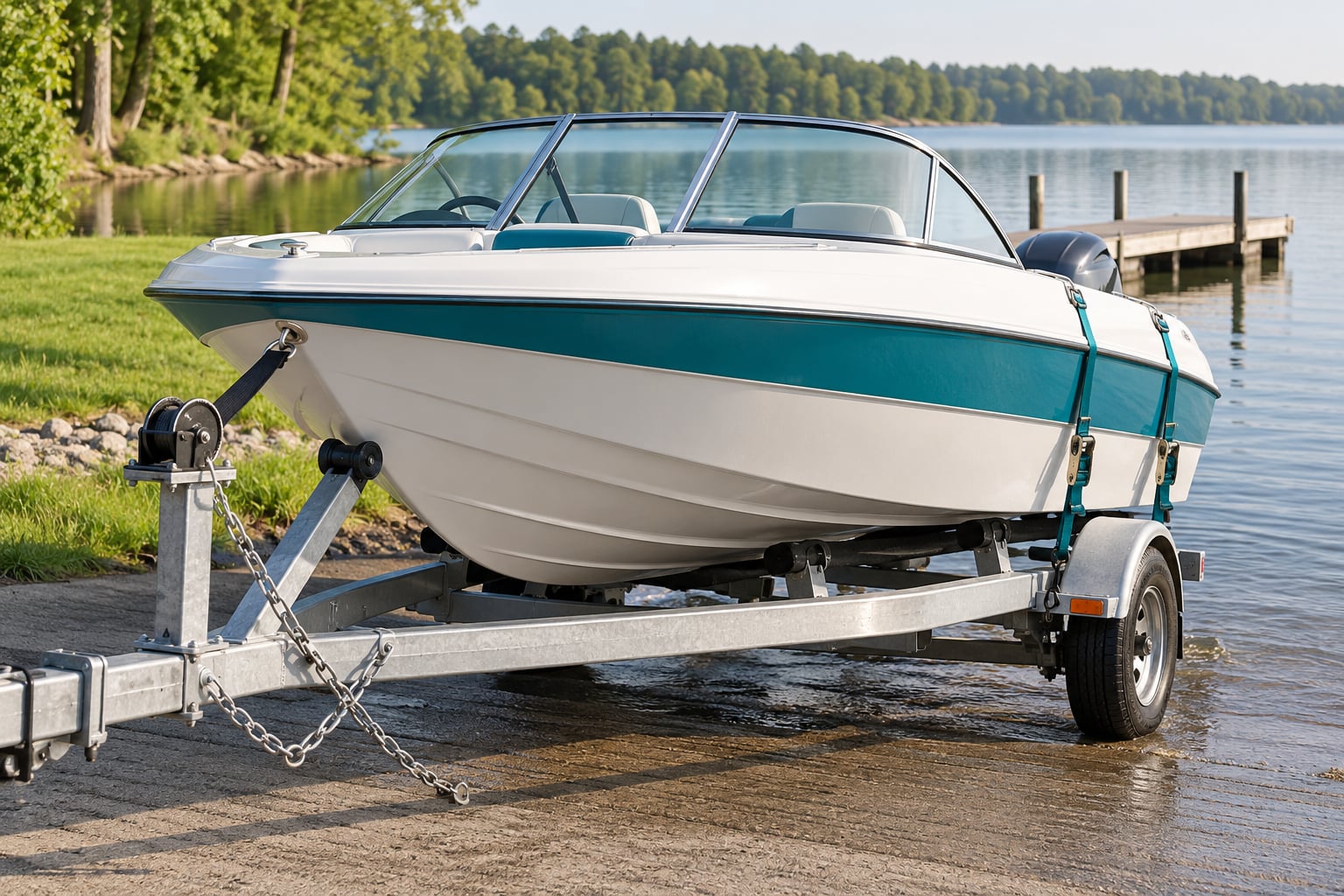
Tying a boat to its trailer comes down to four attachment points: a winch strap at the bow eye, a backup strap or safety chain at the bow, and two ratchet straps pulling the transom down onto the bunks. Get those four right and the boat stays put through braking, turns, and road vibration. The whole job takes about 10 minutes once you know the sequence.
The most common mistake is not a loose strap. It’s the bow strap pulling straight back at a shallow angle, which lets the boat rock up and down at highway speed, and cracks gelcoat or warps aluminum when it does.
The order below matters. Winch first, stern second, chains third, then a hands-on check before the coupler ever touches the ball.
Table of Contents
- 1What You Need
- 2Transom straps, winch straps, and safety chains do different jobs
- 3How to size straps for your boat
- 4Step-by-Step: How to Tie Boat Trailer Straps Correctly
- 51. Match the Straps to the Boat and Trailer
- 62. Position the Boat Correctly on the Trailer
- 73. Attach and Tighten the Winch Strap
- 84. Tie the Transom or Aft Straps
- 95. Attach the Safety Chains
- 106. Check the Spring and Perform a Final Safety Test
- 11Common Mistakes and Fixes
- 12Straps too loose
- 13Straps too tight
- 14Twisted webbing
- 15Shallow strap angle
- 16Chains not crossed
- 17No spring balance or a coupler that latches loosely
- 18Drain plug still in
- 19Skipping the walk-around
- 20Belly bands and side lines on long boats
- 21A few launch and towing habits worth keeping
- 22Frequently Asked Questions
- 23Should boat trailer transom straps be tight or slightly loose?
- 24Do I need a winch strap if I use transom straps?
- 25How tight should the bow strap be when towing a boat?
- 26How do I know when a boat trailer strap needs to be replaced?
- 27Why should safety chains be crossed under the trailer tongue?
- 28What should I check before backing a boat into the water?
- 29Conclusion
What You Need
Your trailer owner’s manual and the boat manufacturer’s instructions come first. Those two documents describe the exact tie-down points built for your hull, and they override anything generic you read online, including this guide.
Beyond that, a standard tie-down job needs:
- A bow winch strap rated above your boat’s weight, threaded through the bow eye or bow cleat.
- Two transom ratchet straps with cam buckles or over-center ratchets, at least 2 inches wide for anything over 20 feet.
- Safety chains rated for the trailer’s gross weight, plus a bow safety chain if your boat has no backup strap.
- A bow backup strap running from the bow eye down to a trailer crossmember, or short of that, a second safety chain.
- Soft loops or a folded piece of carpet wherever webbing touches gelcoat or bare aluminum.
- A ratchet handle and a pair of pliers for freeing a strap whose handle is locked down tight.
Transom straps, winch straps, and safety chains do different jobs
The winch strap handles forward motion. It stops the boat walking off the front of the trailer under braking force.
Transom straps handle vertical movement. They hold the stern planted against the bunks, which is what stops the boat from bouncing and chafing.
Safety chains are the backup. They should never be the primary restraint, and they are not a substitute for stern straps on any boat that bounces.
How to size straps for your boat
Strap capacity is a working load limit, not a break point, and webbing loses strength with age and UV exposure. Buy well above what the table suggests.
| Boat weight | Typical length | Strap width | Minimum working load per strap |
|---|---|---|---|
| Under 2,000 lb | 14 to 18 ft | 1 inch | 1,000 lb |
| 2,000 to 4,000 lb | 18 to 22 ft | 2 inch | 2,500 lb |
| 4,000 to 8,000 lb | 22 to 26 ft | 2 inch | 5,000 lb |
| Over 8,000 lb | Pontoon and multi-engine | 2 inch or 3 inch | 10,000 lb |
For saltwater work, stainless hardware is worth the extra money. Plain plated steel ratchets on a saltwater boat can pit and seize within a single season.
Step-by-Step: How to Tie Boat Trailer Straps Correctly
1. Match the Straps to the Boat and Trailer
Find the bow eye, the transom eyes or a transom tie-down bracket, and the frame attachment points before you touch a ratchet. Most boats have all three; some center consoles use an over-the-gunwale stern strap instead of transom eyes.
Check each strap for a readable working load limit label. If the tag is gone, replace the strap rather than guessing.
How you know it worked: you can name the exact frame crossmember or bracket each strap hooks to, and every hook opens and closes smoothly.
2. Position the Boat Correctly on the Trailer
Back the trailer into the water until the bunks or rollers are about halfway submerged, winch the boat down until the hull floats free, then pull forward slowly until the bow stop contacts the hull.
On a bunk trailer the keel should sit in the center of the carpeted bunks. On a roller trailer the boat should sit on the rollers with roughly a third of the hull extending past the last one.
How you know it worked: the boat is centered side to side, fully supported along its length, and the bow stop is snug against the hull with no gap and no pressure.
3. Attach and Tighten the Winch Strap
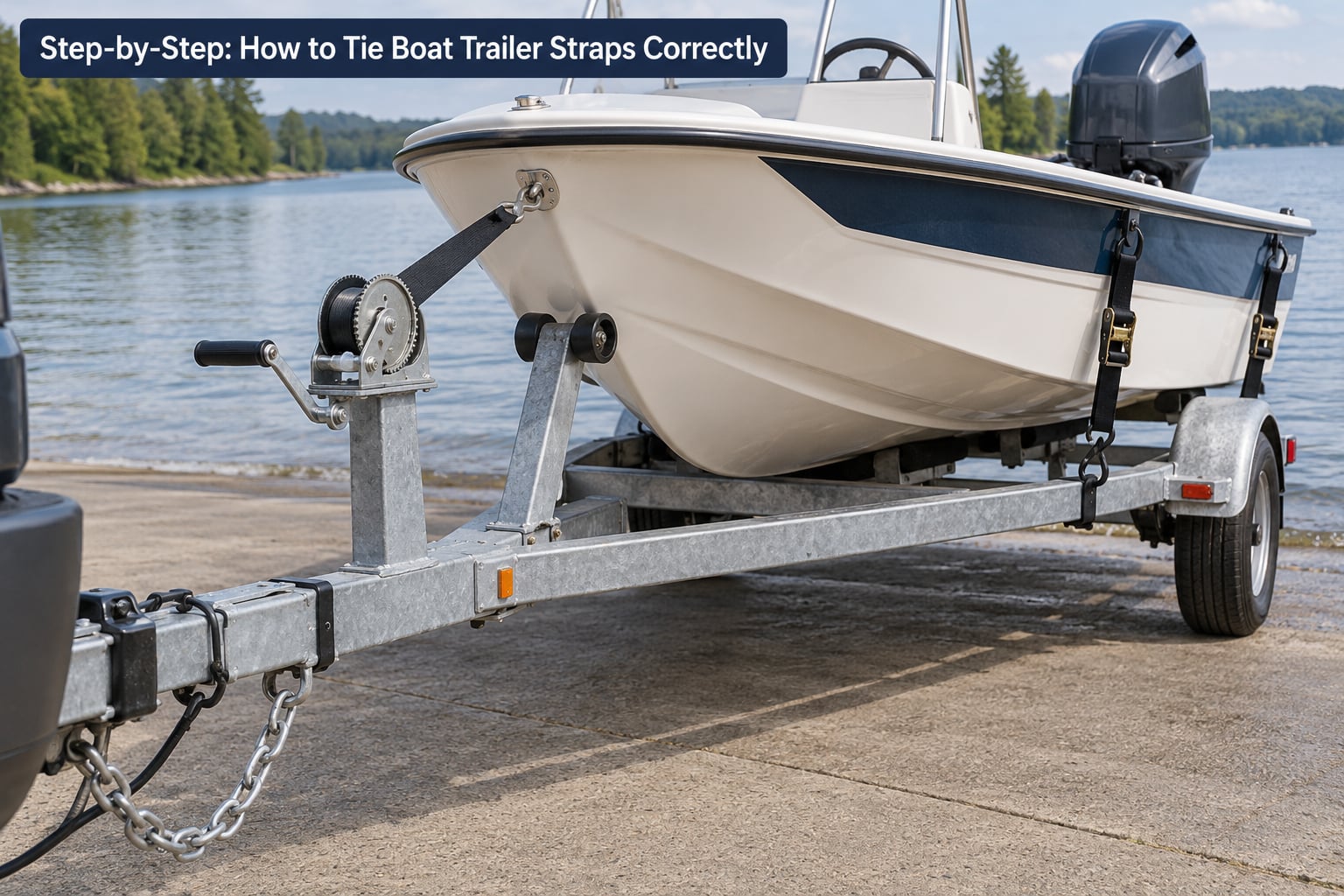
Thread the winch strap through the bow eye from underneath and back over the top, or through the bow cleat in a figure-eight. Pull it tail down through the winch fairlead until the strap is straight and snug against the bow.
Crank the handle to take out the slack. Watch the bow: it should draw down onto the bow stop rather than pull the hull up and forward. If the bow lifts, the strap is routed backwards or the winch stand is too short for that hull.
Then add the backup. Run a second strap from the bow eye down to a crossmember below it, or fit a bow safety chain when your trailer has a chain loop at the front. This is what keeps a winch stand failure from becoming a lost boat.
How you know it worked: the bow eye cannot move up, forward, or side to side when you pull on the hull by hand, and the strap tail has a firm set with no gapping.
4. Tie the Transom or Aft Straps
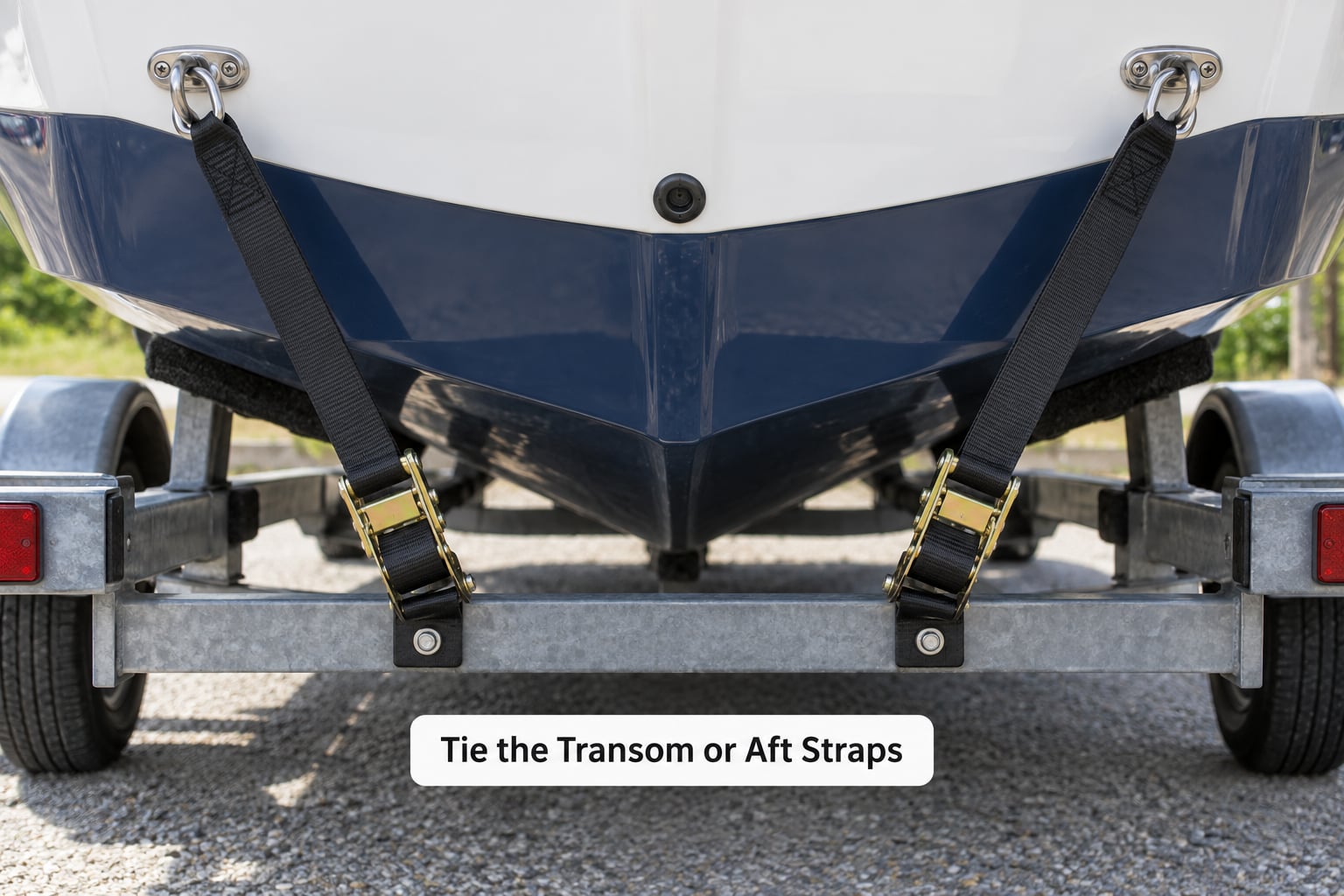
Hook each strap to a frame crossmember or the trailer’s dedicated stern tie-down rail, then to the transom eye on the same side. Do not run one strap across the top of the boat; two separate straps pull down and inward, which is the direction that actually seats the stern.
Set the angle at roughly 45 degrees, pulling down and inward toward the hull. A strap that runs nearly horizontal just squeezes the boat sideways. Keep webbing clear of the propeller, the steering hardware, and any sharp edge on the transom bracket.
Ratchet until the webbing is taut and the stern is planted on the bunks, then stop. You want snug, not crushed. On a fiberglass boat, over-tightening stresses the transom and can crack gelcoat or show a hull shadow later. On aluminum, it warps panels.
How you know it worked: the webbing has no slack, the handle is fully closed, and a firm upward tug on the strap cannot lift the stern.
5. Attach the Safety Chains
Cross the two chains beneath the trailer tongue and hook each end into a rated point on the vehicle’s receiver or bumper bracket. Crossing them means a case where the coupler releases still leaves the trailer attached.
Leave enough slack for full turns without jackknifing, but not so much that the chains drag on the pavement. A rough guide is six to eight inches of slack at the hitch.
Check that no chain shares a hook with the safety cables on a brake-light disconnect, and that nothing loops around the tongue itself.
How you know it worked: both chains are crossed, hooked to separate rated points, and clear of the road surface in a full-lock turn.
6. Check the Spring and Perform a Final Safety Test
Latch the coupler over the ball and pull the spring-loaded latch lever down until it snaps over the hitch pin. The spring on the latch is your first mechanical check: a coupler that latches without resistance or that needs a bungee to stay shut is a coupler that will not hold.
With the parking brake set and the transmission in park, back the trailer straight while someone watches the bow. The chains should go taut before the coupler ever moves, and nothing should shift more than a fraction of an inch.
Then walk the whole rig. Tug hard on each strap, each chain, the bow eye, and the winch strap tail. Look for the one weak link: a hook that flexes, a webbing edge curling, a bolt with a bright rust ring around it.
For long hauls, come back after 5 to 10 miles and check again, then at every fuel stop. New straps stretch as they bed in, and that lost tension is exactly how a boat walks three inches away from the bow stop and starts chafing.
How you know it worked: the coupler is latched and pinned, the chains are taut when you back up, and nothing moves when you tug each component in turn.
Common Mistakes and Fixes
Straps too loose
The webbing looks taut while the boat still moves. Ratchet one or two more clicks, then re-test by tugging upward on the stern strap. Snug means no bounce, no gap under the strap.
Straps too tight
Over-cranked straps bend aluminum and stress a fiberglass transom. Back the handle off until the webbing has a slight give, and use a soft loop at the contact point to spread the load.
Twisted webbing
A twist cuts the strap’s effective strength nearly in half and it will eventually snap at the twist. Unwind any crossed webbing before ratcheting, and re-thread if the strap keeps turning.
Shallow strap angle
A strap pulling straight back or straight sideways does almost nothing to stop bounce. Move the frame attachment point lower so the strap pulls down and inward at roughly 45 degrees.
Chains not crossed
Parallel chains can swing like a pendulum on a curb strike and let the tongue swing. Crossing them under the tongue holds the trailer geometry square.
No spring balance or a coupler that latches loosely
Pop the coupler open and check the latch spring. It should pull the lever closed on its own with firm resistance. A stretched or broken spring means the coupler can lift over the ball on a bump.
Drain plug still in
The fastest way to lose a boat. Fill the livewell and a bucket with water while you drain it, and add the plug to your keys. A plug in the pocket beats a swamped hull.
Skipping the walk-around
Every time, even for a two-minute run to the fuel dock. Most shifts happen in the first few miles or the first fuel stop, not on the highway at hour three.
Belly bands and side lines on long boats
Boats over about 22 feet benefit from a side line or belly band roughly every 8 feet to stop side load in a sudden lane change. They are not a substitute for the transom straps; they keep the hull from walking sideways.
A few launch and towing habits worth keeping
- Rinse straps and hardware with fresh water after every saltwater trip, then let them dry before rolling them up.
- Replace any strap with frayed webbing, loose stitching, a bent hook, or a ratchet that slips under load.
- Retract over-length straps fully before launching so nothing loops near the prop or catches at the ramp.
- Check state rules before a long trip. Some states require stern securement in writing, and tow ratings and legal limits vary by state and change over time.
Frequently Asked Questions
Should boat trailer transom straps be tight or slightly loose?
Snug, not loose and not crushed. The webbing should be taut with no gap underneath, and the stern should not lift when you tug upward on the strap. If you can slide a hand under the strap, it is too loose. If the handle is cranked to its last click and the strap is singing, it is too tight and you are stressing the transom and, on aluminum, warping the panel.
Do I need a winch strap if I use transom straps?
Yes. They do different jobs. The winch strap resists forward movement under braking, and the transom straps hold the stern planted against the bunks so the boat cannot bounce vertically. A boat with stern straps but no winch strap can slide forward off the bow stop in a hard stop, and a boat with only a winch strap will bounce and chafe along the entire bunk line.
How tight should the bow strap be when towing a boat?
Tight enough that the bow eye cannot move up, forward, or side to side when you pull the hull by hand, but not so tight that you lift the boat off its bunks. Watch the bow while you crank: it should draw down onto the bow stop. If the bow rises as you tighten, the strap is routed backwards through the eye or the winch stand is too short for that hull.
How do I know when a boat trailer strap needs to be replaced?
Replace it the moment you see frayed or fuzzy webbing, loose or pulled stitching, a flat or curled edge, a bent or pitted hook, or a ratchet handle that slips when you pull the strap loaded. Also replace any strap without a readable working load limit label. Webbing weakens with UV exposure and salt, so stainless hardware in saltwater areas deserves the same inspection schedule as the strap.
Why should safety chains be crossed under the trailer tongue?
Crossing them keeps the trailer square if the coupler ever releases or breaks. With parallel chains, one failed hook lets the trailer pivot and swing, which is exactly what happens on a curb strike. Crossed chains also stop the tongue from dropping onto the pavement. Leave six to eight inches of slack so the chains never bind in a full turn, but not enough that they drag.
What should I check before backing a boat into the water?
Walk to the bow and confirm the drain plug is out and in your pocket, the plug on the trailer is open, the winch strap is loose enough to let the hull float, and the bow stop is aligned with the hull. Confirm the transom straps are on but not ratcheted down yet, the safety chains are attached and clear of the water, and the lights are working before you back in.
Conclusion
Start at the boat and trailer owner’s manual, because those define the tie-down points built for your hull. Then work the sequence in order: winch strap down to the bow stop, backup strap or chain at the bow, two stern straps pulling down and inward at roughly 45 degrees, crossed safety chains with a few inches of slack, coupler latched on a spring with real resistance.
Then do the part most people skip. Tug every strap and chain, back the trailer a foot and watch the bow, and walk the whole rig before you pull out of the parking lot. Ten minutes of that is cheaper than a cracked transom or a boat left at the bottom of a boat ramp.