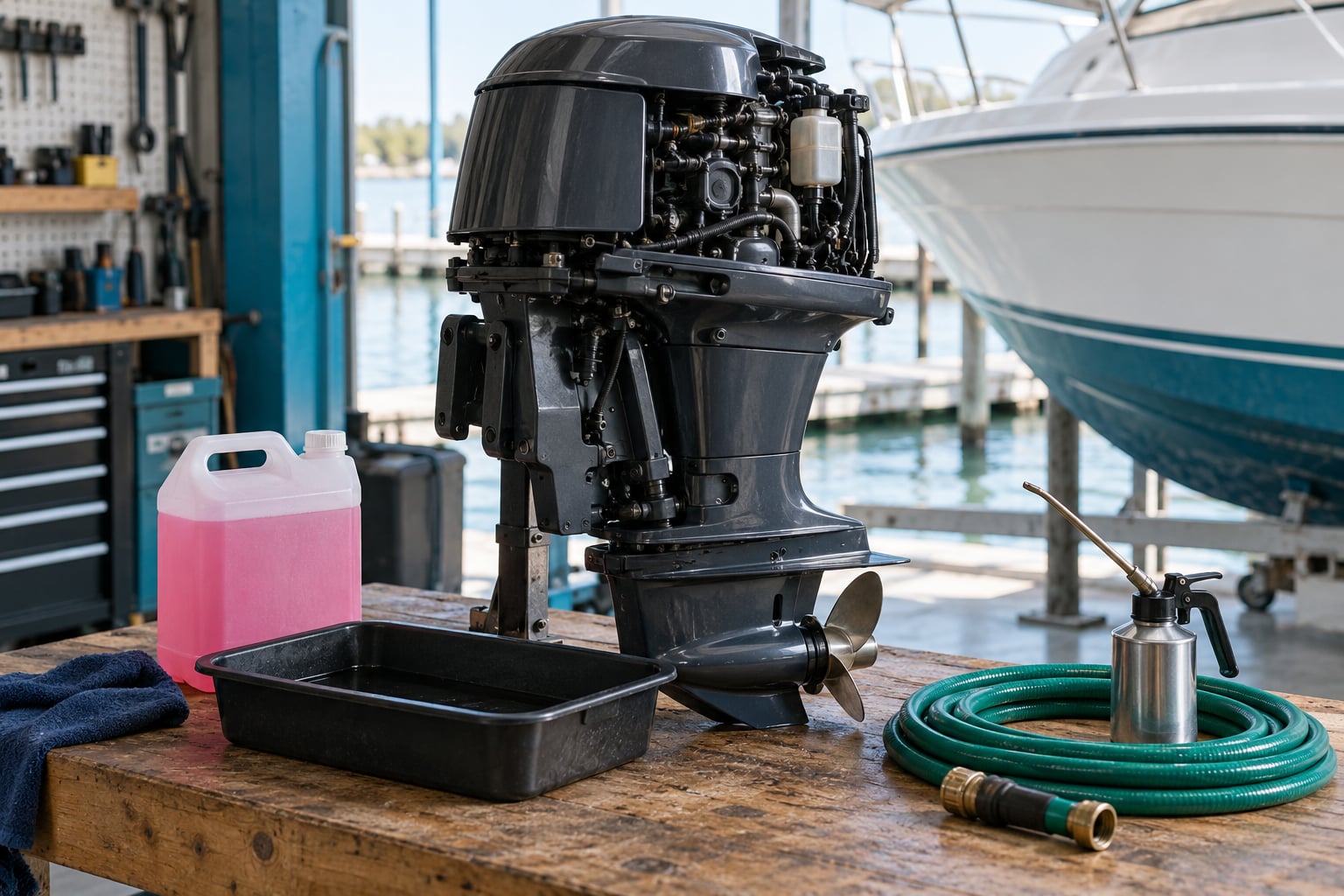
Winterizing a boat engine means clearing untreated fuel out of the fuel system, dealing with every drop of water in the cooling system, coating the cylinder walls with protective oil, and putting the motor somewhere dry and covered. Done right, it takes a few hours on a calm autumn afternoon and it saves you from the one repair category that can end a season early: a cracked engine block.
If you are working out how to winterize a boat engine, start with the owner’s manual for your make and model, then work through the steps below in order. The order matters more than people expect, because each job protects a different part of the motor from a different kind of damage.
Table of Contents
- 1What You Need
- 2How to Winterize a Boat Engine: Step-by-Step
- 31. Check the Owner’s Manual and Identify the Engine Type
- 42. Run or Drain the Fuel System and Add Stabilizer
- 53. Change the Engine Oil and Oil Filter
- 64. Protect the Cooling System
- 75. Clean and Inspect the Engine and Exhaust
- 86. Seal Openings and Store the Boat Safely
- 97. De-Winterize a Boat Engine With a Spring Startup Check
- 10Common Mistakes
- 11Frequently Asked Questions
- 12How long should a boat engine be winterized?
- 13Do I need to change the oil when winterizing a boat?
- 14Can I use automotive antifreeze in my boat engine?
- 15Should I run the engine after adding fuel stabilizer?
- 16How do I winterize an outboard versus an inboard boat?
- 17Conclusion
What You Need
Gather everything before you start. Half-finished winterization usually happens because the drain plug socket was in the truck and the plug was already out.
- The owner’s manual for your engine — the single most important item on the list, since procedures differ by model and by year.
- Marine engine antifreeze — non-toxic propylene glycol, rated for the coldest temperature your area hits. Skip it for outboards.
- Fogging oil — an oil that vaporizes and coats cylinder walls when sprayed into the intake or crankcase.
- Fuel stabilizer — a bottle rated for your tank size, plus enough fresh fuel to top the tank off.
- Marine engine oil and a new oil filter — grade and quantity per the manual.
- Lower unit gear lube — for outboards and sterndrives with a gearcase.
- Drain pan or a 5-gallon bucket, plus a ratchet and sockets that fit your drain plugs.
- Garden hose for flushing, and boat muffs or a flushing kit if you plan to run the engine during the job.
- Marine grease, a grease gun, and a corrosion inhibitor spray.
- Battery maintainer if the boat has a battery you intend to keep connected.
- A ventilated workspace, a fire extinguisher, and a bucket to catch spilled fuel.
How to Winterize a Boat Engine: Step-by-Step
What follows is the general order most manufacturers agree on. Your manual may add steps or move them, and where the two disagree, the manual wins. Procedures vary a lot by engine type, fuel system, and cooling layout, which is why step one is identifying what you actually have.
Two safety rules cover everything else. Disconnect the battery and any ignition source before you work near the intake or pull a plug, and never run an engine in an enclosed space. Keep fuel and ventilation openings clear, keep a fire extinguisher within reach, and run a boat on muffs only outdoors with the cowling off.
1. Check the Owner’s Manual and Identify the Engine Type
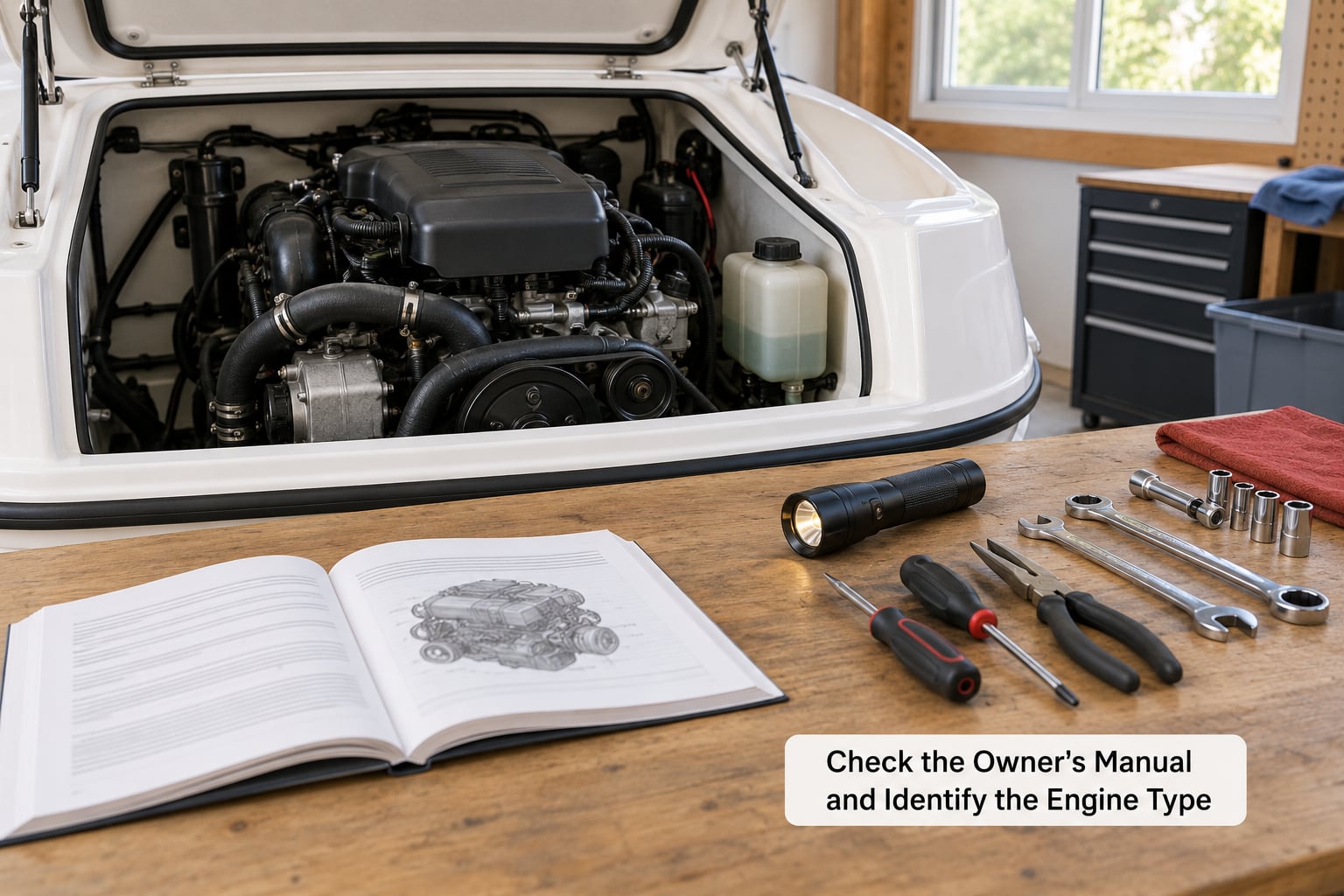
Before anything else, figure out whether you have an inboard, a sterndrive, or an outboard, and whether the outboard is 2-stroke or 4-stroke. This decision changes which steps apply, and getting it wrong is the most common reason a winterization goes bad.
The manual tells you things no generic guide can: whether your engine takes gasohol, which coolant mixture your block was built for, whether the engine has a closed or raw-water cooling system, the exact oil grade and quantity, and where every drain plug sits. Manufacturers revise these things between model years.
Two quick checks while you are in there. Read the plate on the engine for the model year, then open the cooling-system filler and look: a pressurized, capped filler neck usually means a closed cooling system, while an open port near the exhaust means raw water. Get this wrong on the antifreeze step and you can push glycol into an exhaust passage where it does no good at all.
2. Run or Drain the Fuel System and Add Stabilizer
There are two accepted approaches here, and your manual picks one. Add stabilizer to the fuel and circulate it, or drain the fuel system completely where the manufacturer permits it. What nobody should do is run the engine until it dies and hope the tank is empty, because that leaves a bowl of varnish-making fuel in the carburetor.
To add stabilizer, work out the dose from the label ratio and your tank capacity. Most products call for one ounce per gallon, so a 20-gallon tank takes roughly 20 ounces. Pour it in before topping the tank off, run the engine 10 to 15 minutes on muffs so the treated fuel reaches the carburetor and the fuel rail, and shut it down while there is still fuel in the system.
Once it is shut down, clean any spilled fuel off the deck, secure the fuel fill cap, and make sure the vent or flame arrester is clear. If your boat sits on a trailer, double-check the tank and fittings for leaks in the months ahead, because a stabilized tank still slowly off-gasses.
3. Change the Engine Oil and Oil Filter
Warm the engine first and let it run for the 10 to 15 minutes it took to circulate the stabilized fuel. Warm oil drains completely; cold oil leaves half of itself in the crankcase and you will be storing that sludge all winter.
Put a drain pan under the plug, remove the plug, and let the old oil out. While the pan is out, look at it. A milky emulsion, a fuel smell, or glitter in the oil all point to a bigger problem, and a fresh oil change will not fix any of them.
Refill with the exact grade and quantity the manual specifies, using marine-rated oil. Fit a new filter if the engine takes one, then refill, reinstall the plug, and run the engine until the pressure is steady and the oil light stays out. Check the level again a few minutes later, because the filter and the crankcase will hold back some of what you poured in.
Two-stroke engines are the exception. Most two-strokes do not get an oil change, so skip this step entirely and put that effort into fogging instead.
4. Protect the Cooling System
This is where engine types diverge most, and where the real damage happens. Water sitting in a casting expands as it freezes and cracks the block from the inside out. Sacrificial freeze plugs are designed to pop before that happens, which is cheaper, but still a nuisance and a signal that you are into a serious repair.
| Engine type | Cooling system | What to do |
|---|---|---|
| Outboard | Raw water, drains fully with the motor tilted down | Tilt fully down to drain, no antifreeze unless your manual specifically calls for it |
| Inboard | Often closed and pressurized, sometimes raw water as well | Drain every plug, then fill with marine antifreeze |
| Sterndrive | Closed freshwater plus a raw-water leg | Antifreeze the freshwater side, drain the raw-water intake |
Start by running a garden hose through the raw-water intake while the engine runs, so any scale, debris, or a stuck impeller gets flushed out before you close everything up. Shut the engine down and remove every drain plug you can find: the intake plate, the exhaust manifold and risers, the circulating pump suction line on raw-water systems, and the gearbox. Owners miss the circulating pump and the exhaust risers most often.
Then fill closed systems with marine antifreeze. Follow the manual on dilution rather than guessing, and keep one rule in mind: topping up old antifreeze with new antifreeze throws the concentration off in a way you cannot measure by eye. Run the engine until the thermostat opens and hot coolant reaches the manifold, then shut it down with the heater on high to pull the last of it through the block.
Use non-toxic propylene glycol, not automotive antifreeze. Ethylene glycol is toxic, and the difference is cheap. Never put automotive antifreeze in a boat engine, and never fill a raw-water passage that drains into an exhaust hub where the antifreeze would pool and never get pumped out.
5. Clean and Inspect the Engine and Exhaust
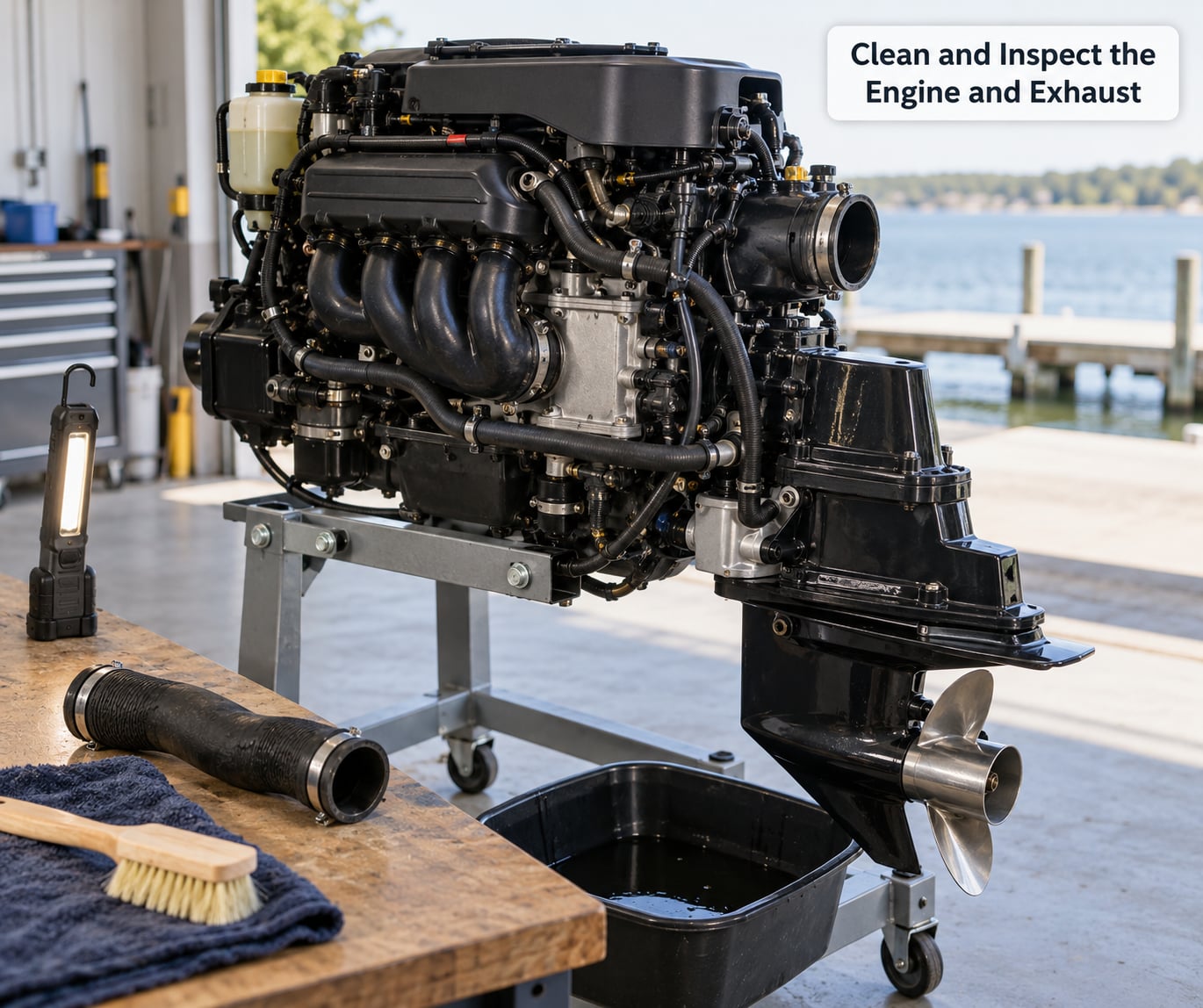
With the plugs out and the fluids handled, give everything a close look. Rinse salt and mud off the block, the exhaust manifold, and the risers, then check the hoses for cracks and the belts for glazing. If the boat lives in saltwater, a rinse with fresh water and a coat of corrosion inhibitor go a long way toward surviving one winter on the trailer.
Look at the exhaust path carefully. Water pooled in a horizontal exhaust section or in the exhaust hub is exactly the freeze damage owners discover in March. Check the water pump impeller if you can reach it without a teardown, since a marginal impeller that gets a couple of months of neglect is a spring repair instead of a fall one.
Remove the propeller and inspect the shaft, the prop shaft, and the lower unit for fishing line, weeds, and corrosion. Look at the sacrificial anodes and replace any that are more than half eaten away.
6. Seal Openings and Store the Boat Safely
Fogging is next on the list for carbureted and 2-stroke engines. With the spark plugs out, spray fogging oil into each spark plug hole until it comes back out, then pull the plug to keep a seal in the hole. On carbureted engines, remove the air horn and spray through the carburetor throat until the engine sputters and chokes. Four-strokes generally do not need fogging through the intake, though fogging the crankcase vent on some models is a manual-specified step.
Refit the plugs, then check the linkages. Grease the steering, throttle, and shift cables, the tilt and trim ram, and every grease fitting the manual lists. Loosen drive belts on engines where the manual recommends it rather than letting them sit under tension and go brittle.
For storage, disconnect the battery or fit a maintainer, fill the fuel tank as full as you safely can to limit condensation, and position the motor the way the manual specifies, which for most outboards means fully down. Cover the boat with a breathable fitted cover, not a shrink wrap or a plastic tarp, and get moisture moving with a dehumidifier or a bilge heater if the boat is indoors. Trapping damp under a tight cover causes more trouble than cold does.
7. De-Winterize a Boat Engine With a Spring Startup Check
De-winterizing is the reverse checklist, and doing it methodically in spring is how you catch a winter problem while it is still small. Work through it before you put the boat in the water, not after.
- Fill a new water separating fuel filter, then top the tank off with fresh fuel and a dose of stabilizer.
- Check the oil level and the gear lube level, and look at the gear lube for a milky appearance, which means water has gotten past a seal.
- Inspect belts and hoses for cracking, and check the water pump impeller and thermostat.
- Refit the spark plugs and confirm they are in good condition.
- Fill the cooling system with the correct coolant, checking the hoses and clamps while you are there.
- Grease the gimbals and steering components, then reconnect the battery and let the maintainer finish its charge.
- Start the engine on muffs and watch for leaks at every drain plug and hose connection for the first few minutes.
- Run it in the slip for several minutes and confirm the exhaust output and steering response before leaving the dock.
Common Mistakes
Almost every winterization failure I hear about comes down to one of these. None of them are complicated, which is exactly why they happen.
Using automotive antifreeze. It is toxic, and it is the wrong chemistry for a marine system. Use non-toxic propylene glycol rated for your coldest expected temperature.
Running the engine out of gas instead of adding stabilizer. Popular advice, and wrong. It leaves a bowl of old fuel in the carburetor that oxidizes into varnish over months of storage. Ethanol-blend fuel can already start breaking down in a matter of weeks, so sooner is better than later.
Adding too little stabilizer. Dose by tank capacity and the label ratio, not by feel. Under-dosing gives you the cost of the bottle without the protection.
Forgetting the oil change. Half-used oil is full of water and combustion byproducts, and it holds them against the bearings all winter.
Missing hidden drain plugs. The raw-water intake plate, the circulating pump suction hose, and the exhaust risers are where freeze damage actually starts. Crawl under the boat and find them all.
Plugging a raw-water intake incorrectly. A raw-water system is meant to drain. Sealing it traps water inside the pump and the block.
Leaving a full lead-acid battery connected all winter. A charged battery still loses capacity while it sits, and a cold one that drops below freezing can sulfate permanently.
Starting the engine in spring without checking the cooling system. A block that froze and cracked will not tell you until you flood it. Walk the hoses first.
Wrapping the boat too tight. Plastic and shrink wrap trap condensation against the hull and the engine. Breathable cover, and keep air moving if the boat is stored indoors.
Two final safety notes. Never mix fuel stabilizers from different manufacturers unless the label explicitly permits it, and never spray fogging oil anywhere near a hot exhaust or an ignition source.
Frequently Asked Questions
How long should a boat engine be winterized?
A properly winterized engine will sit all winter without trouble, and the antifreeze you leave in the block does not expire on any useful timeline. What does expire is the stabilizer in the fuel. Most products claim protection for a full storage season, and many extend a year or more, so topping the tank off and treating it once before storage is enough. Check it in the spring before you assume it held.
Do I need to change the oil when winterizing a boat?
On a 4-stroke, yes. Old oil carries water and combustion byproducts, and leaving it in the crankcase for months invites corrosion on the bearings and cylinder walls. Warm the engine first so the oil drains fully, then refill with the grade and quantity in your manual. On a 2-stroke there is no oil to change, so skip straight to fogging and fuel treatment.
Can I use automotive antifreeze in my boat engine?
No. Automotive antifreeze is usually ethylene glycol, which is toxic, and it is not formulated for a marine system. Use non-toxic propylene glycol marine antifreeze rated for the lowest temperature your area reaches. Also keep in mind that undiluted antifreeze can gel in cold weather, so follow the manual on dilution rather than pouring in straight product.
Should I run the engine after adding fuel stabilizer?
Yes, briefly. Run it 10 to 15 minutes so the treated fuel circulates through the carburetor, the fuel rail, and the water separator. Run it outdoors on muffs with the cowling off, away from any ignition source. Once you have done that, shut it down rather than letting it run dry, because running the tank empty leaves varnish-forming fuel in the carburetor bowl.
How do I winterize an outboard versus an inboard boat?
An outboard drains its raw-water cooling system when tilted fully down, so it usually needs no antifreeze. It does need fuel stabilizer, fresh oil and a filter on a 4-stroke, gear lube in the lower unit, fogging on carbureted and 2-stroke models, and a thorough spray of grease on the linkages. An inboard or sterndrive holds water in the block, so add every outboard step and then drain the block and fill it with marine antifreeze.
Conclusion
Confirm the engine type first, then follow the manufacturer’s winterization procedure for that exact model. Stabilize the fuel rather than running the tank dry, drain every cooling passage you can find before filling an inboard or sterndrive block with marine antifreeze, fog the cylinders, and change the oil and gear lube before the motor sits.
Give the engine and exhaust a proper look before it goes into storage, and fix anything you find rather than hoping cold weather will not notice. Freeze damage and fuel corrosion are the two most expensive things that can happen to a boat over winter, and almost all of it is preventable in one afternoon of careful work.