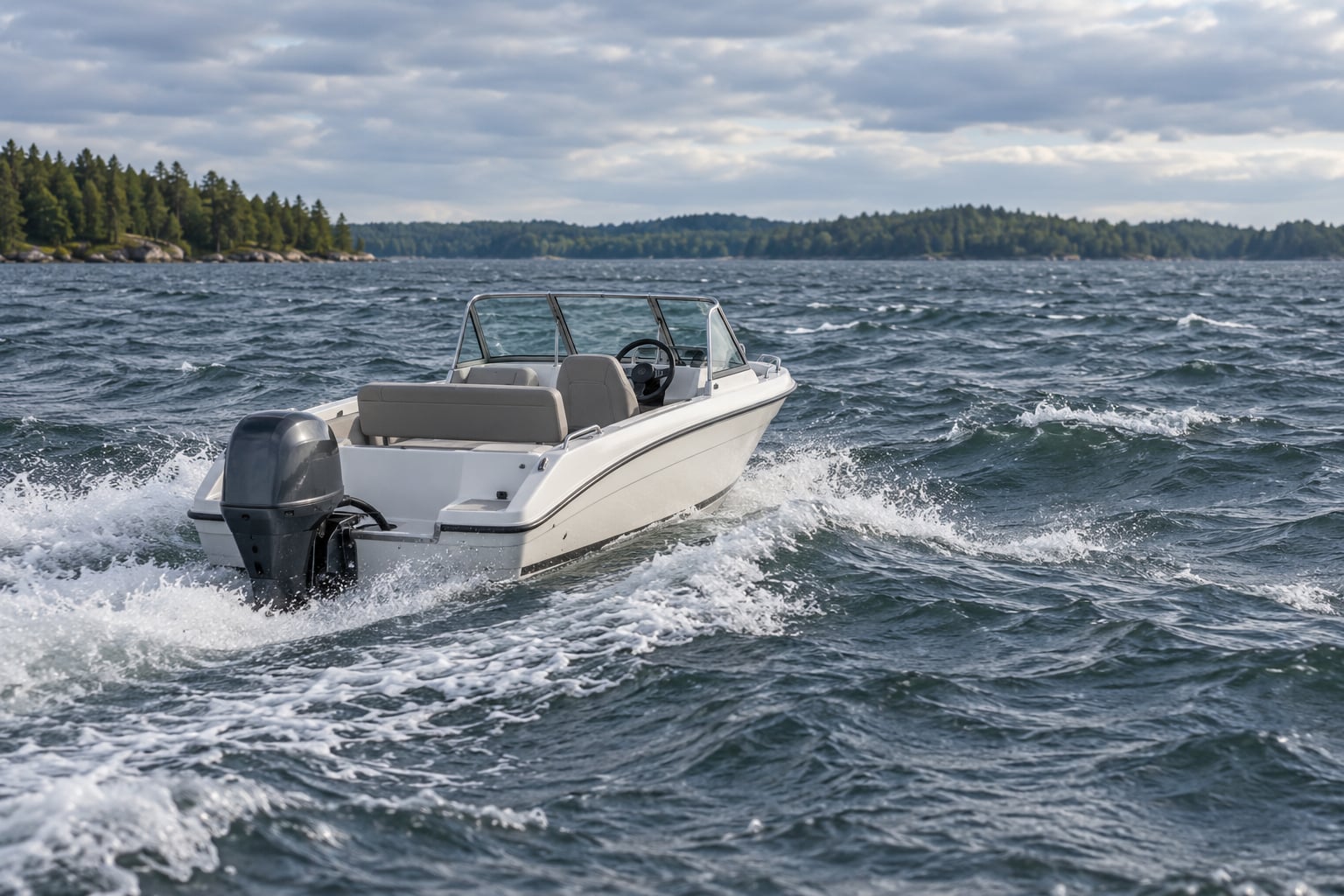
How to handle a boat in rough lake chop comes down to four things: slow down until the hull follows the wave face, point the bow at an angle instead of straight into the chop, trim the bow up so it clears the wave behind you, and work the throttle in and out so the boat stays matched to each wave. Keep everyone seated in a properly fitted life jacket, and turn back toward calmer water before conditions pass the point of no return.
Rough lake chop is not the same danger as ocean swell. Lake wind waves are short and close together, usually 1 to 4 feet tall with wave periods of only 2 to 5 seconds, so the boat never gets a chance to settle between crests. Short, steep chop is what swamps and rolls small boats, and the same open water that is glass at 7 a.m. can build three feet of confused chop by mid-afternoon.
This guide is written for freshwater cruising: aluminum fishing boats, bass boats, pontoons and center consoles on lakes and reservoirs in the U.S. Everything here assumes you are dealing with a short-duration crossing, not extended offshore conditions. If the chop is long and rolling with a period you can count comfortably, the same rules still apply with a lot more margin for error.
The advice below follows the pattern experienced boaters repeat across the big boating forums: slow down, work the throttle, keep the bow up, and be honest about turning back early. Veteran forum users are almost universal on one point. The best way to handle a boat in rough lake chop is to not be in it.
Table of Contents
- 1What You Need
- 2Safety equipment that matters in chop
- 3Weather and water information
- 4Know your boat’s controls and limits
- 5Planning tools
- 6Step-by-Step: How to Handle a Boat in Rough Lake Chop
- 71. Check the weather, lake, and boat condition
- 82. Put on a life jacket and position passengers safely
- 93. Match your speed to the chop
- 104. Adjust the throttle, trim, and heading
- 115. Turn gradually and avoid sharp corrections
- 126. Cross waves at a safe angle when handling a boat in rough lake chop
- 137. Handle spray, wake, and changing conditions
- 148. Return to calm water or the dock safely
- 15Common Mistakes
- 16Running too fast for the chop
- 17Pointing straight into short, close-set chop with a shallow hull
- 18Crossing wakes close aboard
- 19Standing up or moving around while the boat is moving
- 20Making abrupt turns and correcting hard
- 21Ignoring the forecast and the dark-cloud rule
- 22Skipping the bilge pump and the float plan
- 23Frequently Asked Questions
- 24Is it better to go fast or slow in choppy water?
- 25Should you trim up or down in choppy water?
- 26Should you run the bilge pump all the time?
- 27What angle should you take waves at in rough lake chop?
- 28How do I know when a lake is too rough to boat on?
- 29Conclusion
What You Need
Most of the equipment you need is already on the boat. What changes is that in chop you use all of it, and you check it before you leave the ramp rather than after the first wave hits.
Safety equipment that matters in chop
- A properly fitted USCG-approved PFD for every person aboard, worn and buckled before the engine starts.
- A working automatic bilge pump with a float switch, plus a hand pump in a reachable spot.
- A throwable flotation cushion and a sound-producing device such as a whistle or horn.
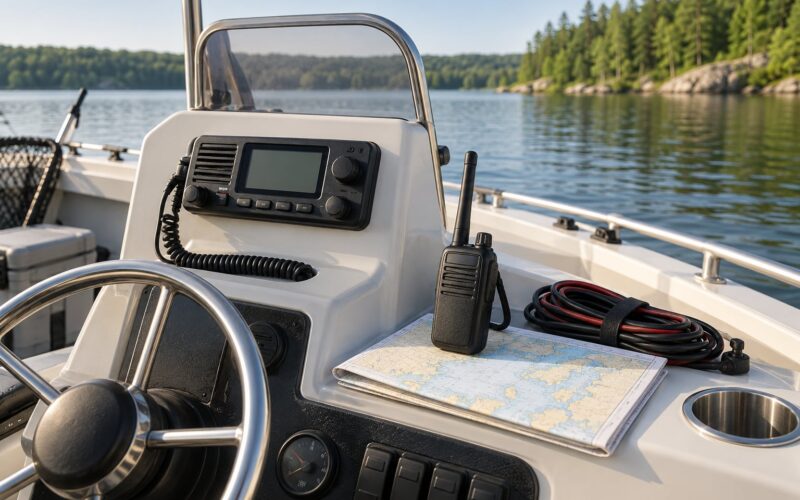
- A VHF radio with DSC, or at minimum a charged phone in a waterproof case, plus a chartplotter or GPS with your route marked.
- An anchor with enough rode for the depth, set up and ready to drop rather than coiled in a locker.
Weather and water information
Pull the National Weather Service zone or marine forecast for the lake the morning you go, then again immediately before you leave the dock. Look at sustained wind, gust factor, and the direction relative to your route. A forecast of 15 mph gusting to 25 means very different things on a four-mile crossing than on a twenty-mile crossing.
Also look at the fetch. Fetch is the distance the wind blows across open water, and it is the single biggest factor in how big lake chop gets. A 12 mph wind across a long, wide lake makes nasty short chop. The same 12 mph in a sheltered bay barely ripples the surface.
Watch the sky. A dark line of cloud on the horizon, a sudden drop in temperature, or flat, hard-edged clouds building in the west usually mean outflow winds are minutes away. On a lake, a thunderstorm that would be an inconvenience inland becomes a squall with straight-line gusts and a quick chop.
Know your boat’s controls and limits
Before you get rough, find out where your trim is. Most outboards and stern drives have an adjustable jack plate, power trim, or jack plate height that changes bow attitude. Know which way it tilts the bow and how far it travels. Know your throttle range at displacement speed, and know your bilge pump switch location without looking for it.
Planning tools
Tell one person on shore your route, your boat description, your number of people aboard, and your expected return time. That float plan costs nothing and it is the thing people on boating forums mention over and over as the thing they wish they had done sooner. Pack a chart or download the lake offline, and note the sheltered coves, island wind shadows and alternate ramps you could use if you need to bail out.
Step-by-Step: How to Handle a Boat in Rough Lake Chop
1. Check the weather, lake, and boat condition
Run the bilge pump for a minute at the dock with the drain plug in and confirm it actually pumps. Check that the plug is snug after every haul-out. Look at the transom, hull and water intake screens for damage or weed, and confirm your fuel is enough for your route plus a slow hour of idling in place if you end up anchored.
Then look at the lake itself from the ramp. Choppy surface texture, streaks of foam moving with the wind, and wind waves on the far shore are all signs you are looking at more than you want. If you can see whitecaps on the open water from the ramp, consider a different day.
2. Put on a life jacket and position passengers safely
A life jacket that is not worn does nothing. Buckle it before casting off, tighten the side straps until it does not ride up over your chin when you tug the shoulders, and check that children are in a properly sized one rather than an adult one with the straps pulled tight.
Get everyone seated low and centered before you enter the chop. Weight to one side is a real steering input, and in short steep waves it can tip a boat that would otherwise ride level. Ask passengers to hold the gunwales or grab a seat back rather than standing, shifting around to look at waves, or walking the deck while the boat is moving. That movement is the most common reason people fall in on a lake, and a fall at speed into a hard-bottomed lake is dangerous.
3. Match your speed to the chop
In short, close-set chop, slow down. Get to just above idle and let the hull follow the wave face instead of slamming into it. Long ago, forum regulars settled on roughly 2,000 rpm in displacement mode with the engine trimmed all the way out as the way to hold the bow out of the water on a small boat. That figure is specific to a particular hull, so treat it as a starting point rather than a rule, and use your boat’s own range.
The one exception is very long, slow swell, where staying on plane and surfing the crests is calmer than dropping into displacement. Lake chop is rarely that shape. Most of the time, more speed in short chop means more slamming, more spray over the windshield and more energy loading the hull.
Match your boat to the water. This table is a starting range, not a guarantee, because hull shape, deadrise and load all change the outcome.
| Boat length | Comfortable lake chop | Likely behavior at the limit |
|---|---|---|
| Under 12 feet | Under 1 foot | Swamps quickly, water over the bow, hard to recover |
| 13 to 16 feet | 1 to 2 feet, short period | Bows bury, passengers soaked, possible broach in a hard turn |
| 17 to 20 feet | 2 to 3 feet | Pounding, spray over windshield, slow and wet ride |
| Pontoon | 1 to 2 feet | Very stable, but windage pushes it off heading; large waves can roll the tubes under |
| Over 21 feet | 3 feet or more | Comfortable, heavier motion, still watch freeboard and passengers |
4. Adjust the throttle, trim, and heading
Trim the bow up so it rides above the following wave instead of punching into its back. On most stern drives and outboards that means adding uptrim until you are comfortable driving the bow slightly high in a straight run on calm water, then backing it off just enough that the bow still settles when you hit the flat.
Keep the throttle hand on the controls and work it with each wave. Slight acceleration as the boat climbs a face, a touch of deceleration as it settles off the back, steady throttle in between. You are trying to keep the hull following the contour of the wave rather than driving through it. Small inputs, applied early, work much better than large inputs applied late.
Trim tabs help here, and the mechanism is straightforward. Trim tabs are small plates hinged at the transom that push water downward, which pushes the stern up, which lifts the bow. That lets you run a normal hull attitude with the bow higher than you could hold it with engine trim alone. Set them in small increments and watch how the boat settles into a trough. If the bow starts skipping or the ride gets twitchy, back them off a notch.
5. Turn gradually and avoid sharp corrections
Make course changes early and slow. A sharp turn in short steep chop puts the beam into an off-angle wave, and the boat can trip over its own bottom edge and broach. Broaching means the stern swings out, the boat ends up sideways to the waves, and in a small boat that is how boats roll. A broach is usually recoverable in a big boat and often is not in a 14-footer.
Turn in a series of small arcs. Change one thing at a time: heading first, then throttle, then trim. If the bow drops off a wave face and starts to dig, add a little uptrim and a touch of throttle before you correct the wheel, because a rudder alone will not lift a buried bow.
6. Cross waves at a safe angle when handling a boat in rough lake chop
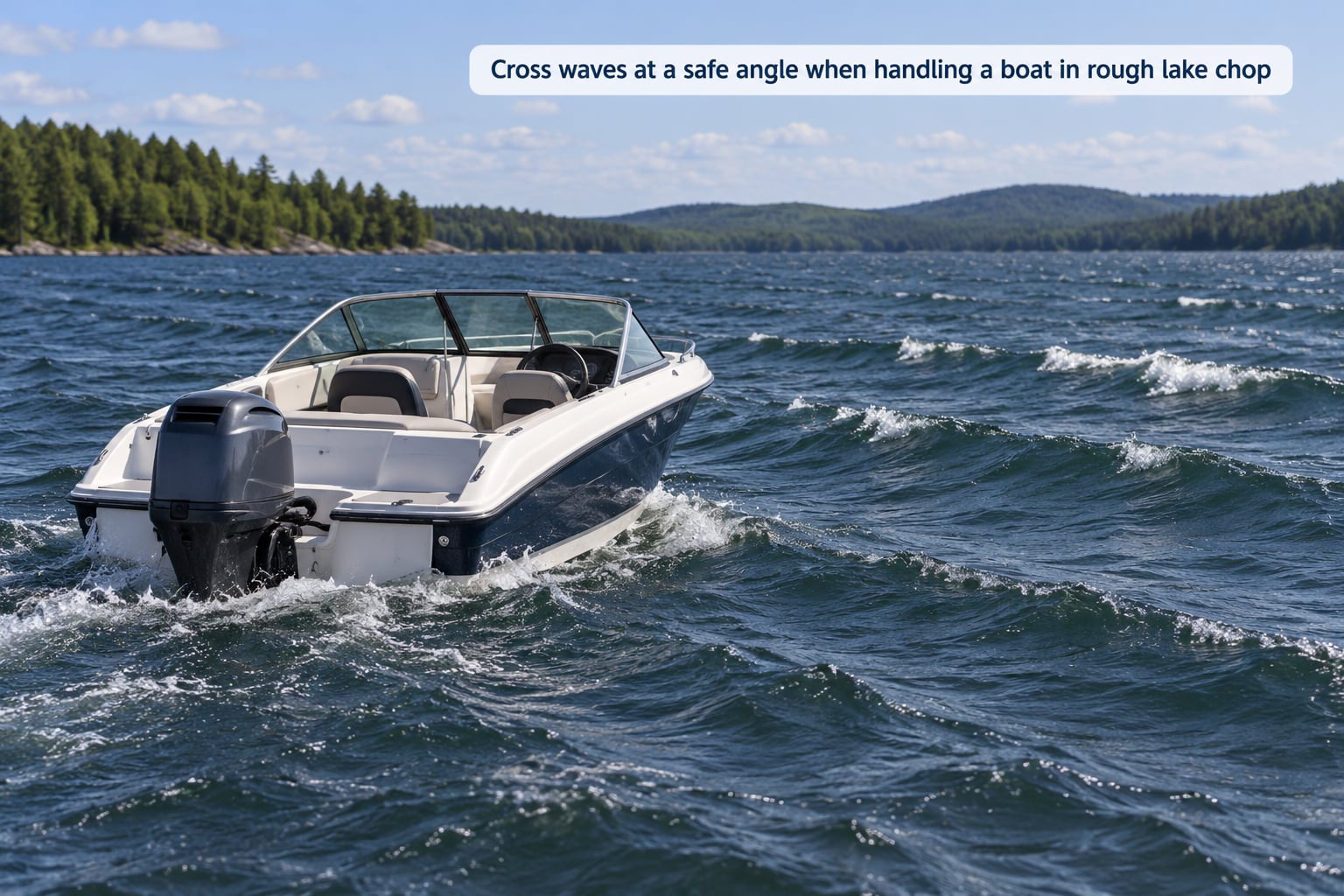
Point the bow at an angle to the waves, somewhere between 30 and 45 degrees off the wave crest, and lengthen the run across each wave. That is the standard advice and it works most of the time, because a longer crossing makes the same wave last longer, so the boat rises and settles instead of taking a punch.
Here is the honest caveat. Boating forums have argued about this for years, and the argument is not fully resolved. Some experienced skippers argue that a deeper-V hull with good deadrise should go nearly head-on in short chop, punch straight through the wave face, and come out the other side, because the hull angle and deadrise deflect water rather than absorb it. That is a legitimate technique on a hull built for it. It is not a technique for a flat-bottomed jon boat, a pontoon, or a heavily loaded small boat.
So decide with these rules. Deep-V or modified-V hull with solid deadrise, wave height well under what the boat is rated for, and moderate period: a shallow head-on or 20-to-30-degree angle is comfortable and efficient. Flat bottom, shallow deadrise, lots of passengers, or waves close together and steep: take the 30-to-45-degree angle, and if the angle is not available, reduce speed further rather than pointing straight in. Either way, never run parallel or beam-on to the waves, because that puts the boat’s weakest point, its side, against the wave face.
7. Handle spray, wake, and changing conditions
Spray is a warning, not a nuisance. If you are taking water over the windshield continuously, the bow is too low, the speed is wrong, or the chop is beyond the boat. Back off uptrim and speed together and reassess.
Give wakes room. A large cruiser wake crossing your bow can take a 16-foot boat’s windshield full in one pass, and forum users report exactly that. When you see a wake, turn to meet it at an angle if you can, slow down, and pass well astern rather than close aboard. Never put the beam on someone else’s wake.
Keep the bilge pump running the whole time you are in chop, with the float switch on, and keep a hand pump within reach. Watch the horizon, not just the bow. If the waves are visibly growing, if the wind is veering and strengthening, or if the color of the water changes to a wind-driven chop, you are losing ground. Conditions that build in ten minutes rarely stop on their own.
8. Return to calm water or the dock safely
The recovery sequence is simple. Decide early, then reduce speed in stages. Bring the bow down off high trim once you are out of the steepest chop, because carrying full uptrim at low speed in calm water is a poor ride and adds drag. Keep the heading as constant as the conditions allow rather than weaving.
As you near the dock or ramp, drop the tabs, bring the engine trim down, and come in at the lowest speed that still gives you steerage. You cannot steer a boat that is idling too slowly, so keep just enough throttle on to hold a line and let the current do the rest. Approach into the wind or into the current when you can, because it holds the boat steady and keeps it from being set sideways onto the dock. If conditions have deteriorated enough that you are picking your way home, anchor in a sheltered cove and wait rather than grinding it out. That decision, made early, prevents almost every bad outcome on a lake.
Common Mistakes
These are the errors that show up over and over in boating discussions, and most of them are about speed, angle or movement rather than skill.
Running too fast for the chop
Speeding up feels like it helps because the bow rides higher for a moment, and then the hull slams. The fix is to reduce to just above idle and hold that speed until the bow behaves. A pounding boat is not a fast boat, it is a damaged hull.
Pointing straight into short, close-set chop with a shallow hull
Head-on is fine on a deep-V hull in moderate seas. On a flat bottom or a heavily loaded boat in tight chop, it is how water comes over the bow. Fix: 30 to 45 degrees, slower speed, more trim. If you cannot angle away, slow down until you can.
Crossing wakes close aboard
Fix: keep a wide berth, slow before the wake, and steer so it hits your bow quarter rather than your beam. One wake can swamp a small boat even in calm water.
Standing up or moving around while the boat is moving
Fix: everyone seated, weight spread evenly along the centerline, hands on a rail or seat back. Weight on one side is a steering input, and in short steep waves it can put a boat over.
Making abrupt turns and correcting hard
Fix: turn early and wide in a series of gentle arcs. If the bow digs, add uptrim and a touch of throttle before touching the wheel. Most broaches start as a steering correction, not a wave.
Ignoring the forecast and the dark-cloud rule
Fix: check the forecast right before you leave, set a turn-back threshold before you go out, and treat a dark line on the horizon or a sudden temperature drop as a reason to head back now. Boating forum regulars are consistent about one thing: leaving before the weather makes the decision for you is always the right call.
Skipping the bilge pump and the float plan
Fix: pump on, plug checked, and someone on shore knows your route, your boat and your expected return time.
Two more safety habits pay off more than any technique. Dress for cold water immersion, not for the air temperature, because spring and fall lake water will put you in shock in minutes. And remember that cold water shock and a capsized boat far from shore is the real emergency, not the wave you just took.
Frequently Asked Questions
Is it better to go fast or slow in choppy water?
In short, close-set lake chop, slower is better. Get to just above idle so the hull follows the wave face instead of slamming into it, keep the bow trimmed up, and hold that speed steady. The exception is long, slow ocean-style swell, where staying on plane and surfing from crest to crest is smoother. On a lake, more speed usually means more pounding, more spray over the windshield and more energy on the hull.
Should you trim up or down in choppy water?
Trim up so the bow rides above the following wave rather than punching into its back face. Add uptrim in small steps until the boat planes with the bow slightly high on a calm run, then ease it back just enough that it still settles into a trough. On many stern drives and outboards you can add trim tabs, which lift the stern and give you more bow height than the engine alone.
Should you run the bilge pump all the time?
Run an automatic bilge pump with a float switch whenever you are underway, not only in rough water. Chop throws spray and green water into the cockpit, and a small amount that nobody notices can add up over a long run. Keep a manual pump within reach, check the impeller and the float switch twice a season, and confirm the drain plug is snug after every haul-out. A pump with a failed float switch is worse than no pump at all.
What angle should you take waves at in rough lake chop?
Usually 30 to 45 degrees off the wave crest, which stretches each wave out so the boat rises and settles instead of taking a punch. A deep-V hull with good deadrise in moderate, longer-period chop can handle a shallow head-on angle well. A flat bottom, shallow deadrise or heavily loaded boat needs the wider angle. Never run parallel or beam-on, because that puts the hull side against the wave face and can roll the boat.
How do I know when a lake is too rough to boat on?
Turn back when you are taking water over the windshield continuously, when waves are visibly growing, when wind is veering and strengthening, or when the bow will not stay up at any speed you are comfortable with. Forecast-based triggers include a small craft advisory for your zone or sustained winds above what your boat is rated for. The clearest test is simple: would you take your kids out in this right now? If not, go back.
Conclusion
If you are already in rough lake chop, the safest thing you can do in the next thirty seconds is reduce speed, hold a steady heading at a 30-to-45-degree angle to the waves, trim the bow up, and keep every passenger seated in a buckled life jacket. Keep the bilge pump running and decide now whether you turn back or anchor in a sheltered cove. Conditions that build in ten minutes rarely stop on their own, and the technique that keeps a boat safe is the decision to leave early.