To match lure size to fish size, scale your bait to the forage your target species is actually eating: pick a lure about 10 to 30 percent shorter than the baitfish it imitates, then pair it with a hook or jighead light enough to let it fall naturally at your target depth. Bigger fish are not automatically caught on bigger bait.
That is the whole method, and it takes about a minute once you know the local forage. The hard part is not the sizing math, it is estimating the size of the fish in front of you before you pick anything out of the box.
I have watched the same argument play out on every fishing forum I read. One guy swears a two inch grub catches his biggest crappie, another says nothing under four inches ever gets touched. Both can be right, because the answer changes with the lake, the water clarity, and where in the lake they were standing.
So this guide gives you an order of operations instead of a brand recommendation. Estimate the fish, size the bait, pair the tackle, read the water, and adjust only after you have ruled out being in the wrong spot. Written for 2026, and it works the same on a pond as it does on a saltwater flat.
Table of Contents
- 1What You Need
- 2Step-by-Step: How to Match Lure Size to Fish Size
- 3Estimate the Target Fish Size
- 4Choose a Lure Proportionally
- 5Adjust for Water Clarity and Depth
- 6Match the Lure to the Fish’s Feeding Style
- 7Test and Adjust on the Water
- 8Lure Size and Hook Size Pairing Chart
- 9Does a Bigger Lure Catch Bigger Fish?
- 10Common Mistakes
- 11Frequently Asked Questions
- 12How do I choose the right lure size for the fish I am targeting?
- 13Does bigger bait catch bigger fish?
- 14What size hook should I use for a 3 inch bait?
- 15How big is a size 10 lure?
- 16Should I match the hatch exactly or go bigger than the forage?
- 17What is the 80/20 rule in fishing?
- 18What to Do First
What You Need
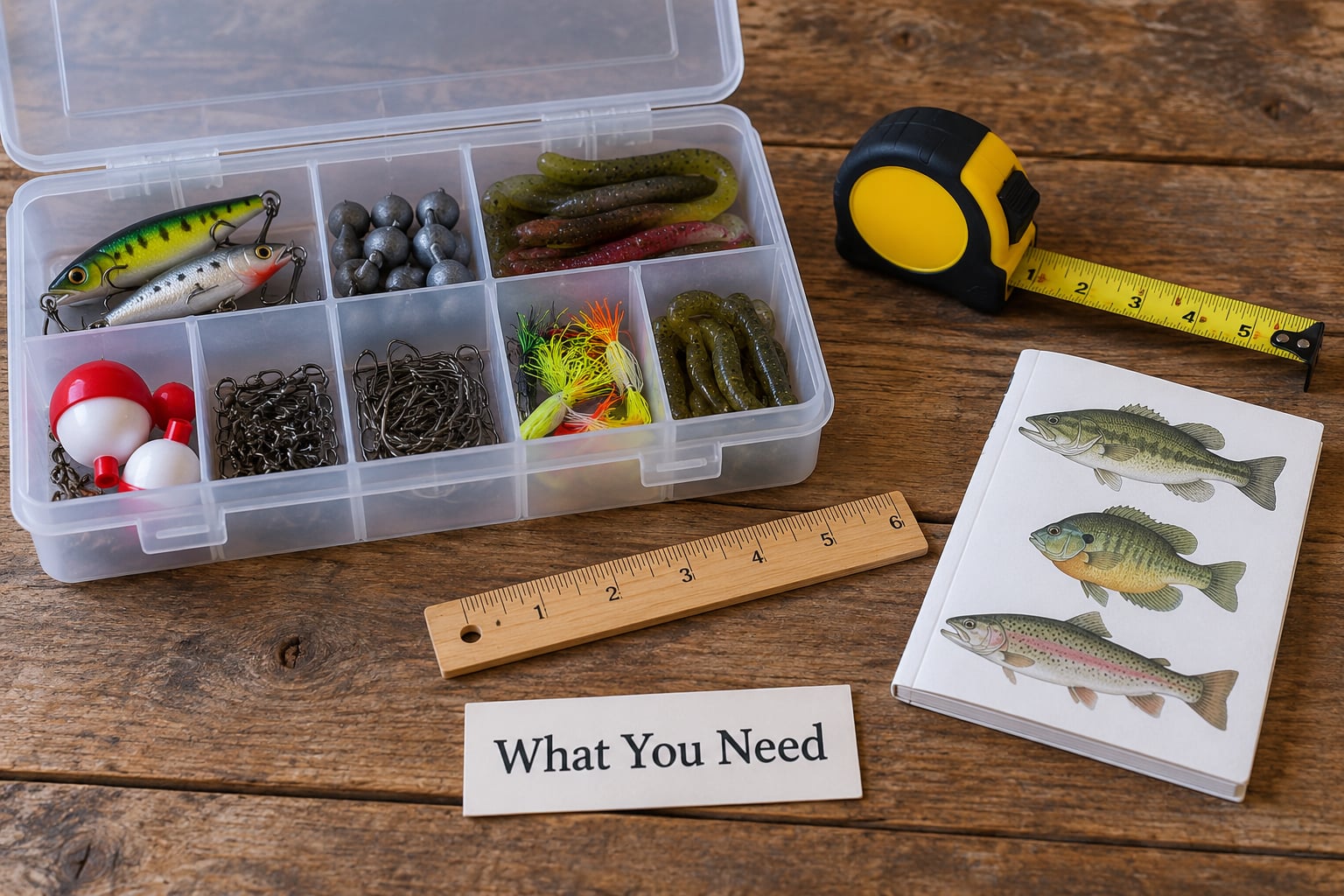
None of this is expensive, and most of it fits in a boat box. The point is to arrive with information, because sizing decisions made blind on the dock are guesses.
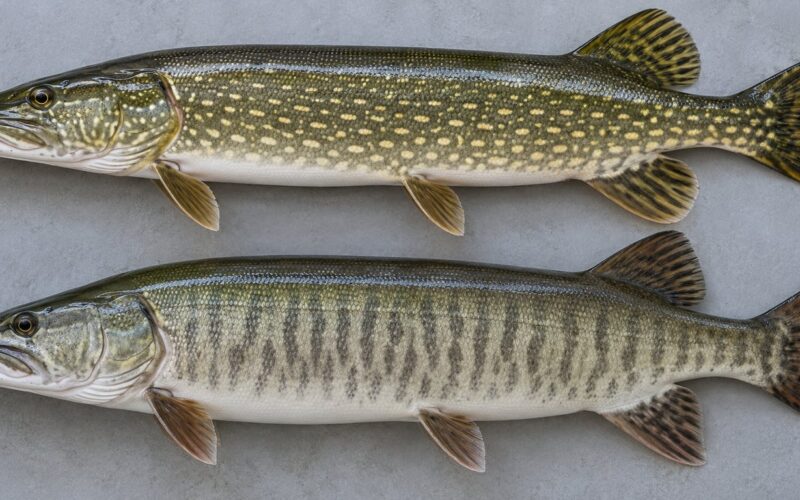
- A fish identification guide, preferably pocket-sized. Knowing whether you are looking for crappie, white perch or a bluegill changes the size range you are aiming at more than any other variable.
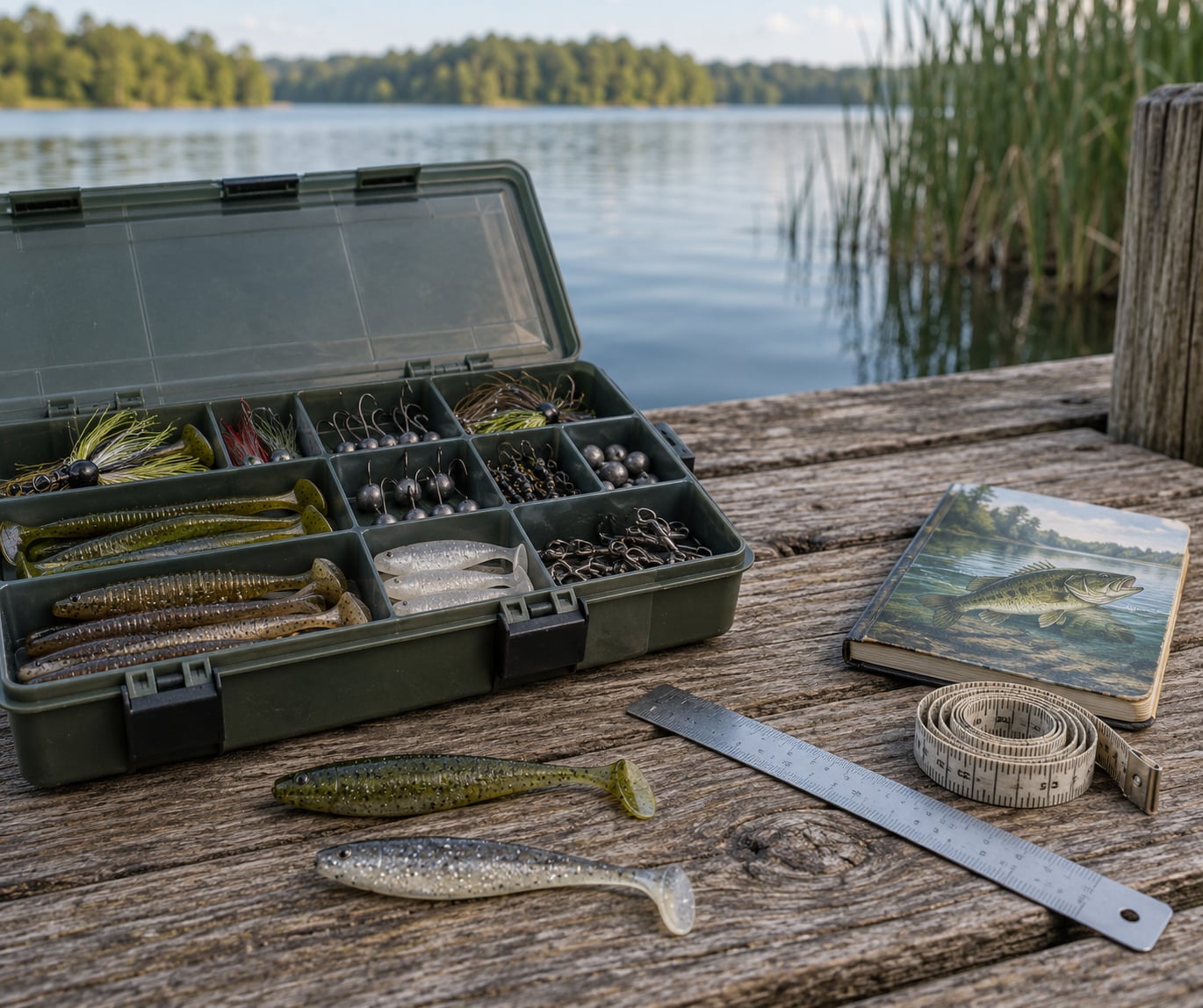
- A ruler or tape measure. You are measuring baitfish, not your catch, though a quick measure of anything you land is how you build your own records over a season.
- A standard soft plastic kit in graduated sizes, roughly 1.5 inch through 5 inch, so you can move one step at a time instead of guessing a new size from scratch.
- A jighead or hook assortment with the common weights in the box. A 1/16, 1/8 and 3/16 ounce spread covers most of what you will change on the water.
- A local fishing report or forage note, even if it is just a photo of the creek’s minnows. Baitfish length is the single most useful number you can bring to the lake.
- A phone with a camera for the forage you find in the shallows. Two inches of measured shad beats any rule of thumb.
That last one is the habit that changes results fastest. Spend five minutes in the shallows before you fish the drop-off and pin down what is actually swimming there.
Step-by-Step: How to Match Lure Size to Fish Size
Estimate the Target Fish Size
Start with a number, not a species name. “Bass” tells you almost nothing about the size of the bass holding your spot, while “14 to 18 inch” tells you what to reach for.
Use whatever evidence you have, in this order. Local records and the last few years of your own catches are the best sources. Next best is a rough proportionality check: a fish’s length is roughly seven to eight times the width of its closed mouth, and that mouth has to cover your lure’s widest point, not its length.
If you have no history at the spot, assume the average fish is smaller than you hope. A crappie angler on the crappie.com forum described catching fish from ten inches to two and a half pounds on the same one sixteenth ounce jig with a two inch tail, which is a good reminder that a single setup covers a wide range.
Write the estimate down. Without it you will rationalize whatever size is already in your hand.
Choose a Lure Proportionally
With a target length in mind, take a lure roughly 10 to 30 percent shorter than that fish. Two very common starting points: a lure about 15 percent of the fish’s total length for a cautious, pressured bite, and closer to 25 percent when the fish are aggressive and feeding hard.
Length alone is not enough. Girth is what the fish actually judges. A slender 4 inch shad and a fat 4 inch creature bait present very differently, and a thick bait can spook fish that would chase the same-length skinny profile.
Then check the mouth. The lure’s girth plus the hook should be able to pass the fish’s mouth with a little clearance, and the hook point should sit inside the bait’s body so the fish has something solid to bite rather than an inch of empty plastic. This is where most oversized presentations quietly fail. The fish sees it, swims three feet, and leaves.
Now the part that gets argued about. A bigger fish will absolutely take a lure smaller than itself, because bass and crappie eat things that are a fraction of their own body length all the time. A 6 pound crappie spends its spring eating 1 inch minnows. The proportional rule sets your starting point; it does not cap you.
Adjust for Water Clarity and Depth
Clarity changes how much a lure needs to be scaled down. In stained or tannin-stained water, fish see outlines and contrast rather than detail, so a slightly larger bait still reads and the fish are less likely to spook at movement.
In clear water, light goes deeper but a fish’s attention is drawn to anything that breaks the pattern. Downsize there rather than changing color, and slow the presentation down. A lure that is too big in clear water usually gets followed and never eaten, so slow retrieves and pauses are the fix that gets overlooked.
Depth is where size turns into a physical problem. A bigger lure with more surface area falls faster, and falling faster means less time to detect a bite. Pair a large soft plastic with a lighter jighead to slow the fall, or accept the fast fall and fish it faster near the bottom.
Depth also dictates how long the lure stays in the strike zone. The crappie.com sizing discussion put it plainly: lure size and profile work with jighead weight to set how fast the bait moves through the water column, and that speed decides the depth you can actually fish.
Match the Lure to the Fish’s Feeding Style
Different species react to size for different reasons, so the same bait can be right for one fish and useless for another in the same water.
Ambush predators such as pike and large smallmouth prefer a profile that looks like a real meal, and they will commit to a larger bait. Chasers such as largemouth bass in open water are often more willing to eat a small, fast bait they can barely see. Bottom feeders like catfish and carp care more about scent and vibration than silhouette, so size matters less than you would think.
Panfish such as bluegill and yellow perch have small mouths and short windows of interest, so tiny baits and light jigs outperform everything else. A crappie angler on the forum noted that smaller fish do not hit big baits as readily, which is a cheap way to weed out dink fish when you only care about the average.
Test and Adjust on the Water
Change one thing at a time, in this order: lure length first, then jighead weight, then presentation. If you swap all three at once, you will never know what worked.
When bites stop, work down the ladder. Go one size smaller on the bait, and if nothing changes, step the jighead down from an eighth to a sixteenth. Then drop to an even lighter jig or add a small splitshot above the lure so the whole rig sinks slowly. That sequence is the most repeatable adjustment routine I have seen documented on the water, and it comes straight from anglers describing their own downsizing runs.
The same forum thread reported the opposite result elsewhere: some lakes, downsize to a 1/64 or 1/80 and the bigger fish start showing. Another angler there said showing a big fish something different also gets its attention. Both are honest reports, and the takeaway is that you have to run the ladder before you decide which rule applies to your water.
Finally, know when you have a sizing problem and when you have a location problem. If you get no follows, no short strikes and no interested fish at all, the fish are probably not there. Follows and aborted strikes mean the bait is being seen and rejected, and that is a size or color problem you can fix from the boat.
Lure Size and Hook Size Pairing Chart
This is the reference table I wish every angler had on the phone before a trip. The fish length column is a typical adult, the lure length is where to start, and the tackle is the pairing that falls naturally with it.
| Species | Typical adult length | Starting lure length | Paired tackle |
|---|---|---|---|
| Bluegill | 6 to 9 inches | 1 to 1.5 inch | Size 8 to 6 hook, 1/32 to 1/16 oz jig |
| Crappie | 10 to 14 inches | 1.5 to 2 inch | 1/16 to 1/8 oz jig |
| Yellow perch | 8 to 12 inches | 2 to 3 inch | 1/8 to 3/16 oz jig |
| Smallmouth bass | 14 to 18 inches | 2.5 to 3.5 inch | 1/8 to 3/16 oz jig |
| Largemouth bass | 16 to 22 inches | 3 to 5 inch | 1/4 to 5/16 oz jig |
| Walleye | 20 to 30 inches | 3 to 5 inch | 1/8 to 3/16 oz jig, live bait rig |
| Lake trout | 20 to 35 inches | 4 to 6 inch swimbait | 1/4 oz or heavier, deep jigging |
| Northern pike | 25 to 40 inches | 4 to 8 inch swimbait | 1/4 to 3/8 oz, slow retrieve |
| Rainbow trout | 12 to 20 inches | 2 to 3.5 inch | Size 6 to 2 treble hook |
| Channel catfish | 20 to 35 inches | Baitfish, 3 to 5 inch | Circle hook, 1 to 1/0 |
| Flatfish, saltwater | 12 to 24 inches | 2 to 4 inch strip or jig | 1/8 to 1/4 oz, 2/0 to 3/0 hook |
Hook sizing runs on two numbering systems that move in opposite directions, which is where most mismatches come from. The plain number scale goes up as the hook gets smaller, so a size 10 is a very small hook and a size 1 is much larger. The aught scale adds a zero and goes down as the hook grows, so 1/0 is smaller than 3/0.
A size 10 hook is roughly three eighths of an inch from eye to bend, wire included, and it is the smallest hook most anglers own. For a 3 inch soft plastic, a size 3 or size 2 offset worm hook is the common answer, which is aught-equivalent to about a 2/0. The printed number is a family reference rather than a dimensional standard, so check the actual gap and wire when you buy.
The pairing table below is the short version, and it is the one I keep in mind on the boat.
| Lure length | Offset worm hook, plain number | Common equivalent | Typical jighead weight |
|---|---|---|---|
| 1 to 1.5 inch | Size 8 to 6 | 2/0 to 4/0 | 1/64 to 1/32 oz |
| 2 inch | Size 4 to 3 | 1/0 to 2/0 | 1/32 to 1/16 oz |
| 3 inch | Size 2 to 1 | 1/0 to 2/0 | 1/16 to 1/8 oz |
| 4 inch | Size 1/0 | 1/0 | 1/8 to 1/4 oz |
| 5 to 6 inch swimbait | 2/0 to 3/0 | 3/0 to 5/0 | 1/8 to 3/8 oz |
Heavier fish also take bigger hooks. A fish under a pound can rarely handle treble hooks, while anything past five pounds benefits from the wider gap and stronger wire that a multi-hook provides.
Does a Bigger Lure Catch Bigger Fish?
No, and this is the single most useful correction in the whole guide. A bigger lure raises your average fish size, but the average comes mostly from weeding out the small fish, not from triggering something in the big ones.
That is the argument from the forum evidence, and it holds up. Anglers on bass boards described never hesitating to go large or heavy, and a trolling angler reported larger crankbaits still produce a few dinks but a better average fish. Meanwhile multiple anglers on the crappie forum insisted that bigger fish is location, location, location.
Both sides are describing the same mechanism. Size is a filter, not a magnet. If your biggest fish came on 2 inch or smaller lures on one lake, downsize and stay there rather than chasing a rule from a different lake.
Common Mistakes
Choosing the lure by depth only. Depth tells you how much weight you need, not how big the bait should be. Pick the size from the forage first, then choose the jighead weight that lets that size fall at the speed you want at that depth.
Reaching for the biggest bait in the box. The largest presentation gets the most free advertisement, which is exactly why it also collects every missed strike. Start proportional and go up only when the bites justify it.
Ignoring clarity. The same 3 inch lure that works in stained water will often follow instead of bite in a clear lake. Downsize in clear water and slow the retrieve before you start changing colors.
Changing size without changing presentation. A smaller lure is usually a slower lure. If you downsize and keep the same fast retrieve, you have changed two variables and learned nothing.
Buying a hook chart when you needed a forage chart. Most sizing charts you will find on hook retailer sites answer a different question. The useful number is the length of the baitfish in the water in front of you.
Treating another angler’s rule as universal. Every downsizing story you read is lake specific. Treat forum advice as the ladder to test, not the answer to copy.
One habit worth adding: after any session, note the lure size, weight and depth that produced your best fish. Three trips of notes will tell you more than any general rule, because it will be your water and your fish.
Frequently Asked Questions
How do I choose the right lure size for the fish I am targeting?
Estimate the typical adult length of the fish first, then pick a lure about 10 to 30 percent shorter than that length. Check girth as well as length, and make sure the lure plus hook will fit through the fish’s mouth. Pair it with a jighead light enough to fall at the speed you want in your target depth.
Does bigger bait catch bigger fish?
Not automatically. A larger lure mostly filters out small fish that will not commit to it, which raises your average size without necessarily finding the biggest fish. Anglers report better average fish on bigger crankbaits while still catching dinks. Where you are fishing matters more than how big the bait is.
What size hook should I use for a 3 inch bait?
A size 2 or size 1 offset worm hook is the most common choice for a 3 inch soft plastic, roughly equivalent to a 1/0 or 2/0 on the aught scale. The hook point should sit fully inside the bait body. Add a larger hook for a thick creature bait and a smaller one for a slim paddle tail.
How big is a size 10 lure?
It depends on whether you mean a hook or a hard bait. A size 10 hook measures roughly three eighths of an inch from eye to bend and is among the smallest hooks made. A size 10 crankbait is about 1.5 inches long, in the same numbering family as size 5 and size 7 hard baits. Check the label, since the two scales run opposite ways.
Should I match the hatch exactly or go bigger than the forage?
Match it closely as your starting point, then adjust with the water. Exact matches work best in clear water and when fish are pressured. In stained water, slightly larger baits still read well. A bigger fish will happily take a lure smaller than itself, so a proportional match sets where you begin, not where you are limited.
What is the 80/20 rule in fishing?
The 80/20 rule is the idea that roughly 80 percent of your fishing results come from 20 percent of the water, the structure and cover that consistently hold fish. It is a location reminder rather than a lure rule: if you are catching nothing, move before you change the size of the bait in your hand.
What to Do First
Measure the baitfish in the shallows before you pick a lure. That one number decides most of the decisions that follow, and getting it right costs you five minutes at the boat ramp.
Start proportional to your estimated fish size, pair it with a jighead that falls at the speed you want, and give it an honest 20 minute test before you change anything. When the bites stop, run the ladder one size down at a time until something works again.
Keep a short note of what worked for you, because your water will tell a slightly different story than anyone else’s forum post ever will.