Boating right of way rules explained in one line: the vessel that can maneuver more easily keeps out of the way of the one that cannot. In practice that means a speedboat yields to a sailboat, a powerboat yields to a kayak, and two powerboats meeting head-on both turn to starboard so they pass port to port. Size never enters into it.
These rules come from the International Regulations for Preventing Collisions at Sea, 1972 — the 72 COLREGs — enforced by the U.S. Coast Guard on US navigable waters, plus state boating law and the local ordinances for the lake or river you are on. This guide translates them into the handful of situations you actually run into on a weekend trip.
Table of Contents
- 1What Is the Right of Way on the Water?
- 2Three layers of law decide who moves
- 3Boating Right of Way Rules Explained at a Glance
- 4How Do You Know Which Boat Has the Right of Way?
- 5What Are the Common Right-of-Way Situations?
- 6Head-on situation (Rule 14): both turn right
- 7Crossing situation (Rule 15): the boat on your right is your problem
- 8Overtaking (Rule 13): the boat behind you moves
- 9The rest of the situations worth knowing
- 10Who Has the Right of Way in a Narrow Channel?
- 11How Do Distance, Visibility, and Navigation Lights Change the Rules?
- 12Whistle and sound signals
- 13Restricted visibility changes everything
- 14What Should You Do If a Collision Is Unavoidable?
- 15After a collision or near-miss
- 16Which US Boating Rules May Vary by State or Waterway?
- 17How Can You Apply the Rules Safely on Your Next Trip?
- 18Frequently Asked Questions
- 19Does a boat always have the right of way because it is larger?
- 20What should I do if another boater does not follow right-of-way rules?
- 21Does a sailboat always have the right of way over a powerboat?
- 22Must a recreational boat always yield to a commercial vessel?
- 23What happens when a boat is stopped with fishing lines in the water?
- 24What is the one-third rule in boating?
- 25Conclusion
What Is the Right of Way on the Water?
Right of way is the boat’s legal claim to the space ahead of it. When two vessels are on a collision course, the navigation rules label one the stand-on vessel and the other the give-way vessel.
The stand-on vessel holds course and speed and expects the other boat to get out of the way. The give-way vessel alters course, reduces speed, or both, early and obviously. Right of way exists to sort out who moves first without anyone having to negotiate, which is exactly why it fails badly when both skippers assume they are the stand-on.
Three layers of law decide who moves
Federal COLREGs set the navigation rules nationwide. State boating statutes layer on licensing, age limits, speed zones and their own enforcement. Local authorities — a lake association, a reservoir authority, a harbor district — can post no-wake zones, one-way channels and bridge opening procedures that override the general habit of the water.
When the layers conflict, the more restrictive one applies to you. A lake can legally tell you to slow to idle speed in a cove where COLREGs would otherwise leave it to your judgment.
Boating Right of Way Rules Explained at a Glance
This table is the whole rule set compressed. Everything below expands on one of these rows.
| Situation | Who keeps clear | What to do |
|---|---|---|
| Head-on meeting | Both vessels | Alter course to starboard, pass port to port, sound one short blast |
| Crossing, other boat on your starboard side | You | Alter course early and substantially, pass behind |
| Overtaking | The overtaking boat | Pass well clear on either side; the overtaken boat holds course |
| Narrow channel, meeting | Both vessels | Keep to your starboard side of the channel, meet port to port |
| Sailboat under sail meets powerboat | The powerboat | Give the sailboat room and a clear line |
| Kayak, canoe, rowboat or paddleboard | The powered boat | Pass astern at a distance; the paddle craft holds course |
| Restricted in ability to maneuver | Every other vessel | Keep clear; it may be restricted by draft or a work site |
| Restricted visibility | Every vessel | No stand-on or give-way exists; sound one prolonged blast every two minutes |
How Do You Know Which Boat Has the Right of Way?
Ask one question first: which vessel can get out of the way more easily? Then, in order from highest priority down:
- Vessels not under command, through some breakdown or force beyond their control.
- Vessels restricted in their ability to maneuver — dredging, surveying, underwater work, launching aircraft, or a sailboat that cannot leave the narrow channel.
- Vessels engaged in commercial fishing, and especially vessels trawling along a line.
- Vessels under sail.
- Vessels propelled by oars or paddles: kayaks, canoes, rowboats and stand-up paddleboards.
- Power-driven vessels, including personal watercraft.
No, the bigger boat does not have the right of way. A 60-foot motor yacht behind a 14-foot sailboat gives way, and so does a large center console facing a paddleboarder. Length, beam and horsepower are not in the list. People get this wrong constantly, usually because courtesy used to run that way on working rivers.
Two related distinctions trip people up. A sailboat running its auxiliary engine is classified as a power-driven vessel, so it loses its place in the hierarchy the moment the engine starts. And a personal watercraft is a power-driven vessel too, not a special category with extra privileges — although a lot of PWC operators behave as though they have them.
What Are the Common Right-of-Way Situations?
Every encounter you will have falls into one of three geometry patterns. Learn these and you can sort out almost anything on the water. Here is boating right of way rules explained without the jargon.
Head-on situation (Rule 14): both turn right
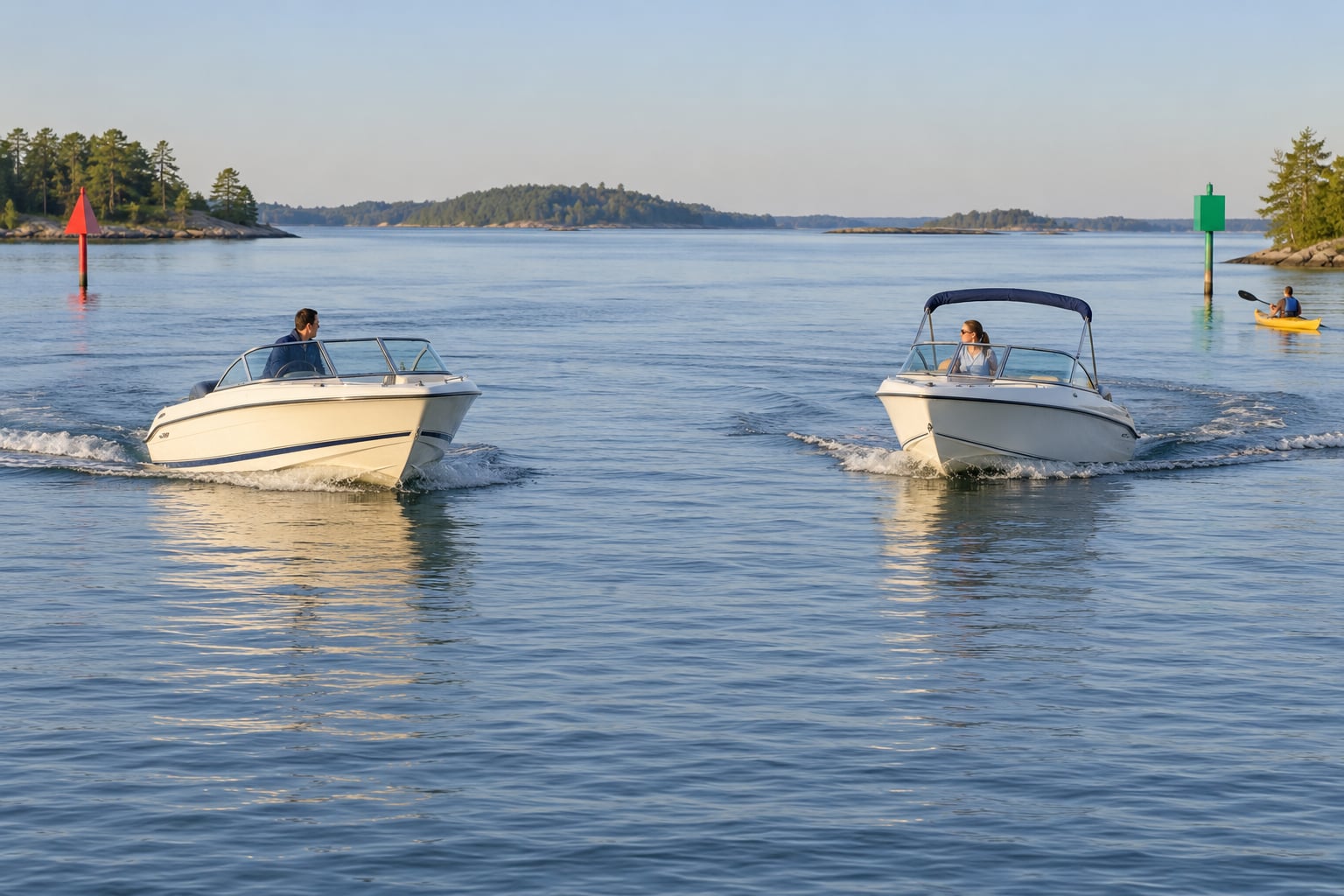
Two vessels approaching each other bow to bow, or nearly so, each altering course to starboard so they pass port to port with the other boat’s red light to starboard. Whoever is operating a vessel of 20 meters or more, or a power-driven vessel, sounds one short blast to signal the intention.
The mistake here is applying “give way to the boat on your right.” In a head-on that rule does not apply, because both boats are simultaneously on each other’s starboard side. Both turn.
Crossing situation (Rule 15): the boat on your right is your problem
The other vessel is crossing ahead of you and approaching from your starboard side. You are the give-way vessel; the other boat holds course and speed. Pass behind it, and make the maneuver visible early enough that the person at the other helm can relax.
If the other boat is coming from your port side, you are the stand-on vessel. Hold your course, keep watching, and be ready to act if the crossing boat fails to yield.
Overtaking (Rule 13): the boat behind you moves
The overtaking vessel is one coming up on a course more than 22.5 degrees abaft the other’s beam — in other words, not roughly parallel, but clearly coming from behind and to one side. When you cannot tell whether a boat is overtaking you or crossing, assume you are the one being overtaken and stay out of its way.
Give a wide berth on whichever side is clear, and never so tight that a wake hits the other hull. Forum discussion on boating boards keeps circling the same point: the most common near-miss is not a rules misunderstanding, it is an overtaking boat squeezing past at a few feet and the boat ahead suddenly turning toward open water.
The rest of the situations worth knowing
- Vessels towing skiers, tubers or wakeboarders. They are constrained in their ability to maneuver, and the people in the water do not move as quickly as a hull does. Give them a very wide berth and stay well clear of the tow rope.
- Boats at anchor. An anchored vessel has limited maneuverability and no ability to get underway quickly. You are the give-way vessel, always.
- A boat in a slip, dock or launch ramp. The vessel that can move freely keeps clear. Hold position until they are clear of the ramp.
- Personal watercraft. Treated as powerboats. They get the same precedence and owe the same deference.
- Both boats think they are stand-on. This happens constantly. The boat with the give-way obligation acts first, and the other vessel does not hold a grudge about it later.
Who Has the Right of Way in a Narrow Channel?
In a channel or fairway narrow enough that vessels cannot pass comfortably, both skippers keep to the starboard side of the channel, which puts them port to port when they meet. A vessel running against the direction of traffic keeps as close as practicable to its own side.
There are two exceptions worth memorizing. A vessel restricted by draft, size or the shape of the waterway must not be impeded by anyone. And a sailboat under sail that cannot maneuver within the channel has priority over a vessel that can — which is why you will sometimes see a boat under sail holding a channel that a powerboat technically has a claim to.
Posted signs and bridge protocols override all of this. At a swing bridge or a narrow opening, follow the marked channel, and expect disagreement about who had priority. On a lake, the bridge operator’s instructions settle it.
How Do Distance, Visibility, and Navigation Lights Change the Rules?
Navigation lights tell you what kind of vessel you are looking at before you can read a hull. Red on the port side, green on the starboard side, white at the stern and white or yellow at the mast for a sailboat under sail. If you can see a red light on your side, that boat has your starboard side and you are the give-way vessel.
Whistle and sound signals
Sound carries much further than light on open water, which is why the whistle is the primary signal. These are the ones you will actually use.
| Signal | Meaning |
|---|---|
| One short blast | Altering course to starboard, or a doubt signal when approaching another vessel in a fog or bend |
| Two short blasts | Altering course to port |
| Three short blasts | Operating astern propulsion |
| Five or more short and rapid blasts | Doubt about whether you are taking sufficient action to avoid collision |
| One prolonged blast | Approaching a bend, an obstruction, or a group of fishing boats; also used in restricted visibility |
Restricted visibility changes everything
In fog, mist, heavy rain or a snow squall, the stand-on and give-way relationship essentially dissolves. Every vessel is responsible for its own safe speed, and sound one prolonged blast at intervals of not more than two minutes if you are in or near an area of restricted visibility.
Slow to a speed you can stop within the distance you can see. On a lake, that often means turning back. The requirement to maintain course and speed while being overtaken does not override the requirement to avoid a collision.
What Should You Do If a Collision Is Unavoidable?
When you have the give-way obligation and the other boat is not keeping clear, the escape action is simple: head for open water. Alter course early, turn hard enough that your intent is obvious, and blow the horn continuously. Throttling down to neutral late in the encounter removes your last option.
If you are the stand-on vessel and a collision looks unavoidable, Rule 17 applies to you too. Both boats act to avoid it. Holding course is not a right when the geometry has stopped being safe.
After a collision or near-miss
- Stop and make the situation safe first. Engine neutral, everybody accounted for, lines and people in the water recovered.
- Give medical aid if it is needed, then exchange vessel and operator information: name, address, registration number, and insurance details.
- Photograph the damage and both boats while they are still in place.
- Report the collision to the state boating authority when the rules require it, and notify your insurer.
- Do not leave the scene. A hit-and-run is a far bigger legal problem than the collision itself.
Which US Boating Rules May Vary by State or Waterway?
The navigation rules are federal and largely uniform. Everything wrapped around them is not.
- Minimum operator ages and required education, which differ by state and by horsepower.
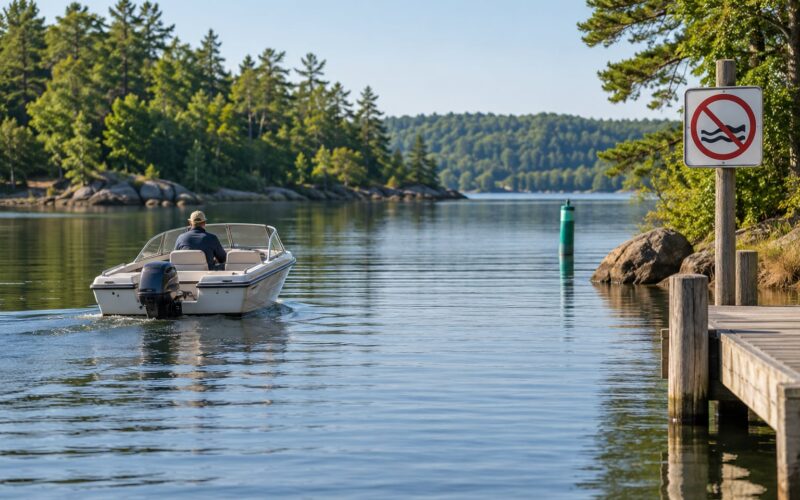
- Speed limits, including the separate no-wake zones that many lakes extend into coves, camp shorelines and near docks.
- Right-of-way exceptions carved out in state law, particularly for river traffic, ferries and some regulated channels.
- Local rules for rental pontoons, personal watercraft and slow-speed craft at ramps and in slips.
- Whether a bridge opens on demand, on a schedule, or only by signal.
Read the ramp signage and the lake’s posted notices before you launch, and treat the slowest sign you see as the one that applies to you.
How Can You Apply the Rules Safely on Your Next Trip?
A short checklist before the motor starts and one habit while underway do more for your odds than memorizing rule numbers.
- Before you leave the ramp: check the local lake or reservoir rules, note the no-wake boundaries, and confirm your chart or GPS has the channel markers and any hazards loaded.
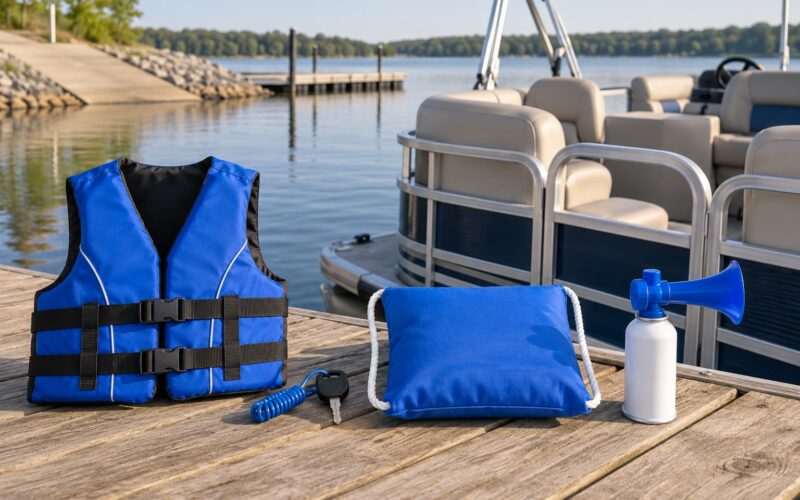
- Equipment that directly reduces your risk: a working VHF radio with channel 16, a sound signal device that can be heard over an engine, navigation lights that work, and a properly fitted life jacket for everyone aboard.
- Set a lookout early. The single most common cause of a collision is a person who did not see the other boat in time to act.
- Communicate before it gets tight. A whistle blast or a quick call on channel 16 explaining your intentions solves more stand-offs than any rule.
- Make your maneuver obvious. Throttle back early, move decisively, and hold the new course long enough that the other skipper knows you are committed to it.
- When in doubt, give way. That fallback is accepted on every waterway and it is never the wrong answer to give twice.
- Keep a log when conditions are unusual. Notes on weather, visibility, boat traffic and any incident matter later if an insurance or reporting question comes up.
Frequently Asked Questions
Does a boat always have the right of way because it is larger?
No. Vessel size, length, beam and horsepower are not part of the right-of-way calculation under the COLREGs. A large motor yacht gives way to a small sailboat under sail, and both give way to a kayaker. What matters is the vessel class and how easily each one can maneuver, so a bigger boat often owes more deference, not less.
What should I do if another boater does not follow right-of-way rules?
If you have the give-way obligation, act first: alter course early, pass astern of the other vessel, and signal with a prolonged or repeated whistle blast. If you are the stand-on vessel, hold your course and speed until the give-way boat fails to act, then take the action Rule 17 allows and note the time, position and course of the other boat for a later report.
Does a sailboat always have the right of way over a powerboat?
Only while it is actually under sail. A sailboat using its auxiliary engine is classified as a power-driven vessel and loses its precedence, which catches out a lot of owners heading into a marina or a narrow channel. A sailboat that cannot maneuver within a narrow channel also keeps its special status even under sail, and every vessel must avoid impeding its passage.
Must a recreational boat always yield to a commercial vessel?
By vessel type, yes: vessels not under command and those restricted in their ability to maneuver come first, then commercial fishing vessels, then sailboats, then paddled craft, then powerboats. But a ferry or a towboat operating a scheduled route can hold a different claim under local rules, and a container ship in a deep-draft channel is simply not maneuverable in the way a cabin cruiser is.
What happens when a boat is stopped with fishing lines in the water?
A vessel fishing is restricted in its ability to maneuver and keeps that status, and trawling vessels rank above sailboats. A vessel engaged in fishing shows two lights in a vertical line, white above red, and sounds one prolonged blast when you approach. If you cannot see the gear, slow down and give the boat a wide berth rather than assuming the water behind it is clear.
What is the one-third rule in boating?
The one-third rule is fuel planning, not a right-of-way rule: keep one third of your tank for the trip out, one third for the trip home, and one third as reserve. It is often confused with right-of-way topics because the word rule appears in both. It has no bearing on which vessel keeps clear on a collision course.
Conclusion
If someone asks you for boating right of way rules explained in a single sentence, give them this: identify the vessel and the situation, keep a proper lookout, act early and obviously if you owe the give-way, and follow the state and local rules for that specific waterway rather than a shortcut from the last lake you fished.
Most mishaps trace back to a late correction, a boat nobody was watching, or two skippers each convinced they were the stand-on vessel. Take the first one out of your driving and the collision never happens.