Driving a pontoon boat for the first time is mostly about slowing down. The boat is wide, stable and hard to capsize, but it answers the wheel lazily and the wind pushes it around, so the skill is patience rather than nerve. Most people feel natural after two or three short outings.
A pontoon is not a car on water. There is no clutch, the throttle lever stays where you put it, and nothing slows you down but your own hand. If you want to drive a pontoon boat for the first time the right way, treat the first hour as practice, not transportation.
Here is the order that works for most beginners: check the boat, learn the controls, start the engine, work at idle speed in open water, then dock before you try anything else. Budget about two hours for your first outing and pick a calm morning with no wind.
Table of Contents
- 1What You Need
- 2Step-by-Step
- 31. Inspect the boat before you start
- 42. Learn the pontoon boat’s controls
- 53. Start the engine and move away from the dock
- 64. Practice steering at low speed
- 75. Practice forward, reverse, and stopping
- 86. Approach and secure the boat at a dock
- 97. Return the boat and shut it down
- 10Common Mistakes
- 11Frequently Asked Questions
- 12How fast should a beginner drive a pontoon boat?
- 13Is it difficult to dock a pontoon boat for the first time?
- 14Do I need boating experience to drive a pontoon boat?
- 15What should I do if the pontoon boat will not start?
- 16Should I practice driving a pontoon boat in an open area first?
- 17What safety equipment does a first-time pontoon boat operator need?
- 18Conclusion
What You Need
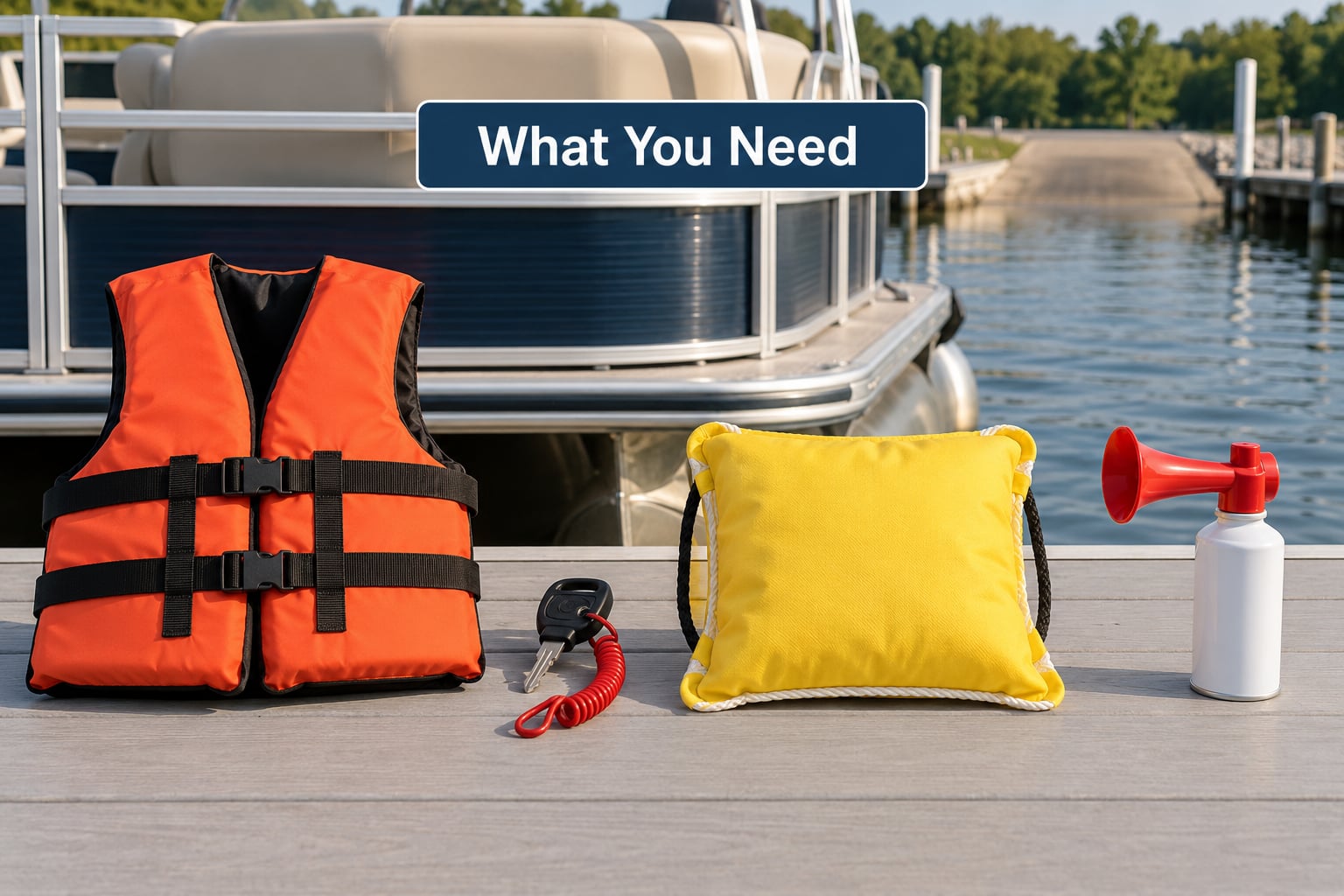
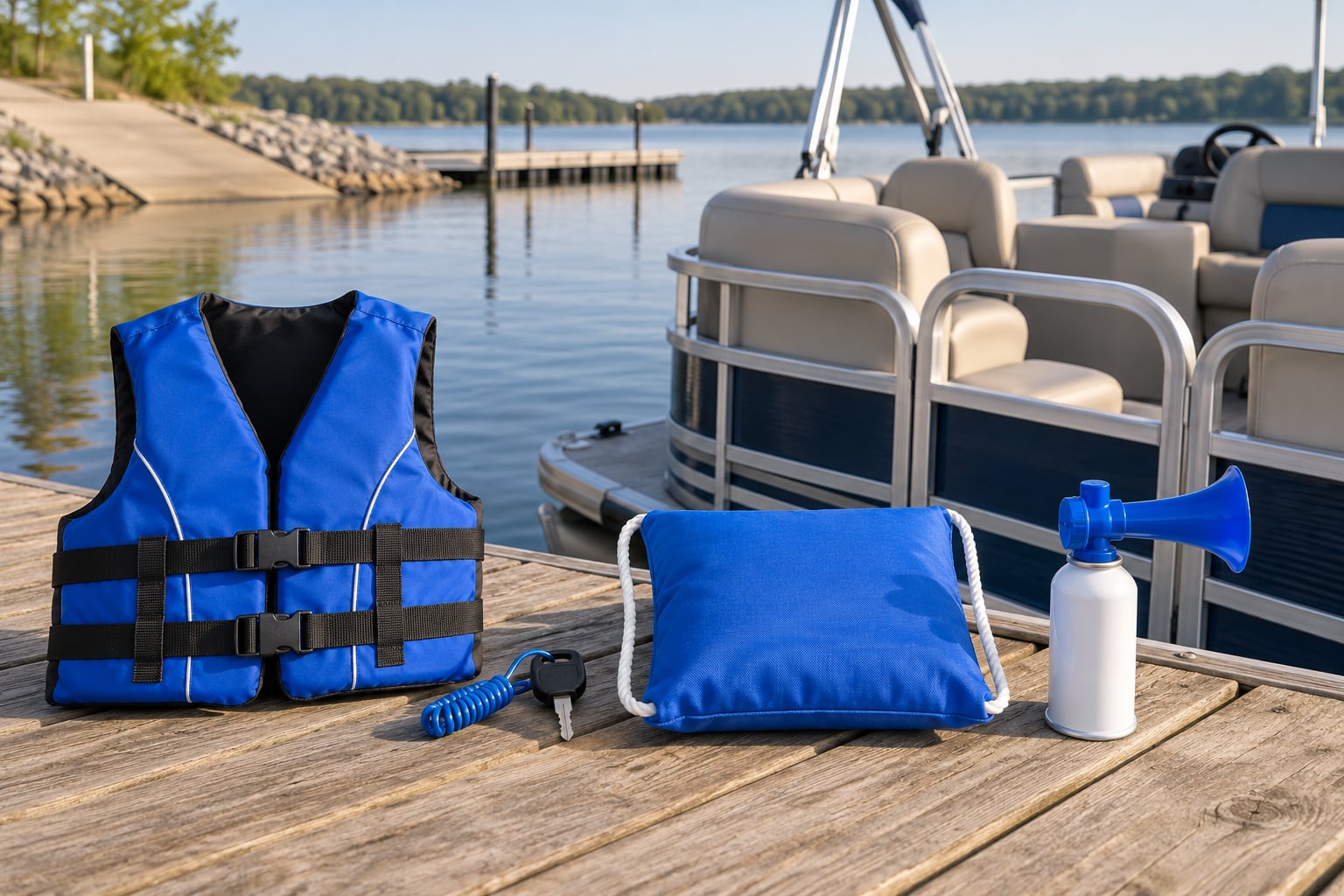
Safety gear comes first, and in most states it is not optional. Every person on board needs a properly sized PFD that they can actually wear, which for adults means one that fastens and does not ride up over the chin. A throwable flotation device is a separate requirement, and it belongs on the deck within reach, not stowed in a compartment.
Also aboard before you push off:
- A working horn or whistle, plus a fire extinguisher mounted where you can reach it
- The kill switch lanyard, clipped to your wrist or belt before the engine ever runs
- Navigation lights that function, checked after dark only if you plan to be out after dark
- A bow line and a dock line coiled and ready, roughly one boat length each
- Fenders sized to the boat and hung on the correct side before the approach
- An anchor with line, if you plan to stop anywhere for more than a while
Check the capacity plate mounted near the helm and read it out loud. It lists the maximum number of people and the total weight the boat is rated for, including motor, gear and passengers, and a large deck with a full cooler can surprise you.
On paper, you need your boating licence or safety certificate if your state requires one, the registration and numbers for the boat, and a chance to read the owner’s manual before you drive. The manual matters, because the exact throttle detent, trim range and gauge layout differ from one model to the next.
One more piece of preparation beats all the gear: tell a person on shore where you are going, who is aboard and when you expect to be back. Veteran owners treat that habit as non-negotiable, and it costs nothing.
Step-by-Step
1. Inspect the boat before you start
Walk the boat end to end before the engine turns over. Look at the pontoons for scrapes, punctures and water sitting inside them, run your hand along the deck for loose fittings, and pull hard on the railing and the fence panels. A rail that moves is a rail that fails with a passenger leaning on it.
Then check the mechanical items in one pass: fuel level, battery switch position, steering wheel for slack or stiffness, throttle lever travel, the bilge pump switch, and the lights. Open the bilge drain plug and look. If a pump has been running, there is a reason, and it is not one you want to find out about later.
2. Learn the pontoon boat’s controls
Sit at the helm and identify everything by touch, because you will be looking at the water more than the dash. Most pontoons give you a steering wheel, a single throttle lever, a trim control, a horn button, the ignition switch, a battery switch and a bilge switch, sometimes on a panel to the port side.
The throttle is the part that confuses new drivers. It works like a column-shift car lever: push it forward past neutral and the engine goes into forward, pull it back and you get reverse, and let go and it rests in neutral. Detents stop the lever on a small hump between forward and reverse, and the amount of forward thrust depends on how far past that hump you push. Owners report that not knowing the detent position caused most of their early panic.
The kill switch lanyard is the emergency engine shut-off. Clip it to you before you start, and remember that if it is clipped to nothing, the engine keeps running when you fall off. Your owner’s manual and your local boating authority always outrank anything written here.
3. Start the engine and move away from the dock
Start in this order: set the battery switch to on, clip the lanyard to your wrist or belt, put the throttle in neutral, raise the motor fully down so the propshaft is in the water, turn the key to on and wait for the gauges to wake, then crank. Let it settle to a steady idle before you touch the throttle.
Before you shift into gear, look behind the boat. The stern is a blind spot and the prop is live whenever the engine runs, so check for swimmers, anglers, a trailing tube and anything floating loose. Post a dedicated lookout the moment you have a passenger aboard, and give them one job: shout if anyone enters the water behind you.
Release the dock line only when you are ready to move, hold the wheel steady, push the throttle forward just enough to idle off the dock, and turn as soon as the bow clears. Keep the passengers seated and low. A crowd at the bow makes the deck act as a diving plane, and the boat can submerge the bow and pop back up with people over the side.
4. Practice steering at low speed
Find open water and stay at idle. Make the wheel move a little at a time, because a pontoon gives you very little feedback at low speed and then a lot of momentum once the boat has weight on the water.
The physics matters more than the technique. A two-tube pontoon leans away from the inside of a turn and pushes the bow outward, so it tends to run wide. A tritoon, with a third tube down the middle, can tip onto that centre tube and turn more like a monohull. Plan your turns early and make them wide and slow.
Keep a course straight and let the wind tell you what it is doing. With a crosswind, the broad flat deck and the railing catch air like a sail, so a boat pointed at the dock can slide sideways off it. Point the bow slightly into the wind when you can, and expect to hold more throttle than feels necessary.
5. Practice forward, reverse, and stopping
Stopping a pontoon takes planning, because there is no brake. Put the throttle in neutral early, which kills the drive to the prop and lets the boat coast, and expect it to keep gliding. Let it drift to a slow walk before you add reverse, and only then pull the throttle back.
Do most of your forward and reverse practice in open water before you attempt it near a dock. Get a feel for how much throttle the boat needs to move at all, then how quickly it stops once you are in neutral. Most beginners reverse too fast and too late. Small bursts, early, and again, beat one firm shove.
Never shift into reverse with anyone standing behind the boat, near the stern, or leaning over the rear rail. If the motor is at idle you are far less likely to catch them, but the rule is not negotiable.
6. Approach and secure the boat at a dock
Set the fenders on the dock side before you leave open water. Approach at an angle of about 20 to 30 degrees to the dock, not straight on, so you can use your forward and reverse like the brakes of a bicycle with one hand.
When you are roughly 10 to 15 yards out, shift to neutral and let the boat coast in. Line the fenders up, take a dock line, coil the excess and wrap it around a cleat. Then use short bursts of forward and reverse to bring the boat alongside. Approach no faster than you would be comfortable hitting, because at that moment you cannot stop any faster.
Give your passengers explicit orders before you start: sit down, stay seated, hands inside the rail. People standing up or moving to the bow during the approach will shift the weight at exactly the wrong second, and it is the single most common cause of a crooked landing. Nobody needs to jump aboard to help.
If the wind is pushing you off the dock, tying a bow line from the forward cleat before you are fully alongside makes the boat pull toward you instead of away, and your last few inches become trivial.
7. Return the boat and shut it down
On the way back, count your passengers and your belongings before you approach anything. Check under the seats, in the cooler and behind the motor, because a cooler lid left open on a run across the lake is a common and expensive surprise.
Back into slip or onto the trailer the same way you came out, at idle, with fenders out. Tie off, then shut down in the reverse order of starting: throttle to neutral, key off, let the engine settle, trim the motor up once it is clear of the water, and turn the battery switch off. The order in the manual for your model wins if it differs.
Do a quick walk-around afterwards. Look for new scrapes, check the water inside the pontoons, drain any water sitting in the bilge, and note anything that felt different today so you can mention it to the dealer. Building the same launch and shutdown routine into every trip is what veteran owners mean when they talk about knowing your boat.
Common Mistakes
Over-correcting the wheel is the classic first-timer error. The boat feels like it is not responding, you swing the wheel hard, and then you have to swing it hard the other way. Fix it by making small inputs early and holding them. If a turn is not working, widen it rather than tightening it.
The second mistake is carrying speed into a dock because you were having a good time. Pick a realistic approach speed and treat it as a ceiling, not a target.
Reversing late and too hard runs a close third. Get into neutral earlier and use the smallest burst of reverse that moves the boat, not the largest one available.
Letting passengers move during docking is a habit worth breaking on the very first trip. People shift forward when they are told to lean out to see the cleat, and the bow drops.
Idle through a wake or a wave instead of slowing down for it. Slowing at the wrong moment lets a bow wave climb under the deck, and the boat can bury its nose. Hold a steady speed, let the hull do the work, and do not stand up.
Forgetting the blind spot is the mistake that can actually hurt. Nobody swims behind a running boat, no one leans over the rear rail while the throttle is in forward, and a lookout is mandatory the moment a passenger is aboard.
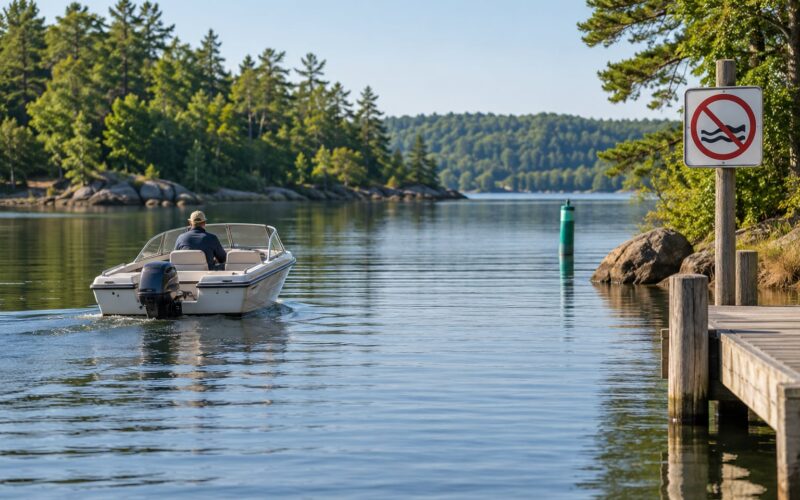
A few more safety habits worth building now: stay sober and attentive at the helm, follow the speed limit and no-wake zone signage, keep a lookout in a small boat with a wide blind arc, carry more PFDs than you think you need, and keep one third of your fuel as reserve so you always have enough to get back.
Frequently Asked Questions
How fast should a beginner drive a pontoon boat?
Keep the throttle at idle or just above it for your first outing, and stay well under the posted limit. A pontoon rarely exceeds cruising speed in normal use, so there is no reason to test the top end on day one. Choose a small area with room to turn, run wide circles, and raise the speed only once low-speed handling feels automatic.
Is it difficult to dock a pontoon boat for the first time?
Docking is the part beginners find hardest, usually because reverse feels unfamiliar and the wide deck catches the wind. The technique that fixes it is practice: approach at 20 to 30 degrees, shift to neutral 10 to 15 yards out, then use short bursts of forward and reverse. Expect to back off and try again a few times.
Do I need boating experience to drive a pontoon boat?
No prior experience is needed, and pontoons are among the easiest boats to learn on because they are wide, stable and slow. Most new operators describe two or three outings before handling stopped feeling like guesswork. Some states require a safety certificate or licence for certain sizes and ages, so check your local boating authority and take the dealer handover ride if one is offered.
What should I do if the pontoon boat will not start?
Work through it in order: confirm the battery switch is on, the throttle is in neutral, the kill switch lanyard is connected and the fuel tank has fuel. Then check for a fuel smell or an overheating light, pull the throttle to neutral, trim the motor down, and try again. Never crank with the prop out of the water. If it still will not run, call the dealer or a marine service and stop for the day.
Should I practice driving a pontoon boat in an open area first?
Yes, and it should be your first move after leaving the dock. Find calm, clear water with no swimmers, no shallow banks and no boat traffic, and spend the first half hour running circles, figure eights and repeated stops. Wind, current and the boat’s own weight all behave differently in open water, and learning them there is far safer than learning them beside a dock.
What safety equipment does a first-time pontoon boat operator need?
A properly fitted PFD for every person aboard, a throwable flotation device within reach, a horn or whistle, a fire extinguisher, working navigation lights, and the kill switch lanyard clipped to you before the engine runs. Bow and dock lines, fenders and an anchor complete the practical kit. Check your capacity plate so you never exceed the rated number of people or total weight.
Conclusion
Learning how to drive a pontoon boat for the first time comes down to four habits: inspect the boat properly before it runs, spend the first half hour practising in clear water at idle speed, make every steering and throttle input gradual, and dock more slowly than feels necessary.
Take the boat out alone or with one calm passenger, pick a still morning, and go near an empty dock until the approach feels ordinary. Once it does, the rest of the lake opens up.