To plan a multi lake road trip, fix your number of days first, then pick one lake per day of travel at most, group the lakes by region so no day turns into a five-hour grind, and book the limited pieces — campsites, boat slips, ferries — before anything else. Done in that order, the trip stays mostly outdoors instead of mostly in the car.
That order matters. Flip it and you end up with a beautiful lake list you can’t actually reach in the time you have, which is the single most common complaint I hear from people who tried to wing it. Seven steps handle it, and the whole process takes a weekend of planning for a two-week trip.
The short version:
- Decide how many days you truly have — count vacation days, not weekends you hope to work around.
- Pick a region, not a list of dream lakes — one state or one mountain range keeps driving sane.
- Verify access and rules lake by lake — ramps, permits, closures, fishing limits, water temperature.
- Compare overnight stops — location and amenities matter more than the cheapest nightly rate.
- Build the daily schedule with real drive times — map distance is not driving time.
- Prep the vehicle and outdoor gear — tow package, tie-downs, first aid, layers, food.
- Recheck a week out and share the plan — conditions change, and someone should know where you are.
Table of Contents
- 1What You Need
- 2Step-by-Step: Build a Lake-by-Lake Itinerary
- 31. Choose the Number of Lakes and Length of the Trip
- 42. Pick a Geographic Region and Base Route
- 53. Check Lake Access, Boating Rules, Weather, and Seasons
- 64. Compare Lodging, Campsites, and Overnight Stops
- 75. Build the Daily Schedule and Drive Times
- 86. Prepare the Vehicle, Boat, and Outdoor Gear
- 97. Confirm Reservations and Make a Backup Plan
- 10Common Mistakes
- 11Frequently Asked Questions
- 12How many lakes should I plan for a multi lake road trip?
- 13What is the best time of year to visit multiple US lakes?
- 14Should I reserve campsites and boat launches in advance?
- 15How do I calculate realistic driving time between lakes?
- 16What should I do if the weather changes during the trip?
- 17Is a multi lake road trip practical with children?
- 18Conclusion
What You Need
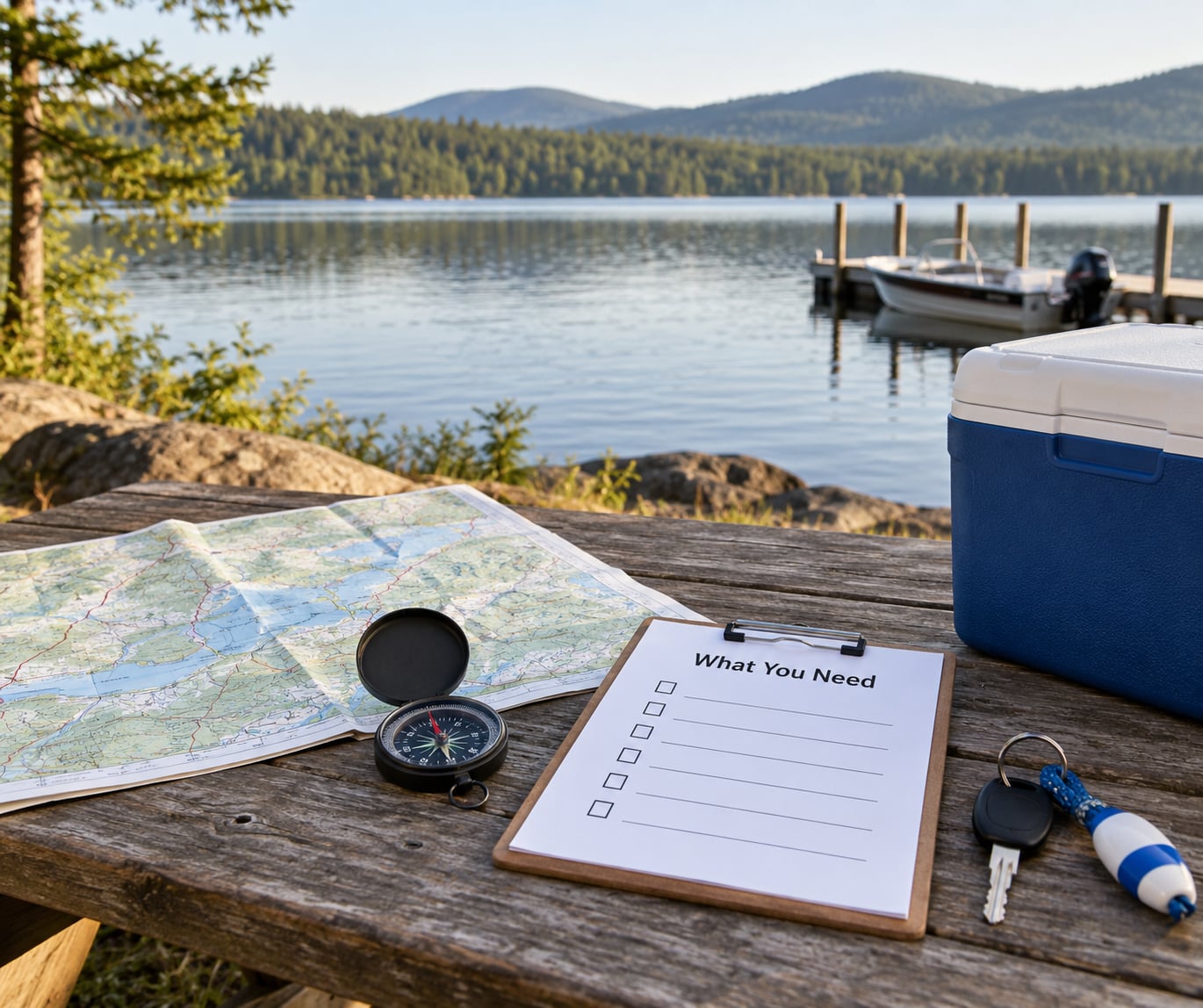
Most of the work happens before you pack, and it’s paperwork and research rather than gear. Gather these inputs first and the rest of the planning goes much faster.
Route tools. A general mapping app handles multi-stop routes fine and will let you reorder stops to test different sequences. What it will not do is tell you whether a particular lake has a usable boat ramp or whether the road in is seasonal gravel. Pair it with state DOT road condition pages, which is where closures actually get announced.
Lake-specific research. For each candidate lake, pull up the official lake or state park page and write down four things: boat launch locations, public beach or swim access, whether a permit is needed for launching, and whether overnight camping exists. Fishing regulations come from the state wildlife agency, not the park page, and those change every year.
Vehicle and outdoor gear. If you are towing anything, confirm your vehicle’s tow rating covers the loaded weight of your boat plus trailer plus gear, not just the boat. Inflatable kayaks and paddle boards change that conversation completely.
Documents. Driver’s license, registration and insurance for the vehicle, boat registration if you’re bringing one, fishing licenses for each state on the route, and any park entry pass your states require. Some parks accept a state park pass, others sell their own daily pass, and mixing them up at the gate is an unpleasant surprise.
Reservation details. Collect the confirmation numbers for every campground, cabin, marina slip and ferry in one place, ideally in a screenshot folder that works without signal. Rural lake areas have poor cell coverage, and that’s exactly where you’ll be.
Budget inputs. Lodging per night, fuel estimate, park entry fees, launch fees where they exist, and a food figure. Rural lake country has few restaurants, so plan on cooking at least half your meals yourself.
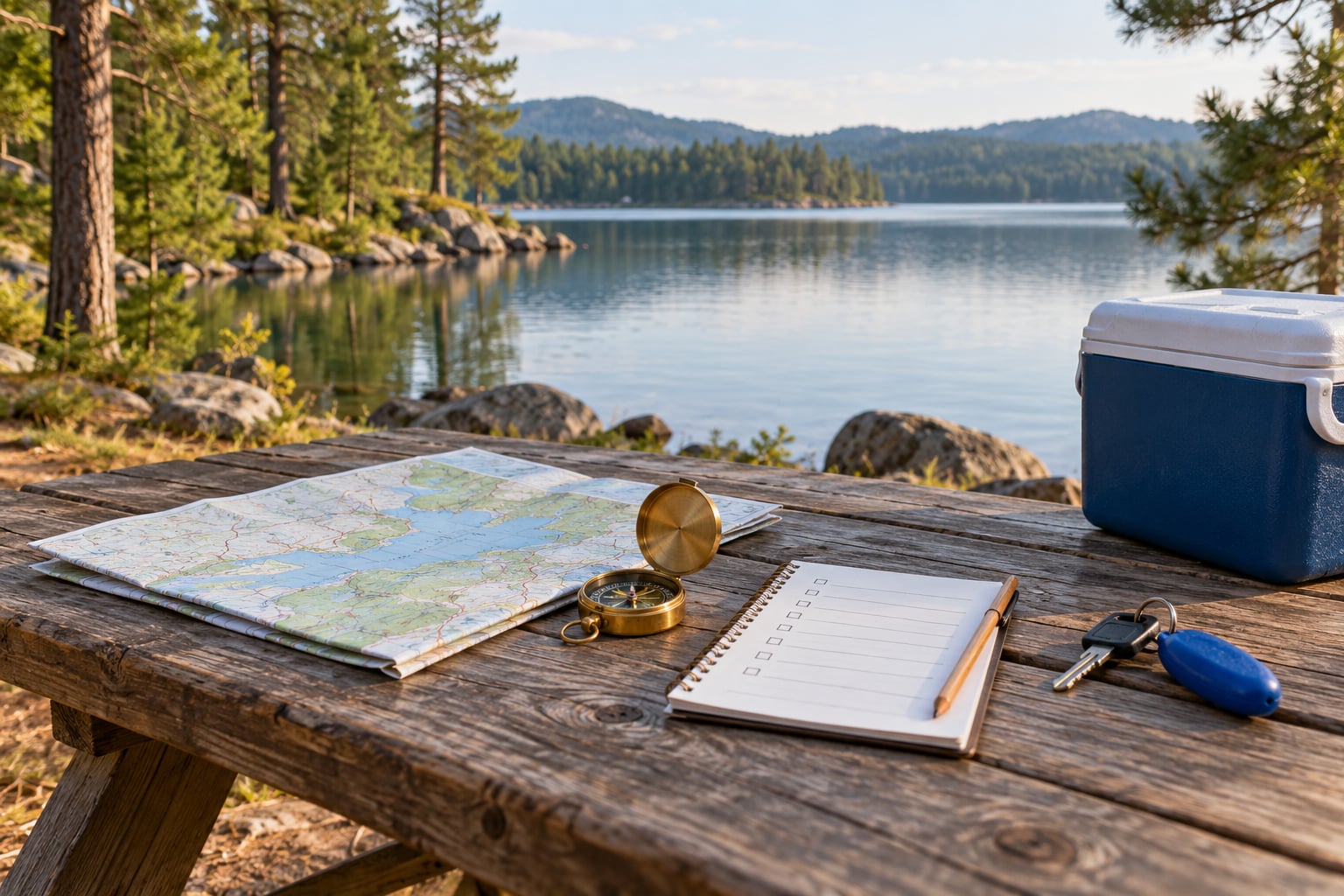
All of this fits on one page. If you want a printable version, write this worksheet with one column per lake: lake name, dates there, drive time from the previous lake, launch access, swim access, fishing rules, overnight booked, confirmation number, and a backup option. Fill in one row per lake and the itinerary almost builds itself.
Step-by-Step: Build a Lake-by-Lake Itinerary
The seven steps below are ordered on purpose. Each one narrows the options the next one has to work with, and every lake you keep ends up matched to a realistic travel day, an activity you’ll actually do, an overnight stay, and a departure point. If a lake can’t satisfy all four, that’s usually the one to cut.
1. Choose the Number of Lakes and Length of the Trip
Start with the days you have, then subtract. Day one is nearly always a travel day, the last day is usually a travel day too, and you want one flexible day held back for weather or fatigue. From what’s left, budget roughly one overnight stop per driving day.
The honest arithmetic looks like this: five usable days supports two lakes properly, or three lakes if you are happy with short visits. Ten usable days supports four or five lakes without anyone spending a whole afternoon in the car. Forum advice repeats the same line over and over — cut stops rather than drive faster. Trying to do both in four days means you’re just driving the entire time.
How many days a lake deserves depends on what kind of lake it is. A large natural lake with several access points, a resort or a good town nearby rewards two nights. A reservoir with a ramp and nothing else does not.
| Lake type | Nights worth planning | What fills those nights |
|---|---|---|
| Large natural lake with multiple access points | 2-3 | Fishing, boat days, swim beach, nearby town for dinner |
| Reservoir with ramps and primitive shoreline | 1 | Early launch, one full water day, camp or cabin night |
| Alpine or high-elevation lake | 1 | Short visit, trail time, cold nights, weather risk |
| State park lake | 2 | Beach, hiking, cabin or campsite, easy groceries nearby |
| Drive-by lake on the way to the next one | 0 | Photo stop, swim break, picnic — do not over-plan it |
You’ll know your number is workable when you can say what you’re doing on each full day. If you can’t, you have too many lakes.
2. Pick a Geographic Region and Base Route
Lakes are spread out, and the biggest planning mistake is treating them like evenly spaced dots. Group them geographically — one state, one national forest, one chain of reservoirs along a single river — and the route orders itself.
Three shapes work well. A loop returns you to your starting town and eliminates one-way rental fees. A one-way path is efficient but costs more if you need to ship a car back. A hub base works when one town has cheap lodging and sits within about an hour of several good lakes — you unpack once and do day trips, which suits families with young kids and anyone hauling a lot of equipment.
Check the shape against the map before committing. If consecutive stops point back and forth, reorder them or drop one. The signal that a region is right is simple: you can get from any lake to the next in under three hours.
3. Check Lake Access, Boating Rules, Weather, and Seasons
This is the step people skip and regret. For every lake, verify the boat ramp exists and is usable, note whether a launch permit or fee applies, and check whether ramp hours match the hours you plan to be on the water.
Then check what you can’t control. Public health departments post swim advisories, and a green algae advisory closes a beach even on a beautiful day. Water temperature varies enormously by latitude and elevation — a southern lake in midsummer and a mountain lake in the same week are different sports entirely. Fishing regulations, size limits, seasons and licence requirements change, and they are set per body of water.
Weather windows matter more than the forecast. Daylight hours shorten noticeably at higher latitudes and in the fall, which compresses your usable lake time. Mountain passes and forest roads can close on weather that looks fine in the valley. Treat every condition and regulation as lake-specific and subject to change, then recheck it in the week before you leave.
4. Compare Lodging, Campsites, and Overnight Stops
Compare on location first. A cheaper cabin forty-five minutes from the ramp costs you an hour a day once you factor launch traffic, fuel and lost lake time. On a multi-lake trip, proximity compounds.
Then look at what each option actually includes: full kitchen or a grill, laundry (a real luxury on a week-long trip), air conditioning in summer, and a dry place to prep fishing gear. Confirm cancellation terms, because you may need flexibility if the weather turns.
Popular lakes fill up early for peak summer weeks and holiday weekends, so decide your dates before you compare anything. Booking those stays first also anchors the rest of the trip — once the nights are locked, you can build the driving days around them rather than hoping it works out.
5. Build the Daily Schedule and Drive Times
Pull up directions for each leg and note the actual driving time, then add 15 percent. Map estimates get optimistic on two-lane roads with slow towns, seasonal traffic and one diesel stop. Build your day around the drive, not after it.
A working day looks like: breakfast, two to three hours of driving, fuel and food, launch and park, several hours on the water, sunset, then cooking in. Leave the last hour of daylight unscheduled. That’s your buffer for a slow ramp, a closed gate or a wrong turn.
Set a maximum daily driving limit based on who’s coming. Three hours is a comfortable ceiling when children are in the car; four is tolerable for adults who like driving. Holding that limit is what separates a trip people remember from one they survive. Identify one backup activity per lake too — a hike, a town to eat in, a marina to walk — so a rained-out afternoon has a plan B.
6. Prepare the Vehicle, Boat, and Outdoor Gear
Run a pre-departure test a few days out. Start the vehicle, check tire pressure including the spare, check the battery, confirm the coolant and oil levels, and run the brake lights. If you’re towing, inspect the hitch, safety chains, breakaway cable and trailer lights while you’re there.
Pack by category so nothing is missing at 6 a.m. Navigation and communication: offline maps, a paper backup, chargers, and a car mount. Water, food and cooler space planned for the whole leg between stores. Weather layers including a rain shell and something warm, since lake evenings cool fast. First aid with blister treatment and any prescriptions. Boating safety: properly sized life jackets for everyone on board, a throwable, horn, whistle, anchor with adequate line, and lights. Propulsion: full fuel, spare prop and pin, and the tools to change it. Campsite gear: tent or tarp, sleeping pads, headlamp, stove, fuel, and a water container.
If you bring the boat, confirm registration is current, tie-downs are rated for the weight, and the battery will last the trip. Do the whole check once, then don’t repack.
7. Confirm Reservations and Make a Backup Plan
In the final week, re-read every confirmation, check road conditions and closures, look at the weather window for each region in order, and confirm you have the permits and licenses for every state on the route. Recheck the ramp status and any advisories for your first two lakes specifically, since those are the ones you cannot easily fix on arrival.
Know where fuel and groceries are. Some lake roads have a single station with limited hours, so fill up before you leave the nearest town and again whenever you’re near half a tank. Decide your backup campsite or simpler lodging for each leg before you need it.
Finally, send your itinerary to someone at home with dates, lake names, campground or cabin confirmation numbers, and your check-in schedule. That’s the whole backup plan, and it’s the part most people skip.
Common Mistakes
Trying to fit too many lakes into the days. This is the one that ruins trips. Fix: run the days-per-lake math above before you research anything, and cut stops rather than compress the schedule. Two nights at your favorite lake beats four one-night stops.
Treating map distance as driving time. A 120-mile figure can be two hours on a good highway and four on two-lane roads in August traffic. Fix: check drive time per leg with a 15 percent cushion.
Overlooking permits and fishing rules. Launch permits, park entry passes and state fishing licences are separate systems. Fix: make each one a line on the worksheet and confirm it before departure.
Assuming seasonal access. Forest roads, boat ramps and some campgrounds close for the season, and low water can leave a ramp unusable at full pool distance. Fix: verify access for your exact dates.
Booking everything last. Campsites, marina slips and ferries on popular routes in peak season fill early, and a rental car booked after the campsites can double your cost. Fix: campsites and slips first, then ferries, then lodging, then the car.
Having no plan B. Weather, closures and tired kids force changes. Fix: hold one flexible day, name a backup activity for each lake, and keep a second lodging option per leg.
Short planning tips: keep one full day completely unbooked, grocery shop once per region instead of daily, cook at least half your meals, download maps before you lose signal, and start each driving day early enough to arrive before sunset.
Frequently Asked Questions
How many lakes should I plan for a multi lake road trip?
Most people do two lakes in five usable days or three lakes in a week. A good rule is one overnight stop per driving day, after subtracting your first and last travel days and one flexible day. Large natural lakes with several access points earn two nights; reservoirs and alpine lakes usually earn one. If you cannot name what you will do on each full day, you have picked one lake too many.
What is the best time of year to visit multiple US lakes?
Timing depends on your region, but the pattern is consistent: early fall gives comfortable water temperatures, fewer crowds and shorter drive times, while late spring and early summer suit families who want beaches and long daylight. Winter opens northern lakes for ice fishing and snowmobile access. Avoid the weeks around major holidays at popular lakes, since campsites and slips fill early. Always check that ramps and forest roads are open for your dates.
Should I reserve campsites and boat launches in advance?
Yes for campsites and marina slips on any popular route, especially peak summer weeks and holiday weekends; those go first. Booking them first also fixes your dates so the rest of the trip can be planned around them. Most public boat ramps do not take reservations, but some large lakes and ferry-only parks do, and a few charge a launch fee or require a permit. Check each lake’s official page rather than assuming.
How do I calculate realistic driving time between lakes?
Use a mapping app to set each leg in the order you plan to travel it, then add fifteen percent. That cushion covers slower two-lane roads, one fuel stop, summer traffic and getting lost once. As a ceiling, keep most driving days under three hours with children and under four with adults. If the total drive time for a day exceeds your limit, change the stop order or move that lake to a different day.
What should I do if the weather changes during the trip?
Use the flexible day you deliberately left unscheduled and move the most weather-sensitive lake into it. Swap boating days for things that work in rain, like a town lunch, a museum, a scenic drive or a longer hike under tree cover. Check marine warnings and beach advisories before you commit to a water day, and keep your gear ready to roll in under an hour. Never push a launch when conditions are unsafe.
Is a multi lake road trip practical with children?
Yes, with fewer lakes and shorter legs. Most families do best with two or three stops, a hard ceiling of three hours of driving a day, and at least one night where nothing is scheduled. A hub base in a town with cheap lodging works well, since you unpack once and take short day trips. Bring familiar snacks, plan the first lake day as a beach day, and give kids a job like choosing the next picnic spot.
Conclusion
A multi lake road trip comes down to four decisions made in the right order: how many days you have, which region you’ll stay inside, how many lakes that supports, and your maximum daily driving time. Decide those four before you look at a single campsite or cabin, then verify access and rules lake by lake and book the limited inventory first.
Write your answers on the worksheet today. Once the numbers are down, picking the lakes takes an afternoon, not a month.