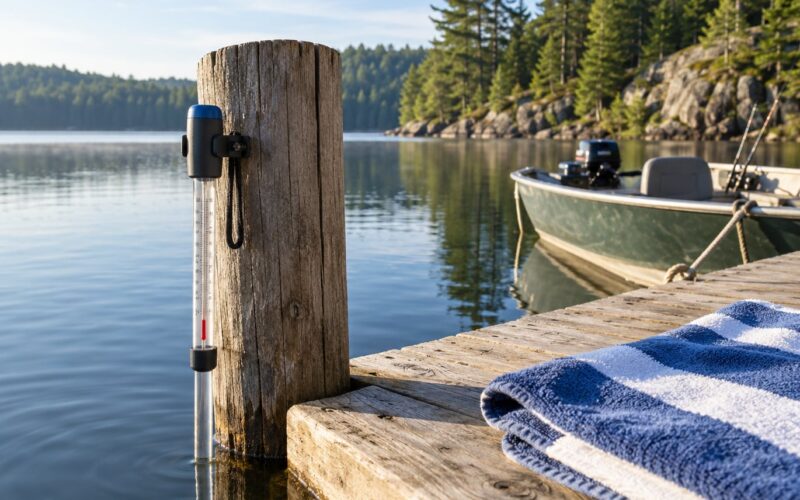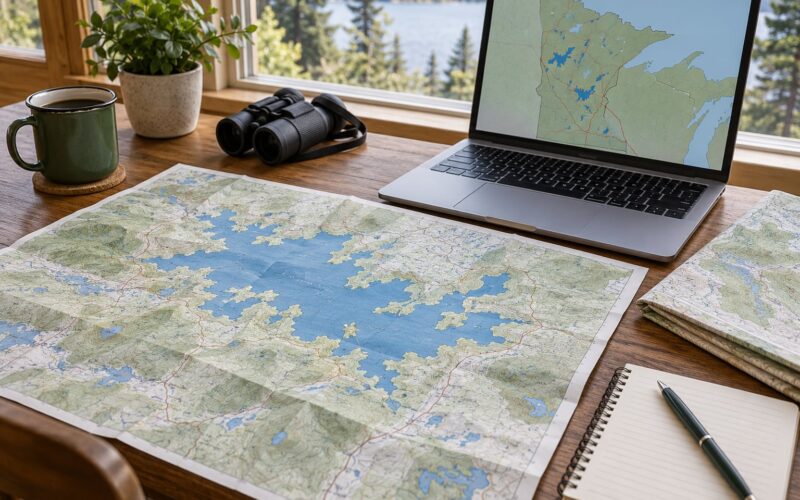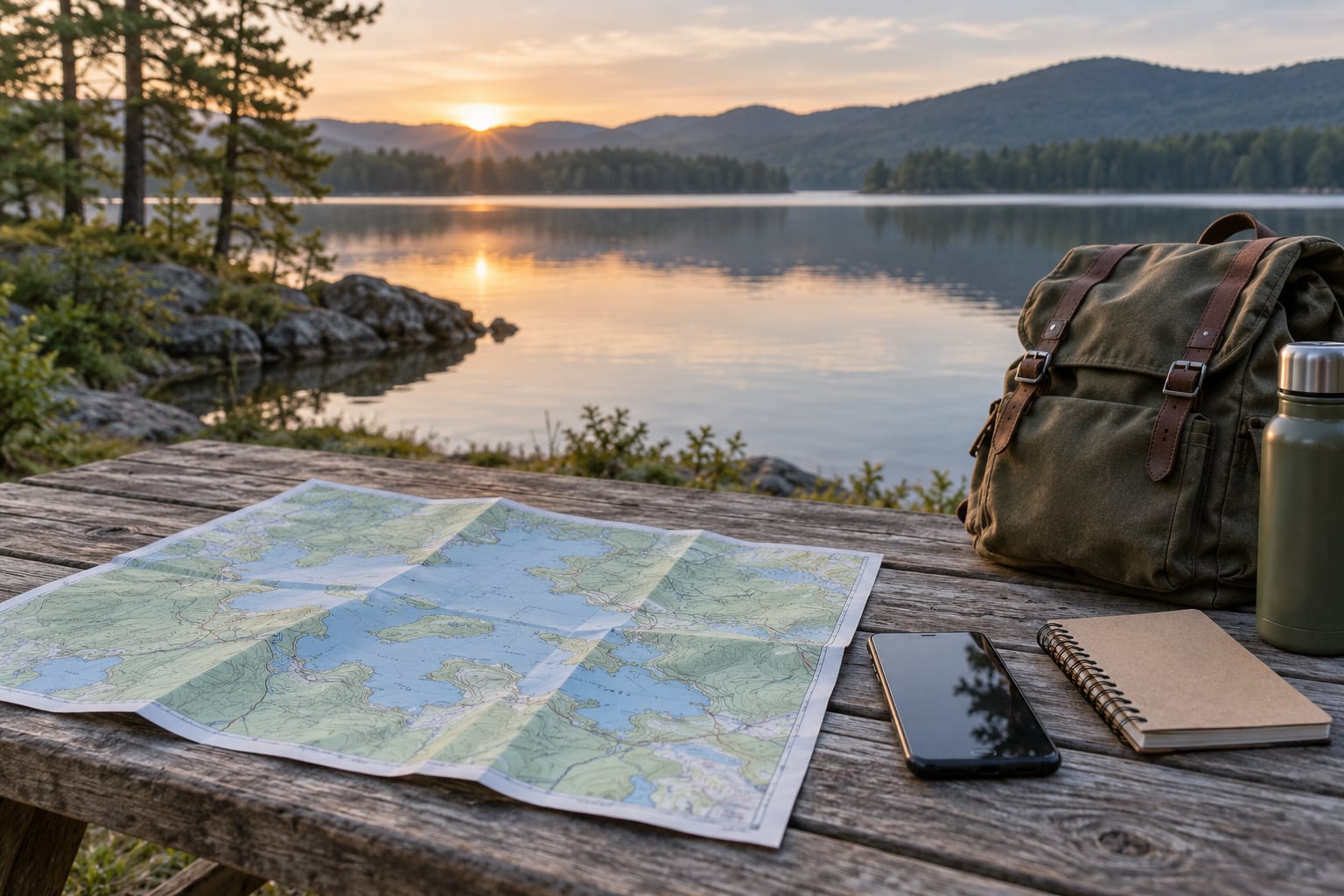
To find a quiet lake with no crowds, you screen the lake before you drive there, then pick the time and the spot inside it that spread people out. In practice that means four levers: how big the lake is, what the motor rules are, what official visitation data says, and when you show up. Most of the work takes about 30 minutes at a desk, and the rest is a two-hour drive to somewhere you’ll mostly have to yourself.
The reason this matters is simple. A lake that feels packed at 11am on a Saturday in July can be silent at 6am on a Tuesday in the same week, and a big popular lake can be emptier than a small one with a bad reputation. Crowds are not a property of a lake. They’re a property of a lake plus a weekend plus a particular hour.
Table of Contents
- 1What You Need
- 2Step-by-Step: How to Find a Quiet Lake with No Crowds
- 3Start with quieter lake types and less popular regions
- 4Check access points, facilities, and crowd evidence
- 5Visit at the right time and confirm current conditions
- 6Have a backup lake and a flexible arrival plan
- 7Common Mistakes
- 8Tips for a quieter lake visit
- 9Frequently Asked Questions
- 10What time of day is a lake least crowded?
- 11Are smaller lakes less crowded than big lakes?
- 12How do I know if a lake is crowded before I drive there?
- 13Can I launch a kayak anywhere on a lake?
- 14What is the 200 rule for camping on a lake?
- 15Which states have the quietest lakes?
- 16Conclusion
What You Need
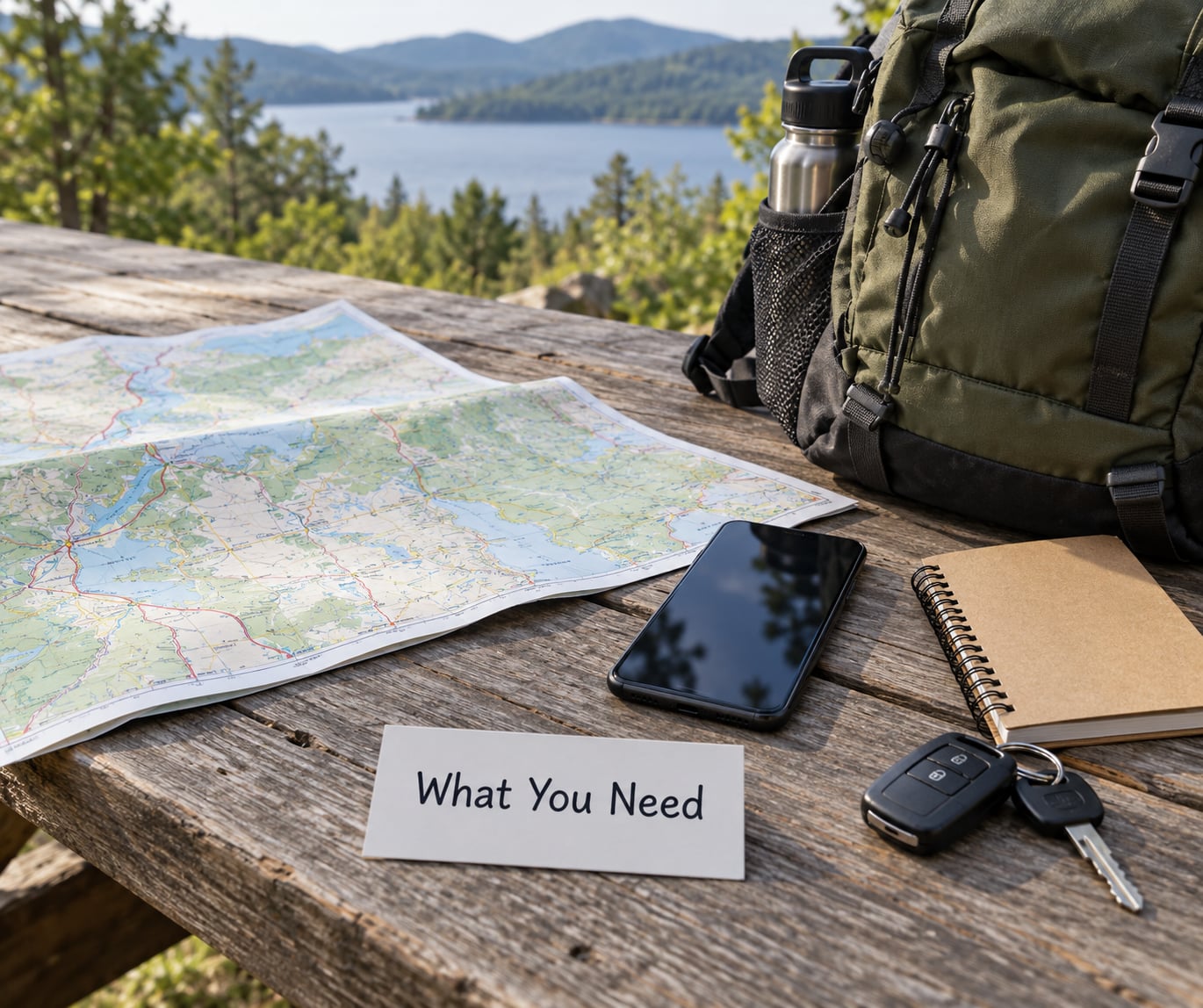
You do not need much, and almost none of it costs anything. What you need is enough information to tell two lakes apart before you commit a tank of fuel to one of them.
- A map you can search by name, not just by pin. A county or state map viewer that lists lake acreage, shoreline miles and access points beats a general map app every time.
- Public-access details for the specific shoreline. Whether there is a state DNR access site, a boat launch, a park entrance, or nothing but a road shoulder.
- Recent visitor comments, dated. A review written last season tells you far more than a photo with no date on it.
- Current conditions. Forecast, water level, fire restrictions, algae advisories and closures.
- A way to get there, plus the fuel for it. Including whether the last few miles are pavement.
- One or two backup lakes. This is the item people skip and then wish they had.
A paper map still earns its place here, incidentally. Satellite imagery on a phone tells you where the road goes. It does not tell you whether the shoreline is private.
Step-by-Step: How to Find a Quiet Lake with No Crowds
Start with quieter lake types and less popular regions
Start with the lake’s size, because it is the single strongest predictor of how many people will be on it. As a rough filter, anything under 1,000 acres is already ahead of most of the field, and the smaller it is the more noticeable the difference becomes. A 200-acre lake with one state access site behaves very differently from a 6,000-acre lake with four ramps, three resorts and a state park on it.
Next, bias toward lake types where crowds are structurally limited rather than merely lower: primitive and boat-in campsites, wilderness lakes reached by trail or water taxi, lakes with no-wake rules, and lakes whose shoreline is mostly undeveloped or privately owned with a public access strip at one end.
Regionally, the same logic applies. Lakes lying inside or just outside major tourism corridors collect traffic that never planned to be there. The Boundary Waters, northern Minnesota, the Adirondacks, the Missouri Ozarks and interior Pacific Northwest forest country all have plenty of lakes that are genuinely uncrowded simply because getting there is a chore. One r/ontario thread put it as a constraint rather than a complaint: an hour and a half of driving was acceptable if the shoreline was right. Paddlers on Expedition Portal describe the same trade in put-ins rather than miles.
Check access points, facilities, and crowd evidence
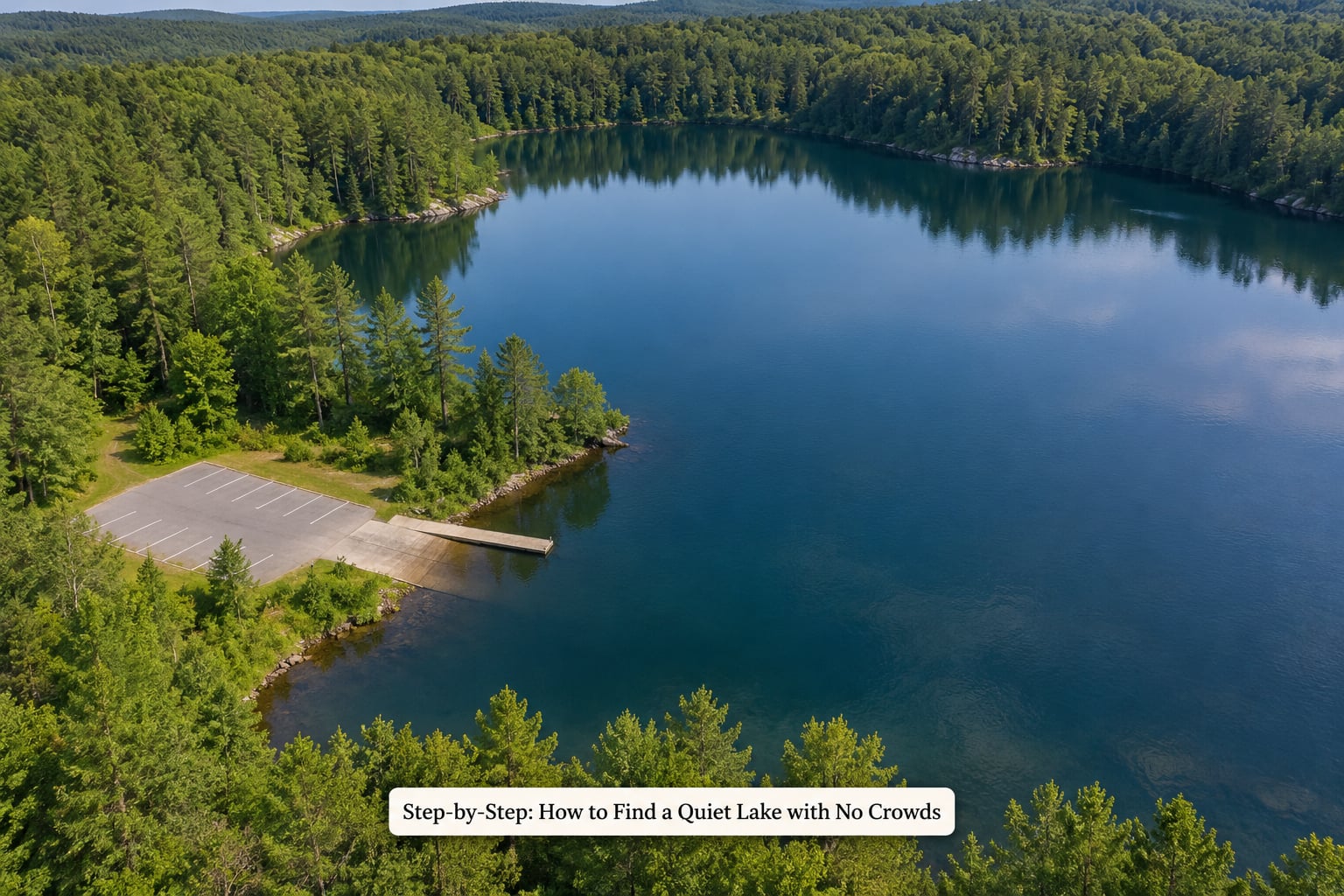
Once you have a shortlist, look at each lake’s access rather than its size alone. The number of boat ramps tells you more about expected traffic than the acreage does, and a lake with two ramps and a paved lot behaves like a busy lake at a fraction of the size.
Count and classify what you find:
- Boat launches. One is a filter. Three or more is a signal.
- Developed facilities: showers, paved lots, concession buildings, playgrounds, group sites.
- Swimming beaches. Beaches concentrate people, and beach-adjacent camping is rarely quiet after 10am.
- Parking capacity at the access site. A lot that holds eight cars fills by 8am on a Saturday.
- Restrooms and potable water. Their presence means maintenance traffic all day.
- Campsite type and reservation method. First-come, first-served sites are packed by mid-morning on weekends; reservable sites are bookable and therefore predictable.
Then read what people actually reported, and check how old it is. Look for dated specifics — how many boats were on the water, whether the launch had room, what the parking looked like at 8am — rather than adjectives like “peaceful” and “pristine.”
On regulation, the no-wake rule is the best single predictor of quiet available on a map, because it caps both speed and boat size at the same time. Lakes where motors are prohibited outright, or where horsepower is capped, attract paddlers and small boats in a way that large-lake launches do not. You can read most of this off the state boating regulations map before you go.
Verify quietly with data too. Federal agencies publish annual recreation visit counts for the areas they manage, and state tourism and natural-resource agencies publish similar figures for their parks. A lake whose parent park draws a fraction of the visitors of a famous one is a reasonable bet even if it looks better on paper.
Visit at the right time and confirm current conditions
Timing does more work than lake selection. The strongest combination is a weekday morning, and the specific window that works is arriving before 7am and having your spot picked by 8am, well before the mid-morning arrival wave. Midweek in the shoulder months buys you even more, because the weekend day-trippers who would fill a mid-sized lake largely disappear.
What does not reliably work is assuming a shoulder season guarantees an empty lake. Forum users report the opposite fairly often: they show up in the off-season expecting solitude and find it busier than a summer weekend, usually because a good chunk of the summer crowd is local and fishes through the cold months. Check recent comments for the specific month you are considering, not just for the lake in general.
Conditions can also change what a lake is. Low water exposes a shoreline that can be difficult to reach or illegal to walk on. Fire restrictions can close an area outright during dry summer months. Algae blooms and swim-fee programs change who shows up. Snowmobilization, when snowmobiles are allowed on a frozen lake, replaces quiet with noise, and that is worth checking if winter solitude is the goal.
So confirm on the day or the evening before: the forecast, any closure bulletin, the ramp status if it is a boating trip, and whether the water level makes the access usable.
Have a backup lake and a flexible arrival plan
Pick one primary lake and one or two alternates within the same drive, so switching costs you a detour rather than a trip home. This matters because the most common failure is not picking a bad lake. It is arriving at a good lake after the good spots are gone.
On arrival, decide whether to stay or move before you unload. If the parking area is full or the launch queue is longer than you want to sit in, the fix is usually time, not lake: come back at 4pm or move to the backup. Backcountry campers get this right by setting up before dark, which is why that advice keeps showing up in mountain and boundary-water trip reports.
And once you are on the water or at the shore, distance does the rest of the work. Paddle or drive to the far end of the lake, or into a sheltered cove behind an island or a point. Crowds cluster at launches and developed shorelines; almost nobody paddles a third of a mile past a no-wake boundary.
Common Mistakes
| Quiet lake signals | Crowded lake red flags |
|---|---|
| Under 1,000 acres | Large lake with several public ramps |
| No-wake rule or motor limits | Unrestricted high-speed boating |
| Undeveloped shoreline | Resorts, marinas, dense campsites |
| One access point, gravel or long drive | Paved lot, showers, large beach |
| Low official visitation figures | Flagship park with millions of annual visits |
| Recent comments mention few boats | Reviews describe ramp lines and full lots |
| Boat-in or primitive sites | Developed campground with unenforced limits |
Judging by scenery. A pretty shoreline attracts exactly the people you are trying to avoid. Look at the access and facilities instead.
Relying on old reviews. A comment from three summers ago tells you about a different lake. Weight anything under a year lightly.
Ignoring capacity. A campground that says twenty people per site but does not enforce it will hold thirty. Where limits are unenforced, treat the site as full earlier than you would like.
Arriving after the quiet window. Late morning on a Saturday is the worst arrival at almost any lake. Everything good has already been taken.
Skipping closures and rules. Seasonal closures, fire restrictions, launch permits and tribal or private shoreline rules are the fastest way to end a quiet day early.
Ignoring the access road. An hour on gravel, a low-water crossing or a road that closes after rain will send you home at sunset, and that is exactly what happens at many of the quietest lakes.
Expecting solitude to be free of downsides. Quiet lakes tend to have no services, poor cell coverage, mosquitoes and, in some regions, bears. Some readers want a coffee-shop car park and a swim beach. Solitude is not for everyone, and picking the wrong lake is how a “perfect quiet spot” turns into a bad weekend.
Tips for a quieter lake visit
Keep noise down at the launch and on the water, because the people you are sharing the lake with today are the ones who decide whether the lake stays usable tomorrow. Idle through no-wake zones, keep music off the ramp, and give other anglers room at the same structure.
Do not block a launch. Prepare your boat at the trailer, stage gear out of the way, and keep the ramp clear for others coming through.
Camp where the rules say, which in most backcountry water means 200 feet from the shoreline and at least a day’s walk from other campsites. That standard, known as the 200 rule, is not paperwork pedantry. It exists because concentration is what makes a lakeshore feel crowded.
Use established sites, pack out what you bring in including the bag you carried in, and keep fires where fire is permitted at all. Respect private shoreline and stay off posted land, since the access strip you parked on may be the only public ground for miles.
Leave room for other visitors. If you want the far end of a lake to yourself, do not assume everyone wants to fight you for it, and do not occupy a shoreline you cannot use.
Frequently Asked Questions
What time of day is a lake least crowded?
The quietest hours are early morning, roughly before 8am, because most day visitors arrive after 10am on a summer weekend and camp overnighters are still asleep. Mid-afternoon on a weekday can also work. Dusk is the other reliably open window, though less useful for photography unless you plan to stay past sunset.
Are smaller lakes less crowded than big lakes?
Usually, yes, and size is the strongest single predictor you can use without driving there. A lake under about 1,000 acres with one access site will normally hold fewer people than a multi-thousand-acre lake with several ramps and resorts. The exception is a small lake with a well-known name, easy road access or a beach, which can draw a remarkable number of day-trippers.
How do I know if a lake is crowded before I drive there?
Check dated reviews and visitor comments for boat and parking counts, then look for low recreation visit figures for the managing agency and check whether the lake has a no-wake or horsepower restriction. Look at the number of boat ramps relative to acreage. If comments from the last few months describe full lots or ramp lines, that is more reliable than scenery photos with no dates.
Can I launch a kayak anywhere on a lake?
Usually not. In most states you launch at a designated public access site, and putting in from private shoreline or a posted stretch is trespassing even if you are only touching the water. Designated sites are also the crowded ones, so check for a secondary ramp, a primitive site, or a state access area on a different part of the lake before you settle on the main put-in.
What is the 200 rule for camping on a lake?
The 200 rule is a Leave No Trace standard for backcountry campsites: set up at least 200 feet from the shoreline and at least a day’s walk from another campsite. It exists so that concentration does not turn a quiet shoreline into a crowded one, and because lake water is easily contaminated by soil erosion around tents and fires.
Which states have the quietest lakes?
It depends less on the state than on the lake type. Northern Minnesota, Wisconsin’s Apostle Islands region, Michigan’s Upper Peninsula, the Adirondacks, the Missouri Ozarks and interior Pacific Northwest forest country all hold lakes that stay quiet because access is inconvenient. Judge individual lakes by acreage, access and motor rules rather than by state reputation.
Conclusion
Start with the least glamorous part: pick a lake under about 1,000 acres, confirm it has one access point and some kind of motor restriction, and read comments from the last few months to check nobody reported a ramp queue. Then go on a weekday, arrive before 7am, and once you are there paddle or drive to the far end. Keep one backup lake within the same drive and do not be proud about using it.