To plan a fall foliage lake trip well, give yourself a two-week window instead of a single weekend, pick one lake whose access you have actually confirmed, and build an itinerary that still works when the wind picks up or the color runs a few days early. That combination of timing, confirmed access, and a backup plan is what separates a trip that hits peak color from one that spends three days looking at brown trees.
Most families can do this in about two weeks of planning, starting in early summer. The parts that catch people out are the boring ones: whether the boat ramp is open in October, whether the campground has water running in November, and whether the forecast for the lake differs from the forecast for the nearest town.
Here is how I would sequence it.
Table of Contents
- 1What You Need
- 2Step-by-Step: How to Plan a Fall Foliage Lake Trip
- 3How to plan a fall foliage lake trip around the best foliage
- 4Choose a lake that matches your group
- 5Confirm access, parking, and reservations
- 6Build a simple weather and clothing plan
- 7Plan activities for changing conditions
- 8Pack, brief everyone, and check the final details
- 9Common Mistakes
- 10Tips for a More Enjoyable Fall Lake Weekend
- 11Frequently Asked Questions
- 12When is the best time to visit a lake for fall foliage?
- 13How far in advance should I plan a fall lake trip?
- 14What should I do if the leaves are not at peak color?
- 15Can I bring children and dogs on a fall lake trip?
- 16Is it safe to boat or paddle when fall weather changes quickly?
- 17How can I plan a fall foliage lake trip on a budget?
- 18Conclusion
What You Need
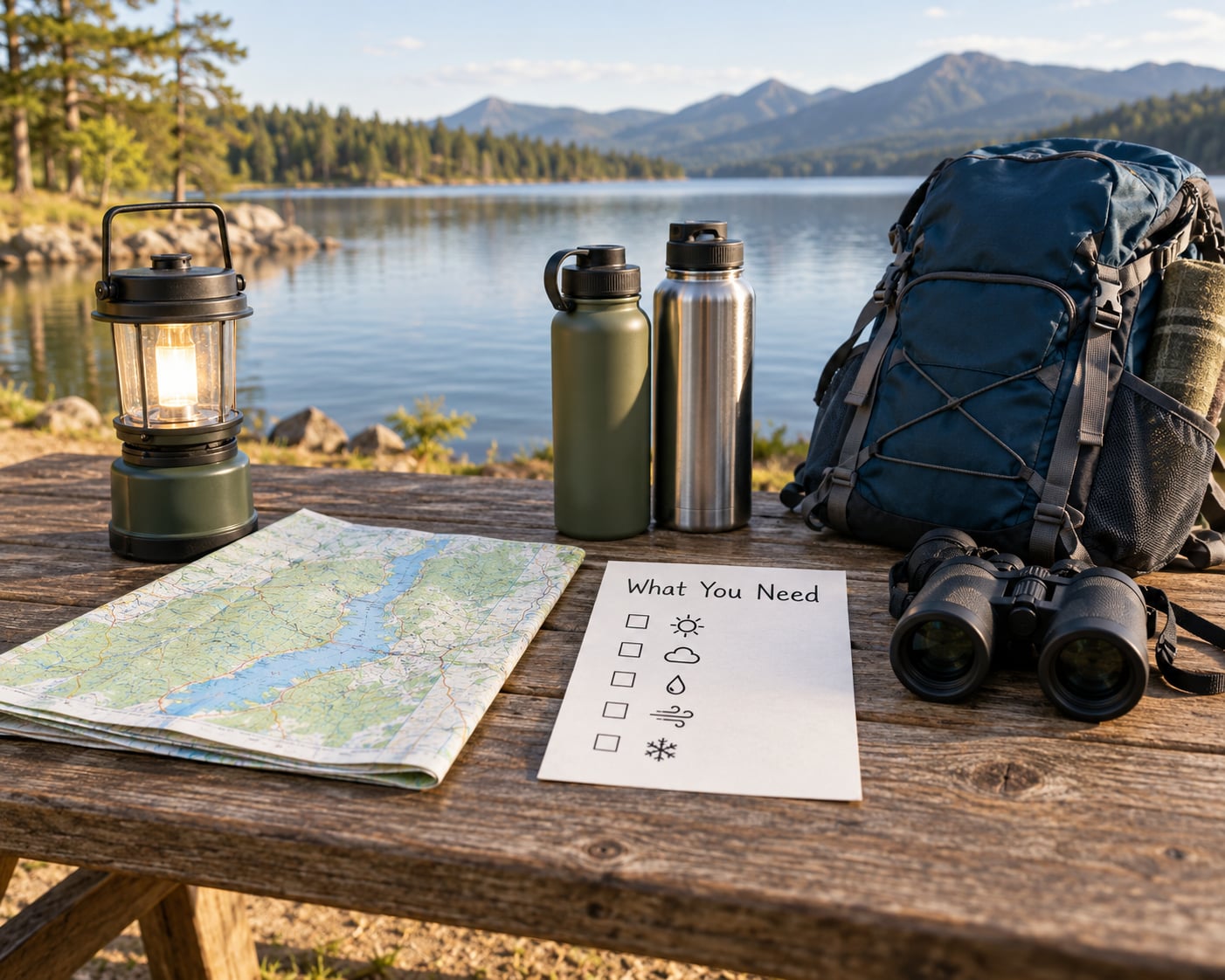
Everything below fits in a phone folder and a single printed sheet. Pulling it together in one sitting saves you from making booking decisions in a rush later.
- Two or three candidate dates inside a two-week window, plus the reasoning for each. A window beats a date because peak color rarely lands where a prediction map says it will.
- Regional foliage report sources. At least one official state or regional tracker and one user-submitted photo report. They disagree often, and the disagreement is useful information.
- One live webcam pointed at a stand of trees near your elevation. Nothing replaces watching actual leaves for a season before you commit money.
- Lake specifics: how you reach the water, whether it is a boat ramp or a carry-in launch, whether restrooms run year-round, and where shelter exists if weather turns.
- A booking with free cancellation. Shoulder-season rates are usually better than peak rates, and the cancellation window is what lets you shift dates if the color moves.
- A reliable forecast source plus an offline map download. Many lake areas have no reliable cell coverage, and paper directions stop working when your phone dies at 8 percent.
- An emergency contact list and a meeting point. Write down the lake name, the access road number or name, and one landmark everyone can find. This matters most if you are splitting into groups.
- A gear list in three columns: clothing layers, on-water kit, and backup activities for bad weather.
Step-by-Step: How to Plan a Fall Foliage Lake Trip
How to plan a fall foliage lake trip around the best foliage
Set your dates using a two-week viewing window centered on the regional peak estimate, not a single predicted peak day. Foliage forecasts are models built from temperature records, elevation, and historical timing, and they are directionally right rather than precise.
Three signals narrow the window faster than any map. Cool nights with sunny days push color forward, so a stretch of unusually cold nights in early autumn often means an earlier peak. Elevation and latitude shift timing noticeably, with higher ground and more northern lakes turning roughly a week to ten days ahead of nearby lowlands. Elevation is the lever most people overlook, and it lets you stretch a single trip by moving from the high side of a range down toward the valley as the season advances.
Start checking the regional tracker weekly from six to eight weeks out, then daily during the final two weeks. Look for the language “near peak” and “past peak” rather than hunting for a single peak date. When reports start saying past peak in your target town, shift your destination rather than your schedule if you can, since the lowlands or the southern end of the range is usually about a week behind.
You know the timing work is done when you have two dates you are genuinely happy with, not just one you hope survives.
Choose a lake that matches your group
Match the lake type to who is coming. A quiet forest lake works well for families with young children because the water is usually shallow, calm, and ringed by short walking trails. A boat-access lake suits anglers and anyone with a trailer, since you can get a boat in quickly and reach water that a road does not. A lakeside campground gives you the cheapest and most flexible option, but it also means you check water availability, hookups, and how late the campground actually stays open.
Compare candidates on the same handful of things: drive time from home, type of water access, what facilities run in late autumn, whether the shoreline is walkable, and how far you are from a town if someone needs medical care. Elevation belongs in that comparison too, because it sets both the color timing and the temperature you should expect on the water.
Leave room to change your mind on the lake, not just the dates. Two lakes within an hour of each other give you a real fallback when one is fogged in, too windy, or already stripped bare.
Confirm access, parking, and reservations
Check the details that quietly decide whether a lake works in autumn. Day-use hours, boat ramp operating dates, parking capacity, restroom availability, seasonal road closures, permit requirements, and whether the marina or launch takes a seasonal pass are all worth a phone call or an email rather than an assumption.
Call the managing agency. Ask specifically what changes after Labor Day and what the first closing date is, because “open” in a brochure often means open through summer. Ask whether the ramp is closed to trailered boats after a given date, which is common once the water gets cold, and whether that closure is posted anywhere a driver would actually see it.
For lodging and campsites, book refundable first and confirm the cancellation deadline in writing. Peak foliage weekends at good lakeside cabins and popular campgrounds fill up months ahead, so a placeholder reservation is a reasonable move even before the color forecast firms up.
Keep a written backup: a second campground, a second launch, or a nearby town that has reliable facilities. That list is worth more than a second week of forecast checking.
Build a simple weather and clothing plan
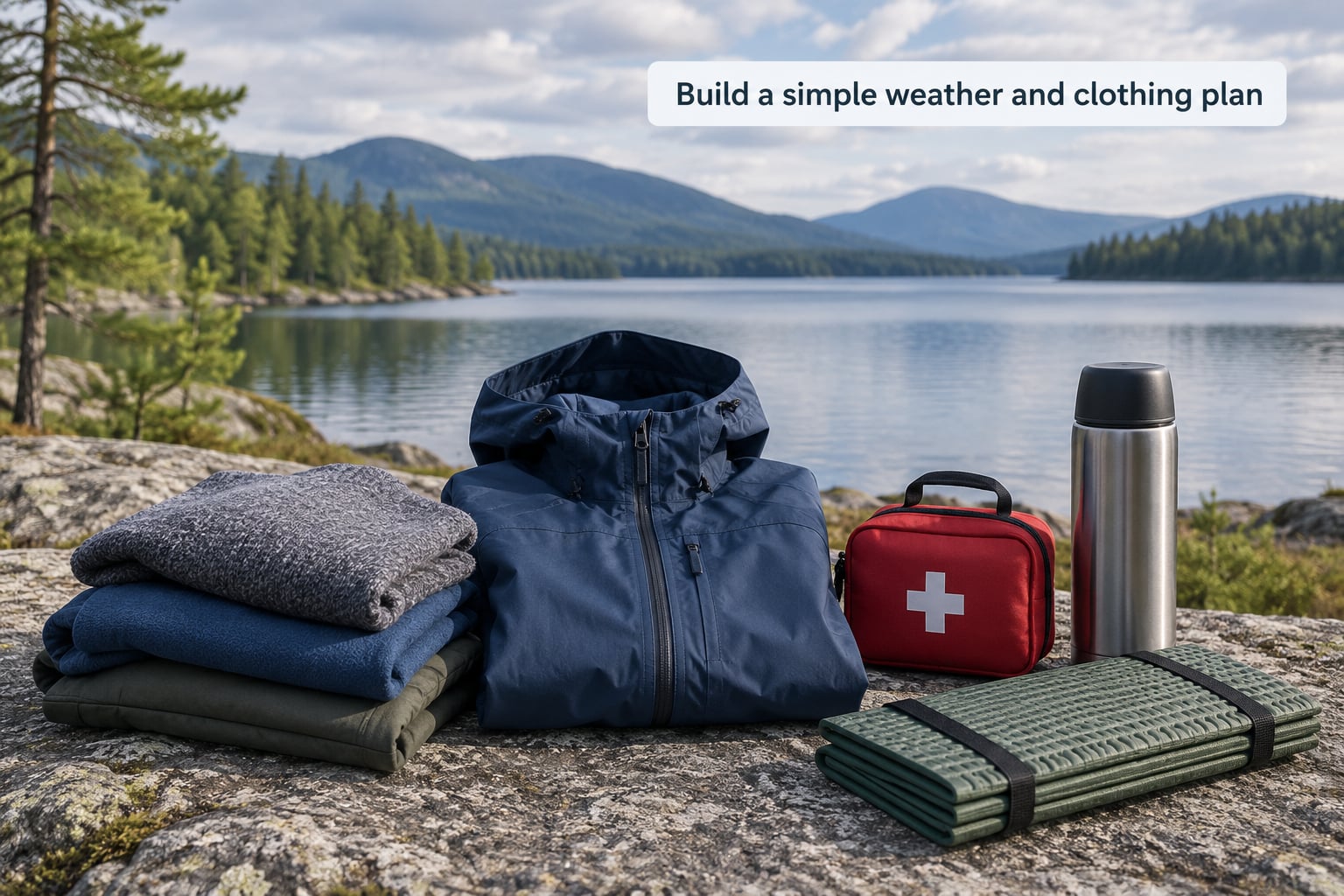
Plan for two conditions in the same day. Inland lakes can be calm at sunrise and choppy by mid-afternoon as the surface heats unevenly, and the air over the water is usually several degrees colder than the forecast for the nearest town, especially in early morning and late in the season.
Pack in layers and finish with a windproof and water-resistant outer shell. Three thin layers beat one heavy jacket because you will be adding and removing pieces all day on the water. Add a warm mid-layer that stays dry, wool or synthetic socks, a spare dry set sealed in a bag, and a hat and gloves that you can find without taking off your gloves.
Keep electronics and spare batteries off the cold floor of the boat and out of wet pockets. Cold drains a phone faster than people expect, and a dead phone is the reason a routine day on the water becomes an emergency.
Set a go and no-go rule before you leave the driveway: sustained wind or a small-craft advisory means paddling and small boats stay tied, and everyone shifts to shore activity. Deciding in advance keeps the decision calm instead of argumentative.
Plan activities for changing conditions
Build one primary plan and one backup plan that both work on the same day. The primary plan should use the lake, since that is the reason you came. The backup should be on shore and within a ten-minute walk.
For families, the primary plan is usually a slow paddle or a shoreline walk in the morning when the water is glassy, then a fireside or covered-picnic afternoon if the wind comes up. Anglers often plan around the morning bite and treat the afternoon as scouting coves. Boaters pair a launch at first light with a sheltered cove for the middle of the day. Campgrounds make the backup easy, since the shelter, a stove, and a board game are already on site.
Keep every activity under about three hours. Shorter blocks mean you can reschedule around wind without losing the day, and they leave room for the unplanned thing that ends up being the memory of the trip.
Pack, brief everyone, and check the final details
The night before, run through a short checklist rather than repacking everything. Clothing layers plus a rain shell, water and food for the day plus a spare meal, a first-aid kit, a charged phone and a power bank, a headlamp each, a life jacket per person for anyone on the water, offline maps downloaded, and a whistle or signal mirror in the group kit.
Brief the group in five minutes. Say where you are going, what time you return, the meeting point if you get separated, who carries the first-aid kit and the phone with the map, and what the no-go rule is for weather. If kids are coming, agree on the hand-holding rule near the dock and where they are allowed to run.
Then confirm the mechanical details. Fuel for the tow vehicle with a real reserve, a spare tire and the tools to change it, trailer lights working if you are towing, registration and safety gear for the boat, and the launch fee or pass you need. Check the ramp status and the weather one more time in the morning, because conditions and access can change overnight.
Common Mistakes
Booking a single peak date. Prediction maps are models, not promises. A two-week window with a refundable reservation absorbs the miss instead of ruining the trip.
Choosing an isolated lake without checking access. No cell signal, no ramp hours, no restrooms, and no firewood. Isolation that looks appealing in summer is a different experience in November.
Overpacking gear. The classic mistake is arriving with a full tackle setup for one afternoon of fishing. Bring what you will use and rent the rest locally, since gear shops near lakes usually stock kayaks, rods, and cold-weather layers.
Ignoring wind. It is the deciding variable on open water in autumn, and it arrives in the afternoon far more often than in the morning.
Building an itinerary with no backup. A single-thread plan turns a windy afternoon into a wasted day. One shore-based alternative solves it.
Driving six hours a day and never getting out. Stop every hour or two, and keep driving time under four hours on an active day so the lake does not feel like a drive you squeezed past.
Tips for a More Enjoyable Fall Lake Weekend
Arrive at first light. The water is smoothest and the air is clearest in the first two hours, and you will share the shoreline with very few people.
Go midweek when you can. Weekends around a peak lake bring traffic, full ramps, and long lines, while a weekday trip gives you the same color with the lake to yourself.
Keep children within arm’s reach near water, and treat the dock and boat ramp as the least forgiving places on the trip. A life jacket for every child is simpler than supervision that depends on your attention never drifting.
Stay in designated areas, pack your trash out, and clean, drain, and dry any boat or gear before moving to another body of water. Quarantine steps feel fussy until invasive species move through a connected water system.
Keep the lake as the anchor and the rest as flexible. A weekend with one fixed thing on it, such as a sunrise paddle or a single mapped hike, feels calmer than three packed days that keep slipping.
Frequently Asked Questions
When is the best time to visit a lake for fall foliage?
Most lakes in the Northeast reach peak color from the second half of September into early October, with higher ground and more northern lakes turning first. The Rockies and the Upper Midwest usually peak from mid-September through mid-October. Treat any date as the center of a two-week window and check the regional foliage report each week, since weather shifts the peak earlier or later by up to two weeks.
How far in advance should I plan a fall lake trip?
Start research in early summer and book lodging by the end of summer, roughly three to four months ahead for a peak-week weekend at a popular lake. Book refundable so you can adjust once reports come in. If you cannot commit that early, plan for a shoulder week just before or after the peak, where availability is far easier and rates usually drop.
What should I do if the leaves are not at peak color?
Keep a second lake in the same region and move to it rather than waiting. Elevation is the reliable lever, so a lake a few thousand feet higher or fifty miles north is often a week behind or ahead. Look for the trees still turning in sheltered coves and along river edges, where color lingers longest, and use photography and fishing as the plan for the day you did not get peak.
Can I bring children and dogs on a fall lake trip?
Yes, with preparation. Choose a lake with a carry-in launch or shallow, calm water, a short walking loop, and restrooms, and check leash rules for dogs because many shoreline areas and state parks restrict or ban them near water. Keep children in a life jacket at the dock and boat ramp, and pack a bag for the dog that includes water, a towel, and a warm layer for evening walks.
Is it safe to boat or paddle when fall weather changes quickly?
Boating in autumn is safe with preparation, because the risk is cold rather than weather itself. Check the marine forecast and any small-craft advisory each morning, wear a properly fitted life jacket on everyone, and keep a windproof shell within reach in the boat. Head in on calm mornings, plan to be back before the afternoon wind builds, and stay in on small craft whenever conditions are uncertain.
How can I plan a fall foliage lake trip on a budget?
Travel just outside peak week, look for a campground or a cabin away from the water, and rent boats or kayaks locally instead of towing your own. Shoulder-season rates are usually well below peak rates, and many lake areas have free or low-cost launch options. Cooking instead of eating out each meal and visiting shoulder-season festivals instead of ticketed events usually save more than trimming one night of lodging.
Conclusion
How to plan a fall foliage lake trip comes down to three things: choose two dates inside a two-week window instead of trusting one predicted peak day, confirm one lake whose access you have verified with the managing agency, and build an activity plan that survives a windy afternoon. Everything else, from packing to the group briefing, follows from those three decisions.
Start tonight. Pick two dates, pick one lake, and make the call about access before you book anything.